
On this page17 sections
✓ Prices and practical details last verified July 7, 2026
Beijing is where China’s imperial past sits closest to the surface: a walled palace at the exact center of the city, temple axes laid out by Ming dynasty (1368-1644) astronomers, and the Great Wall an hour’s drive north. It is also a working capital of 20+ million people, which shapes the visit in practical ways. Almost every major sight now requires an advance, real-name reservation against your passport, and the famous ones sell out days ahead. Plan Beijing more than you would plan Shanghai, and it repays the effort: no other city in China puts this much history within one metro network.
Highlights
- Walk the full south-north axis of the Forbidden City (故宫), then climb the hill in Jingshan Park (景山公园) behind it for the rooftop panorama.
- Choose the right Great Wall (长城) section: Mutianyu for a first visit, Badaling for easy rail access, or Jinshanling for a longer hike.
- Hear the dawn or dusk flag ceremony on Tiananmen Square (天安门广场), the symbolic center of the country.
- Get deliberately lost in the hutongs (胡同) around the Drum Tower, the last living remnant of old Beijing’s lane-house fabric.
- Eat Peking duck (北京烤鸭) in the city that named it, carved tableside and wrapped in pancakes.
Transportation
Two airports
Beijing Capital International Airport (首都国际机场 / PEK) sits northeast of the city and handles most international flights. Check current direct routes on FlightConnections. The Airport Express (机场快轨) runs to Sanyuanqiao and Dongzhimen in about 20-30 minutes for CNY25, connecting to Metro Lines 10 and 2. A taxi is roughly CNY100-150 and 45-70 minutes to the city center. Use the official rank, not touts in the arrivals hall.
Beijing Daxing International Airport (大兴国际机场 / PKX) is the newer starfish-shaped hub far south of the city. The Daxing Airport Express (大兴机场线) reaches Caoqiao station in about 19 minutes for CNY10-35 depending on distance (CNY35 for the full airport-to-Caoqiao run); a taxi to the center is roughly CNY200-260 and 50-80 minutes. When booking flights, note which airport you land at. They are on opposite sides of the city, nearly two hours apart by road.
Beijing is a major entry point for China’s visa-free transit policies. See the visa and entry guides in the Before Travel section for current rules.
Railway stations
Beijing has several major stations, and which one you use depends entirely on where you are going: Beijingnan (北京南站) for Shanghai and Tianjin, Beijingxi (北京西站) for Xi’an and points southwest, Beijing Chaoyang (北京朝阳站) for Chengde and the northeast, and Beijingbei (北京北站) for the Datong and Zhangjiakou corridor. Always check the station printed on your ticket because crossing the city between stations can take an hour.
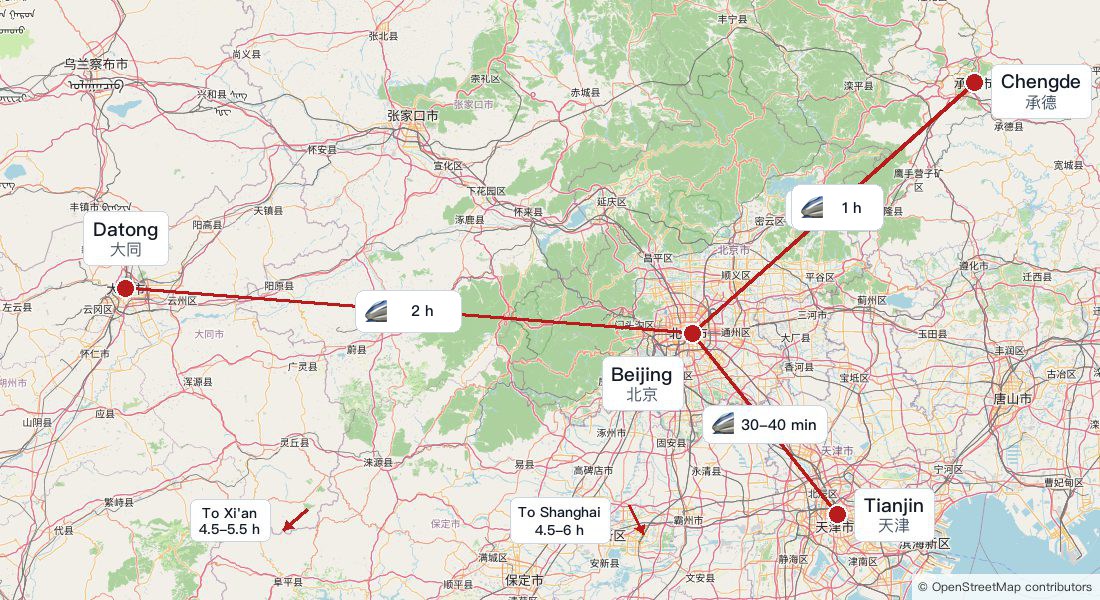
High-speed rail times from Beijing to Tianjin, Chengde, and Datong. Shanghai and Xi'an are 4.5-6 hours away in the directions shown.
Common onward routes
| Route | Best option | Travel Time | Notes |
|---|---|---|---|
| Beijing (北京) -> Tianjin (天津) | High-speed train | 30-40 minutes | The classic intercity line; runs every few minutes from Beijingnan. |
| Beijing (北京) -> Chengde (承德) | High-speed train | 1 hour | For the Qing dynasty (1644-1912) mountain resort and temples; from Beijing Chaoyang. |
| Beijing (北京) -> Datong (大同) | High-speed train | 2 hours | Yungang Grottoes and the Hanging Temple; from Beijingbei. |
| Beijing (北京) -> Xi’an (西安) | High-speed train | 4.5-5.5 hours | Terracotta Army; from Beijingxi. |
| Beijing (北京) -> Shanghai (上海) | High-speed train or flight | 4.5-6 hours by rail | City-center to city-center; the train usually beats flying door-to-door. |
Getting around
The metro covers most places in this guide and fares are CNY3-9 for almost any trip in the city. The easiest way to pay needs no app at all: Visa, Mastercard, Amex, JCB, and UnionPay contactless cards all tap directly at the gate, network-wide. If you’re relying on a foreign card, enable contactless/small-amount payments with your bank before you travel. Otherwise, a transport QR code in Alipay or WeChat works just as well. One Beijing-specific ritual is the airport-style security check at every station. Bags go through a scanner, and staff sometimes inspect bottles, so add a few minutes at busy interchanges and more around Tiananmen.
Taxis and Didi (ride-hailing) work well, but distances are long and the ring roads jam solid at rush hour; the metro usually wins inside the city. Drivers rarely speak English, so have your destination written in Chinese. Around the Drum Tower and Houhai, ignore pedicab drivers offering “hutong tours” at the roadside; the good tours are booked, not hailed.
Drone warning:
The entire administrative region of Beijing is controlled airspace. No outdoor drone flight is permitted without approval from the air traffic management authority, including at remote Great Wall sections inside Beijing. Rules effective from 1 May 2026 also prohibit travelers from transporting or carrying drones and their core components into Beijing, including while transiting by train, plane, coach, or car. Leave the drone outside Beijing rather than relying on manufacturer geofencing.
Key Attractions
Beijing’s sights split into an imperial core and a ring of half-day and day trips. The core includes the Forbidden City, Tiananmen Square, the Temple of Heaven, the Drum Tower hutongs, and the Lama Temple. These sights line up along and beside the city’s ancient central axis and fill two full days. The outer ring includes the Summer Palace and Yuanmingyuan in the northwest, several Great Wall sections across the mountains north of Beijing, the 798 Art District in the northeast, and Universal Studios in far eastern Tongzhou. The map marks Mutianyu as the recommended first-visit section; section 8 compares the major alternatives. Click a numbered dot to jump to the corresponding section.

1. The Forbidden City (故宫)
Getting there: Metro Line 1 to Tiananmen East (天安门东) or Tiananmen West (天安门西), then walk north through the square security check
Admission: CNY60 in peak season (April-October), CNY40 off-season; the Treasure Gallery and Clock Gallery are CNY10 each on top. Advance reservation only; no gate sales
Time needed: Half a day minimum; a full day if you love museums
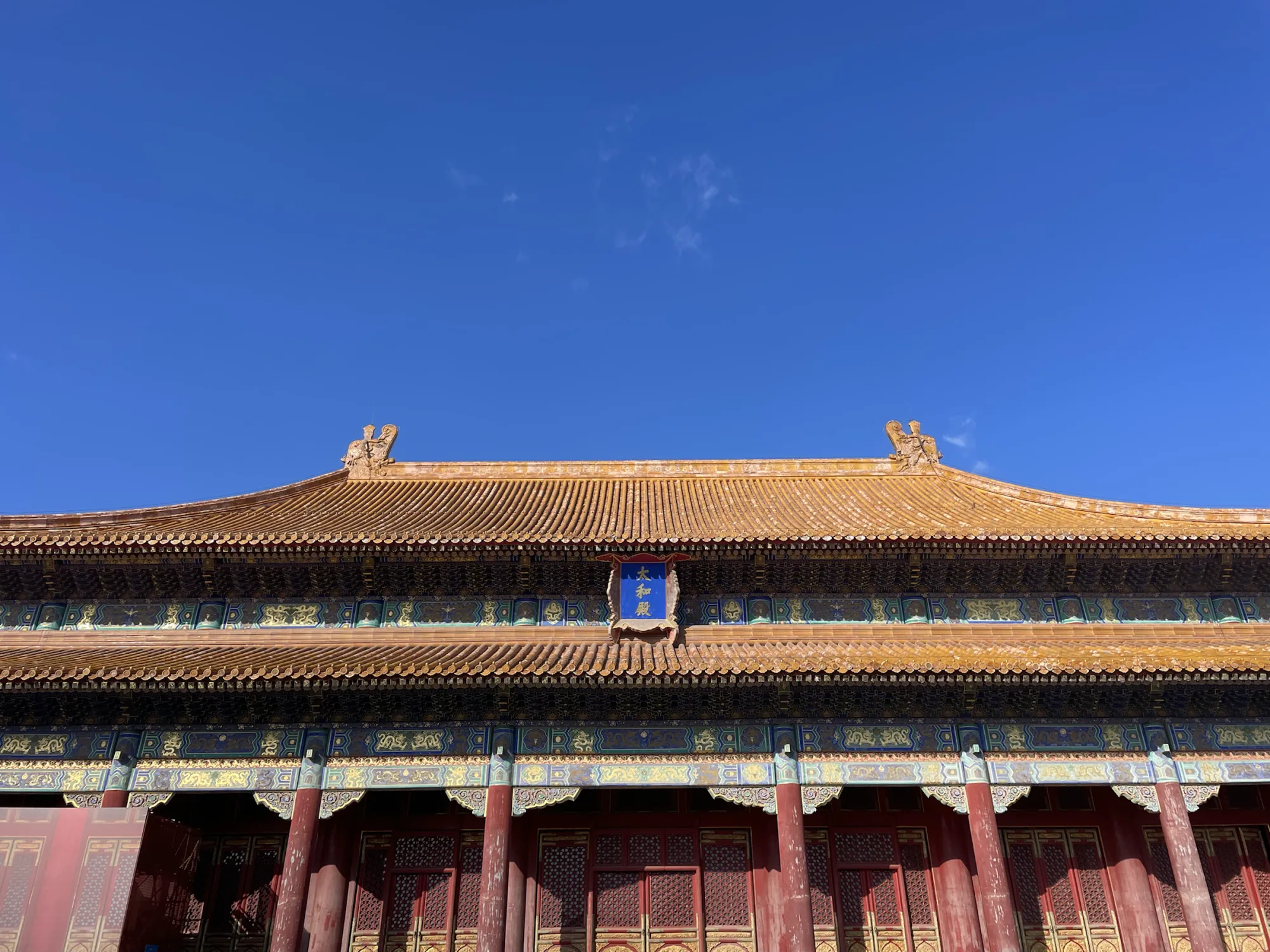
The Forbidden City, formally the Palace Museum (故宫博物院), was the seat of 24 Ming dynasty (1368-1644) and Qing dynasty (1644-1912) emperors and is the largest surviving palace complex in the world: nearly a thousand buildings on a strict south-north axis behind a moat and ten-meter walls. You enter from the south through the Meridian Gate (午门) and walk the axis north, so plan it as a one-way route rather than a loop.
Booking: read this first
Tickets are released 20:00 Beijing time, seven days ahead on the official 故宫博物院 WeChat mini-program, the only authorized channel. No third-party platform sells legitimate skip-the-queue tickets, and there are no same-day tickets at the gate. Booking is real-name against your passport number, and you enter by showing the same passport. In holiday periods tickets vanish within minutes of release; on ordinary weekdays a day or two ahead is usually enough. The museum is closed most Mondays.
What to see
- The three great halls (三大殿)
The ceremonial heart of the axis. The Hall of Supreme Harmony (太和殿) is the largest wooden building in China, raised on a triple marble terrace. - The inner court and side alleys
North of the ceremonial halls, the emperor’s private quarters shrink to human scale. Duck into the side alleys east and west of the axis. Most visitors never leave the centerline, and the courtyards there are strikingly quiet. - Treasure Gallery (珍宝馆) and Clock Gallery (钟表馆)
Two separately ticketed side exhibitions worth the extra CNY10 each: imperial regalia in one and a hall of extravagant automaton clocks in the other. - Jingshan Park (景山公园)
Exit the north gate, cross the road, and climb the artificial hill (admission CNY2) for the classic view back over the entire golden-roofed complex. If you cannot secure a Forbidden City ticket, Jingshan Park is still well worth visiting for a panoramic view across the palace and its central axis. It is the best photo in Beijing for the price.
Caution
Anyone offering “tickets available today” outside the walls is selling either nothing or an overpriced tour that happens to include a slot. If the mini-program shows sold out, it is sold out. Switch your days around rather than trust a scalper.
2. Tiananmen Square (天安门广场)
Getting there: Metro Line 1 to Tiananmen East/West, or Line 2 to Qianmen (前门) for the south end
Admission: free, but requires an advance reservation — bookable up to seven days ahead
Time needed: 1-2 hours, plus queueing time for security
Tiananmen Square is one of the largest public squares in the world, flanked by the Great Hall of the People, the National Museum of China, and Chairman Mao’s mausoleum. The Tiananmen gate tower, the rostrum bearing Mao’s portrait, closes the north end. It is the political center of the country and feels like it: entry is through airport-style checks, and the atmosphere is formal rather than festive.
What to see
- The flag-raising and lowering ceremonies (升降旗仪式)
A military honor guard raises the national flag at sunrise and lowers it at sunset before substantial crowds. The raising in particular is a pilgrimage event for domestic tourists. Times shift daily with the sun; check them, and arrive well before. - The square itself
The Monument to the People’s Heroes at the center, the mausoleum behind it, and the sheer scale. The walk from end to end takes longer than you expect. - National Museum of China (国家博物馆)
Free but separately reserved; the ancient China galleries downstairs are excellent and quiet by comparison. - Zhengyangmen & Qianmen Street (正阳门与前门大街)
Zhengyangmen stands at the south end of Tiananmen Square and once formed the principal southern gateway into Beijing’s inner city. Continue south through the gate area to Qianmen Street, a heavily reconstructed shopping street; the Dashilan (大栅栏) lanes just west of it retain more original texture. This area has plenty of restaurants, cafes, bakeries, and snack shops, making it a convenient place to stop for a meal or coffee before continuing the day.
Caution
Book the square reservation before you travel. It applies to the square itself, separately from the Forbidden City ticket. Carry your passport; nothing here admits you without it.
3. Temple of Heaven (天坛)
Getting there: Metro Line 5 to Tiantan East Gate (天坛东门)
Admission: CNY15 in peak season, CNY10 off-season for the park alone; the through ticket that includes the main altar buildings is CNY34 / CNY28
Time needed: 2-3 hours
The Temple of Heaven is where Ming dynasty (1368-1644) and Qing dynasty (1644-1912) emperors performed the annual rites for a good harvest. Its ensemble of round altars and halls sits in a vast walled park, with geometry that encodes the old cosmology of a round heaven over a square earth. Architecturally it is the equal of the Forbidden City; atmospherically it is far more relaxed, because the park doubles as the neighborhood’s living room.
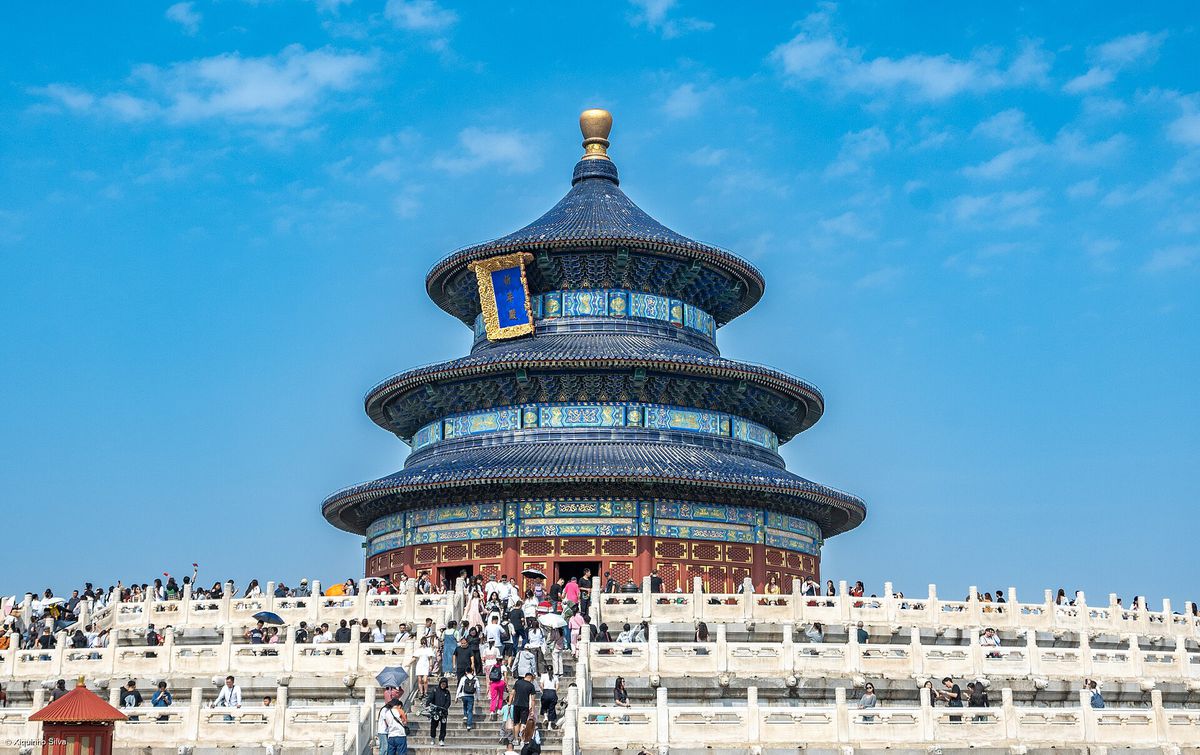
Photo: xiquinhosilva, CC BY 2.0, via Wikimedia Commons
What to see
- Hall of Prayer for Good Harvests (祈年殿)
The triple-roofed round hall on its marble terrace was built entirely without nails and is one of the most recognizable buildings in China. This is what the through ticket is for. - The Circular Mound Altar (圜丘坛) and Echo Wall (回音壁)
The open-air altar where the emperor addressed heaven directly, and the curved wall that carries a whisper around its circumference when crowds allow you to test it. - The park in the early morning
Come at opening and the park belongs to tai chi groups, ribbon dancers, choir circles, and jianzi (毽子) kickers. It is one of the best free spectacles in Beijing; the monumental buildings open later than the park gates. - The cypress groves
Some of the trees are older than the temple itself. The Nine-Dragon Cypress (九龙柏) is over 500 years old.
Caution
Buy the through ticket (联票), not the bare park ticket. The park-only ticket leaves you outside every building you came to see, and upgrading inside means more queueing.
4. Drum Tower & the Hutongs (鼓楼与胡同)
Getting there: Metro Line 8 to Shichahai (什刹海) or Line 2/8 to Guloudajie (鼓楼大街)
Admission: Streets free; Drum Tower CNY20 for the Drum Tower, CNY30 for a joint ticket with the Bell Tower
Time needed: Half a day, ideally drifting into evening
The blocks around the Drum and Bell Towers are the largest surviving stretch of Beijing’s hutong fabric: the grey-brick lanes and courtyard houses (四合院, siheyuan) that once made up the whole city inside the walls. This is the counterweight to the monumental Beijing of the axis: low, horizontal, lived-in, and best explored without a fixed plan.
What to see
- Drum Tower (鼓楼) and Bell Tower (钟楼)
The twin timekeepers of the old city, facing each other across a small square where locals play jianzi. The Drum Tower’s steep stairs lead to drum performances several times a day and a view straight down the axis. - Shichahai and Houhai lakes (什刹海后海)
Willow-lined lakes ringed by walking paths, with swimmers in summer, skaters on natural ice in deep winter, and a strip of bars that gets loud after dark. - Nanluoguxiang (南锣鼓巷) and its side alleys
The famous lane itself is a crowded snack corridor; the point is the quiet parallel hutongs branching off it, including Mao’er (帽儿胡同), Ju’er (菊儿胡同), and the lanes westward toward Yandai Xiejie (烟袋斜街). - A courtyard cafe
Many siheyuan now house cafes and small restaurants, offering the only polite way to see inside a courtyard without living in one.
Caution
Pedicab drivers around Houhai quote one price and demand another, per person, at the end. If you want a rickshaw hutong tour, book through your hotel at a written price. You can also just walk; everything here is walkable.
5. Lama Temple (雍和宫)
Getting there: Metro Line 2 or 5 to Yonghegong (雍和宫)
Admission: CNY25, advance booking via the temple’s WeChat account 雍和宫游客信众服务 recommended
Time needed: 1-2 hours
The Lama Temple is Beijing’s grandest working Tibetan Buddhist temple. A former princely mansion converted into a Tibetan Buddhist monastery in the 18th century, its halls rise in sequence to an 18-meter Maitreya Buddha carved from a single sandalwood trunk. Unlike the museum sights on this list, it is a functioning place of worship, thick with incense smoke and people praying in earnest, especially around exams and the new year.
Tibetan Buddhism held an unusually important place at the Qing dynasty (1644-1912) court, particularly under the Yongzheng and Qianlong emperors. It was both a sincere form of imperial religious practice and a shared language through which the Manchu rulers maintained relationships with Tibetan and Mongolian Buddhist elites across their multiethnic empire. The court supported the Gelug school, received prominent lamas, commissioned scriptures and religious art, and built major monasteries in Beijing and Chengde. Qianlong studied Tibetan Buddhism closely and cultivated the image of a Buddhist universal ruler. Yonghegong therefore functioned not only as a monastery, but also as an imperial religious institution connecting the capital with the wider Tibetan Buddhist world.
What to see
- The five halls in sequence
Each hall’s Buddha is taller than the last. The architecture stage-manages the crescendo deliberately. - The sandalwood Maitreya (万福阁)
The single-trunk statue in the final pavilion, a Guinness-certified marvel that photographs poorly and astonishes in person. - The Confucius Temple and Imperial College (孔庙和国子监)
Five minutes’ walk down Guozijian Street, one of Beijing’s prettiest streets, is a serene counterpoint: China’s second-largest Confucius temple and its old imperial academy. - Wudaoying Hutong (五道营胡同)
The gentrified lane opposite the temple gate, good for lunch or coffee after.
Caution
Free incense is provided inside; politely ignore anyone outside the gate selling “blessed” incense bundles or offering to guide your prayers for a fee.
6. Summer Palace (颐和园)
Getting there: Metro Line 4 to Beigongmen (北宫门) for the north gate, or Xiyuan (西苑) for the east gate; 40-60 minutes from the center
Admission: CNY30 in peak season, CNY20 off-season; the through ticket including the inner sights is CNY60 / CNY50
Time needed: Half a day; a full day at a stroll
The Summer Palace is the imperial garden where the Qing dynasty (1644-1912) court escaped the summer heat. Three quarters lake and one quarter hill, it is arranged as a landscape painting you can walk through. Rebuilt by the Empress Dowager Cixi in the late 19th century (notoriously with funds earmarked for the navy), it is the finest classical garden in northern China and a genuine half-day of walking.
What to see
- The Long Corridor (长廊)
A 728-meter covered walkway along the lakeshore, every beam painted with a different scene from history and legend. - Longevity Hill (万寿山) and the Tower of Buddhist Incense (佛香阁)
The climb up the central axis rewards you with the postcard view over Kunming Lake; the tower is one of the separately ticketed inner sights covered by the through ticket. - Kunming Lake (昆明湖)
Walk the causeways modeled on Hangzhou’s West Lake, or cross to South Lake Island over the Seventeen-Arch Bridge (十七孔桥). Ferries and pedal boats run in season. - Suzhou Street (苏州街)
A canal-side market street behind the hill, built so the court could play at shopping. Kitschy then and kitschy now, it is somehow still charming.
Caution
Gates are far apart: entering at Beigongmen puts you behind the hill, entering at the east gate puts you by the main halls. Decide your route before you pick an exit station, and don’t plan to “pop in” because the grounds are enormous.
7. Yuanmingyuan / Old Summer Palace (圆明园)
Getting there: Metro Line 4 to Yuanmingyuan Park Station (圆明园站), Exit B, beside the south gate
Admission: CNY10 for the park or CNY25 for the through ticket covering the separately ticketed ruins and exhibition areas (official tickets and opening times)
Time needed: 3-4 hours; longer if you walk across the full park
Yuanmingyuan was the Qing dynasty (1644-1912) emperors’ vast garden and palace complex before the Summer Palace became the better-known imperial retreat. It combined Chinese garden landscapes with buildings and collections drawn from across the empire, while the northeastern Western Mansions (西洋楼) incorporated European-style architecture designed with Jesuit involvement. Anglo-French forces looted and burned the complex in 1860, and further destruction continued during the following decades. What survives is primarily a landscape of lakes, foundations, scattered stonework, and a few preserved or restored structures rather than a reconstructed palace.
What to see
- Western Mansions and Dashuifa (西洋楼与大水法)
The carved stone ruins most closely associated with Yuanmingyuan are in the far northeast of the park. They represent only a small European corner of a much larger garden, but they make the site’s destruction immediately visible. - The lake landscapes and garden foundations
Most of the park is open water, wooded paths, lotus ponds, and subtle traces of former halls. The experience is quieter and more archaeological than the Summer Palace. - Yuanmingyuan Museum at Zhengjue Temple (圆明园博物馆 / 正觉寺)
This surviving temple complex explains the garden’s construction, imperial life, collections, destruction, and conservation. Museum entry is free after entering the park, but current opening days should be checked before visiting. - The panoramic model (圆明园盛时全景模型)
The large model helps make sense of the scale and density of the original Three Gardens, which can otherwise be difficult to imagine from the surviving foundations.
Practical route
Enter from the south gate, begin with Zhengjue Temple and the museum, then continue northeast through the lake landscapes to the panoramic model and Western Mansions. The famous Dashuifa ruins are a long walk from the south gate, so use an internal electric cart for one leg if time or mobility is limited. The east gate is the most convenient exit after visiting the ruins.
Caution
If you have time for only one imperial garden, the Summer Palace is more visually complete and easier to understand on a first visit. Choose Yuanmingyuan for Qing dynasty (1644-1912) history, archaeology, and a quieter landscape. Visiting both on the same day is possible because they are close, but it makes for a long day with substantial walking.
8. The Great Wall (长城)
Getting there: The visitor sections lie 60 to 125 kilometers north of central Beijing. Badaling has the easiest rail connection; the other sections are generally simpler by direct tourist bus, Didi, rental car, booked car, or an organized tour without shopping stops
Admission: Each scenic area has its own ticket and reservation system. Cable cars, internal shuttles, and night access are usually separate
Time needed: A full day including transport for most sections
The Great Wall is not a single attraction gate. Beijing and neighboring Hebei have several visitor sections, each with a different balance of restoration, scenery, crowds, physical difficulty, and transport. Mutianyu remains the best all-round choice for a first visit, but it is not automatically the best choice for every traveler.

Quick comparison
| Section | Character | Access from Beijing | Crowds and effort | Best for |
|---|---|---|---|---|
| Mutianyu (慕田峪) | Fully restored wall on forested ridges, cable car, chairlift, and toboggan | About 1.5 hours by road; direct tourist buses also operate | Busy but usually calmer than Badaling; easy to moderate with lifts | Best overall first visit, families, mixed fitness levels |
| Badaling (八达岭) | Most developed and heavily restored, with the broadest visitor infrastructure | High speed train from Beijingbei or Qinghe to Badaling Great Wall Station; buses also run | Usually the busiest section; easier surfaces and accessibility options | Best without a car, older visitors, limited mobility, very short planning time |
| Jinshanling (金山岭) | Long, photogenic ridges with restored and weathered sections and many watchtowers | About 2 to 2.5 hours by road; booked car or hiking tour is simplest | Much quieter; sustained climbs and a genuine hike | Best for hiking and photography |
| Simatai (司马台) | Steep, dramatic wall beside Gubei Water Town, with controlled evening access | About 2 hours by road; usually paired with Gubei Water Town | Moderate crowds, steep terrain, cable car available | Best for a night view or overnight trip |
| Huanghuacheng Lakeside Great Wall (黄花城水长城) | Wall, reservoir, wooded hills, and boat views in one scenic area | About 1.5 to 2 hours by road | Usually calmer, with flexible walking and leisure options | Best for water scenery and a relaxed family day |
| Gubeikou (古北口) | Less restored wall, old passes, and quiet mountain scenery | About 2 hours by road; a booked car or guided hike is simplest | Very quiet, rough underfoot, and more difficult to navigate | Best for a guided, low-crowd hike |
| Juyong Pass (居庸关) | A fortified mountain pass with temples, gates, and a steep wall loop | About 1 to 1.5 hours by road | Less expansive ridge scenery; the loop itself is steep | Best for a shorter trip and military architecture |
| Jiankou (箭扣) | Unrestored, crumbling, and extremely steep wild wall | No formal tourist access | Dangerous, exposed, and climbing is prohibited | Not recommended for ordinary visitors |
Recommendation
- Choose Mutianyu if this is your first Great Wall visit and you want the most reliable balance of scenery, comfort, and time.
- Choose Badaling if straightforward public transport or accessibility matters more than avoiding crowds. Reserve the high speed train early because departures are limited.
- Choose Jinshanling if the walk itself is the priority. It delivers the strongest combination of long views, watchtowers, quieter paths, and visible changes between restored and older masonry.
- Choose Simatai if you want to stay at Gubei Water Town and see the wall after dark. Night access and cable car packages change seasonally, so confirm the current ticket combination.
- Choose Huanghuacheng Lakeside Great Wall for a gentler scenic day involving water, wooded trails, and optional boat rides.
- Choose Gubeikou if you want a quieter, less restored section without attempting closed wild wall. Use a guide who knows the open boundaries and safe access paths.
- Choose Juyong Pass if you have less time and care more about a fortified pass than the classic wall winding across distant ridges.
- Do not treat Jiankou as a free alternative. It is not an open tourist scenic area, climbing is prohibited, and the unrepaired masonry and almost vertical terrain cause serious accidents.
Mutianyu practical plan
Getting there: About 70 km northeast of the city. A rental car, Didi, or a booked car takes about 1.5 hours; direct tourist buses leave central Beijing in the morning in season
Admission: CNY40 (discounts for children, students, and seniors — check the current child policy when booking); park shuttle CNY15; cable car or chairlift CNY100 one-way or CNY140 round trip, with a toboggan-descent option priced the same as the round trip
Mutianyu is fully restored Ming dynasty (1368-1644) wall snaking along a forested ridge, with more than 20 watchtowers and convenient infrastructure. A cable car goes up, while a chairlift and toboggan serve the lower western section, letting you spend your energy on the wall itself rather than the approach. Book entry through the official Mutianyu channels or a major platform; tickets use real name registration like most major Beijing sights.
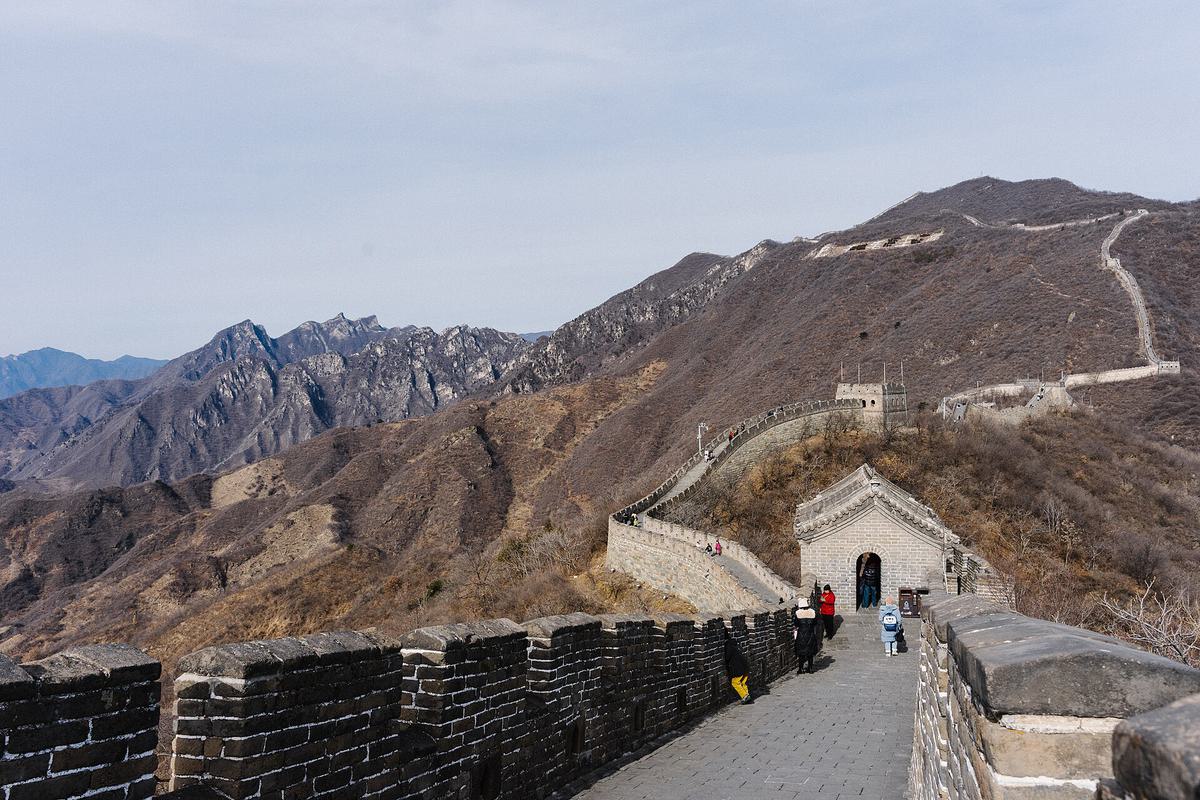
Photo: Lloyd Tudor, CC BY-SA 4.0, via Wikimedia Commons
How to do Mutianyu
- Getting up: From the visitor center, the shuttle covers the road to the wall base; then choose the cable car (to Tower 14) or the open chairlift (to Tower 6). Fit walkers can hike up in 40-60 minutes instead.
- On the wall: The classic walk runs between Towers 6 and 20. Allow 2-3 hours with photo stops. The steep climb to Tower 20 is the best viewpoint; beyond it the unrestored “wild wall” is officially off-limits.
- Getting down: The toboggan (滑道), a metal luge track from Tower 6, is genuinely fun and the reason to pick the chairlift side for your descent.
- Timing: Arrive at opening or after 14:00 to miss the tour-bus window. Autumn (late October-early November) sets the hillsides on fire with color; winter is cold, empty, and spectacular after snow.
Caution
Ignore “Great Wall day tour” touts at hotels and stations that bundle jade factory and tea house stops. You lose half the day to shopping detours. Book transport yourself or use a reputable operator with an itinerary that explicitly excludes shopping stops. Do not enter closed wild sections or follow routes that cross barriers. Opening areas, night sessions, cable car operations, and discounts can change with weather and maintenance, so check the official page for your chosen section before departure.
9. 798 Art District (798艺术区)
Getting there: Didi is simplest (30-40 minutes from the center); or Metro Line 14 to Wangjing South (望京南) and a 15-20 minute walk
Admission: The district is free; individual exhibitions ticket separately
Time needed: Half a day
798 is a decommissioned 1950s East German-designed electronics factory complex reborn as China’s best-known contemporary art quarter. Bauhaus-style sawtooth-roofed workshops house galleries, studios, design shops, and cafes, with Maoist-era slogans still stenciled on some ceilings. It is the easiest window into the Beijing that isn’t imperial: current, commercial, and self-aware.
What to see
- UCCA Center for Contemporary Art (尤伦斯当代艺术中心)
The anchor institution, with museum-grade rotating exhibitions. Check what’s on before you go. - The factory architecture itself
Sawtooth roofs, riveted pipework, and the giant preserved machinery in some halls; the buildings compete with the art. - Smaller galleries at random
Most are free; quality swings wildly, which is half the fun. Weekday afternoons are quietest. - Sculpture courtyards and street art
The outdoor pieces, including caged dinosaurs and oversized figures, are the district’s photo landmarks.
Caution
Many galleries close on Mondays, and the district only wakes up around 10:30-11:00. Pair it with a lazy morning, not a dawn start.
10. Universal Studios Beijing (北京环球影城)
Getting there: Metro Line 7 or the Batong Line to Universal Resort Station (环球度假区站); use Exit B, C, or D and walk about seven minutes through CityWalk to security (official transport guide)
Admission: Variable dated pricing; buy through the official ticket page, official App, or official WeChat or Alipay mini-program using the visitor’s passport details
Time needed: One full day
Universal Studios Beijing is in Tongzhou, well east of central Beijing. It is one of the world’s largest Universal parks and is worth a dedicated day for theme-park fans, families, and anyone especially interested in Harry Potter or Transformers. Do not try to combine it with the Forbidden City, Summer Palace, or Great Wall; the transport, security, queues, and evening shows make this a complete day by itself.
What to prioritize
- The Wizarding World of Harry Potter (哈利·波特的魔法世界)
The park’s most consistently crowded land. Harry Potter and the Forbidden Journey is the main ride, while Flight of the Hippogriff is a gentler outdoor coaster. Go here immediately after entry if it is your priority. - Transformers Metrobase (变形金刚基地)
Decepticoaster is the strongest conventional thrill ride in the park. Transformers: Battle for the AllSpark is the major indoor motion-based attraction. - Jurassic World Isla Nublar (侏罗纪世界努布拉岛)
Jurassic World Adventure is the signature dark ride. The land also has a large scenic lagoon and works well after dark. - Kung Fu Panda Land of Awesomeness (功夫熊猫盖世之地)
A fully indoor, China-specific land that is useful during rain, severe heat, or winter cold. It is visually elaborate but generally less intense than the headline rides. - WaterWorld (未来水世界)
The large stunt show is one of the easiest high-value experiences because one performance accommodates far more guests than a ride queue. Check showtimes early and arrive before seating closes.
Plan the day
Download the official Universal Beijing Resort App before arrival. It shows current opening hours, ride waits, showtimes, closures, and the day’s Express products. Arrive before the published park opening so security and the walk through CityWalk do not consume the first low-queue period. Use the first hours for two or three headline rides, then switch to shows and less popular lands when queues peak in the afternoon.
Universal Express is separate from admission and its price varies by date and product. It can be worthwhile on weekends, public holidays, and summer dates, but first check the official App’s actual queue pattern. On an ordinary weekday, arriving early and using a disciplined route may be enough.
Caution
Tickets use real-name registration. Bring the physical passport entered during booking, and bind any authorized third-party order in the official App or mini-program before arriving. Buy only through an official or authorized channel. Operating hours, outdoor rides, parades, and shows can change with season and weather, so check the official App again on the morning of the visit.
Suggested Itineraries
2 Days in Beijing
Day 1: The axis
Tiananmen Square early (flag ceremony if you can face the hour), the Forbidden City through the morning and past lunch, Jingshan Park for the overview photo, then walk or bus north to the Drum Tower hutongs for the late afternoon and dinner around Shichahai.
Day 2: The Wall and the Temple of Heaven
Leave early for your chosen Great Wall section and give it the morning and early afternoon. Mutianyu is the default first-visit choice; use Badaling for easier rail access or Jinshanling for a longer hiking day. Return for the Temple of Heaven before closing only if you choose one of the closer sections and still have energy.
3 Days in Beijing
Days 1-2 as above, then:
Day 3: Gardens and lamas
The Lama Temple and Guozijian Street in the morning, the Summer Palace for the whole afternoon into golden hour on Kunming Lake.
4-5 Days: Beijing in full
Add the 798 Art District paired with a Sanlitun evening, a proper museum day (the National Museum plus the Capital Museum), a full day at Universal Studios Beijing, or a high-speed day trip. Universal requires its own day rather than being paired with a central-city attraction. Tianjin’s European quarter is 30-40 minutes away, while Chengde’s mountain resort takes about 1 hour. Duck dinner on the last night: book it.
Where to Stay
Location matters more in Beijing than in most Chinese cities because distances are huge. Staying inside the Second Ring Road, roughly the old walled city, puts the axis sights and hutongs within short hops; staying out by the CBD or Zhongguancun means commuting to everything you came for. Prices below are rough high-season guides; check current rates before booking.
Luxury
- International five-stars around Wangfujing and the east Second Ring
Walking distance to the Forbidden City on one side and mall-and-embassy Beijing on the other. Often CNY1,500-4,000+/night.
Courtyard boutique
- Siheyuan hotels in the Gulou and Dongsi hutongs
Converted courtyard houses with rooms opening onto a private yard offer the most Beijing way to sleep in Beijing. Rooms are characterful rather than large, and quiet at night in a way no tower hotel matches. Often CNY800-2,000/night.
Midscale
- Domestic design chains (Atour 亚朵, Ji Hotel 全季, and similar)
Reliable and clean; look for properties near a Line 2, 5, or 8 station inside or just outside the Second Ring. Often CNY400-800/night.
Budget
- Hostels and budget chains around Gulou and Qianmen
Both clusters put the core sights in walking-plus-one-metro-stop range. Often CNY200-450/night, with courtyard hostels around the Drum Tower the best atmosphere per yuan in the city.
Where to Eat
- The Gulou hutongs: The densest mix of old-school noodle shops, courtyard restaurants, and new cafes. This is the best all-around eating neighborhood for visitors.
- Niujie (牛街): Beijing’s best-known Muslim quarter and the historic center of the city’s Hui community. Come for reliable halal food (清真), including copper-pot lamb hotpot, lamb and beef dumplings, braised beef, meat pies, pastries, and street snacks. Niujie Mosque (牛街礼拜寺) anchors the neighborhood, while the nearby supermarkets and food counters make it easy to sample several dishes in one visit.
- Guijie / Ghost Street (簋街): A neon strip of late-night restaurants east of the Lama Temple, famous for spicy crayfish (麻辣小龙虾) at 2 a.m.
- Qianmen and Dashilan: Home of century-old brands (老字号) serving duck, boiled lamb, and pastries, mixed with tourist filler. Pick the queues with locals in them.
- Malls everywhere: As across urban China, upper-floor mall food courts are where locals actually eat well and cheaply. They are never a bad fallback.
Dishes to Try
- Peking duck (北京烤鸭): Roast duck carved tableside, wrapped in thin pancakes with scallion, cucumber, and sweet bean sauce. Quanjude (全聚德) is the historic name; locals now queue at Siji Minfu (四季民福), where you should book ahead, or Jing Zun (京尊) for better value.
- Zhajiangmian (炸酱面): Beijing’s definitive noodle bowl consists of thick wheat noodles under a dark fried soybean-and-pork sauce, mixed with shredded vegetables at the table.
- Copper-pot lamb hotpot (铜锅涮羊肉): Paper-thin lamb swished through a clear broth in a charcoal-chimney copper pot and dipped in sesame sauce. It is Beijing’s winter institution but good year-round.
- Jianbing (煎饼): The breakfast crepe combines egg, a crispy cracker, scallion, and chili, all prepared on a griddle in under a minute. Buy it from a morning street window, not a food court.
- Lamb skewers (羊肉串): Cumin-dusted grilled lamb from Xinjiang-style restaurants and late-night grills; order by the fistful.
- Imperial-style pastries (京八件 / 豌豆黄): Sweet pea-flour cakes, red-bean pastries, and rolling donkey (驴打滚, glutinous rice rolls in soybean flour) from old-brand shops like Daoxiangcun (稻香村).
- Douzhir (豆汁儿): A grey, sour, fermented mung-bean drink. It is the most local thing you can order and a one-sip experiment for most visitors. Have it with a fried ring (焦圈) like the regulars do.
- Tanghulu (糖葫芦): Glassy, tart candied hawthorn skewers. Once a winter street snack, they are now sold year-round.
Hero photo: Tojan76, CC BY-SA 3.0, via Wikimedia Commons.
Help keep this guide accurate
Found something incorrect, outdated, or missing? Tell us what changed and include a source when possible.
Suggest an update