
On this page13 sections
✓ Prices and practical details last verified July 11, 2026
Datong sits in the far north of Shanxi, an old frontier city that was once the capital of the Northern Wei dynasty (386-534) and later a garrison on the edge of the steppe. That history left it an extraordinary concentration of early Buddhist art and ancient timber architecture: the colossal carved Buddhas of the Yungang Grottoes, the gravity-defying Hanging Temple on its cliff, and the thousand-year-old wooden pagoda at Yingxian, the oldest and tallest of its kind in the world. The city itself has rebuilt its Ming dynasty (1368-1644) walls and old temples into a walkable core. It is a compact, rewarding stop, easily reached by fast train from Beijing.
Highlights
- Stand before the colossal carved Buddhas of the Yungang Grottoes (云冈石窟), one of China’s greatest Buddhist cave complexes.
- Climb the cliff-hanging walkways of the Hanging Temple (悬空寺) below the sacred peak of Mount Heng (北岳恒山).
- Look up at the Yingxian Wooden Pagoda (应县木塔), the world’s oldest and tallest surviving wooden tower.
- Walk the rebuilt Datong Ancient City Wall (大同古城墙) at dusk, and the temples inside it.
- See the glazed-tile dragons of the Nine Dragon Wall (九龙壁), the oldest and largest in China.
Transportation
Getting there
Most visitors reach Datong by high-speed rail. Datong Yungang Airport (大同云冈机场 / DAT) has a limited domestic network and is useful only when a convenient direct flight matches your route. Check current destinations on FlightConnections.
Railway stations
Datongnan (大同南站) is the high-speed rail hub and the main arrival point for visitors. Typical high-speed rail journeys to Datongnan take about 1.5 to 2 hours from Beijing, 1.5 hours from Taiyuan, and 1 hour from Hohhot. These fast connections make Datong an easy addition to an itinerary through Beijing, Shanxi, or Inner Mongolia.
The older Datong Railway Station (大同站), north of the city centre, handles conventional trains and some through services. Always check the station shown on your ticket because Datongnan and Datong Railway Station are on opposite sides of the city.
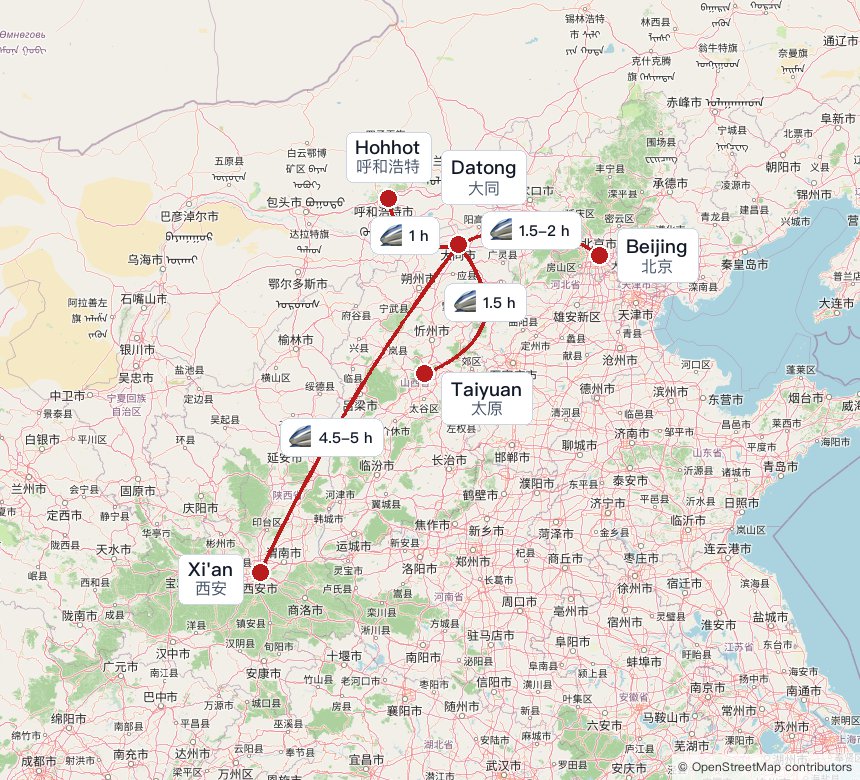
High-speed rail times from Datong to Beijing, Hohhot, Taiyuan, and Xi'an. Most fast trains leave from Datongnan.
Common onward routes
| Route | Best option | Travel Time | Notes |
|---|---|---|---|
| Datong (大同) -> Beijing (北京) | High-speed train | 1.5-2 hours | The easiest link; Datong is a natural add-on to Beijing. |
| Datong (大同) -> Hohhot (呼和浩特) | High-speed train | 1 hour | West onto the Inner Mongolian grassland. |
| Datong (大同) -> Taiyuan (太原) | High-speed train | 1.5 hours | South to Shanxi’s capital and Pingyao beyond. |
| Datong (大同) -> Xi’an (西安) | High-speed train | 4.5-5 hours | South via Taiyuan toward the old Tang dynasty (618-907) capital. |
Getting around
the city sights are walkable within the rebuilt old town, but Yungang, the Hanging Temple, and the Yingxian pagoda are spread out, so a car, tour, or the inter-site shuttle buses save a lot of time. The classic approach is a day for the Yungang Grottoes and the old city, and a second day combining the Hanging Temple, Mount Heng, and the Yingxian pagoda, all southeast of the city on the way toward Taiyuan. Organized day tours and shuttle buses run to all three and save the hassle of piecing together local transport.
Key Attractions
Datong’s sights fall into two groups. The Yungang Grottoes lie just west of the city, and the rebuilt old town holds a cluster of temples and the city wall, all shown in the map zoom. The other great sights are day trips to the southeast: the Hanging Temple and Mount Heng near Hunyuan, and the wooden pagoda at Yingxian. The numbers on the map match the sections below; click a numbered dot to jump to it.
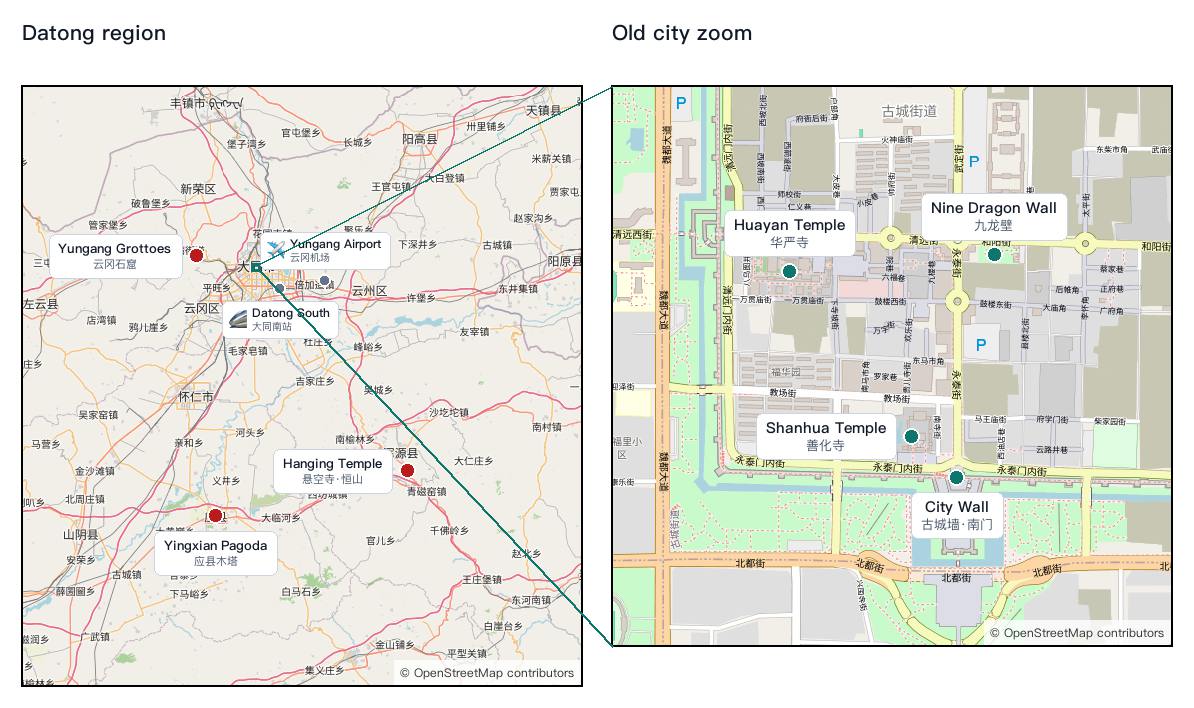
1. Yungang Grottoes (云冈石窟)
Getting there: About 16 km west of the city; bus, taxi, rental car, or tour from the center
Admission: CNY120
Time needed: Half a day
The Yungang Grottoes are one of the three great Buddhist cave complexes of China, over 250 caves and niches cut into a sandstone cliff in the 5th and 6th centuries by the Northern Wei dynasty (386-534), holding more than 50,000 statues. They range from tiny carved figures to a seated Buddha nearly 17 metres tall, many still bearing traces of paint, and the mix of Indian, Central Asian, and Chinese styles marks a key moment in the spread of Buddhism into China. It is a UNESCO World Heritage site and the single unmissable sight in Datong.

The usual visit runs west from the entrance through the ceremonial approach and Lingyan Temple, then follows the cave cliff before finishing near Yungang Museum.
The cave numbers run east to west along the cliff. Caves 16 to 20, the Tanyao Five Caves (昙曜五窟), form the earliest monumental group. Most caves east of them belong to the middle phase, when plans and decoration became more elaborate; the smaller caves west of cave 20 largely belong to the later phase.
What to see
- Caves 16 to 20, the Tanyao Five Caves (昙曜五窟)
The earliest imperial group is monumental in scale. Cave 18 is especially rich in small Buddhas across the main figure’s robe, while cave 20 contains the famous open-air seated Buddha that has become the emblem of Yungang. - Caves 5 and 6 (第5窟 / 第6窟)
Cave 5 holds Yungang’s tallest Buddha. Cave 6 is organized around a square central pillar and surrounds visitors with an unusually complete sequence of scenes from the Buddha’s life. - Caves 7 and 8 (第7窟 / 第8窟)
These paired caves are among the most expressive at the site. Look for the lively figures, elaborate ceilings, and the Central and South Asian influences that distinguish Yungang from later Chinese cave temples. - Cave 12, the Music Cave (音乐窟)
Musicians and celestial performers play a remarkable range of instruments across the front chamber, making this one of the best places to study Northern Wei dynasty (386-534) music and costume. - Caves 1 to 3 (第1窟至第3窟)
Caves 1 and 2 are often called the Pagoda Caves. The vast but unfinished cave 3 reveals the process and ambition behind carving a sanctuary directly into the cliff. - Yungang Museum (云冈博物馆)
Finish here for archaeological context, conservation displays, and a clearer explanation of how the styles and construction methods changed across the site.
Caution
The site is large and exposed, so allow a half day and bring sun or wind protection depending on the season. Some caves are dim and photography is restricted inside the most fragile ones; respect the signs.
2. Hanging Temple (悬空寺) & Mount Heng (恒山)
Getting there: Near Hunyuan, about 65 km southeast of Datong; day tour, hired car, or rental car
Admission: CNY15 to enter the scenic area plus CNY100 for the timed ticket to actually climb up onto the temple; the climb ticket is scarce and sells out fast, so book it 7 days ahead through the 北岳云游 mini-program. Mount Heng is CNY45 plus about CNY20 for the round-trip shuttle bus; a cable car up the mountain is extra
Time needed: Half a day for both
If you cannot secure a climb-up ticket, view and photograph the Hanging Temple from outside, then continue to Mount Heng or move on to the next stop in your itinerary.
The Hanging Temple is one of China’s most photographed buildings, a cluster of halls and walkways built into a sheer cliff face, apparently held up by little more than slender wooden posts, though hidden beams cut into the rock do the real work. Founded some 1,500 years ago, it is unusual for honoring Buddhism, Taoism, and Confucianism together. It sits at the foot of Mount Heng, the Northern Great Mountain of China’s five sacred peaks, a Taoist mountain of temples and trails that can be climbed separately.

Scenic shuttles connect Hengshan Visitor Centre with the Hanging Temple and Sanyuan Palace at Yuemenwan. From Sanyuan Palace, continue by shuttle to the hiking trailhead at Zhenwu Temple, or take the cableway to the upper mountain paths.
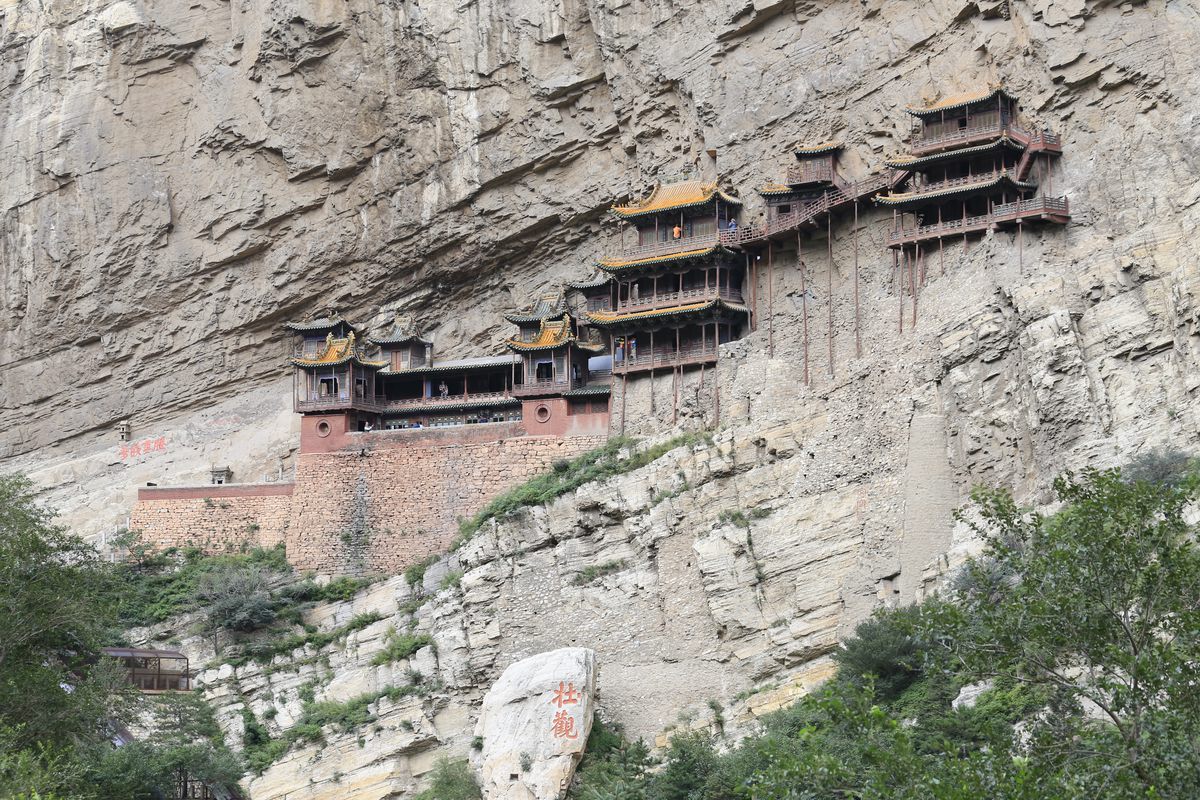
Photo: Zhangzhugang, CC BY-SA 3.0, via Wikimedia Commons
What to see
- The cliff walkways
Narrow wooden galleries and halls clinging to the rock, linked by steep stairs, with drops straight down. - The three-faith halls
Shrines honoring the Buddha, Laozi, and Confucius together, rare in Chinese temple architecture. - Mount Heng (北岳恒山)
The sacred Taoist mountain above, with temple trails and a cable car for those with more time.
Caution
The climb-up ticket for the temple is separate, scarce, and time-slotted, and it sells out within minutes of release; book it 7 days ahead through the official mini-program, or you will only see the temple from below. The walkways are narrow and get congested, and they are not for those uneasy with heights.
3. Yingxian Wooden Pagoda (应县木塔)
Getting there: In Yingxian county, about 75 km south of Datong; day tour, hired car, or rental car
Admission: around CNY50; note that for conservation reasons you can no longer climb the ancient pagoda and view it from the ground and lowest level only
Time needed: 1 to 2 hours
The Sakyamuni Pagoda at Fogong Temple, better known as the Yingxian Wooden Pagoda, is the oldest and tallest fully wooden pagoda in the world, built in 1056 and still standing after nearly a thousand years and numerous earthquakes, without a single nail. Its interlocking bracket sets are a marvel of traditional Chinese carpentry, and it holds important Buddhist statues and relics. It pairs naturally with the Hanging Temple on a day trip southeast of the city.
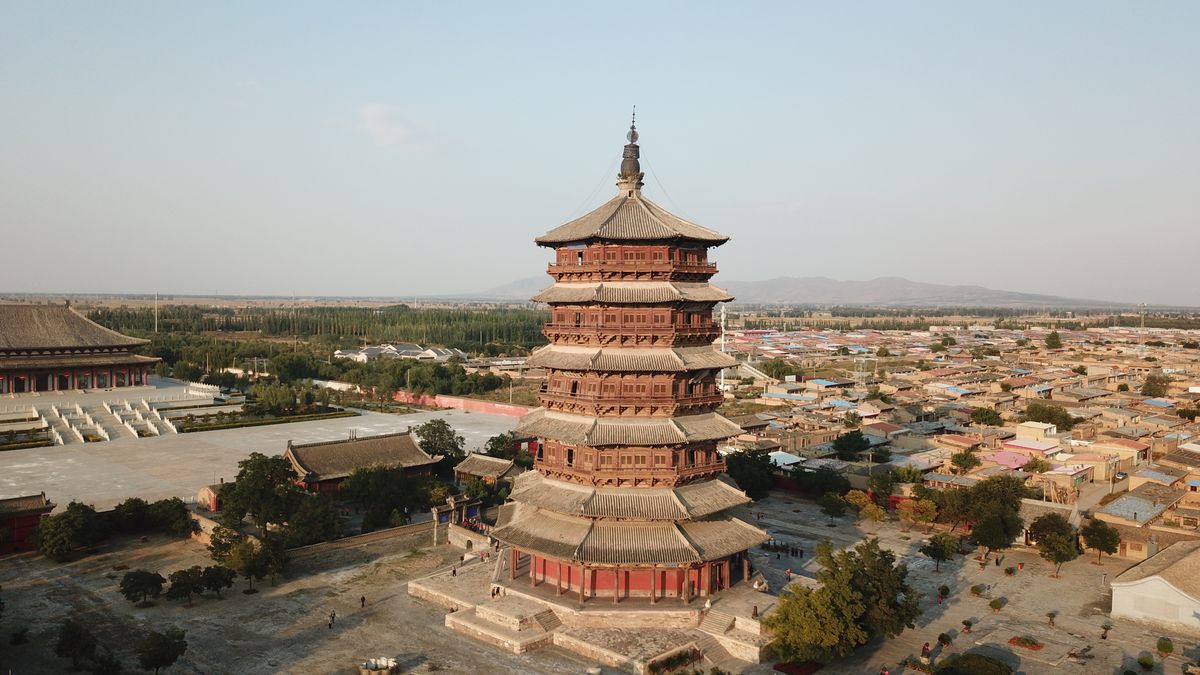
Photo: Charlie fong, CC BY-SA 4.0, via Wikimedia Commons
What to see
- The pagoda’s structure
The five visible stories of interlocking timber brackets, an engineering feat that has outlasted a millennium of earthquakes. - The ground-floor Buddha
A large seated Sakyamuni statue on the lowest level, with wall paintings around it. - The setting
The pagoda rising over the low county town, especially striking in soft evening light.
Caution
For conservation reasons you can no longer climb the pagoda; visitors view it from the ground and the lowest level only. It is a long way out for a single monument, so combine it with the Hanging Temple rather than making a separate trip.
4. Datong Ancient City Wall (大同古城墙)
Getting there: Rings the old city center; walkable from anywhere inside it
Admission: free to walk the top of the rebuilt Ming city wall; late afternoon into dusk is the best time
Time needed: 1 to 2 hours
Datong has rebuilt its Ming dynasty (1368-1644) city wall into a complete circuit around the old town, a broad rampart of grey brick with gates, towers, and a walkway along the top. Walking or cycling the wall gives an overview of the restored old city and its temples, and it is at its best in the late afternoon and at dusk, when the light softens and the wall and gate towers light up. The reconstruction is modern, but the scale gives a real sense of the old garrison city.

The rebuilt Ming dynasty (1368-1644) wall (dark red) rings a compact grid you can walk in a day. Red dots are religious sites, orange dots are old-town landmarks, and blue dots are museums and cultural spaces, including the Dongnanyi historic district. The four gates each keep their barbican; the south Yongtai Gate is the usual place to climb onto the wall.
What to see
- Yongtai Gate and the wall circuit (永泰门 / 大同城墙)
Yongtai Gate on the south side is the usual place to climb onto the rebuilt wall. Walk a short section for views over the old city, or return around dusk when the gates and towers are illuminated. - The central towers and screens
The Bell Tower (钟楼), Drum Tower (鼓楼), Sipailou arch (四牌楼), Kuixing Tower (魁星楼), and Cross Street Five Dragon Screen (十字街五龙壁) form a compact sequence through the western and central old city. The Five Dragon Screen dates from 1724 and is the most convincing historic detail among this group of mostly reconstructed landmarks. - West-side religious quarter
Continue past the Grand Mosque (清真大寺), Chunyang Palace (纯阳宫), and Kaihua Temple (开化寺), then spend your main sightseeing time at Huayan Temple and Shanhua Temple. These two temples contain the strongest surviving historic architecture on this side of the old city. - Immaculate Heart Cathedral (圣母圣心堂)
Tucked into Dusi Street, this Roman Catholic cathedral is one of the old city’s more unexpected landmarks. The first church here was completed in 1891. In 1922, the Belgian Congregation of the Immaculate Heart of Mary took responsibility for the newly established Datong apostolic prefecture, giving the cathedral its present dedication. The building was destroyed and rebuilt more than once during the 20th century, so its interest lies in Datong’s less visible Catholic history rather than entirely original architectural fabric. - East-side heritage walk
Pair the reconstructed Prince Dai’s Mansion (代王府) with the original Nine Dragon Wall, then continue to Guandi Temple (关帝庙), Datong Prefecture Confucian Temple (大同府文庙), and Fahua Temple (法华寺). This route mixes surviving monuments with rebuilt compounds, so read the signs at each stop rather than assuming everything is ancient. - Museums and lighter stops
The China Sculpture Museum (中国雕塑博物馆) occupies the north-wall barbican. The Liang Sicheng Memorial Hall (梁思成纪念馆) explains how Datong’s historic architecture was documented, while Pingcheng Memory Hall (平城记忆馆) and Dongnanyi (东南邑) work well as shorter exhibition and rest stops on the east side.
Caution
The city wall and many of the towers and streetscape elements are recent reconstructions, so treat the wall walk primarily as an overview of the old city. However, the area is not simply a replica district. Huayan Temple, Shanhua Temple, the Nine Dragon Wall, Guandi Temple, and several smaller religious buildings preserve substantial historic fabric and rank among Datong’s most important monuments. The wall top is exposed, so a windbreak helps in the cold months.
5. Huayan Temple (华严寺)
Getting there: Inside the old city, a short walk from the center
Admission: around CNY50 for the Huayan Temple complex
Time needed: 1 to 1.5 hours
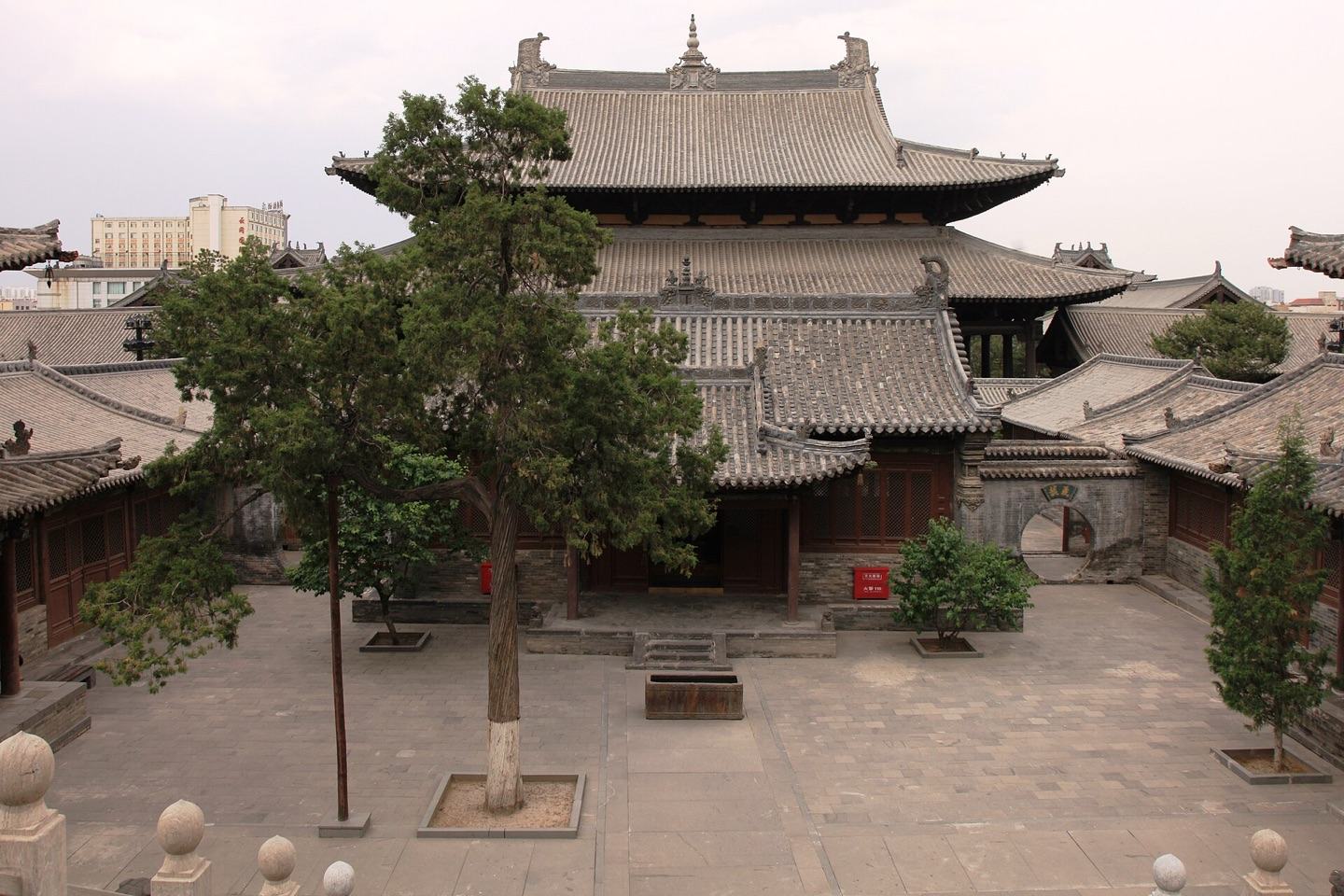
Huayan Temple is the largest and best-preserved Buddhist temple in Datong. It was founded in 1038 during the Liao dynasty (916-1125), and its Bhagavan Sutra Hall (薄伽教藏殿) survives from that same year. The hall contains a celebrated group of Liao dynasty (916-1125) painted clay statues, including a serene bodhisattva often called the “Oriental Venus.” The great Mahavira Hall (大雄宝殿), rebuilt in 1140 during the Jin dynasty (1115-1234), is one of the largest surviving early timber halls in China. The temple is a highlight of the rebuilt old city and a rare survival of early architecture.
What to see
- The Mahavira Hall (大雄宝殿)
A vast early timber hall, among the largest of its age in China, with grand Buddha statues inside. - The Bhagavan Sutra Hall (薄伽教藏殿)
Home to exquisite Liao dynasty (916-1125) painted clay bodhisattvas, the temple’s artistic treasure. - The temple layout
Unusually oriented and split into upper and lower monasteries, worth a slow look.
Caution
The statues in the sutra hall are fragile and dimly lit, and photography may be restricted; treat it as a place to look closely rather than shoot. It can be busy on weekends as one of the old city’s main sights.
6. Nine Dragon Wall (九龙壁)
Getting there: In the old city on Da Dong Street
Admission: around CNY10 for the Nine Dragon Wall
Time needed: 30 minutes
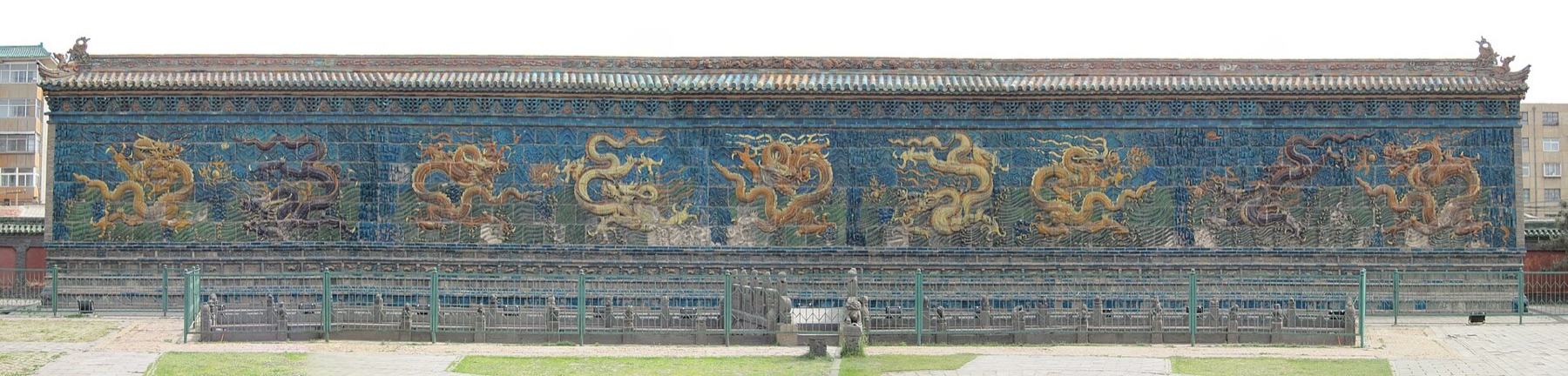
Datong’s Nine Dragon Wall is the oldest and largest glazed-tile screen wall of its kind in China, built around 1392 as the spirit screen before the palace of a Ming dynasty (1368-1644) prince, and far bigger than the better-known one in Beijing. Its nine writhing dragons, in yellow, blue, green, and purple glaze, stretch some 45 metres along a low wall, reflected in a strip of water in front. It is a quick but worthwhile stop in the old city.
What to see
- The nine glazed dragons
A long screen of vividly colored ceramic dragons, each in a different pose against a tiled sky and sea. - The reflecting pool
A channel of water in front that mirrors the dragons, part of the original design.
Caution
It is a single wall and a short visit, so fold it into a wider walk around the old city rather than making a special trip. Morning light is kinder on the glaze for photographs.
7. Shanhua Temple (善化寺)
Getting there: In the south of the old city, near the wall
Admission: Modest, sometimes bundled with other old-city sights
Time needed: 1 hour
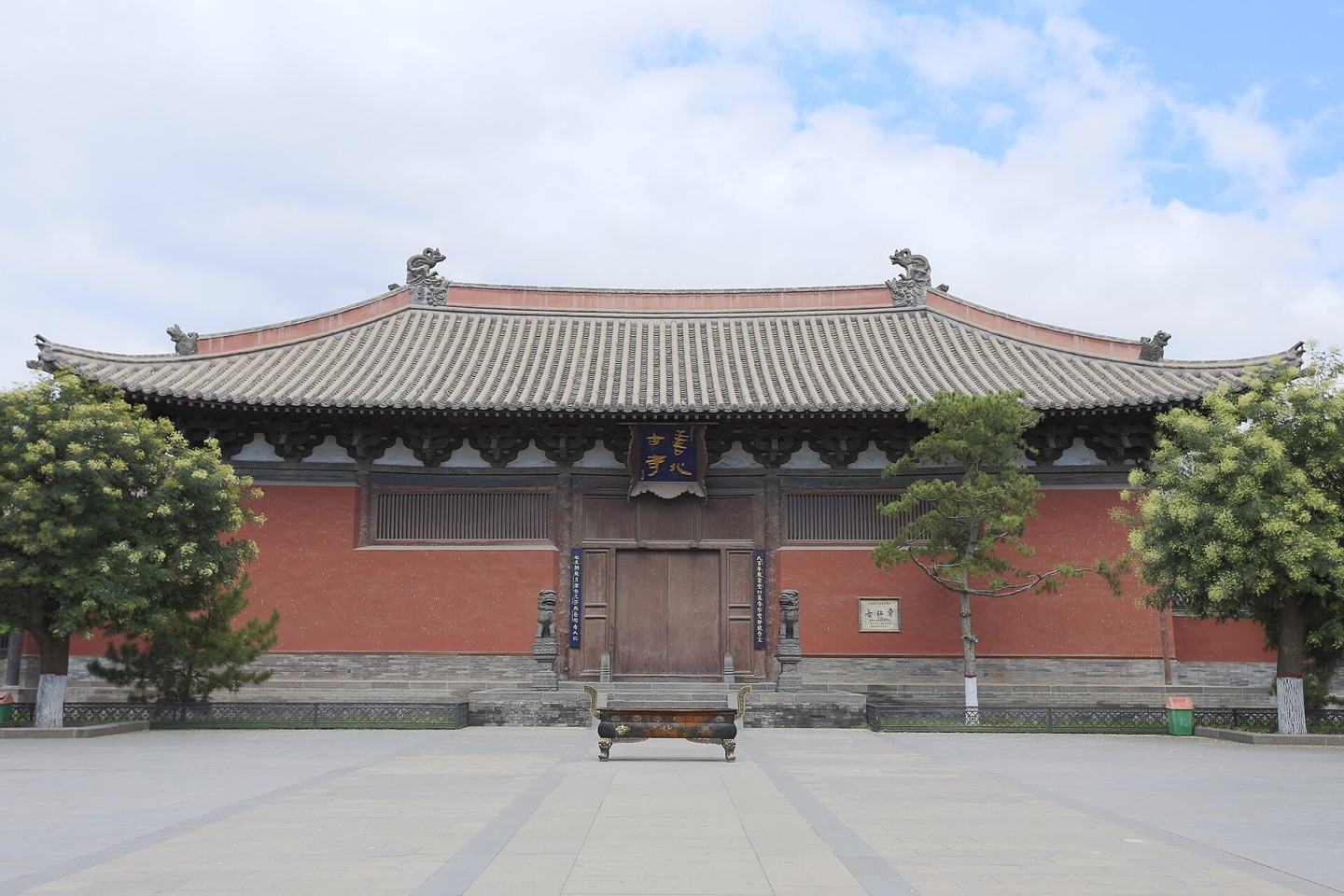
Shanhua Temple was founded in 738, although its surviving buildings are considerably later. The Mahavira Hall (大雄宝殿) dates from the 11th-century Liao dynasty (916-1125), while the Main Gate (山门) and Three Saints Hall (三圣殿) were built during the Jin dynasty (1115-1234) reconstruction of 1128 to 1143. It is quieter than Huayan and preserves expressive Jin dynasty (1115-1234) statues, including a lineup of celestial guardians. Together with Huayan, it makes the rebuilt old city a genuinely rewarding place for early Buddhist architecture.
What to see
- The Sansheng Hall and Mahavira Hall
Early timber halls with Jin dynasty (1115-1234) statues, less crowded than Huayan’s. - The Heavenly King Hall (天王殿)
A rare surviving Jin dynasty (1115-1234) gate hall, an architectural highlight. - The clay guardian figures
A row of expressive celestial guardians, among the temple’s finest sculptures.
Caution
Like the other old-city temples, parts of the surroundings are reconstructed, though the main halls are genuinely old. Combine it with the nearby city wall and Nine Dragon Wall for an efficient old-city morning.
Suggested Itineraries
2 Days in Datong
Day 1: Grottoes and old city
The Yungang Grottoes in the morning, then the rebuilt old city in the afternoon for Huayan Temple, the Nine Dragon Wall, and Shanhua Temple, finishing with the city wall at dusk.
Day 2: The southeast day trip
A full day southeast of the city for the Hanging Temple and Mount Heng near Hunyuan, then the Yingxian Wooden Pagoda on the way, best done by tour or hired car to link them.
Adding it to Beijing
Datong works well as a two-night side trip from Beijing, an hour and a half or so away by fast train. Many travelers do the grottoes and old city on the day of arrival, the southeast sights the next day, and head back on the third.
Where to Stay
The rebuilt old city is the most atmospheric and convenient base, walkable to the temples, the wall, and the food. The newer part of town around the stations has more standard business hotels. Prices below are rough high-season guides; check current rates before booking.
Midscale
- Old-city and station hotels
Reliable domestic chains inside or near the old city, handy for the sights and the fast train. Often CNY250-500/night.
Budget
- Guesthouses and budget hotels
Simpler, cheaper rooms in and around the old city, some in courtyard-style buildings. Often CNY120-280/night.
Where to Eat
- Old city streets: The rebuilt lanes hold most of the city’s restaurants and snack stalls, strong on Shanxi noodles and local specialties.
- Noodles above all: Shanxi is China’s noodle heartland, and Datong’s knife-shaved noodles are the local staple.
- Hotpot and grill: Warming lamb hotpot and barbecue suit the cold northern climate, especially in winter.
Dishes to Try
- Knife-shaved noodles (刀削面): Shanxi’s signature noodle, shaved in thick ribbons straight into the pot, served with rich toppings.
- Datong huimian and yellow-flour dishes (黄糕): Local starchy staples of the northern Shanxi diet, filling and traditional.
- Sliced braised pork and local lamb: Hearty northern meat dishes suited to the climate, often in stews or hotpot.
- Shanxi vinegar (老陈醋): The famous aged vinegar of Shanxi flavors many local dishes; noodles come with a generous splash.
- Yumai and oat noodles (莜面): Rolled oat-flour noodles steamed into little tubes, a regional specialty of the highlands.
- Hunyuan liangfen (浑源凉粉): A cold starch-jelly snack from near the Hanging Temple, dressed with chili and vinegar.
Hero photo: Steve Cadman, CC BY-SA 2.0, via Wikimedia Commons.
Help keep this guide accurate
Found something incorrect, outdated, or missing? Tell us what changed and include a source when possible.
Suggest an update