
On this page15 sections
✓ Prices and practical details last verified July 15, 2026
Changbaishan, the “Ever-White Mountain,” is the great volcano of China’s northeast, straddling the border with North Korea. Its crown is Heaven Lake, a deep blue crater lake ringed by jagged peaks that fills an old caldera at over 2,000 metres, and its slopes drop through hot springs, waterfalls, and dense primeval forest. It is one of China’s most revered mountains, a national nature reserve of rare volcanic and alpine scenery, and a place people come to in summer for the lake and forests and in winter for deep powder skiing. Reaching it takes effort, and the famous lake is often hidden in cloud, but on a clear day it is unforgettable.
Highlights
- Gaze down on the deep blue crater of Heaven Lake (天池) from the rim of the volcano.
- Watch the Changbai Waterfall (长白瀑布) thunder from the crater rim, with hot springs steaming below.
- Rest by the still, forest-ringed Green Deep Pool (绿渊潭) on the North Slope.
- Walk the mossy chasm of the Underground Forest (地下森林), sunk into an old volcanic fault.
- Choose among three very different approaches: the sight-packed North Slope, the open West Slope, or the remote South Slope beside the North Korean border.
- Ski deep powder in winter at the West Slope’s ski resorts, Wanda or Huamei.
Transportation
Getting there
The high-speed railway serves on west and north sides of Changbaishan. The two similarly named stations are far apart, so choose the station for your slope before buying a ticket.
| Scenic area | Railway station | Best base or transfer |
|---|---|---|
| North Slope (北坡) | Changbaishan Station (长白山站) | Erdaobaihe, then an optional shuttle from Chibei or Huangsongpu (黄松蒲), or a car or taxi to the entrance |
| West Slope (西坡) | Changbaishanxi Station (长白山西站) | Songjianghe, Wanda Resort, or Huamei Resort, then an optional shuttle from Chixi or Baixi, or a car or taxi to the entrance |
| South Slope (南坡) | Changbaishanxi Station (长白山西站) | Same as West Slope, and prearranged car or tour for the long transfer to the South Scenic Area visitor center |
Changbaishan Station / Erdaobaihe (长白山站 / 二道白河) is the correct arrival point and base for the North Slope. The Chibei District Transit Center (池北区交通集散中心) is in town, not at the mountain entrance. Its shuttle to the North Scenic Area entrance costs CNY25 return; the shorter return shuttle from Huangsongpu (黄松蒲) costs CNY9. Both are optional. You may drive or take a taxi to the entrance instead, but private vehicles cannot replace the required internal eco-shuttle inside the scenic area.
Changbaishanxi Station (长白山西站) is the correct station for the West Slope, the Wanda and Huamei resort areas, and most South Slope trips. The return shuttle from the Chixi District Transit Center (池西区交通集散中心) to the West Scenic Area entrance costs CNY19; the return shuttle from Baixi (白溪) costs CNY9. These external buses are optional if you drive or take a taxi to the entrance, but the internal eco-shuttle remains required.
Changbaishan Airport (NBS) is also on the west side, close to the ski resorts and the West Slope. It is much less convenient for the North Slope. Check current nonstop destinations on FlightConnections, as schedules change by season.
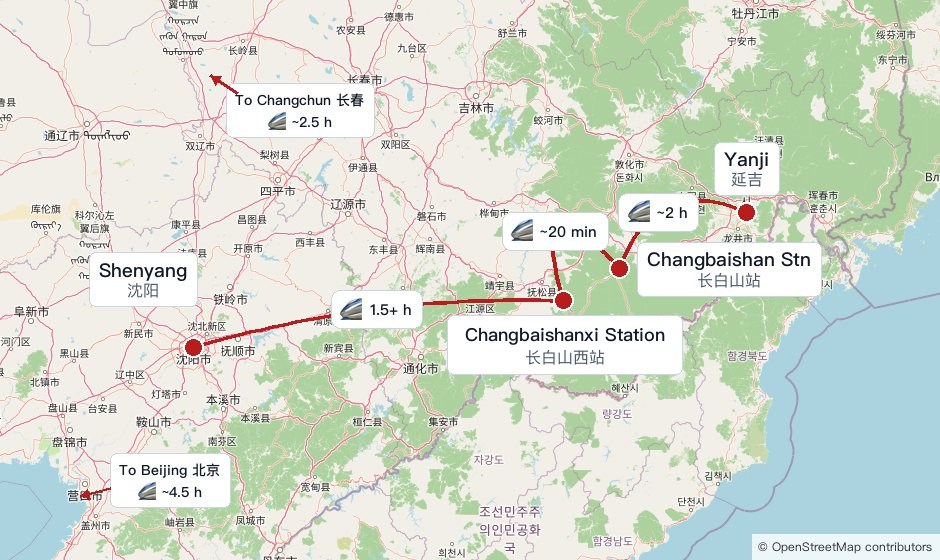
Use Changbaishan Station for the North Slope. Use Changbaishanxi Station or Changbaishan Airport for the West and South Slopes.
Common onward routes
| Route | Best option | Travel Time | Notes |
|---|---|---|---|
| Changbaishan Station -> Yanji (延吉) | High-speed train via Dunhua | About 2 hours | Useful for combining the North Slope with Yanbian food and culture. |
| Changbaishan Station -> Changchun (长春) | High-speed train | About 3.5 to 4 hours | Services vary, so compare direct trains and Dunhua connections. |
| Changbaishanxi / Changbaishan Station -> Shenyang (沈阳) | High-speed train | From about 1.5 to 2 hours | The new Shenbai line is much faster than the former rail route. |
| Changbaishanxi / Changbaishan Station -> Beijing (北京) | High-speed train | From about 4.5 hours | Direct services run toward Beijing Chaoyang; check the exact station and train on 12306. |
Getting around
Each slope has its own entrance, ticket inventory, visitor center, and internal shuttle system. You cannot move freely between slopes inside the reserve, and the road transfer around the mountain takes hours.
- North Slope: The easiest first visit and the slope with the largest ticket allocation. Park shuttles link Heaven Lake, Changbai Waterfall, Julong Hot Springs, Green Deep Pool, and the Underground Forest. A separate off-road vehicle climbs from the transfer station to the crater rim.
- West Slope: Quieter and more open. A park shuttle reaches the upper area, followed by 1,442 steps to the Heaven Lake viewpoint. Jinjiang Grand Canyon and alpine vegetation are the main lower stops.
- South Slope: The most remote and capacity-controlled route. Park vehicles can reach the summit area, but tickets are much scarcer and weather or border-area controls can affect opening. Arrange the long road transfer before arrival.
All three scenic areas use timed, real-name reservations. Search the official WeChat account 长白山 for current opening notices and tickets. Secure a South Slope ticket before committing to a non-refundable transfer.
Key Attractions
Choose the slope before choosing individual sights. The North Slope provides the fullest sightseeing day and the easiest logistics. The West Slope gives a broader, less obstructed Heaven Lake view and is close to the ski resorts. The South Slope is the longest transfer and has the fewest tickets, but many visitors consider its direct, open view over Heaven Lake the best of the three. The tickets price are the same for all slopes. ¥105 ( have student/senior discount with valid IDs) + ¥85 eco-shuttle.
| Slope | Best for | Main sights | Where to stay |
|---|---|---|---|
| North Slope (北坡) | First visits, easier tickets, the most complete day | Heaven Lake, Changbai Waterfall, Julong Hot Springs, Green Deep Pool, Underground Forest | Changbaishan Station / Erdaobaihe |
| West Slope (西坡) | A wide Heaven Lake view, summer flowers, winter ski trips | Heaven Lake steps, alpine tundra, Jinjiang Grand Canyon | Changbaishanxi Station / Songjianghe, Wanda Resort, or Huamei Resort |
| South Slope (南坡) | The strongest lake view and a remote border landscape | Heaven Lake, alpine tundra, Yalu River headwaters and canyon scenery | Same as West Slope with a prearranged transfer |
Each slope has its own visitor center (游客中心) at the mountain. The North and West also have their own railway station (🚄) and transit centers (集散中心, 🚌) in the nearest base town. South Slope visits require a separately arranged transfer. Pick your slope first, then click its N, W, or S marker to jump to that slope’s section.

The map separates Changbaishan Airport from Wanda and Huamei resorts and marks the smaller Baixi and Huangsongpu (黄松蒲) access points. Open the interactive map to zoom in.
North Slope Overview (北坡)
Getting there: High-speed rail to Changbaishan Station (长白山站). Continue to the North Scenic Area entrance by the shuttle from Chibei Transit Center, the shuttle from Huangsongpu (黄松蒲), or your own car or taxi.
Tickets: North Scenic Area admission is CNY105, plus CNY85 for the required internal eco-shuttle; the North Slope summit minibus costs a separate CNY80 and is available only after purchasing a North Scenic Area ticket
Best for: A first Changbaishan visit, travelers who want more sights, and easy trails.
Time needed: One full day, about 5 to 7 hours inside the park
The North Slope is the most practical and complete introduction to Changbaishan. Its sights sit close together and the whole visit runs on the park’s own buses and shuttles, so it asks little of your legs and is the natural first choice. It normally receives the largest ticket allocation and collects almost all of the mountain’s famous non-lake sights on one circuit: after trying for Heaven Lake, you continue to Changbai Waterfall and the Julong Hot Springs, Green Deep Pool, and the Underground Forest, with the Small Heaven Lake and a mammoth museum as optional add-ons if time and energy allow.
The map below starts at the North Slope visitor center and traces the internal eco-shuttle, summit minibus, and waterfall walking route. Click a numbered dot to jump to its attraction section.

Tickets and booking
| Component | Price | Note |
|---|---|---|
| North Scenic Area admission | ¥105 | Required, with student/senior discount possible with IDs |
| Internal eco-shuttle | ¥85 | Required |
| Chibei Transit Center to the scenic-area entrance | ¥25 round trip | Optional; skip it if driving or taking a taxi to the entrance |
| Huangsongpu (黄松蒲) to the scenic-area entrance | ¥9 round trip | Optional; skip it if driving or taking a taxi to the entrance |
| Heaven Lake summit minibus | ¥80 | The only way up to the summit; runs only when weather permits |
Driving or taking a taxi replaces only the external bus to the entrance. It does not replace the ¥85 internal eco-shuttle.
Entry is by timed, real-name reservation on the official 长白山 WeChat mini-program; North Slope tickets are released seven days ahead and drop at 6pm, so enter your ID details in advance and book the moment they open in the summer and winter peaks. Aim for an early morning slot, when queues are shortest and the odds of a clear lake are best, and reach the visitor center about half an hour before your slot to clear ticket checks. The two hot-spring resorts at the North Gate, Crowne Plaza and DoubleTree, may offer guests fast-track tickets, so ask when booking if skipping the queue matters to you.
The classic North Slope day
Reach the scenic-area entrance by transit shuttle, car, or taxi, then continue on the park’s internal vehicles. Once inside, follow the operating sequence rather than trying to double back:
- Town to the North Scenic Area entrance: the optional Chibei shuttle covers 30.5 kilometres in about 30 minutes. Drivers and taxi passengers may go directly to the entrance instead.
- Visitor center to the internal transfer center: the official route board shows a combined 16.5 kilometres and about 20 minutes by park vehicle, passing other spots without stopping,save that walk for the way back.
- Transfer center to Heaven Lake: change to the summit vehicle for the 10.2-kilometre climb, listed at about 15 minutes. Lines can be long.
- Heaven Lake: take in the crater lake from the rim viewpoints, then ride back down to the transfer center.
- Changbai Waterfall and Julong Hot Springs: continue by park vehicle, then walk past the steaming springs to the falls.
- Green Deep Pool: the emerald, waterfall-fed pool, one of the prettiest and easiest stops.
- Underground Forest: the sunken forest trail, the most demanding walk of the day.
People usually stay around Changbaishan Station / Erdaobaihe (长白山站 / 二道白河) at the foot of the mountain. It has the widest choice of hotels and restaurants and the easiest access to the Chibei District Transit Center. Huangsongpu Transit Center (黄松蒲交通集散中心) is a smaller departure point closer to the mountain entrance, with guesthouses nearby.
Two hot-spring hotels sit at or very close to the North Gate. Crowne Plaza Resort Changbaishan Hot Spring (长白山温泉皇冠假日酒店) is beside the entrance, includes access to its volcanic hot spring. DoubleTree by Hilton Changbaishan Hot Spring (长白山温泉希尔顿逸林酒店) is about 1.5 kilometres from the entrance beside Linxi Hot Spring. Confirm whether your room package includes a scenic-area fast-track or transfer benefit before booking.
Practical tips
- Watch the weather. Whether the summit road opens at all depends on conditions, so check the official channels the night before and again on the morning of your visit, and pick the clearest forecast day.
- Layer up. The rim is cold and extremely windy even in summer, so pack a windproof jacket over a t-shirt, plus sunglasses and a hat you can fasten tight against the wind.
- Guard against motion sickness. The summit vehicle climbs a road of 72 switchbacks; take medication ahead if you are prone to it, and try for a front seat.
- Travel light. There is free luggage storage at the visitor center, and food inside the park is limited and pricey, so bring your own water and snacks.
1. Heaven Lake / Tianchi (天池)
Getting there: The ¥80 summit vehicle from the internal transfer center.
Heaven Lake, or Tianchi, is the reason people climb Changbaishan: a deep, round crater lake of astonishing blue, filling the caldera of the volcano and ringed by sixteen jagged peaks, with the China-North Korea border running right across the water. At more than 2,000 metres it is the highest crater lake in the world of its kind, and standing on the rim as the cloud parts to reveal it is a genuinely stirring moment. The catch is the weather: the summit is often wrapped in cloud and wind, and a clear view is a matter of luck.
On the North Slope the rim has two viewing routes from the drop-off. The higher one (marked A) climbs a flight of steps to a loftier vantage, while the lower one (marked B) is a level walk to the famous lake-side stone marker and is usually less crowded; take the B route first if your legs are tired.
What to see
- The crater and the lake
The full sweep of the caldera and its blue water from the rim viewpoints, weather permitting. - The ringing peaks
The sixteen surrounding summits, several topping 2,500 metres, along the crater rim. - The border marker
The China-North Korea boundary that runs across the lake, marked at the West Slope viewpoint.
Caution
The lake is famously shy, hidden in cloud more often than not, so give yourself more than one chance if you can and go early on the clearest forecast day. The rim is cold, windy, and high. Bring warm, windproof layers even in summer.
2. Changbai Waterfall & Hot Springs (长白瀑布)
Getting there: On the North Slope, a walk up from the shuttle transfer
Time needed: 1 to 2 hours
The Changbai Waterfall is the outflow of Heaven Lake, a 68-metre cascade where the lake’s water pours over the crater rim and begins its journey as the Songhua River. The walk up the valley to its foot is one of the highlights of the North Slope, and just below it the Julong hot springs steam out of the ground, hot enough that vendors boil eggs in them for you to eat. In winter the falls partly freeze into a spectacular wall of ice.
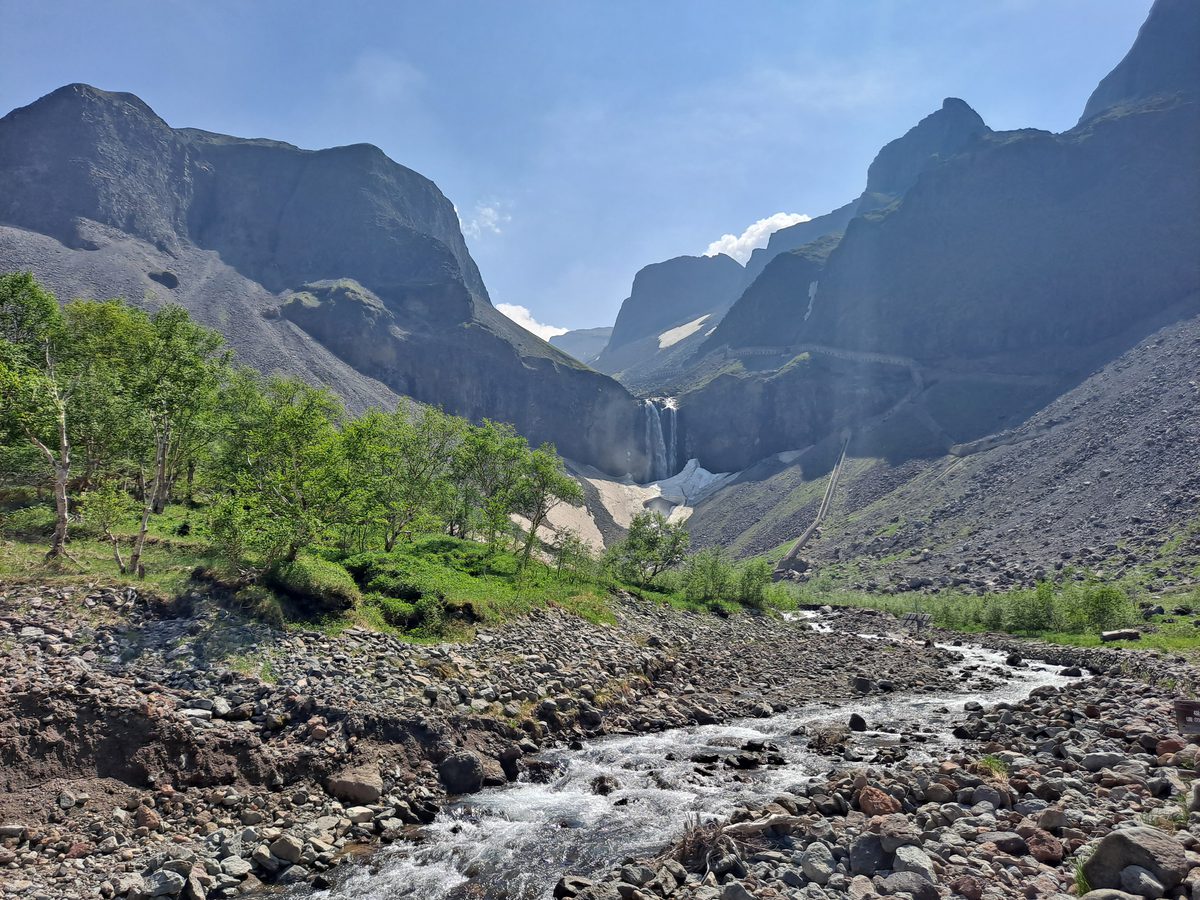
Photo: EditQ, CC BY-SA 4.0, via Wikimedia Commons
What to see
- The waterfall
The 68-metre cascade from the crater rim, the outlet of Heaven Lake, seen from the valley path. - The Julong hot springs (聚龙温泉)
Steaming mineral springs beside the trail, with tender eggs slow-cooked in the boiling water, sold at about three for CNY10. - The frozen falls in winter
The cascade turns to ice in the cold season, a dramatic contrast to its summer roar.
Caution
The path up to the falls is at altitude and can be icy or wet, so tread carefully. The hot-spring pools are extremely hot; look but do not touch beyond the areas set aside for bathing.
3. Green Deep Pool (绿渊潭)
Getting there: On the North Slope, a short walk from the shuttle road
Time needed: 30 to 45 minutes
Green Deep Pool, Luyuantan, is a small, jewel-like pool fed by a waterfall and ringed by dark spruce and fir forest, its water an intense emerald green from the minerals and the reflected trees. It is an easy, gentle stop on the North Slope between the bigger sights, especially pretty in mist and quietly spectacular in autumn when the surrounding forest turns color. A short boardwalk lets you take it in from several angles.
What to see
- The emerald pool and its waterfall
The vivid green pool and the small cascade feeding it, framed by evergreen forest. - The boardwalk viewpoints
Short walkways giving different angles on the water and trees. - Autumn color
The surrounding forest turning gold and red in September and October.
Caution
It is a quick stop rather than a destination, so fold it into the North Slope circuit. The boardwalks can be slippery when wet or frosty.
4. Underground Forest (地下森林)
Getting there: On the North Slope, near the eco-shuttle stop.
Time needed: 1.5 to 2 hours
The Underground Forest is a strange and beautiful place where an ancient volcanic fault has dropped the ground away, leaving a deep, mossy chasm with a mature forest growing on its sunken floor, its treetops level with the surrounding plateau. A walking trail runs about 1.5 kilometres each way, roughly 3 kilometres round trip with a fair number of steps, through some of the finest old-growth spruce and fir on the mountain, ending near a viewpoint over the Erdao Baihe river. It is a cool, green, and often overlooked corner of the North Slope; if your legs are tired, walk a short way in for the atmosphere and turn back.
What to see
- The sunken forest
The deep fault valley with its mature forest growing far below the surrounding plateau. - The old-growth trees
Tall spruce and fir along the trail, some of the best primeval forest in the reserve. - The river viewpoint
An overlook near the end of the trail above the young Songhua river.
Caution
The trail involves a fair amount of walking and some steps, at altitude, so allow time and pace yourself. It is shaded and cool even in summer, so bring a layer.
West Slope Overview (西坡)
Getting there: High-speed rail to Changbaishanxi Station (长白山西站), or fly to Changbaishan Airport. Continue to the West Scenic Area entrance by the CNY19 return shuttle from Chixi Transit Center, the CNY9 return shuttle from Baixi, or your own car or taxi.
Tickets: West Scenic Area admission is CNY105, plus CNY85 for the required internal eco-shuttle
Best for: A broad, open Heaven Lake view, summer wildflowers, and easy access to the ski resorts
Time needed: One full day
The West Slope trades the North Slope’s string of forest and water sights for a wider, more open experience of the mountain. Its single great draw is the panorama over Heaven Lake from the top of the 1,442 steps, reached through belts of alpine tundra and summer wildflower meadows, with Jinjiang Grand Canyon lower down. There are fewer individual stops than on the North Slope, but the scenery feels more spacious, and the slope sits right beside the ski resorts.
Changbaishanxi Station is the correct rail arrival point. Transfers connect it with Songjianghe, the Chixi District Transit Center, Changbaishan Wanda International Resort, and Changbaishan Huamei Resort. The Chixi shuttle is convenient but not compulsory: driving or taking a taxi to the scenic-area entrance avoids that external fare. Do not arrive at Changbaishan Station / Erdaobaihe unless you are prepared for a long road transfer around the mountain.
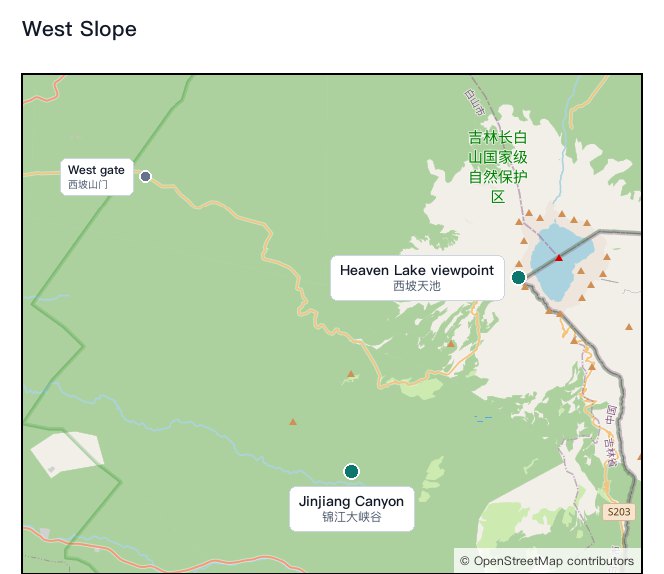
Tickets and access
| Component | Price | Required? |
|---|---|---|
| West Scenic Area admission | CNY105 | Required |
| Internal eco-shuttle | CNY85 | Required inside the scenic area |
| Chixi Transit Center to the scenic-area entrance | CNY19 return | Optional; skip it if driving or taking a taxi to the entrance |
| Baixi to the scenic-area entrance | CNY9 return | Optional; skip it if driving or taking a taxi to the entrance |
Private cars and taxis can take you to the entrance, but they do not replace the CNY85 internal eco-shuttle. Unlike the North Slope, the West Slope has no separate summit-minibus charge because visitors climb the 1,442 steps.
West-side resort areas and skiing
Two large resort zones sit west of the mountain. Both are useful bases for the West Slope, Changbaishan Airport, and winter skiing, but they are separate developments.
- Changbaishan Wanda International Resort (长白山万达国际度假区)
The larger and more developed ski village, with more than 30 ski runs, restaurants, hot springs, and a wide range of hotels. The luxury end includes Park Hyatt Changbaishan and Hyatt Regency Changbaishan. Marriott Bonvoy options include The Westin Changbaishan Resort and Sheraton Changbaishan Resort. This is the easiest choice for a full-service ski holiday with many dining and hotel options. - Changbaishan Huamei Resort (长白山华美胜地)
A quieter, more spread-out resort zone formerly known as Luneng Resort. Its best-known hotels include Club Med Changbaishan, the Accor-managed Swissôtel Resort Changbaishan, and Wang Changbai MGallery. It combines downhill and cross-country skiing with family activities and resort shuttles. Club Med is useful for travelers who want an all-inclusive ski package.
Changbaishan is one of China’s better-developed destination ski areas, with reliable cold weather, natural snow, resort hotels, and lift networks designed for multi-day stays. The ski season, open lifts, and package inclusions change each winter, so compare the two resorts before booking.
5. West Slope Heaven Lake Viewpoint (西坡天池)
Getting there: Reach the West Scenic Area entrance by optional transit shuttle, taxi, or rental car, then use the internal eco-shuttle and climb 1,442 steps to the rim
Admission: CNY105 admission plus the CNY85 internal eco-shuttle; no separate summit-vehicle fee
Time needed: Half a day
From the top of the West Slope’s 1,442-step stairway the caldera opens out with fewer foreground obstructions than on the North Slope, giving what many consider the widest, clearest Heaven Lake view of the two rail-served slopes. The climb takes around an hour with rest points, through alpine tundra and, in July and August, slopes of wildflowers. It is the one unmissable sight of the West Slope.
What to see
- The Heaven Lake panorama
The wide, open view of the crater lake from the top of the steps, often the clearest of the accessible slopes. - The 1,442 steps
The wooden stairway up to the rim, a stiff climb of around an hour with rest points. - The alpine meadows
Summer wildflower slopes on the way up, at their best in July and August.
Caution
The stair climb is genuinely tiring at altitude, so take it slowly. Assisted options may be available for travelers who cannot manage the full climb. It is a long way from the North Slope, so plan one slope for the day.
6. Jinjiang Grand Canyon (锦江大峡谷)
Getting there: On the West Slope side, lower down the mountain
Admission: Covered by the park ticket
Time needed: 1 to 1.5 hours
The Jinjiang Grand Canyon is a dramatic gorge cut into the volcanic tuff on the west side of the mountain, its walls carved by erosion into rows of jagged pinnacles and spires above a forested river. A boardwalk runs along the rim through fine forest, giving views down into the canyon, and it makes a good add-on to a West Slope day. It is quieter than the summit and shows a very different, lower-altitude face of the volcano.
What to see
- The canyon and its spires
The eroded volcanic gorge with its rows of rock pinnacles, seen from the rim boardwalk. - The rim forest
Tall spruce and fir along the walkway, part of the reserve’s primeval forest. - The quieter atmosphere
A calmer, lower stop away from the summit crowds.
Caution
It is on the West Slope side, well away from the North Slope sights, so it fits a West Slope itinerary rather than a North Slope one. The boardwalk is exposed in places, so mind the drop.
South Slope Overview (南坡)
Getting there: High-speed rail to Changbaishanxi Station (长白山西站), then a prearranged scenic shuttle, organized tour, hired car, or rental car to the South Scenic Area entrance
Tickets: South Scenic Area admission is CNY105, plus CNY85 for the required internal eco-shuttle
Best for: The strongest, closest Heaven Lake view, for travelers who can secure a scarce ticket and a long transfer
Time needed: A full day including the long road transfer
The South Slope is the most remote Chinese approach to Heaven Lake. It runs beside the North Korean border and reaches a high viewpoint very close to the crater, with a broad, direct perspective over the water. On a clear day, many visitors consider this the best Heaven Lake view of all three slopes. The park vehicle reaches the summit area, so the lake viewpoint requires less climbing than the West Slope.
The trade-off is difficult logistics. South Slope tickets are released in much smaller numbers, the drive is the longest, and opening can change with weather, road, ecological, or border-area conditions. Changbaishanxi Station is the correct rail gateway, but the station is not beside the South Slope. Reserve the official ticket and confirm transport before travel.
Tickets and access
| Component | Price | Required? |
|---|---|---|
| South Scenic Area admission | CNY105 | Required |
| Internal eco-shuttle | CNY85 | Required inside the scenic area |
The long transfer to the South Scenic Area entrance is separate from these two charges. Confirm its price and pickup point when arranging your shuttle, tour, or private car.
What to see
- The South Slope Heaven Lake view
A close, open panorama over the crater lake with relatively little foreground obstruction. - The China and North Korea border landscape
The route follows a sensitive frontier zone and gives the mountain a noticeably more remote atmosphere. Follow all signs and photography restrictions. - Alpine tundra and forest zones
The journey climbs through intact vegetation belts, from dense forest to birch and exposed volcanic tundra. - Yalu River headwaters and canyon scenery
The southern side drains toward the Yalu River and includes volcanic valleys and waterfalls, subject to the route open that day.
Caution
Do not build a short, inflexible itinerary around the South Slope. Tickets are scarce, the summit can close in poor weather, and the road transfer consumes much of the day. Keep a North or West Slope alternative if seeing Heaven Lake is more important than seeing it specifically from the south.
Suggested Itineraries
The basic two-day sequence
Day 1: Arrive in the evening. Take the train or flight to the correct side of Changbaishan and stay near your chosen slope. Use Erdaobaihe or Huangsongpu (黄松蒲) for the North Slope. Use Songjianghe, Wanda Resort, or Huamei Resort for the West or South Slope. Collect any supplies and confirm the next morning’s transport before bed.
Day 2: Start early and spend the day on the mountain. Book an early entry slot and leave your hotel in time for the first practical shuttle or transfer. On the North Slope, try Heaven Lake first if the summit road is open, then continue to the waterfall, hot springs, Green Deep Pool, and Underground Forest. The West and South Slopes also require most of a day.
After descending
The comfortable choice is to stay one more night, eat locally, and leave the following morning. It is also possible to take a late high-speed train directly to your next destination after descending. Allow generous time for the scenic shuttle, road traffic, luggage collection, and the transfer to Changbaishan Station or Changbaishanxi Station. Avoid a tight connection because park transport and summit conditions can delay the day.
Add weather flexibility
Cloud, wind, snow, or ice can hide Heaven Lake or close the summit road even when the lower scenic area remains open. A short visit gives you only one chance. Travelers for whom Heaven Lake is the main priority should consider staying several days and keeping at least one day flexible as a weather backup. With three or four nights, you can retry the same slope or combine the North Slope with a west-side stay, depending on ticket availability and the forecast.
Where to Stay
Choose accommodation by slope. The bases are too far apart for casual daily commuting.
North Slope (北坡)
- Changbaishan Station / Erdaobaihe (长白山站 / 二道白河): The most practical North Slope base, with the widest range of hotels, guesthouses, restaurants, and tour services. It is also convenient for the Chibei District Transit Center.
- Huangsongpu (黄松蒲): Guesthouses near this smaller transit point place you closer to the scenic-area entrance. Choices for food and evening activities are much more limited than in Erdaobaihe.
- North Scenic Area entrance: Crowne Plaza Resort Changbaishan Hot Spring (长白山温泉皇冠假日酒店) and DoubleTree by Hilton Changbaishan Hot Spring (长白山温泉希尔顿逸林酒店) are the two main hotels at or near the entrance. Both have hot-spring access, and hotel packages may include transfers or faster scenic-area entry. Confirm the current benefit before booking.
West Slope (西坡)
- Songjianghe (松江河): The main town base for the West Slope and Changbaishanxi Station. It offers cheaper local hotels, restaurants, and everyday services than the resort zones.
- Changbaishan Wanda International Resort (长白山万达国际度假区): The larger full-service ski resort, with Park Hyatt, Hyatt Regency, Westin, Sheraton, and less expensive resort hotels. It is convenient for skiing, Changbaishan Airport, and West Slope transfers.
- Changbaishan Huamei Resort (长白山华美胜地): A quieter resort zone with Club Med, Swissôtel, Wang Changbai MGallery, villas, and family-oriented hotels. It suits travelers who want an all-inclusive or self-contained ski stay.
South Slope (南坡)
Use the same bases as the West Slope: Songjianghe, Wanda Resort, or Huamei Resort. The South Slope has no equally practical accommodation hub at its entrance, so arrange an early private transfer, scenic shuttle, or tour and confirm the pickup location before booking.
Prices vary sharply between summer weekends, autumn foliage, ski season, and public holidays. Check what a resort rate includes, as some packages bundle airport or station transfers, ski passes, equipment, lessons, hot springs, or breakfast.
Where to Eat
- Erdaobaihe town: Most of the area’s restaurants are here, strong on Northeastern and Korean-Chinese food.
- Korean-Chinese cuisine: This is the edge of the Yanbian Korean region, so cold noodles, barbecue, and kimchi feature alongside Dongbei dishes.
- Mountain and forest foods: Wild mushrooms, mountain vegetables, and local freshwater fish appear on menus in season.
Dishes to Try
- Korean cold noodles (冷面): Chewy buckwheat noodles in a chilled broth, a Yanbian specialty.
- Barbecue and kimchi (烤肉、泡菜): Korean-style grilled meat and pickles, widespread in this border region.
- Wild mountain mushrooms (山珍菌菇): Foraged fungi from the reserve’s forests, a local delicacy.
- Changbaishan freshwater fish: River and lake fish from the mountain’s clean waters, often steamed or stewed.
- Ginseng and mountain tonics (人参): The Changbai range is famous for ginseng, which turns up in soups and tonics.
- Dongbei stews (乱炖): Hearty Northeastern one-pot stews, warming after a cold day on the mountain.
Hero photo: A Chinese user, CC BY-SA 4.0, via Wikimedia Commons. Cropped for display.
,_Aug_12_2022.jpg)
Help keep this guide accurate
Found something incorrect, outdated, or missing? Tell us what changed and include a source when possible.
Suggest an update