
On this page13 sections
✓ Prices and practical details last verified July 11, 2026
Harbin is the “Ice City,” the capital of China’s far northeast, where long, brutal winters have been turned into the country’s greatest festival of ice and snow. Built up around the Russian-financed railway a century ago, it keeps a strong Russian flavor in its onion-domed cathedral, cobbled European high street, and love of bread, sausage, and beer. Most visitors come in the depths of winter, when the Songhua River freezes solid and the Ice and Snow World rises in glowing towers of illuminated ice, but the city rewards a summer visit too. Come dressed for the cold and ready for a place that feels a little like Russia dropped into Manchuria.
Highlights
- Photograph the green-domed Saint Sophia Cathedral (圣索菲亚大教堂), Harbin’s Russian-built landmark.
- Stroll the cobbled European facades of Central Street (中央大街) and try a Harbin ice cream bar in the cold.
- Wander the glowing ice castles of the Ice and Snow World (冰雪大世界), the world’s biggest winter ice park.
- See the snow sculptures on Sun Island (太阳岛) and the big cats of the Siberian Tiger Park (东北虎林园).
- Escape to the Russian-themed estate of Volga Manor (伏尔加庄园) outside the city.
Transportation
Getting there
Harbin Taiping International Airport (哈尔滨太平国际机场 / HRB) connects to cities across China and some international routes. Check current direct routes on FlightConnections. Harbin is a high-speed rail hub, about an hour from Changchun, two from Shenyang, and 4.5 to 5 hours from Beijing; Harbin Taiping International Airport adds wide flight connections, with an airport bus and metro into the city. Winter is peak season, so book flights, trains, and hotels well ahead.
Railway stations
Harbinxi (哈尔滨西站) is the main high-speed hub, with the fastest trains south to Changchun, Shenyang, and Beijing. Harbin Station (哈尔滨站), the historic station near the center, handles a mix of services and is closer to the sights. Check which one your ticket uses.
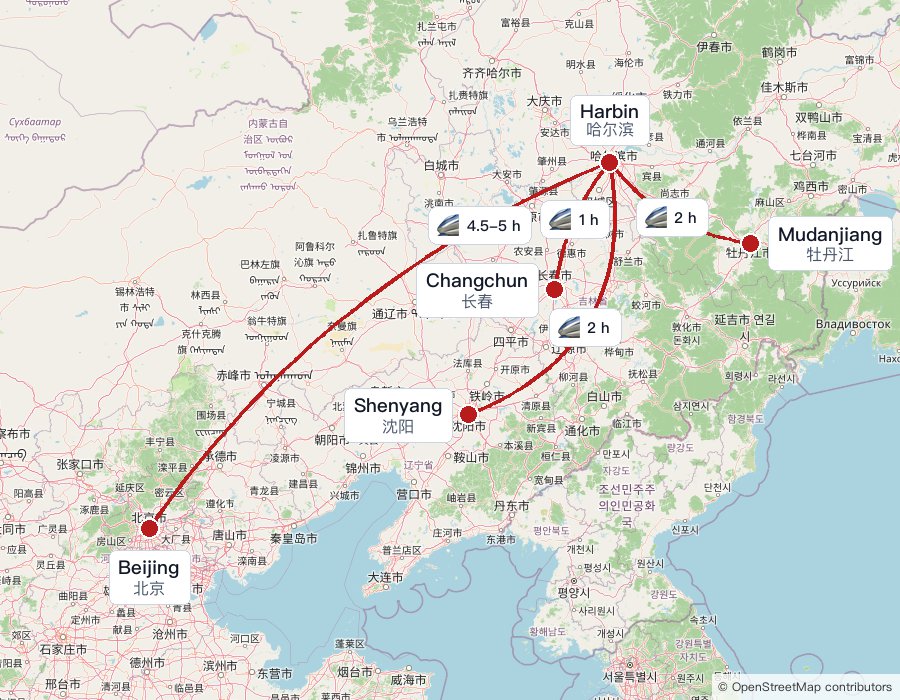
High-speed rail times from Harbin to Changchun, Shenyang, Mudanjiang, and Beijing. Most fast trains leave from Harbinxi.
Common onward routes
| Route | Best option | Travel Time | Notes |
|---|---|---|---|
| Harbin (哈尔滨) -> Changchun (长春) | High-speed train | 1 hour | The nearest big city, south on the Northeast corridor. |
| Harbin (哈尔滨) -> Shenyang (沈阳) | High-speed train | 2 hours | Further south toward Liaoning. |
| Harbin (哈尔滨) -> Mudanjiang (牡丹江) | High-speed train | 2 hours | East toward Yabuli, Snow Town, and the Changbai ranges. |
| Harbin (哈尔滨) -> Beijing (北京) | High-speed train | 4.5-5 hours | The long ride back to the capital; flying is an alternative. |
Getting around
The metro and buses cover the city, and fares are CNY2 to start, rising with distance; most city trips cost CNY2 to 5. The central sights, Saint Sophia and Central Street, are walkable together, and taxis are cheap for the winter attractions across the river on Sun Island and at the Ice and Snow World. The single biggest factor is the cold: in deep winter it is routinely below minus 20C, so dress in serious layers, keep phone batteries warm, and plan indoor breaks between the outdoor sights.
Key Attractions
Harbin’s sights split by season and by side of the river. The year-round city sights, Saint Sophia Cathedral, Central Street, and Zhaolin Park, cluster in the old center and fill the map zoom. The winter blockbusters sit across the Songhua River in Songbei: the Ice and Snow World, the snow sculptures of Sun Island, and the Siberian Tiger Park, with the Russian-themed Volga Manor further out to the southeast. The numbers on the map match the sections below; click a numbered dot to jump to it.
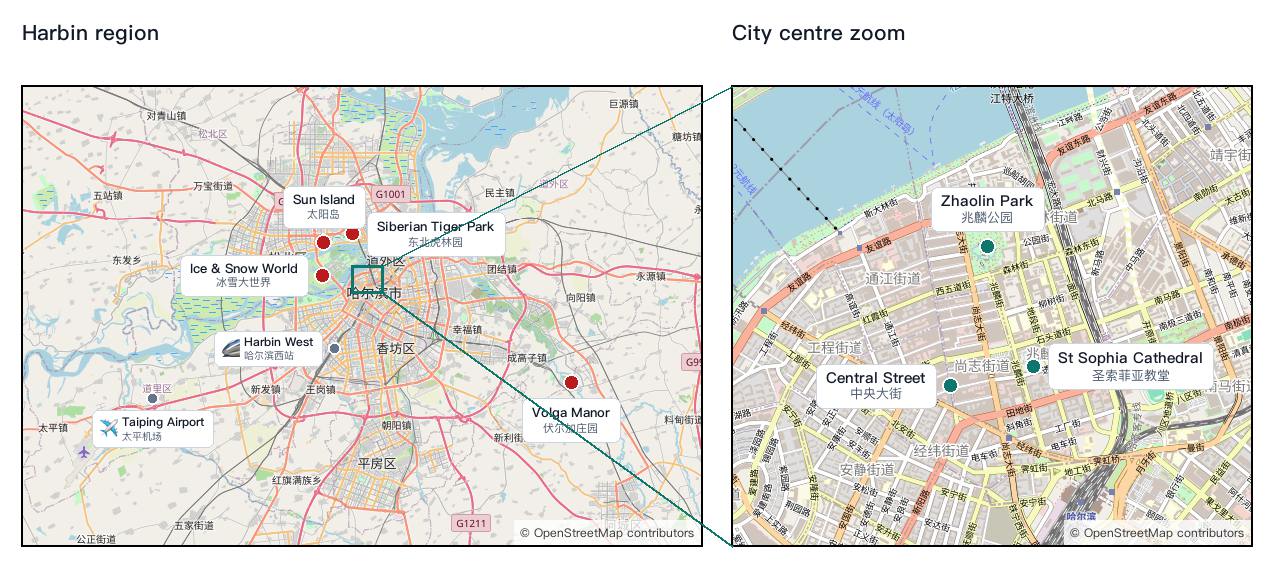
1. Saint Sophia Cathedral (圣索菲亚大教堂)
Getting there: In the Daoli district center, a short walk from Central Street
Admission: CNY15 (half price for students); the cathedral is now an architecture and art museum rather than a church
Time needed: 1 hour
Saint Sophia is Harbin’s signature landmark, a grand Russian Orthodox cathedral of red brick topped by a black-green onion dome and golden crosses, built in 1907 for the Russian railway workers and now the largest Orthodox church in the Far East. It no longer holds services; inside it is a museum of the city’s history and architecture. The square around it is the classic photo spot, especially under snow, and the cathedral looks its best floodlit against a winter dusk.
What to see
- The exterior and square
The red-brick facade and green dome from the surrounding plaza, the essential Harbin photograph. - The interior museum
Exhibits on old Harbin’s Russian and railway history inside the former nave, under the dome. - The evening lighting
The cathedral floodlit after dark, particularly striking with snow on the square.
Caution
It is a museum now, not a working church, so do not expect services. The square is exposed and bitterly cold in winter, so photograph quickly and warm up nearby.
2. Central Street (中央大街)
Getting there: In the Daoli district, running down to the Songhua River
Admission: Free
Time needed: 2 to 3 hours
Central Street, or Zhongyang Dajie, is a 1.4-kilometre cobbled pedestrian boulevard lined with early-20th-century European architecture, a legacy of Harbin’s cosmopolitan railway boom. It is the city’s showpiece, paved with granite blocks and flanked by old banks, hotels, and department stores in Baroque and Art Nouveau styles, now full of shops, bakeries, and restaurants. Eating a Modern-brand ice cream bar outdoors in freezing weather is a local rite, and the street runs down to the frozen river and its ice-slide fun in winter.
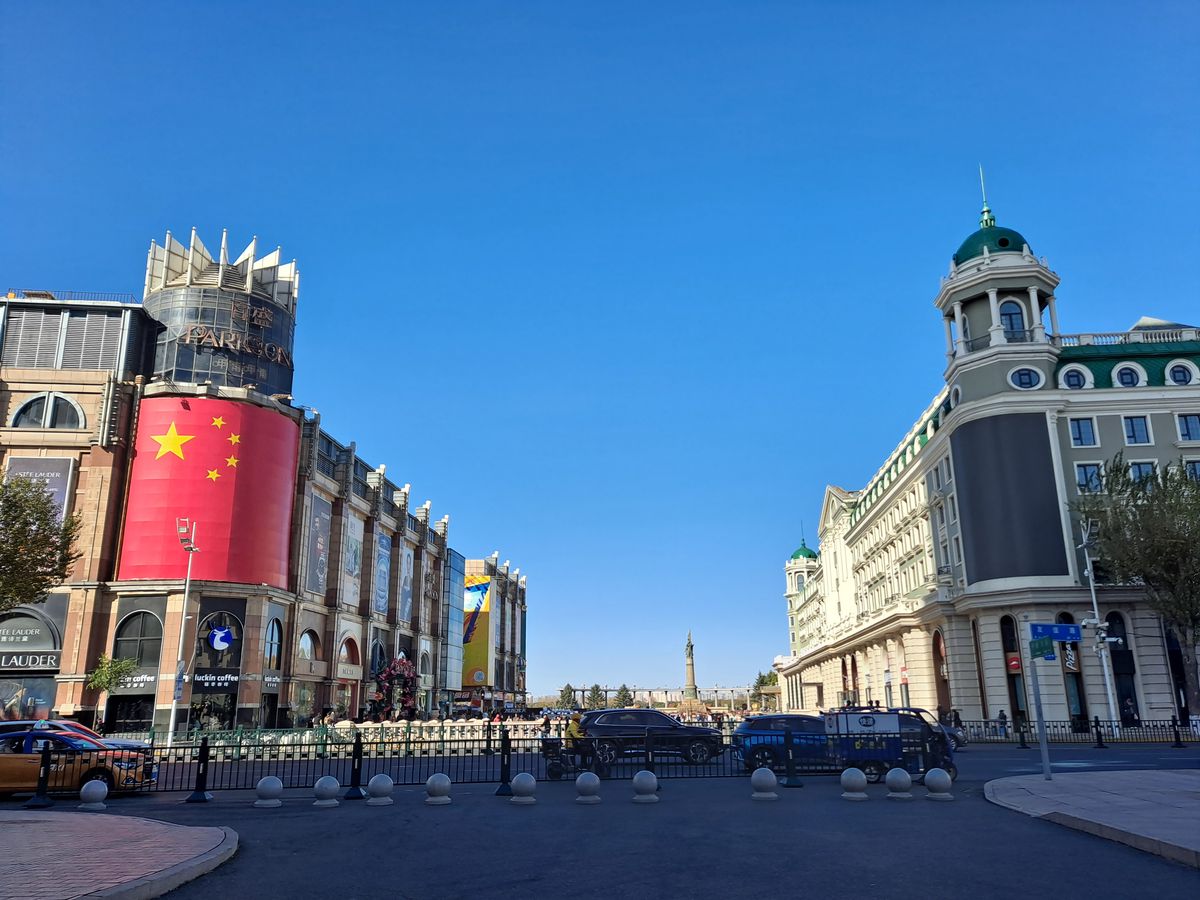
Photo: EditQ, CC BY-SA 4.0, via Wikimedia Commons
What to see
- The cobbled boulevard
The granite-paved pedestrian street and its restored European facades, best walked end to end. - The old buildings
Grand former banks, hotels, and stores in Baroque and Art Nouveau styles, with plaques telling their history. - The frozen river at the foot
In winter the Songhua River at the street’s end becomes a playground of ice slides, sledding, and stalls.
Caution
It is touristy and lined with souvenir and food stalls, so prices run high; treat the architecture and the atmosphere as the draw. In deep winter the walk is genuinely cold, so pace it with warm stops.
3. Zhaolin Park & the Ice Lanterns (兆麟公园)
Getting there: In the center near Central Street
Admission: Free in summer; the winter Ice Lantern Fair is ticketed
Time needed: 1 to 2 hours
Zhaolin Park is a small central park that hosts Harbin’s oldest winter tradition, the Ice Lantern Art Fair, which began in 1963 long before the giant Ice and Snow World across the river. Its carved ice sculptures, lit from within with colored light, are smaller and more intimate than the vast park in Songbei, and its central location makes it an easy add-on to the old-city sights. In the warm months it is simply a pleasant green park.
What to see
- The Ice Lantern Fair (冰灯游园会)
Carved and illuminated ice sculptures in winter, the tradition that started Harbin’s ice festival. - The intimate scale
A more compact, walkable ice display than the huge Ice and Snow World, and closer to the center. - The summer park
A quiet central green space with a pond and paths outside the winter season.
Caution
The ice fair runs only in the cold season, roughly the same window as the other winter sights. It is smaller than the Ice and Snow World, so treat it as a bonus rather than a substitute.
4. Harbin Ice and Snow World (冰雪大世界)
Getting there: Across the Songhua River in Songbei, north of the center
Admission: the Ice and Snow World is around CNY268 to 328 for a standard adult ticket (concessions cheaper), open only in winter and best after dark when the ice is lit; evening tickets cost more
Time needed: An evening
The Ice and Snow World is the headline of the Harbin International Ice and Snow Festival, an enormous park built each winter from blocks of ice cut out of the frozen Songhua River, sculpted into full-size castles, towers, and slides and lit from within with millions of colored LEDs. Walking among the glowing ice buildings after dark, riding the long ice slides, and seeing the whole park blaze with color is one of the great winter experiences in the world. It exists only for the cold season and vanishes with the thaw.
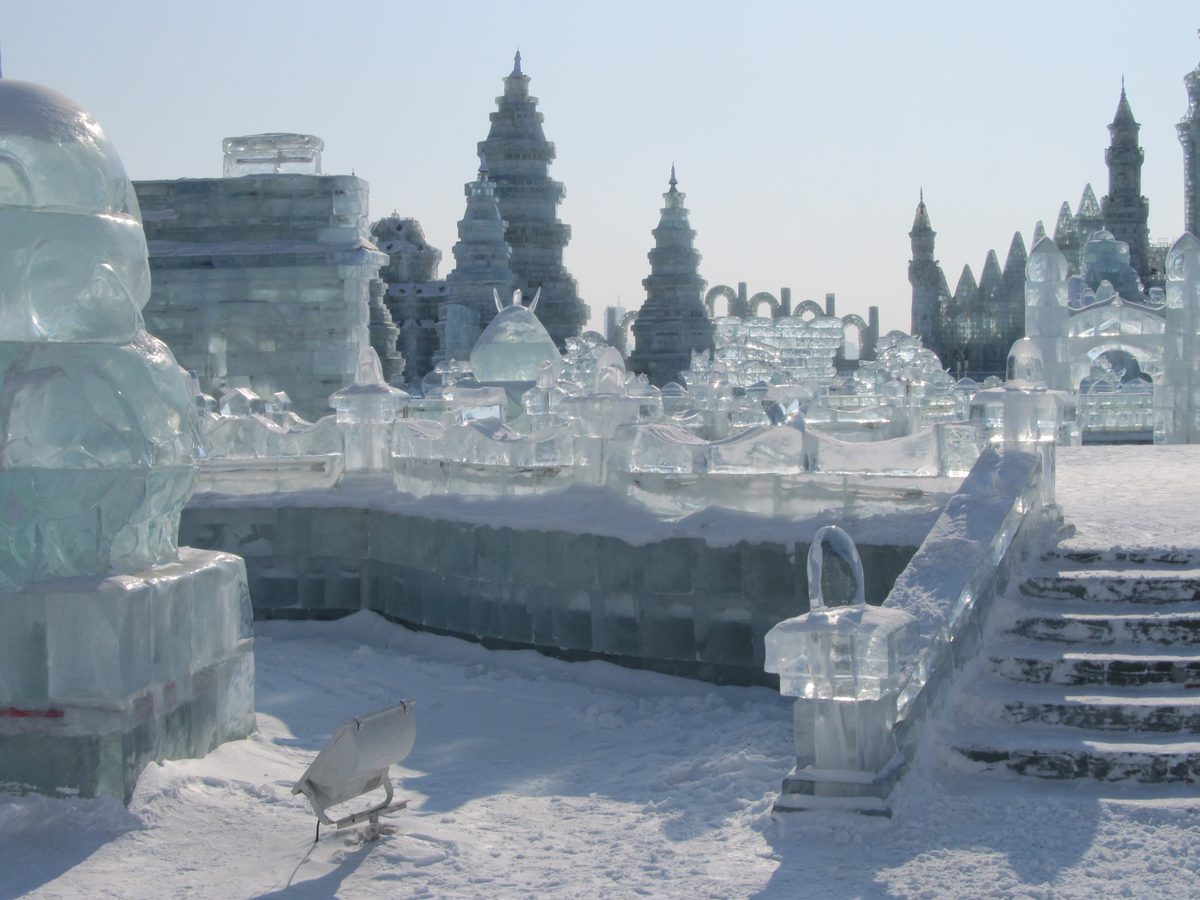
Photo: Tracy Hunter, CC BY 2.0, via Wikimedia Commons
What to see
- The illuminated ice buildings
Full-size castles, pagodas, and towers carved from river ice and lit in shifting colors, best after dark. - The ice slides
Long slides built into the ice structures, a highlight for all ages. - The nightly shows
Performances and light displays staged through the winter evenings.
Caution
It is bitterly cold and mostly outdoors at night, so wear every layer you have and expect to warm up often. It is winter-only, roughly late December to late February, and evening tickets cost more than daytime, so plan around the schedule and the temperature.
5. Sun Island (太阳岛)
Getting there: Across the river in Songbei; bus, taxi, or the ropeway over the Songhua
Admission: the Sun Island park is free in the warm months; in winter the Snow Sculpture Art Expo held there is ticketed at around CNY198 (concession about CNY128)
Time needed: Half a day
Sun Island is a large park on the north bank of the Songhua, a summer retreat of gardens, lakes, and a Russian-themed area that in winter becomes the site of the Snow Sculpture Art Expo. Where the Ice and Snow World is built of clear ice, this is the home of huge carved snow sculptures, some enormous, best in daylight. In the warm months it is a green escape from the city, popular with locals for picnics and boating.
What to see
- The Snow Sculpture Art Expo (雪博会)
Giant carved snow sculptures across the park in winter, a daytime companion to the evening ice park. - The summer gardens
Lakes, lawns, and a squirrel island, a warm-weather picnic and boating spot. - The Russian-themed area
A small district of Russian-style buildings reflecting Harbin’s heritage.
Caution
The snow expo and the summer park are two different experiences, so what you see depends entirely on season. The island is large, so allow time to walk or use the internal transport.
6. Siberian Tiger Park (东北虎林园)
Getting there: In Songbei on the north bank of the river
Admission: around CNY90 to 100, including the caged safari bus through the tiger enclosures
Time needed: 1.5 to 2 hours
The Siberian Tiger Park is a large breeding and research reserve for the endangered Siberian (Amur) tiger, home to hundreds of the big cats along with lions and other animals. Visitors tour the enclosures in a caged safari bus, watching the tigers roam in large open areas, and there are walkways over some sections. It is a conservation center rather than a polished zoo, and views on the feeding practices are mixed, but it is a rare chance to see these tigers at close range.
What to see
- The tiger enclosures
Large open areas where the Siberian tigers roam, viewed from the caged safari bus. - The walkway sections
Elevated walkways over parts of the park for closer, calmer viewing. - The other big cats
Lions, leopards, and other animals kept alongside the tigers.
Caution
This is a working breeding facility, and the live-feeding options some visitors find unsettling; you can skip them. It is on the north bank near the other winter sights, so it combines well with Sun Island.
7. Volga Manor (伏尔加庄园)
Getting there: About 40 km southeast of the city; taxi, rental car, or organized tour
Admission: around CNY100 for the Russian-themed Volga Manor estate, about 40 km southeast of the city
Time needed: Half a day
Volga Manor is a large Russian-themed estate on the outskirts of Harbin, built around a lake with reconstructions of Russian buildings, most notably a full-scale replica of the Saint Nicholas Church that once stood in central Harbin before it was demolished. It leans into the city’s Russian heritage with onion-domed architecture, Russian food, and boat rides, and makes a pleasant half-day escape, prettiest under snow or in green summer.
What to see
- The Saint Nicholas Church replica
A full-size reconstruction of the wooden Orthodox church Harbin lost, the estate’s centerpiece. - The Russian-style grounds
Lakeside buildings, gardens, and pavilions in Russian architectural styles. - Seasonal activities
Boating and lawns in summer, snow and ice activities in winter.
Caution
It is a themed resort rather than a historic site, so come for the atmosphere and the church replica rather than authenticity. It is well out of town, so factor in the travel time or join a tour.
Suggested Itineraries
2 Days in Winter Harbin
Day 1: The old city and the ice park
Saint Sophia Cathedral and Central Street in the day, an ice cream bar in the cold, then the Ice and Snow World across the river in the evening when it lights up.
Day 2: Snow and tigers
The Snow Sculpture Expo on Sun Island and the Siberian Tiger Park nearby by day, and Zhaolin Park’s ice lanterns or more of Central Street in the evening.
3 to 4 Days: Beyond the city
Add Volga Manor for a Russian-themed half day, or head east toward the ski slopes of Yabuli and the picture-book Snow Town (Xuexiang), both a couple of hours out and popular winter add-ons that need their own day or overnight.
A summer alternative
Out of the ice season, Harbin is a cool-summer city break: the cathedral, Central Street, and Sun Island’s gardens all work in green, and the Songhua riverfront comes alive, without the deep freeze.
Where to Stay
Staying near Central Street and Saint Sophia puts you among the sights, the food, and the metro, and within easy reach of the river and the winter attractions across it. Prices below are rough winter-high-season guides and drop off-season; check current rates before booking.
Midscale
- Central Street area hotels
Reliable domestic chains in and around the old center, the most convenient base. Often CNY300-700/night in winter high season, less the rest of the year.
Budget
- Hostels and budget hotels
Cheaper, sociable options near the center, popular with festival visitors. Often CNY150-400/night in winter, cheaper off-season.
Where to Eat
- Central Street: The city’s food showcase, strong on Russian-influenced bread, sausage, and the famous ice cream bars.
- Russian restaurants: Harbin’s heritage shows up in borscht, cured meats, and dark bread served in old European-style dining rooms.
- Northeastern home cooking: Hearty Dongbei stews, dumplings, and grilled skewers suit the cold, in big shareable portions.
Dishes to Try
- Guo bao rou (锅包肉): Sweet-and-sour battered pork, a signature Northeastern dish that Harbin claims as its own.
- Harbin red sausage (红肠): Russian-style smoked sausage, a local specialty sold all along Central Street.
- Modern ice cream bars (马迭尔冰棍): The old Modern brand’s ice pops, eaten outdoors even in deep winter.
- Borscht and Russian bread (苏泊汤、大列巴): Russian-influenced soup and big round loaves, a legacy of the railway era.
- Dongbei stews (乱炖): Hearty one-pot stews of pork, potato, and vegetables, comfort food for the cold.
- Dumplings and skewers: Northeastern dumplings and grilled meat skewers, filling and cheap.
Hero photo: Enming Yan, CC BY-SA 4.0, via Wikimedia Commons.
Help keep this guide accurate
Found something incorrect, outdated, or missing? Tell us what changed and include a source when possible.
Suggest an update