
On this page14 sections
✓ Prices and practical details last verified August 1, 2026
Dunhuang is the great oasis of the Silk Road, a green town cradled between the Gobi and the dunes at the western end of the Hexi Corridor. For a thousand years caravans rested here before facing the deserts west of the passes, and the faith and art they carried left one of the world’s supreme treasures: the painted grottoes of Mogao. Around the town the desert does the rest, piling up the Mingsha singing dunes above the spring-fed Crescent Lake, and stretching out to the ruined watchtowers of Yangguan and Yumen and the wind-carved badlands beyond. It takes effort to reach this far corner of Gansu, but few places pack so much history and raw desert scenery into one trip.
Highlights
- Stand inside the painted Buddhist grottoes of the Mogao Caves (莫高窟), the finest cave art in China.
- Visit the quieter Yulin Caves (榆林窟) for superb Tang dynasty (618-907) and Western Xia dynasty (1038-1227) murals without Mogao’s crowds.
- Climb the Mingsha singing dunes above the improbable Crescent Lake (月牙泉) for sunset.
- Ride out to the lonely Han dynasty (202 BCE-220 CE) ramparts of Yumen Pass (玉门关) on the old Silk Road.
- Watch the light change over the wind-sculpted ridges of the Yardang Geopark (雅丹).
- Eat your way through the Shazhou night market on skewers, noodles, and apricot juice.
Transportation
Getting there
Dunhuang sits far out in western Gansu, so plan the approach. Dunhuang Mogao Airport (DNH), 13 km east of town, has flights from Xi'an, Lanzhou, Beijing, and other cities and is the quickest way in; by rail, the Lanxin high-speed line stops at Liuyuan South, about 130 km north, with a 2 hour bus link, while slower overnight trains run right into Dunhuang's own station. Check current flight routes on FlightConnections.
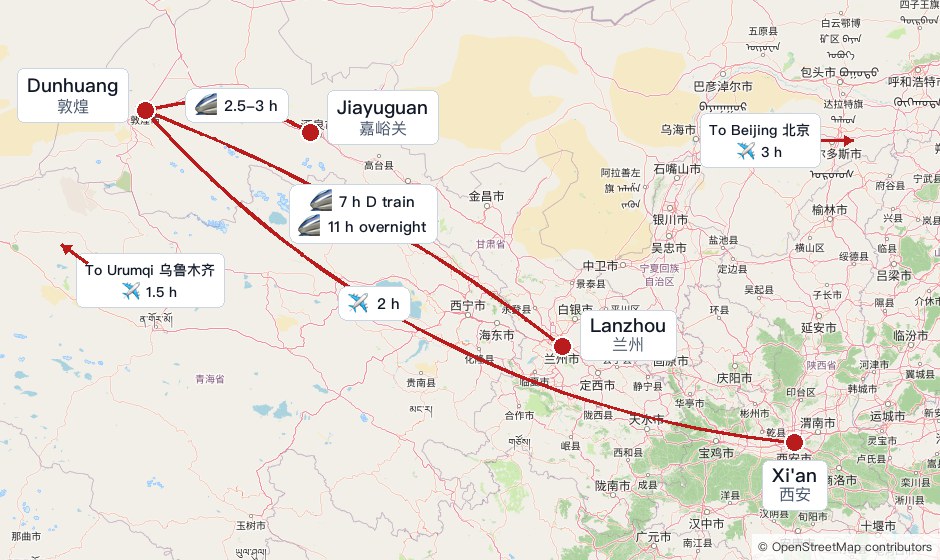
Reaching Dunhuang: flights into Dunhuang Mogao Airport from Urumqi, Xi'an, and Beijing, plus rail links along the Hexi Corridor from Jiayuguan and Lanzhou.
Common onward routes
| Route | Best option | Travel Time | Notes |
|---|---|---|---|
| Dunhuang -> Jiayuguan (嘉峪关) | Train | 2.5-3 hours | The great Ming dynasty (1368-1644) fort at the corridor’s end, an easy add-on east. |
| Dunhuang -> Lanzhou (兰州) | Train | About 7 hours by D train; about 11 hours overnight | The faster daytime train saves time, while the overnight train can preserve a sightseeing day and replace a hotel night. |
| Dunhuang -> Xi’an (西安) | Flight | ~2 hours | The Silk Road’s eastern anchor, with wide onward links. |
| Dunhuang -> Urumqi (乌鲁木齐) | Flight | ~1.5 hours | Onward into Xinjiang and the far west. |
| Dunhuang -> Beijing (北京) | Flight | ~3 hours | Seasonal direct flights from Dunhuang Mogao Airport. |
Getting around
The sights split into two groups. The town cluster, the Mogao Caves, the Mingsha dunes and Crescent Lake, and the night market, is close in and easy to reach by taxi or the local bus. The desert sights, Yangguan, Yumen, the Yardang badlands, and the Western Thousand Buddha Caves, are strung along a long loop of empty road to the west, so most people cover them by chartered car or a day tour rather than public transport. A common plan is one day for Mogao and the dunes near town, and one long day for the west line.
Key Attractions
Dunhuang has two faces. Close to town sit its greatest sights, the Mogao grottoes just southeast, the Mingsha dunes and Crescent Lake just south, and the night market in the center, and these fill the map zoom. The wider region holds the historic passes and badlands to the west, plus the quieter Yulin Caves to the east in Guazhou. The numbered map covers all eight sights; the orange Yulin marker represents a separate full-day trip.

1. Mogao Caves (莫高窟)
Getting there: Take a taxi, local bus, tour transfer, or rental car to the Mogao Caves Digital Exhibition Center (莫高窟数字展示中心). After check-in and the films, a scenic-area shuttle continues to the caves. Do not drive directly to the cave area, which has no public ticket office or parking.
Admission: the regular full-price ticket costs CNY238 in peak season (April 1 to November 30) and includes the digital presentation plus eight physical caves; from December 1 to March 31, the regular full-price ticket is CNY140 and includes the digital presentation plus ten physical caves. The separately listed emergency visit covers four physical caves and costs CNY100 at full price. Most short-term foreign visitors should budget for the full price, since the published concession policy is framed around Chinese citizens and holders of specified Chinese documents. Official website | Book tickets on Trip.com.
Time needed: Half a day
The Mogao Caves, the “Caves of a Thousand Buddhas,” are the reason many people come to Dunhuang and among the greatest cultural sites on earth. Cut into a cliff above a desert stream, some 500 surviving grottoes hold a thousand years of Buddhist mural painting and sculpture, from the fourth century onward, their walls covered in flying apsaras, jataka tales, and serene Buddhas in colors still vivid after fifteen centuries. A visit starts at the digital center with two immersive films that set the context and protect the fragile caves, then a shuttle carries you to the cliff for a guided walk through a rotating handful of the caves themselves. It is unforgettable, and it is strictly managed to preserve what remains.
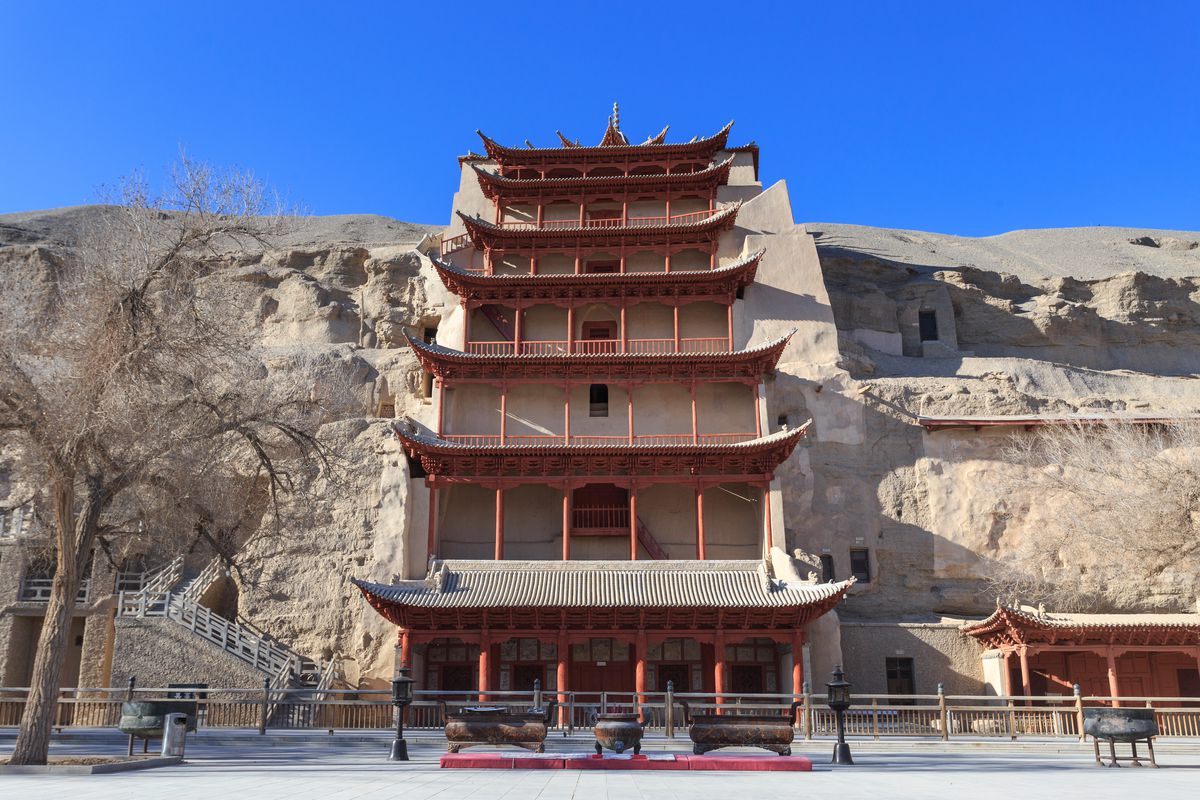
Photo: Zhangzhugang, CC BY-SA 4.0, via Wikimedia Commons
What to see
- The painted grottoes
A rotating selection of about eight caves on the standard tour, spanning many dynasties of mural and statue art. - The digital center films
Two high-resolution films, one panoramic dome show, that reveal caves and details the walking tour cannot include. - The nine-storey pagoda (九层楼)
The landmark timber tower on the cliff, sheltering a giant seated Buddha, and the symbol of Mogao.
Caution
book through the official Mogao Caves reservation website using a real-name document; the Dunhuang Academy lists online reservation service hours as 07:00 to 22:00. Capacity is controlled, especially in peak season, so reserve before reaching Dunhuang rather than relying on the cave-site entrance. Start at the Mogao Caves Digital Exhibition Center, not at the protected cave area, which has no ticket office. Photography is not allowed inside the caves. If regular admission is unavailable, the emergency visit still enters four physical caves, but it omits the digital presentation and provides a substantially shorter visit.
2. Crescent Lake & Mingsha Dunes (月牙泉鸣沙山)
Getting there: 5 km south of town, by bus 3, taxi, or bike
Admission: CNY110 in peak season (May to October) and CNY55 off-season, and the ticket stays valid for 3 days so you can return for both sunrise and sunset; inside, the electric cart is CNY10 each way and a camel ride runs about CNY100
Time needed: Half a day, best in late afternoon
Just beyond the southern edge of town the Mingsha Shan, the “Singing Sand Mountains,” rise in great smooth ridges of pale sand, and in a hollow among them lies Crescent Lake, a slender curved pool of spring water that has somehow survived among the dunes for centuries. It is the classic image of Dunhuang: the crescent of blue water and its little temple pavilion, framed by towering golden dunes. You can climb the dunes on a wooden stair ladder, slide back down, ride a camel in a long caravan train, and watch the sand glow at sunset. On a windy day the dunes really do hum, the “singing” that gives them their name.
What to see
- Crescent Lake (月牙泉)
The crescent-shaped spring and its restored pavilions, ringed by reeds in the base of the dunes. - Climbing the dunes
The stair ladders up the ridge for the classic view down over the lake, unbeatable near sunset. - Camel caravans
The long lines of camels that carry visitors over the sand, an easy taste of the old Silk Road.
Caution
Go in the late afternoon for cooler sand and the best light, and bring the bright orange shoe covers sold at the gate to keep sand out. Summer midday heat on the dunes is fierce, so carry water and sun cover.
3. Shazhou Night Market (沙州夜市)
Getting there: In the center of town, off Yangguan Road
Admission: Free
Time needed: An evening
The Shazhou night market is where Dunhuang comes alive after dark, a warren of lanes near the town center strung with lanterns and thick with the smoke of grills. It is part food court, part bazaar: rows of stalls sell lamb skewers, hand-pulled noodles, and stuffed flatbreads, while others push dried apricots, Hami melon, jade trinkets, and Dunhuang-themed souvenirs. There is usually a tea-house corner with local music. It is touristy and you should bargain for goods, but it is a fun, tasty way to spend the evening after the dunes.
What to see
- The food lanes
Skewers, donkey-meat noodles, roast lamb, and cold apricot-pit juice at open-air stalls. - The souvenir stalls
Dried fruit, melons, nightlights shaped like the grottoes, and Silk Road curios to browse. - The tea houses
Corners for a pot of tea and a rest, sometimes with live local music.
Caution
Prices for goods are aimed at visitors, so haggle and expect to pay less than the first ask. Stick to busy, freshly cooked stalls for food, and check the bill before you order pricier dishes like seafood.
4. Yangguan Pass (阳关)
Getting there: About 70 km southwest of town, on the west-line loop
Admission: about CNY50 plus a CNY10 shuttle
Time needed: 1 hour
Yangguan, the “Sun Pass,” was one of the two great western gateways of Han dynasty (202 BCE-220 CE) China, the southern door to the Silk Road routes toward the deserts and oases beyond. Only one substantial ancient structure remains: a solitary Han dynasty (202 BCE-220 CE) beacon tower on a gravel ridge. There is not a large surviving fort to explore, but this sparse ruin is itself more than 2,000 years old. The name carries huge weight in Chinese culture thanks to a famous Tang dynasty (618-907) farewell poem set here at the edge of the known world. A modern museum and reconstructed gate area explain the frontier history, while the beacon remains the site’s authentic ancient core.
What to see
- The Han dynasty (202 BCE-220 CE) beacon tower
The surviving watchtower on its ridge, the genuine relic of the old pass, above the gravel desert. - The Yangguan museum
Exhibits on the Silk Road frontier, Han dynasty (202 BCE-220 CE) garrison life, and the poetry that made the pass famous. - The desert view
The wide, stony expanse west of the pass, the threshold of the ancient routes onward.
Caution
Pair Yangguan with Yumen Pass and the Yardang Geopark for a long full-day western loop. For a shorter day trip, combine it with the Western Thousand Buddha Caves instead. Start early and carry food and water because services are limited. Shade is scarce, so bring sun protection.
5. Yumen Pass (玉门关)
Getting there: About 90 km northwest of town, on the west-line loop
Admission: about CNY40, with a CNY50 shuttle that also covers the nearby Han dynasty Great Wall rampart and the Hecang granary ruins
Time needed: 1 to 2 hours
Yumen, the “Jade Gate,” was the northern of the two Han dynasty (202 BCE-220 CE) passes, named for the jade that came east along this route from Khotan. What survives is the “Small Square Fort,” a lone rammed-earth blockhouse standing square and stark on the gravel plain, one of the most evocative ruins on the whole Silk Road. The same ticket reaches two nearby relics: a long, crumbling stretch of Han dynasty (202 BCE-220 CE) Great Wall built of reeds and clay, and the Hecang granary, a ruined supply depot that once fed the frontier garrisons. The familiar restored Great Wall sections visited from Beijing are predominantly Ming dynasty (1368-1644), while the frontier wall at Yumen dates to the Western Han dynasty (202 BCE-9 CE), roughly fifteen centuries earlier. Out here the scale of the empty desert, and of the effort to hold this frontier, really lands.
The three principal remains are widely separated. You enter beside Small Fangpan Castle, where the internal sightseeing shuttle starts. It continues to the Han Great Wall and Hecang City, then returns to Small Fangpan. Use the shuttle rather than trying to walk between the sites.

The internal shuttle starts and ends at Small Fangpan Castle, beside the scenic-area entrance.
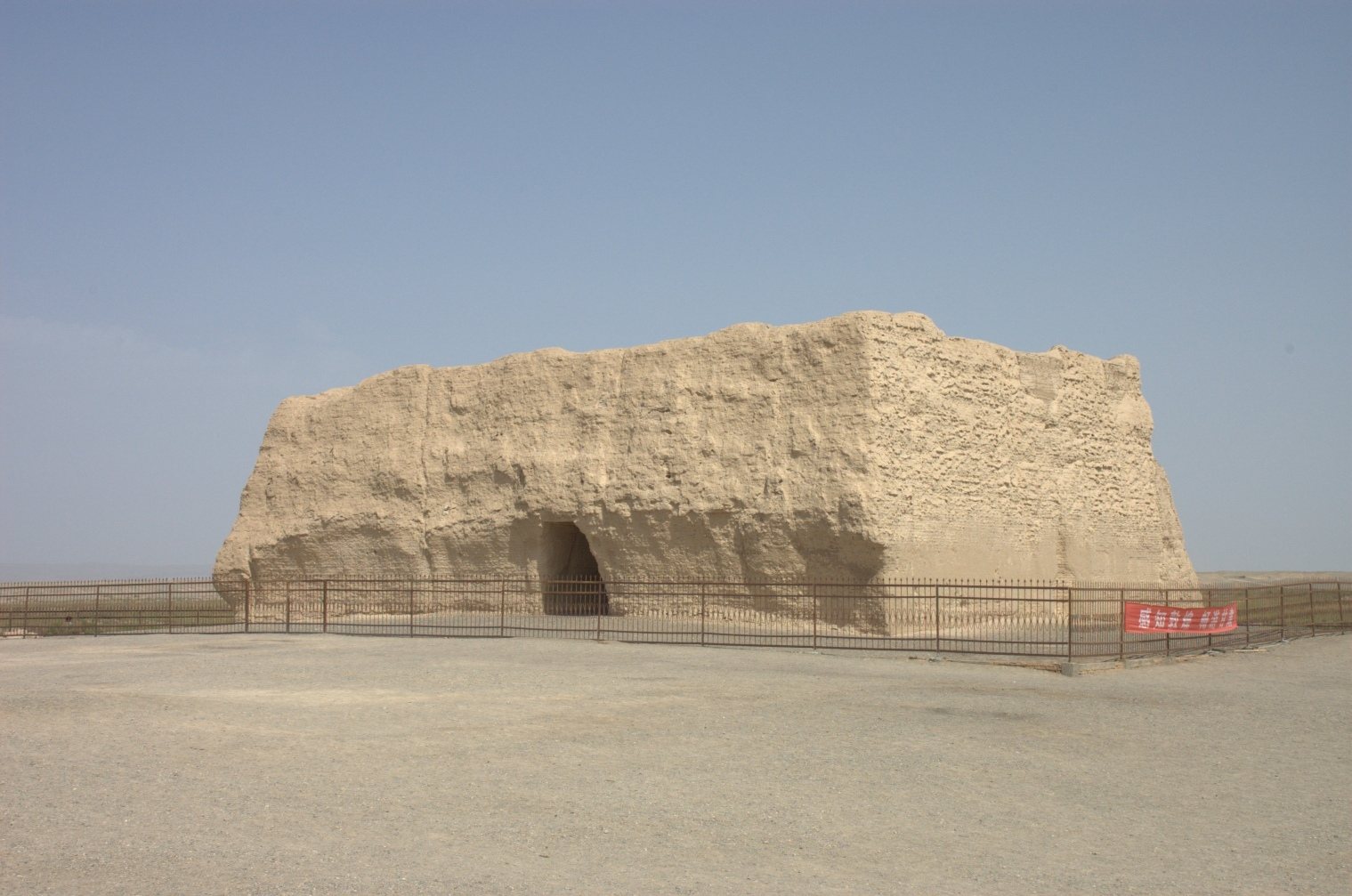
What to see
- Small Fangpan Castle (小方盘城)
The surviving Yumen Pass itself. It served as the Yumen commandant’s headquarters in the Western Han dynasty (202 BCE-9 CE) and the commandant’s administrative seat in the Eastern Han dynasty (25-220 CE). Travelers presented their passage documents here and completed the frontier formalities before continuing west. - Han Great Wall (汉长城)
The western frontier line built during the Western Han dynasty (202 BCE-9 CE). Its reed-and-gravel walls linked beacon towers and small forts, combining military defence with protection and control of the Silk Road corridor. - Hecang City · Big Fangpan Castle (河仓城·大方盘城)
A large military granary and storage complex set beside the historic Shule River corridor. Its concealed position, ventilated chambers, and surrounding beacon system protected the grain and supplies needed by frontier garrisons.
Caution
The three sites are too far apart to cover comfortably on foot. Board the internal shuttle at Small Fangpan Castle and stay with the circuit until it returns there. It is far from town with no food out here, so bring your own and plenty of water.
6. Yardang Geopark (雅丹地质公园)
Getting there: About 180 km northwest of town, beyond Yumen Pass
Admission: about CNY50 admission plus a compulsory CNY70 tour bus, since the wind-carved ridges are spread across a wide loop road; it sits roughly 100 km beyond Yumen Pass, so most people combine the two on one long west-line day
Time needed: 2 to 3 hours
Beyond Yumen Pass the desert turns strange. The Yardang National Geopark, nicknamed the “Devil City,” is a vast field of wind-carved earthen ridges, sculpted by centuries of fierce Gobi wind into shapes that people have named the fleet, the peacock, the sphinx, and more. A tour bus loops between the main formations, with stops to walk out among them, and the place is at its eeriest and most beautiful in the low light of early morning or late afternoon, when the ridges throw long shadows and the wind moans between them. It is the farthest point on the west line and the reason the loop runs so long.
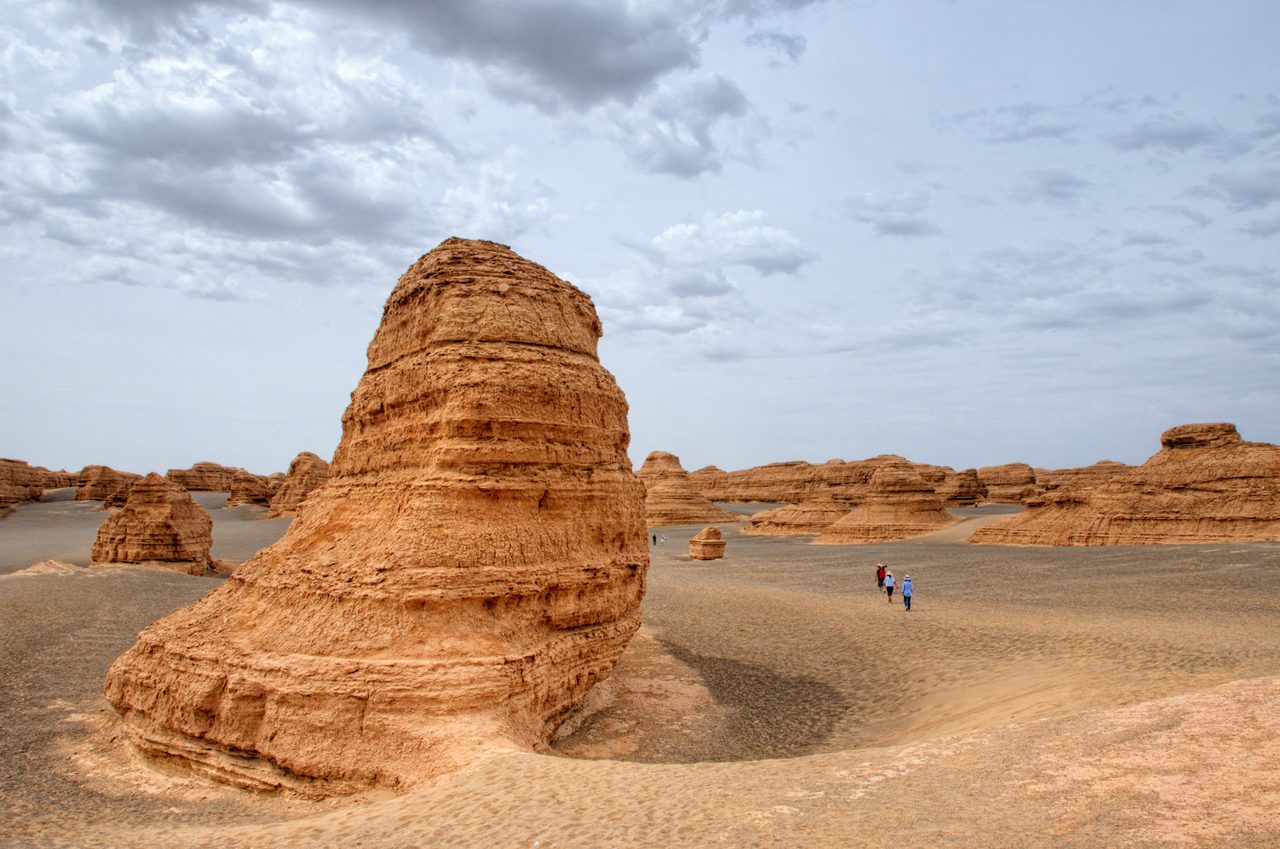
Photo: lwtt93, CC BY 2.0, via Wikimedia Commons
What to see
- The named formations
The signature ridges, the ship fleet, the peacock, and others, that the loop road links. - The Devil City atmosphere
The howling wind and eerie shapes that earned the badlands their nickname, best at dawn or dusk. - The desert light
The long shadows and warm color over the ridges in early and late hours, prime for photographs.
Caution
It is very far out, so it makes for a long day and is usually done on a chartered car or tour that also covers the passes. Wind and sun are relentless; bring layers, water, and eye protection against blowing grit.
7. Western Thousand Buddha Caves (西千佛洞)
Getting there: About 35 km west of town, on the Dang River
Admission: about CNY30
Time needed: 1 to 2 hours
The Western Thousand Buddha Caves are Mogao’s quieter little sister, a smaller set of grottoes cut into a cliff above the Dang River west of town. They hold Buddhist murals and statues of the same tradition, some dating back to the Northern Wei dynasty (386-534), and while there are far fewer of them the setting is lovely and the crowds are thin. For travelers who cannot get a Mogao ticket, or who simply want more cave art in a calmer place, they make a rewarding stop, often folded into the start of a west-line day.
What to see
- The riverside grottoes
A compact set of painted caves in the cliff above the green ribbon of the Dang River. - Early murals
Wall paintings and sculpture from the Northern Wei dynasty (386-534) onward, kin to those at Mogao. - The quiet setting
A peaceful, uncrowded alternative to the big site, in a pretty river oasis.
Caution
Opening caves can be limited and depend on a guide, so it can be worth pairing with the passes rather than a trip on its own. As at Mogao, photography inside is not allowed.
8. Yulin Caves (榆林窟)
Getting there: About 170 km east of Dunhuang in a gorge south of Guazhou. Most visitors drive a rental car, hire a chartered car, or join an organized day tour.
Admission: CNY55 for foreign visitors, including a CNY15 foreign-language guiding fee. Official website.
Time needed: Allow most of a day from Dunhuang, including the road journey
Yulin is Mogao’s quieter sister site, with painted caves cut into opposing cliffs above the tree-lined Yulin River. Its art belongs to the same wider Dunhuang tradition, but the atmosphere is more intimate and the visitor flow is much lighter. The surviving caves are especially strong for Tang dynasty (618-907), Western Xia dynasty (1038-1227), and Yuan dynasty (1271-1368) murals. If Mogao’s regular tickets are unavailable, Yulin is the best serious alternative rather than a consolation stop, though it does not match Mogao’s scale.
What to see
- Tang dynasty (618-907) and Western Xia dynasty (1038-1227) murals
Exceptionally detailed Buddhist paintings that extend the story told at Mogao, with Western Xia dynasty (1038-1227) art a particular strength. - The gorge setting
Caves face each other across the narrow river valley, creating a calmer and more dramatic setting than Mogao’s broad cliff front. - Representative caves
Selected major caves may be available separately in addition to the ordinary guided visit; ask at the ticket office after arrival.
Caution
Yulin is far from Dunhuang, so it is not a quick substitute to squeeze into a spare morning. Arrange transport in advance and treat it as a dedicated day trip, or visit while continuing east through Guazhou. Photography inside the caves is prohibited.
Suggested Itineraries
2 Days: The Essentials
Day 1: Mogao and the dunes
The Mogao Caves in the morning on your pre-booked ticket, a rest through the midday heat, then the Mingsha dunes and Crescent Lake in the late afternoon for sunset. Finish at the Shazhou night market for dinner.
Day 2: The west line
A long day by chartered car or tour out to Yangguan and Yumen passes, the Han dynasty (202 BCE-220 CE) Great Wall and Hecang granary, and the Yardang badlands, with the Western Thousand Buddha Caves on the way if time allows.
Adding a day
With a third day, make the full-day trip to the quieter Yulin Caves, or stay close to town for the dunes at sunrise, the Dunhuang Museum, and an evening show. The extra day also gives a buffer if the Mogao tickets you want fall on your second day rather than your first.
A Silk Road leg
Many travelers fold Dunhuang into a longer Hexi Corridor route, arriving from or continuing to Jiayuguan and Zhangye (with its rainbow Danxia hills) to the east, or into Xinjiang to the west.
Where to Stay
Most visitors stay in Dunhuang town, which is compact and has the full range of places to sleep, from luxury resorts and smart hotels to family guesthouses. Central properties are within easy reach of the night market and transport to the dunes, while the more secluded resorts trade some convenience for space, design, and quiet. Prices below are rough peak-season guides and drop sharply off-season; book well ahead for July and August.
Luxury
- Dongyi Dunhuang Hotels and Resorts (东驿敦煌酒店)
A polished desert-inspired resort close to the Mingsha dunes. Choose it for distinctive architecture, landscaped grounds, and a quieter stay without being too remote from town. - Jangala Dunhuang (敦煌碧玥酒店), an SLH hotel
A secluded 25-room member of Small Luxury Hotels of the World, near Dunhuang Ancient City. It suits travelers who value privacy and the hotel experience more than walking access to the night market. The property operates seasonally, so confirm that it is open for your dates before planning around it.
Midscale
- Four Points by Sheraton Dunhuang (敦煌福朋喜来登酒店)
A relatively new internationally branded option on the eastern side of the urban area, convenient for the road toward the airport, railway station, and Mogao Caves. Check its distance from the night market if evening walkability matters. - Domestic hotel chains
Dunhuang also has branches of familiar Chinese chains such as JI Hotel (全季酒店), Atour (亚朵酒店), Orange Hotel (桔子酒店), Hanting (汉庭酒店), and Vienna Hotel (维也纳酒店). They are useful for standardized rooms and predictable service, but compare the exact branch location because properties are spread between the center, the Mingsha area, and the eastern approach to town. - Town hotels
Comfortable hotels around the center and near the night market, the most convenient base. Often CNY350-800/night in the summer peak, much less off-season.
Budget
- Guesthouses and hostels
Simpler, cheaper rooms and family-run inns across town, many with a desert-tour desk. Often CNY120-350/night, higher in July and August.
Where to Eat
- Shazhou night market: The town’s main eating scene after dark, strong on grilled and noodle dishes.
- Local Gansu and Silk Road food: Lamb, hand-pulled noodles, and wheat dishes dominate, with Central Asian touches.
- Desert fruit: Dunhuang is famous for its apricots, grapes, and Hami melons in season, sold everywhere.
Dishes to Try
- Donkey-meat yellow noodles (驴肉黄面): Dunhuang’s signature dish, thin hand-pulled noodles with tender braised donkey meat.
- Lamb skewers (烤羊肉串): Cumin-dusted mutton grilled over charcoal, a night-market staple.
- Stuffed sackcloth flatbread (胡羊焖饼): Chewy torn flatbread stewed with lamb, hearty desert fare.
- Apricot-pit juice (杏皮水): A cold, tangy-sweet drink from local apricots, the perfect antidote to the dunes.
- Braised chicken with pippins (大盘鸡): The Xinjiang-style big-plate chicken with potatoes and noodles, common out west.
- Dried fruit and melons (瓜果): Apricots, raisins, dates, and Hami melon from the oasis farms, at their best in late summer.
Hero photo: N509FZ, CC BY-SA 4.0, via Wikimedia Commons.
Help keep this guide accurate
Found something incorrect, outdated, or missing? Tell us what changed and include a source when possible.
Suggest an update