
On this page13 sections
✓ Prices and practical details last verified July 27, 2026
Xi’an was the greatest city of ancient China, the capital of eleven dynasties and the eastern terminus of the Silk Road, where the Tang dynasty (618-907) drew merchants and monks from across Asia. That history is written into the ground: the buried army of the First Emperor east of the city, the intact Ming dynasty (1368-1644) walls that still ring the old center, and the great Tang dynasty (618-907) pagodas to the south. It is also a superb place to eat, with a Muslim Quarter shaped by centuries of Silk Road trade. Compact, walkable, and an easy fast-train ride from Beijing or Chengdu, Xi’an is on nearly every first China itinerary for good reason.
Highlights
- Stand before the buried ranks of the Terracotta Army (兵马俑), thousands of life-size warriors guarding the First Emperor’s tomb.
- Cycle the top of the intact Xi’an City Wall (西安城墙), the best-preserved city wall in China.
- Eat your way through the Muslim Quarter (回民街), a Silk Road food street of skewers, breads, and sweets.
- Climb the Tang dynasty (618-907) Big Wild Goose Pagoda (大雁塔) and see the treasures of the Shaanxi History Museum (陕西历史博物馆).
- Take on the vertiginous trails of Mount Hua (华山), one of China’s five sacred peaks.
Transportation
Getting there
Xi’an Xianyang International Airport (西安咸阳国际机场 / XIY) is a major hub northwest of the city. Check current direct routes on FlightConnections. Xianyang International Airport (XIY) is northwest of the city; the airport metro (the Airport Intercity line) and airport buses reach the center in around an hour, and a taxi is roughly CNY100 to 130. Xi’an is also a central node on the high-speed rail network, well connected in every direction.
Railway stations
Xi’an Bei (西安北站) is the huge high-speed hub north of the city and the main arrival point for fast trains from Beijing, Chengdu, Luoyang, and beyond. The older Xi’an Railway Station (西安站), just outside the north wall, handles conventional services and is closer to the center. Check which one your ticket uses, since Xi’an Bei is well out of town and linked by metro.
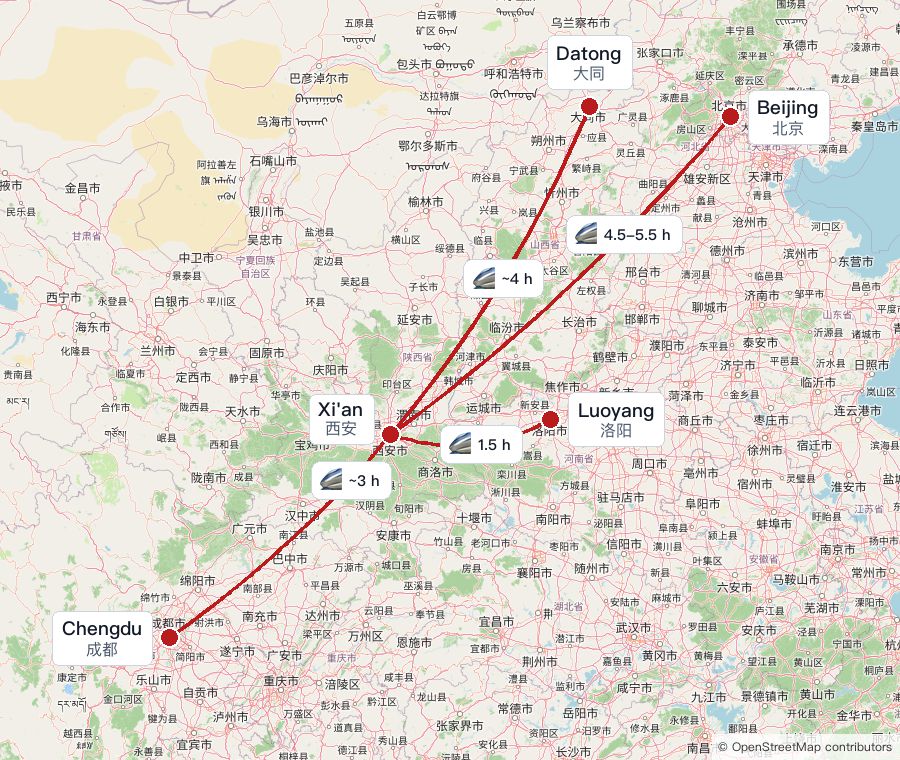
High-speed rail times from Xi'an to Luoyang, Chengdu, Datong, and Beijing. Most fast trains leave from Xi'an Bei.
Common onward routes
| Route | Best option | Travel Time | Notes |
|---|---|---|---|
| Xi’an (西安) -> Luoyang (洛阳) | High-speed train | 1.5 hours | East to the Longmen Grottoes and Shaolin, covered in our Luoyang guide. |
| Xi’an (西安) -> Chengdu (成都) | High-speed train | ~3 hours | South through the mountains to Sichuan. |
| Xi’an (西安) -> Datong (大同) | High-speed train | ~4 hours | North to the Yungang Grottoes in Shanxi. |
| Xi’an (西安) -> Beijing (北京) | High-speed train | 4.5-5.5 hours | A long but comfortable ride; flying is an alternative. |
Getting around
The metro covers the city sights well and reaches Xi’an Bei station and the airport; fares are CNY2 to start, rising with distance; most city trips cost CNY2 to 6, paid with a transport QR code in Alipay or WeChat. The walled center is compact and walkable, and cycling the wall itself is a highlight. For the Terracotta Army, a dedicated tourist bus runs from near the train station; for Mount Hua, take the high-speed train to Huashan Bei and a shuttle to the base.
Key Attractions
Xi’an’s sights split into the walled old city and a set of outliers. The city wall rings the center, with the Bell and Drum Towers and the Muslim Quarter inside it, and the Big Wild Goose Pagoda and Shaanxi History Museum a short ride south; these fill the map zoom. The two big excursions are east of the city: the Terracotta Army and, further out, the sacred peak of Mount Hua. The numbers on the map match the sections below; click a numbered dot to jump to it.
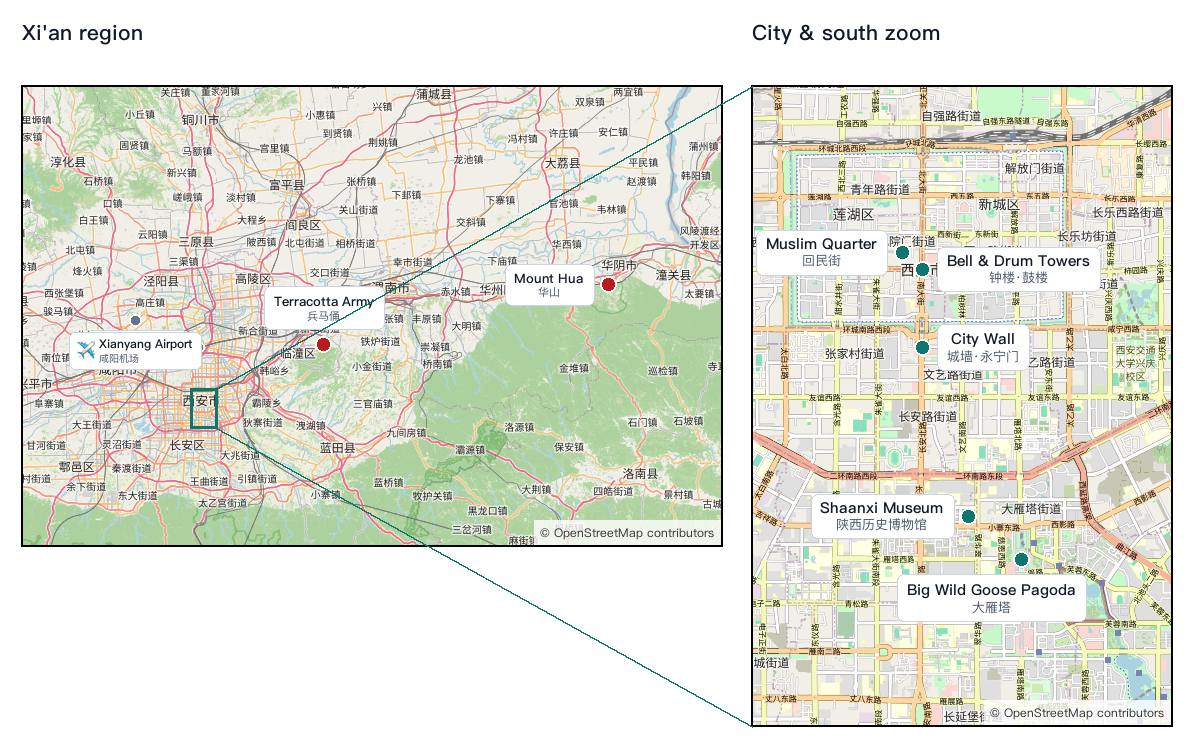
1. Terracotta Army (兵马俑)
Getting there: Metro Line 9 to Huaqingchi (华清池), then Bus 613 or a taxi to the museum. To visit Lishan Garden first, stay on Line 9 to Qinling West (秦陵西) and take a taxi to the Lishan Garden entrance.
Admission: CNY120 for adults; the same price applies in peak and low seasons
Opening hours: ticket checks run 08:30-17:00 from March 16 to November 15 and 08:30-16:30 from November 16 to March 15; major-holiday hours may change
Booking: advance real-name reservation is required for every visitor, including foreign and free-admission visitors; bring the original passport used for the reservation. Book through the official website or the museum’s official WeChat accounts 秦始皇帝陵博物院 or 兵马俑票务在线.
Time needed: Half a day
The Terracotta Army is one of the great archaeological finds of all time: an army of thousands of life-size clay soldiers, horses, and chariots buried in 210 BCE to guard the tomb of Qin Shi Huang, China’s First Emperor, and rediscovered by well-diggers in 1974. Every figure is individual, down to the faces and armor, and standing before the ranks in the vast hangar of Pit 1 is genuinely awe-inspiring. It is the single reason many people come to Xi’an, and it lives up to the billing.
The ticket covers both the Terracotta Army Museum and the Qin Shi Huang Mausoleum Archaeological Site Park at Lishan Garden, with a free shuttle bus between them.

Green marks the free shuttle between the two parks. Purple follows paid battery cart route inside the Terracotta Army park, red marks the paid loop inside Lishan Garden, and gray dashes are walking connections. Numbers identify the principal stops.
A practical visiting order
To avoid the largest morning tour groups, consider visiting Lishan Garden (丽山园) before the Terracotta Army pits. Its paid electric cart follows the perimeter roads past the access points for the K9901 Acrobatic Figures Pit (百戏俑坑), K0006 Civil Official Figures Pit (文官俑坑), and Bronze Chariot Museum (铜车马博物馆). On the return leg it crosses in front of the palace-hall ruins, before returning to the visitor center. It does not drive across the Qin Shi Huang tomb mound. The mound and the burial-pit area inside the loop are reached on foot. The park is extensive, so the cart is useful if you want to conserve energy.
After Lishan Garden, take the included shuttle to the Terracotta Army Museum. The paid cart inside this park runs from its boarding point near the visitor center to the eastern drop-off. It is optional and generally unnecessary, since this section is easy to walk. Follow the gray walking connection to Pit 1, then continue through Pit 1 → Pit 3 → Pit 2 → the exhibition hall. This keeps the route straightforward while placing the most famous army formation at the start of the pits section.
What to see
- Pit 1
The largest and most famous pit, with the long marching columns of infantry under a huge covered hall. - Pits 2 and 3
Smaller pits with cavalry, archers, and the command post, plus better-preserved individual figures. - Lishan Garden and the bronze chariots
The emperor’s tomb mound, specialist burial pits, and two exquisite half-size bronze chariots displayed in their own museum.
Food nearby
The long commercial street near the museum exit has plenty of quick meals. Wei Jia Liangpi (魏家凉皮) and Weasley Burger (魏斯理汉堡) are convenient Chinese and Western fast-food options.
Caution
It is far out and extremely popular. Arrive at opening or visit Lishan Garden first and enter the pits closer to midday. Avoid unofficial guides and fake “museums” around the entrance; use the official guide desk inside the site or an audio guide. A guide adds a lot, since the figures need context to appreciate.
2. Xi’an City Wall (西安城墙)
Getting there: Rings the old city; the South Gate (永宁门) is the main access point
Admission: CNY54 (around CNY27 concession); you can rent a bike to ride the 14 km circuit on top
Time needed: 2 to 3 hours
Xi’an has the most complete ancient city wall in China, a massive Ming dynasty (1368-1644) rampart 14 kilometres around, wide enough to drive on, with gates, watchtowers, and a moat. You can walk it, but the classic thing is to rent a bike at the South Gate and ride the full circuit on top, looking down into the old city on one side and the modern city on the other. It is floodlit and especially atmospheric in the evening.

The wall forms a complete loop around the old city. Teal marks the four principal gates; orange marks the Bell Tower, Drum Tower, and Muslim Quarter.
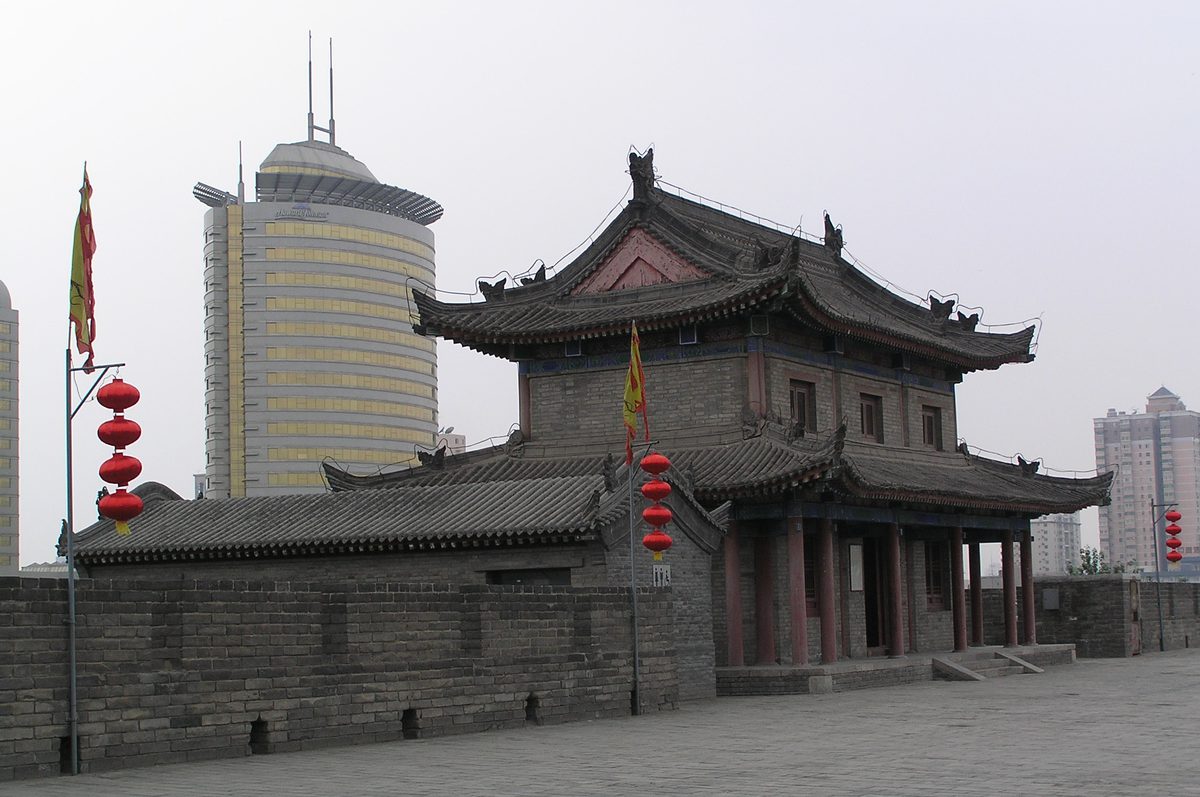
Photo: Mr. Tickle, CC BY-SA 3.0, via Wikimedia Commons
What to see
- The full wall circuit by bike
The 14 km loop on top of the wall, rentable bikes at the main gates, about 1.5 to 2 hours at a relaxed pace. - The South Gate (永宁门)
The grandest and most restored gate, with ceremonial performances and the main ticket office. - The wall at night
Lit gates and towers make an evening walk or ride along a stretch of the wall a highlight.
Caution
The wall surface is uneven brick, so ride carefully, and rental bikes are timed, giving you about two hours to complete the loop. It can be windy and exposed on top, so dress accordingly.
3. Bell Tower & Drum Tower (钟楼)
Getting there: At the very center of the walled city; Metro Lines 1 and 2 meet at Bell Tower
Admission: the Bell Tower and Drum Tower are around CNY30 each, or a little less for a combined ticket; the surrounding square and Muslim Quarter are free to wander
Time needed: 1 to 1.5 hours
The Bell Tower and Drum Tower stand at the heart of the old city, a pair of grand Ming dynasty (1368-1644) towers that once sounded the hours and marked the center of Xi’an. The Bell Tower sits on a roundabout at the exact middle of the walled city, and the Drum Tower a short walk northwest marks the entrance to the Muslim Quarter. Both can be climbed for close-up views of their timber architecture and the streets below, and both are floodlit at night.
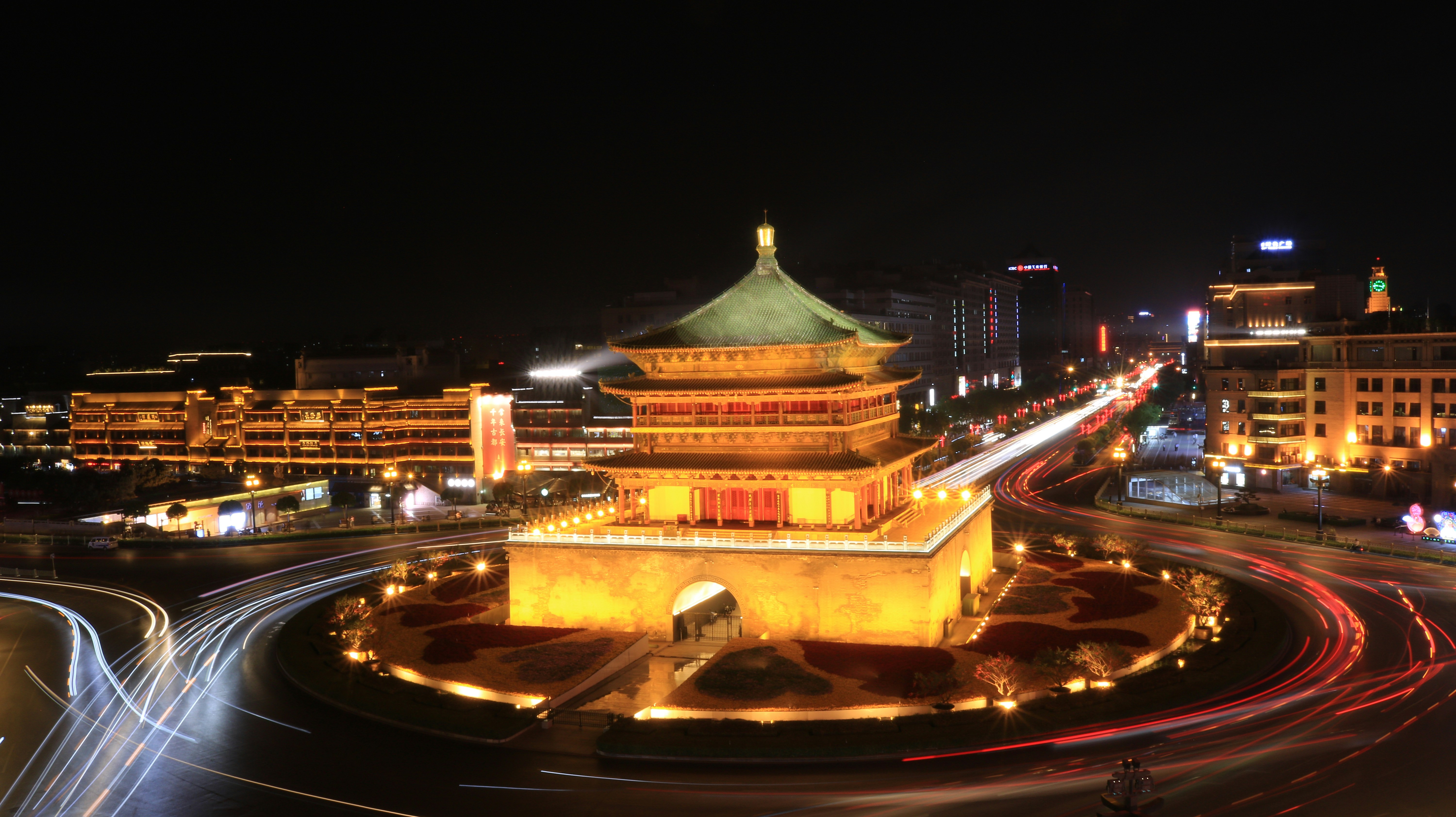
Photo: XingYu Xian, Unsplash
What to see
- The Bell Tower (钟楼)
The larger tower at the city’s central crossroads, with a great bronze bell and city views from the balcony. - The Drum Tower (鼓楼)
Its companion to the northwest, housing a collection of drums, at the edge of the Muslim Quarter. - The towers at night
Both are dramatically lit after dark, best seen from the square between them.
Caution
The Bell Tower sits on a busy traffic roundabout reached by an underground passage, not across the road directly. The interiors are small, so the main value is the architecture and the view rather than extensive exhibits.
4. Muslim Quarter (回民街)
Getting there: Behind the Drum Tower, in the northwest of the walled city
Admission: Free
Time needed: An evening
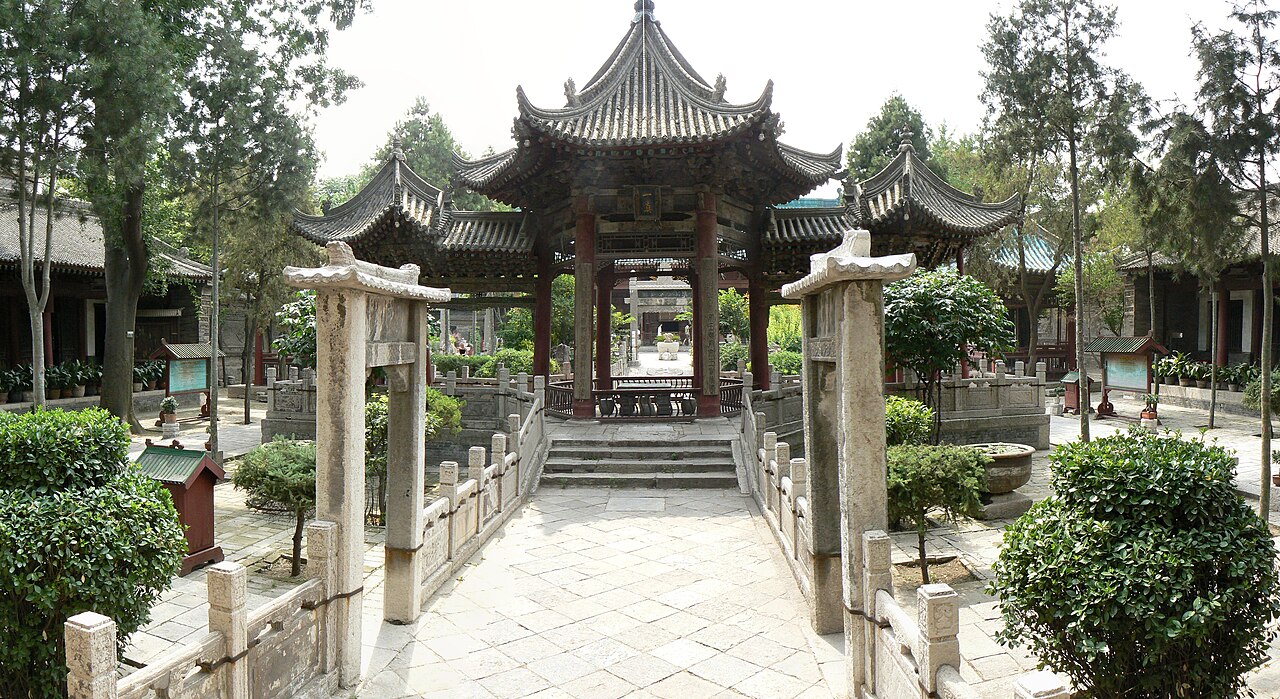
The Muslim Quarter is the historic neighborhood of Xi’an’s Hui community, whose roots go back to Silk Road traders, and today it is the city’s best-known food street. The lanes around Beiyuanmen are packed with stalls and shops selling lamb skewers, flatbreads, hand-pulled noodles, dried fruit, and sweets, thick with smoke and crowds in the evening. Beyond the food, the Great Mosque hidden in the lanes is one of the oldest and largest in China, built in a Chinese temple style.
What to see
- Beiyuanmen food street (北院门)
The main lane is lively after dark but heavily commercialized. Use it as an introduction, then explore the surrounding alleys for a more interesting view of the neighborhood. - The Great Mosque (大清真寺)
A serene, Chinese-style mosque of courtyards and pavilions tucked in the lanes, over a thousand years old. - Capital City God Temple (都城隍庙)
A Ming dynasty (1368-1644) Daoist temple on West Street that once oversaw City God temples across northwest China. It is a quieter cultural stop near the southern edge of the quarter. - The side lanes
Quieter alleys off the main street with more local food and fewer crowds.
Caution
It is intensely crowded and touristy in the evenings, and quality varies stall to stall; follow the busy local-looking places. Prices are higher than elsewhere in the city, and some vendors round up, so watch your change.
5. Big Wild Goose Pagoda (大雁塔)
Getting there: In the south of the city; Metro Line 3 or 4 to Dayanta Station (大雁塔站), exit B or C, about 5 minutes’ walk to the pagoda
Admission: Da Ci'en Temple (大慈恩寺) costs CNY10 (student CNY5); climbing the pagoda costs an additional CNY25 (on-site only); the North Square fountain show outside is free. Book the temple ticket via the WeChat mini program '大慈恩寺'.
Time needed: 1.5 to 2 hours
The Big Wild Goose Pagoda is a 7th-century brick pagoda built to house Buddhist scriptures brought back from India by the monk Xuanzang, whose journey inspired the novel Journey to the West. It stands inside the Da Ci’en Temple in the south of the city and can be climbed for views over the modern district around it. The large square to the north stages a popular music-and-fountain show in the evenings, free to watch.
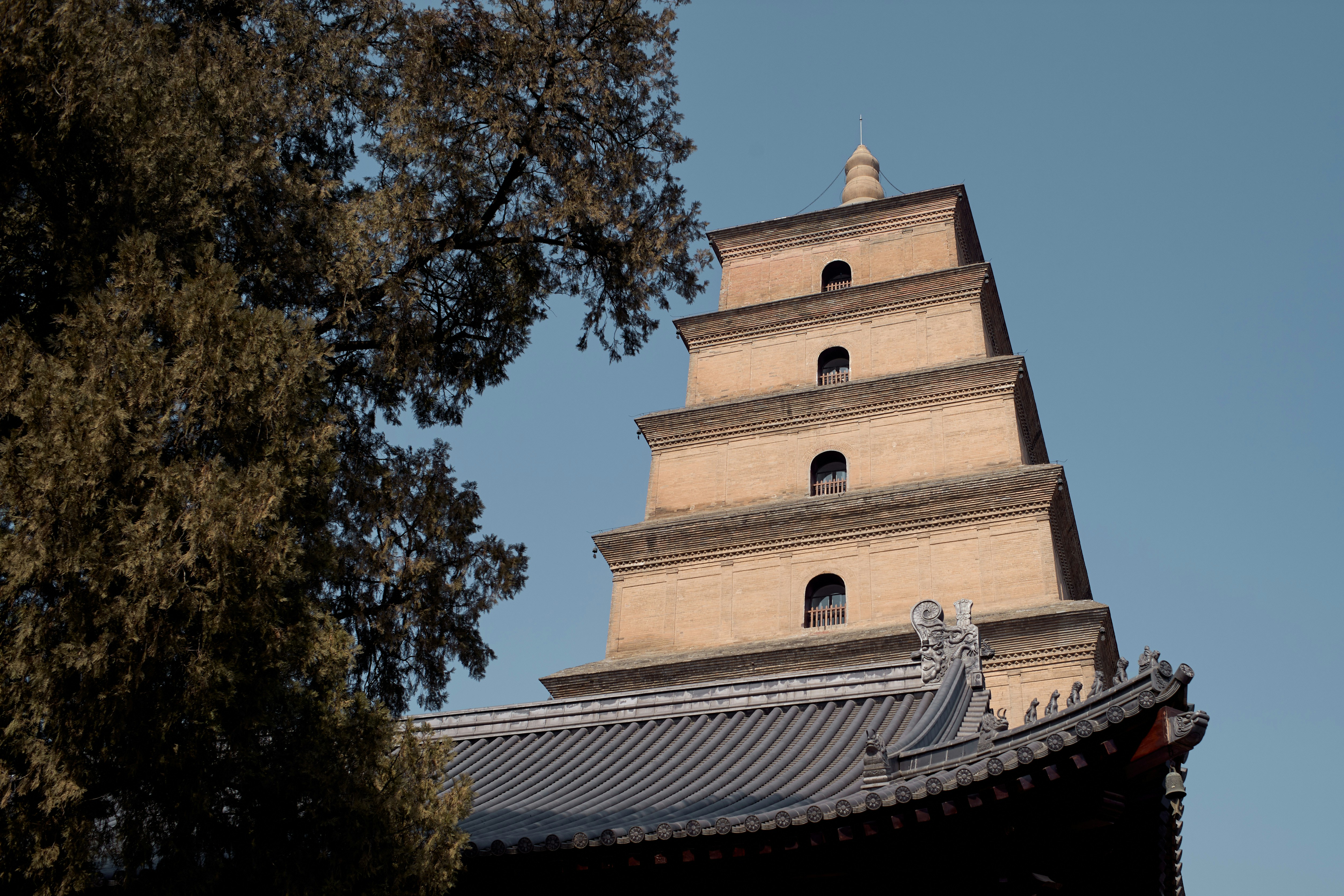
Photo: Noah Zhao, Unsplash
What to see
- The pagoda and Da Ci’en Temple
The tall Tang dynasty (618-907) brick pagoda in its temple grounds, climbable for a rooftop view. - The North Square fountain show
A large music-and-water show in the plaza north of the pagoda, staged on a schedule in the evening. - The Xuanzang connection
Statues and displays on the monk whose scriptures the pagoda was built to hold.
Caution
Climbing the pagoda is a separate ticket on top of the temple entry, and the stairs are steep and narrow. The fountain show draws big crowds, so arrive early for a spot near the front.
6. Shaanxi History Museum (陕西历史博物馆)
Getting there: Metro Line 2 or 3 to Xiaozhai Station (小寨站), about 10 minutes’ walk east; also a short walk from the Big Wild Goose Pagoda
Admission: Basic exhibition: free (must reserve via the '陕西历史博物馆' WeChat public account, tickets released at 17:00 daily up to 5 days ahead). Paid: Treasure Gallery (大唐遗宝展) CNY30; Tang Murals Gallery (唐代壁画珍品馆) CNY270 (includes Treasure Gallery). Book the basic free ticket first, then pay for special galleries on-site.
Time needed: 2 to 3 hours (half a day if adding special galleries)
The Shaanxi History Museum is one of the best museums in China, a vast collection tracing the region’s history through the Zhou dynasty (c. 1046-256 BCE), Qin dynasty (221-206 BCE), Han dynasty (202 BCE-220 CE), and Tang dynasty (618-907), when this was the center of the Chinese world. Bronzes, gold and silver, Tang dynasty (618-907) murals, and Silk Road objects fill the halls, and it gives essential context for everything else you see in Xi’an. The basic exhibition is free but tightly rationed, so plan ahead.
Ticket tiers
- Basic exhibition (基本陈列馆) — Free but must reserve in advance. Covers the main galleries (Halls 1–3) from prehistory through the Tang dynasty (618-907), where most of the famous pieces live.
- Treasure Gallery / Hejiacun Exhibition (大唐遗宝展) — CNY30. Hall 4 displays the Hejiacun hoard of Tang dynasty (618-907) gold, silver, and gems, including the iconic agate cup. Buying this ticket also lets you into the basic exhibition — a good backup if free tickets sell out.
- Tang Murals Gallery (唐代壁画珍品馆) — CNY270 (includes the Treasure Gallery). A climate-controlled gallery of original tomb murals from Tang dynasty (618-907) royalty. Limited to 300 tickets per day.
What to see
The basic exhibition follows a chronological path through Chinese civilisation, from its prehistoric origins to the cosmopolitan peak of the Tang dynasty (618-907).
- Prehistory and Zhou dynasty (c. 1046-256 BCE) — Neolithic pottery and jade, followed by the ritual bronzes of the Zhou dynasty (c. 1046-256 BCE) — monumental ding tripods and bell sets that defined Chinese bronze casting for centuries.
- Qin dynasty (221-206 BCE) — Weapons, roof tiles, and architectural elements from the First Emperor’s palace complex, giving context to the Terracotta Army you visited east of the city.
- Han dynasty (202 BCE-220 CE) — The opening of the Silk Road is the story here: silk fragments, foreign-influenced glass and gold, and the earliest evidence of cultural exchange with Central Asia.
- Tang dynasty (618-907) — The grand finale. Tang dynasty (618-907) tri-colour glazed pottery (唐三彩), silver vessels, Buddhist sculptures, and mirrors — objects that reflect Chang’an (modern Xi’an) as the most cosmopolitan city on earth.
- Treasure Gallery (Hall 4, paid) — The Hejiacun hoard: over a thousand pieces of Tang dynasty (618-907) gold and silver, including the national-treasure agate cup in the shape of a beast’s head and the intricate lotus-pattern gold bowl. This is the museum’s single greatest room.
- Tang Murals Gallery (paid) — Original murals lifted from Tang dynasty (618-907) royal and aristocratic tombs, including the famous 阙楼图 (Gate Tower) and 客使图 (Envoys). Climate-controlled and limited to 300 daily visitors.
Booking
The official WeChat public account “陕西历史博物馆” (or its mini program “陕西历史博物馆票务系统”) is the only booking channel. Tickets are released at 17:00 daily, up to 5 days ahead. Create an account and pre-fill visitor details before the release time. Each ID can book one ticket per day; each account can book up to five per day.
Caution
Free tickets vanish within minutes of release, so be ready at 17:00 sharp. If you miss them, the CNY30 Treasure Gallery ticket is a reliable fallback that includes the basic exhibition. The museum is large and popular; allow extra time and expect queues at peak hours. It is closed on Mondays (except public holidays).
7. Mount Hua (华山)
Getting there: High-speed train from Xi’an Bei to Huashan Bei (华山北站), about 30 minutes, then a free shuttle or taxi to the visitor centre
Admission: Peak season (Mar–Nov): CNY160 (concession CNY80); low season (Dec–Feb): CNY100 (concession CNY50). North Peak cable car single CNY80 peak / CNY45 low; West Peak cable car single CNY140 peak / CNY120 low. Shuttle bus: north line CNY20, west line CNY40. Book via '华山旅游服务平台' WeChat official account.
Time needed: A full day (start early)
Mount Hua is the Western Great Mountain of China’s five sacred peaks, a cluster of sheer granite summits famous for the drama and difficulty of its climbs. Cable cars now reach the North and West Peaks, but the mountain keeps its reputation for hair-raising routes, including the notorious plank walk bolted to a vertical cliff. Between the summits are temples, teahouses, and some of the most spectacular high scenery near any Chinese city, often above a sea of cloud.

Gray traces the walking route from Jade Spring Temple through Hua Shan Men and onward to the summit circuit. Orange marks both the North Peak and West Peak cableways. Blue follows the mountain roads used by the scenic shuttles from the visitor centre to the two cableway bases.
Ticket tips
Three separate purchases: entrance ticket, shuttle bus (visitor centre to cable-car base), and cable car. Book them together via the “华山旅游服务平台” WeChat official account to save time. Peak-season weekends sell out days ahead, so book early.
Route options
- West up, North down (recommended for most) — Cable car to West Peak, walk via South and East to North Peak, cable car down. About 5–6 hours. The most scenic route with less uphill.
- North up and down — Cable car to North Peak, then a full loop over the other peaks and back to North Peak. About 6–7 hours. More climbing, lower cost.
- Full hike — Enter via the 24-hour Hua Shan Men (华山门) on foot (about 4–6 hours up to North Peak). For the fit and those who want the classic experience. Headlamps recommended for night climbs.
The five peaks
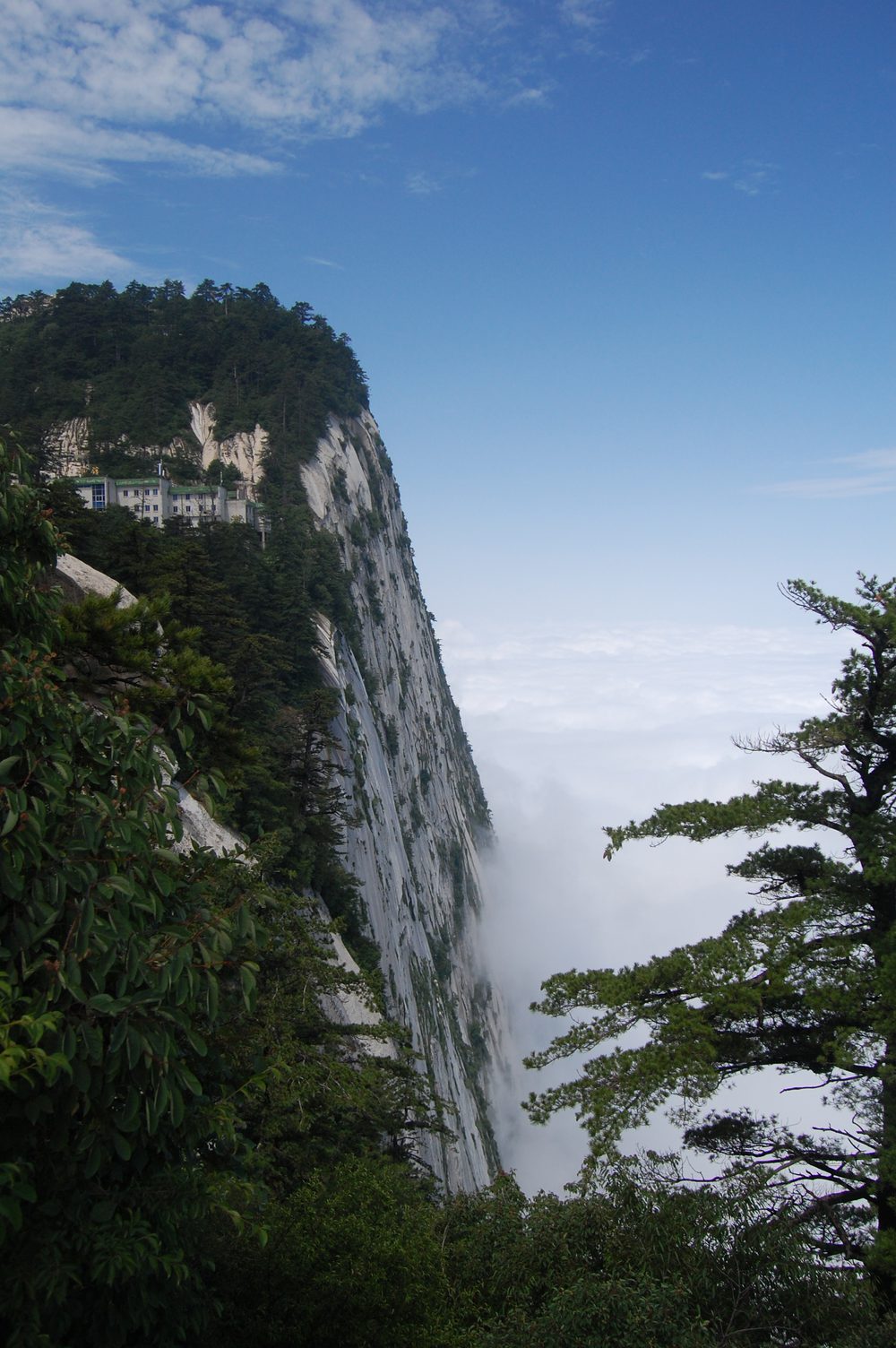
- North Peak (云台峰) — The lowest summit, arrival point for the North Peak cable car. Good sunrise views.
- West Peak (莲花峰) — The most scenic, reached by the longer cable car. The iconic “lotus flower” shape.
- South Peak (落雁峰) — The highest (2,154 m). The plank walk (长空栈道) is here — a separate CNY30 safety-harness fee, cash only.
- East Peak (朝阳峰) — The classic sunrise viewpoint.
- Central Peak (玉女峰) — The smallest, a pass-through between East and West.
Cliff-side attractions
Two extreme experiences that require separate booking via the “华山旅游服务平台” WeChat official account. Tickets released daily at 06:30, limited to 150 people per day per attraction, in batches of 30. Safety-harness rental costs CNY30 each.
- Plank Walk (长空栈道) — On South Peak’s east face, a 110-metre line of wooden planks bolted to a sheer cliff, built in the Yuan dynasty (1271-1368) by the Taoist He Zhizhen. The vertical drop exceeds 700 metres. Walkers wear a full-body harness with two locking carabiners, alternating them along the safety cable — one is always attached. It is as much a psychological test as a physical one. Requirements: height ≥150 cm, age 15–55. No access in rain or high wind.
- Eagle’s Flip (鹞子翻身) — On East Peak, a near-vertical 30-metre descent down a concave cliff face to the Chess Pavilion (下棋亭), where Chen Tuan is said to have played Emperor Zhao Kuangyin for the mountain itself. Climbers face the rock, feel for hidden footholds with their toes, and flip their body around the edge — hence the name. Requirements: height ≥160 cm, age 15–55.
Caution
This is a real mountain, with long climbs, steep exposed stairs, and changeable weather; wear proper shoes and carry water and a warm layer. The plank walk and the busiest cable cars can involve long waits, so start early and pace the day. The visitor centre stops selling cable-car tickets at 16:00; the last cable car down is around 19:00 (旺季) or 18:00 (淡季). For emergencies: 0913-4365088.
Suggested Itineraries
2 Days in Xi’an
Day 1: The old city
The city wall by bike in the morning, the Bell and Drum Towers around midday, and the Muslim Quarter in the evening for street food.
Day 2: The army and the Tang dynasty (618-907) south
The Terracotta Army first thing, back to the city for the Shaanxi History Museum in the afternoon, and the Big Wild Goose Pagoda and its fountain show in the evening.
3 Days: Adding Mount Hua
Days 1 to 2 as above, then a full day at Mount Hua, an easy high-speed train ride east, using the cable cars to reach the summits.
Xi’an as a Silk Road base
Xi’an is the eastern gateway to the old Silk Road and pairs naturally with an onward run northwest to the grottoes and deserts of Gansu, or east to Luoyang’s Longmen Grottoes. Many travelers slot it between Beijing and Chengdu on a first China loop.
Where to Stay
Staying inside or just outside the walled city, near the Bell Tower, puts you in the middle of the sights, the metro, and the food. The area around the Big Wild Goose Pagoda in the south is quieter and modern. Prices below are rough high-season guides; check current rates before booking.
Luxury
- Central and wall-area five-stars
International brands near the Bell Tower and the South Gate, some with wall or city views. Often CNY600-1,600+/night.
Boutique
- Courtyard and design hotels
Smaller stays in and around the old city, some in restored courtyard buildings. Often CNY400-900/night.
Midscale
- Domestic chains (Atour 亚朵, Ji Hotel 全季, and similar)
Reliable and central; look for a property near a metro stop inside the walls. Often CNY250-550/night.
Budget
- Hostels and budget hotels
Xi’an has a strong backpacker scene with sociable hostels near the Bell Tower and the wall. Often CNY120-300/night.
Where to Eat
- The Muslim Quarter: The city’s signature food street, best for skewers, flatbreads, and sweets, though touristy and pricey.
- Local noodle shops: Xi’an is a noodle city, and small shops all over serve its famous hand-pulled and hand-torn styles.
- Around the Bell Tower: Malls and restaurants in the center cover everything from local specialties to national chains.
- Roujiamo stands: The “Chinese hamburger” of chopped meat in a griddled bun is a street staple found everywhere.
Dishes to Try
- Roujiamo (肉夹馍): Chopped braised pork (or lamb) stuffed in a crisp flatbread, Xi’an’s signature snack.
- Biangbiang noodles (biángbiáng面): Wide, hand-pulled belt noodles with chili and vinegar, written with one of the most complex Chinese characters.
- Yangrou paomo (羊肉泡馍): A hearty lamb soup poured over bread you tear into pieces yourself, the local comfort dish.
- Liangpi (凉皮): Cold wheat or rice noodles in a spicy, tangy sauce, a refreshing warm-weather staple.
- Lamb skewers (羊肉串): Cumin-heavy grilled lamb skewers, a Muslim Quarter mainstay.
- Persimmon cakes and sweets (黄桂柿子饼): Fried persimmon cakes and other Silk Road sweets sold in the old lanes.
Hero photo: CEphoto, Uwe Aranas, CC BY-SA 3.0, via Wikimedia Commons.
Help keep this guide accurate
Found something incorrect, outdated, or missing? Tell us what changed and include a source when possible.
Suggest an update