
On this page12 sections
✓ Prices and practical details last verified August 2, 2026
For most travelers, Urumqi is primarily a transport hub for a longer journey through Xinjiang rather than the trip’s main destination. The regional capital is where flights and railways connect the far-flung routes toward Turpan, Kashgar, northern Xinjiang, and the Ili valley.
The city itself is a modern crossroads of Uyghur, Kazakh, Hui, and Han life, with Silk Road history, lamb and noodles, busy markets, and a handful of worthwhile urban sights. It also works as a base for the snow-fed Heavenly Lake in the Tianshan mountains and the green summer pastures to the south. Give the city a day before continuing across Xinjiang, adding another day if you want one of the mountain excursions.
Highlights
- Wander the lanes and landmark tower of the International Grand Bazaar (国际大巴扎).
- Trace the Silk Road and meet the Tarim mummies at the Xinjiang Regional Museum.
- Climb Hongshan Park (红山公园) for the pagoda and the view over the city.
- Ride up to the deep blue Heavenly Lake of Tianshan (天山天池) below the snows of Bogda Peak.
- Escape to the green summer meadows of the Nanshan pastures (南山) south of the city.
Transportation
Getting there
Urumqi is the hub of the whole region, so most trips through Xinjiang pass through it, whether by air or by rail.
Railway Station
The Lanxin high-speed line runs east from Ürümqi Station (乌鲁木齐站), reaching Turpan (吐鲁番) in about an hour and Hami (哈密) in about two and a half hours, with sleeper and regular trains reaching the rest of the region. Distances out here are vast, so flying between the far cities such as Kashgar (喀什) and Yining (伊宁) usually beats the long train.
Airport
Urumqi Tianshan International Airport (乌鲁木齐天山国际机场 / URC) is about 16 km northwest of the center, with flights across China and to Central Asia. Check current flight routes on FlightConnections. All flights use the single large terminal that opened in 2025, and Metro Line 1 links the airport to the city: a free airport people-mover runs from the terminal to the metro station, then Line 1 takes about 75 minutes to the center for around CNY6.
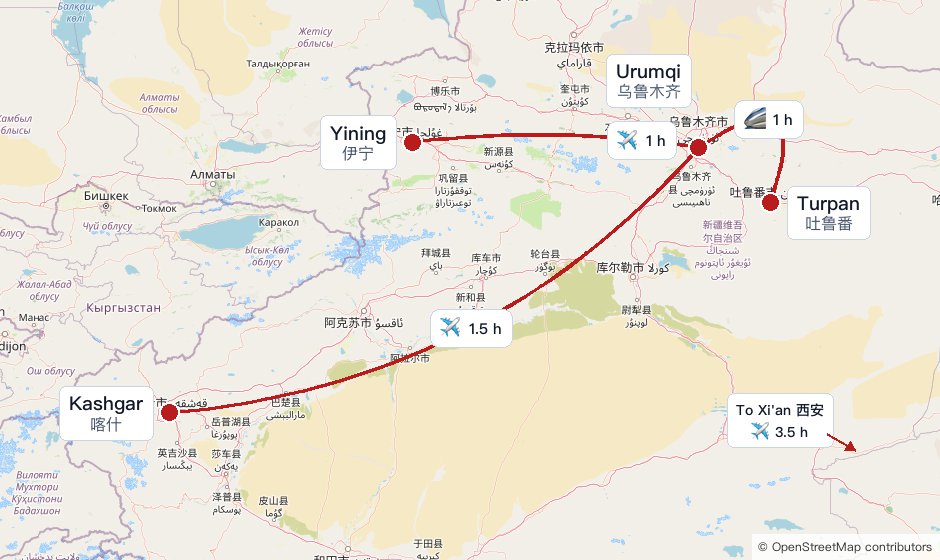
Onward from Urumqi: high-speed rail to Turpan, and flights to Kashgar, Yining, and Xi'an for the wider Silk Road and inland China.
Common onward routes
| Route | Best option | Travel Time | Notes |
|---|---|---|---|
| Urumqi -> Turpan (吐鲁番) | High-speed train | ~1 hour | The desert oasis of grapes and ancient ruins, an easy day or overnight. |
| Urumqi -> Yining / Ili (伊宁) | Flight | ~1.5 hours | Gateway to the green Ili valley and the Sayram and Kanas lakes. |
| Urumqi -> Kashgar (喀什) | Flight | ~2 hours | The old Silk Road city of the deep southwest, with its Sunday bazaar. |
| Urumqi -> Xi’an (西安) | Flight | ~3.5 hours | The Silk Road’s eastern anchor and the way back into inland China. |
Getting around
The city center is walkable and well served by a metro line and buses, and taxis and ride-hailing are cheap. The museum, Hongshan Park, and the Grand Bazaar are all in or near the center, while the Heavenly Lake, the Nanshan pastures, and Dabancheng lie an hour or more out of town. For those mountain trips most people take a day tour or charter a car, since public transport to them is slow or seasonal. Note that Xinjiang runs on Beijing time officially, but daily life quietly follows the sun about two hours later, so shops and meals start and end late.
Key Attractions
Urumqi’s draws sit at two scales. The city map covers the Xinjiang Regional Museum, Hongshan Park, and the International Grand Bazaar. The wider region adds the Dabancheng wind farm and salt lake, the Heavenly Lake in the Tianshan to the east, and the Nanshan pastures to the south. The numbers on the map match the sections below; click a numbered dot to jump to it.
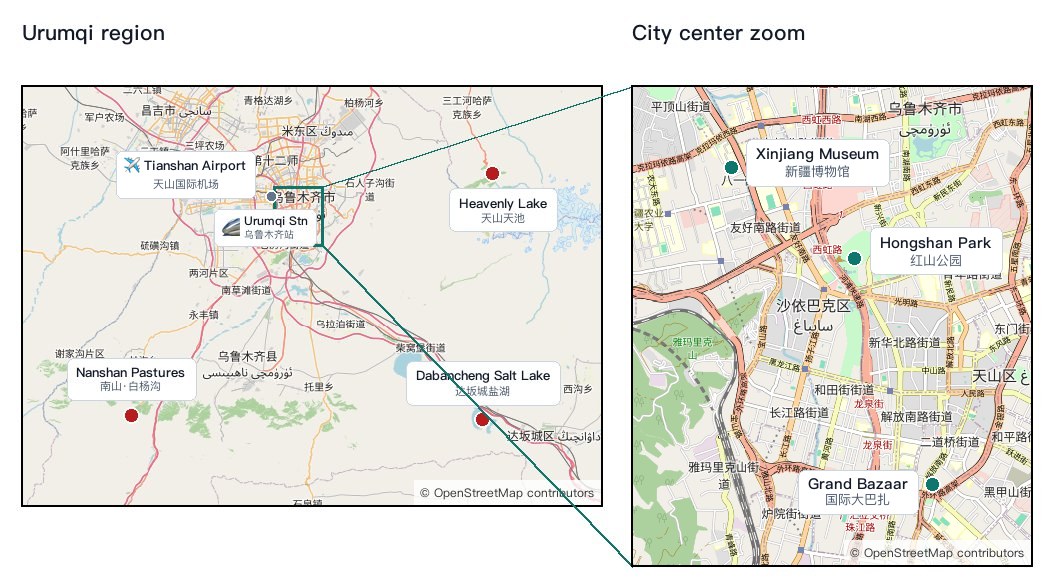
1. International Grand Bazaar (国际大巴扎)
Getting there: In the Erdaoqiao district south of the center, on Metro Line 1 to Erdaoqiao (二道桥) station, then a short walk to the main entrance
Admission: the bazaar itself is free to wander; the observation tower and the evening song-and-dance dinner show are the main paid extras
Time needed: 2 to 3 hours
The Xinjiang International Grand Bazaar is the modern heart of Uyghur commerce in Urumqi, a large complex built in 2003 in Islamic style around a landmark brick observation tower, on the site of the old Erdaoqiao market. Its lanes and halls are packed with stalls selling dried fruit and nuts, carpets and silks, jade and knives, embroidered hats and musical instruments, and the smell of grilling lamb drifts through it all. There is a pedestrian street, a performance theatre, and plenty of places to eat. It is touristy and you should bargain hard, but it is the easiest place to feel the region’s crossroads culture in one stop.
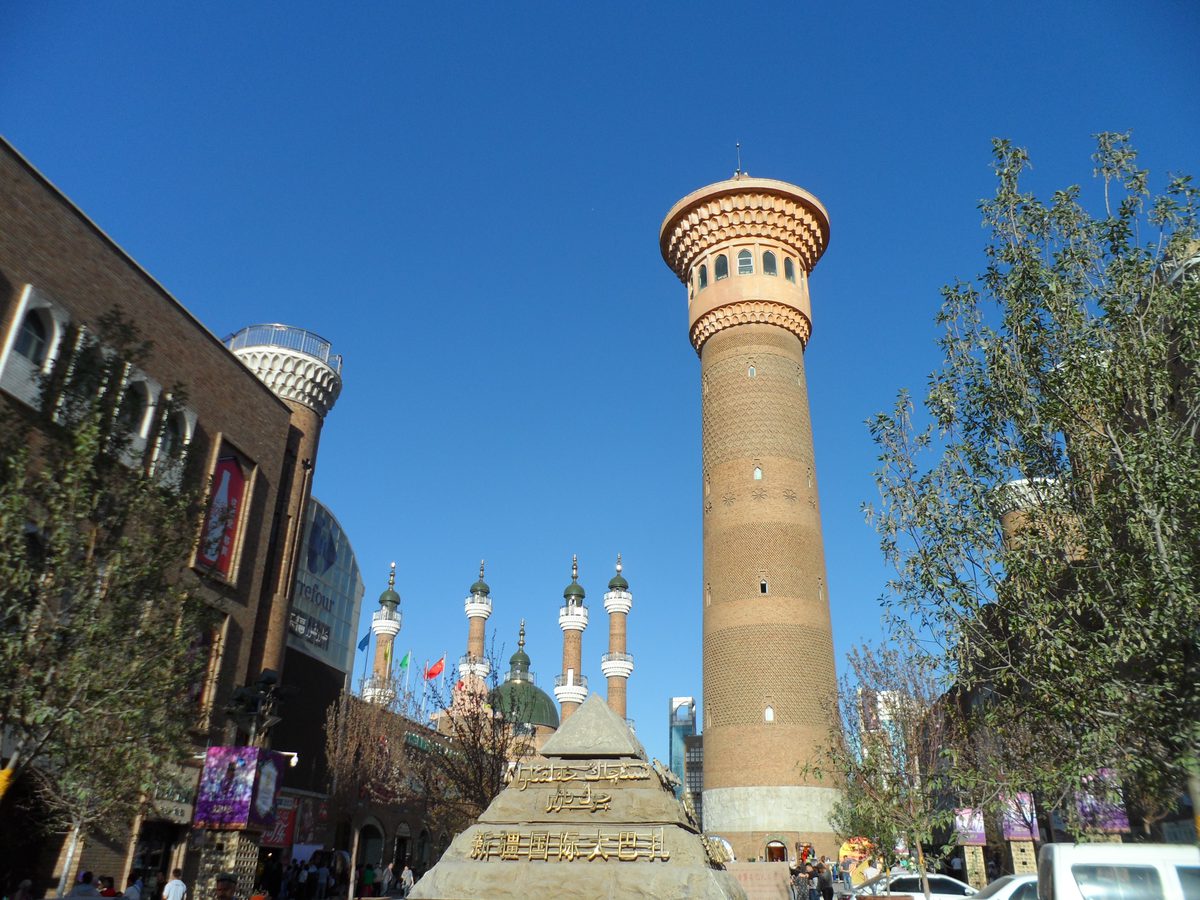
Photo: 螺钉, CC BY-SA 4.0, via Wikimedia Commons
What to see
- The observation tower
The tall brick tower at the heart of the bazaar, climbable for a view over the district. - The market stalls
Dried fruit, nuts, carpets, jade, hats, and instruments across the halls and the pedestrian street. - The food and shows
Lamb skewers and Uyghur dishes, plus an evening song-and-dance dinner performance. - Lingguan Lane (领馆巷)
A short walk from the bazaar, this narrow lane is where locals actually eat, its stalls selling meat naan, baked samosas, hand-pulled noodles, and Yili milk tea at cheaper prices than the bazaar’s tourist restaurants.
Caution
Prices are aimed at visitors, so haggle firmly and compare a few stalls. Weigh dried fruit and nuts yourself and confirm the price per unit before buying to avoid the common weighing tricks.
2. Hongshan Park (红山公园)
Getting there: Central, north of the museum, a short taxi or walk
Admission: Free
Time needed: 1 to 2 hours
Hongshan, “Red Hill,” is the rocky bluff that rises in the middle of Urumqi, long the city’s symbol and its best free viewpoint. A nine-storey pagoda crowns the top, built two centuries ago to guard against floods in local legend, and paths wind up through gardens, pavilions, and a small amusement area to the summit. From the top you look out over the whole sprawl of the city to the mountains beyond. It is a pleasant, easy climb and a favorite spot for locals in the evening, especially at sunset.
What to see
- The summit pagoda
The Qing dynasty (1644-1912) Zhenlong Pagoda on the red rock, the landmark of the city. - The city view
A wide panorama over Urumqi’s towers to the Tianshan on a clear day. - The gardens and pavilions
Terraced paths, flower beds, and viewpoints on the way up.
Caution
It is a real if short uphill walk, so take it steadily. The summit is popular at sunset, so expect company and go a little earlier for a quieter climb.
3. Xinjiang Museum (新疆维吾尔自治区博物馆)
Getting there: Central, on Xibei Road, by taxi, bus, or Metro Line 1 to Balou (八楼) station, then a short walk or bus
Admission: entry is free but by real-name reservation on the museum's official WeChat account 新疆维吾尔自治区博物馆, usually 1 to 7 days ahead; open Tuesday to Sunday, 10:00 to 18:30 (last entry 18:00), and closed Mondays; go for the Silk Road relics and the famous Tarim Basin mummies
Time needed: 2 to 3 hours
The Xinjiang Uygur Autonomous Region Museum is the best single introduction to the region’s astonishing history, and a must before heading out along the Silk Road. Its halls trace the many peoples of Xinjiang and the trade routes that crossed it, with silks, documents, and relics pulled from the desert sands. Its most famous treasures are the naturally preserved mummies of the Tarim Basin, including the strikingly well-kept “Beauty of Loulan,” thousands of years old and preserved by the dry desert. It is free, well laid out, and genuinely fascinating.
What to see
- The Tarim mummies
The desert-preserved bodies, including the famous Beauty of Loulan, in the museum’s signature hall. - The Silk Road relics
Silks, coins, documents, and everyday objects from the oasis kingdoms along the routes. - The peoples of Xinjiang
Displays on the region’s many ethnic groups, their dress, crafts, and customs.
Caution
Book the free entry ahead on the museum’s official WeChat account (新疆维吾尔自治区博物馆) and bring your passport, and check the Monday closure before you go. The mummy hall draws crowds, so visit it first if you can.
4. Dabancheng Wind Farm & Salt Lake (达坂城)
Getting there: About 90 km southeast, usually en route to Turpan
Admission: about 90 km southeast on the road toward Turpan, the wind farm and salt lake are free to view; most people pass them on a Turpan day trip rather than making a special journey
Time needed: A stop of an hour
The wind-blasted pass at Dabancheng, on the road southeast toward Turpan, is home to one of China’s largest wind farms, thousands of turbines marching across the gravel plain between the mountains. Nearby lies a broad salt lake whose still water throws mirror reflections of the sky on a calm day. The town is also famous in a well-loved Xinjiang folk song about its pretty girls and long braids. There is not a great deal to do here, but the sea of spinning turbines and the shining salt flats make a memorable photo stop on the way to or from Turpan.
What to see
- The wind farm
Thousands of turbines spread across the windy pass, a striking sight from the highway. - The salt lake
A wide salt lake with mirror-like reflections when the wind drops. - The folk-song town
Dabancheng of the famous song, with a small old town and roadside stalls.
Caution
There are no real facilities out here, so treat it as a photo stop rather than a destination. The wind is fierce and constant, which is the whole point, so hold onto hats and doors.
5. Heavenly Lake of Tianshan (天山天池)
Getting there: About 110 km east by organized day tour, chartered car, or rental car to the visitor center, followed by the compulsory park shuttle
Admission: CNY95 in peak season (April to October) and CNY45 in winter, plus a compulsory shuttle of CNY60 round trip up to the lakeshore, since private cars stop far below
Time needed: A full day
The Heavenly Lake, Tianchi, is the classic day trip from Urumqi and one of the most beautiful sights in the north of Xinjiang: a long, deep, alpine lake of clear blue-green water set in a bowl of spruce forest, with the snow-capped Bogda Peak rising behind it. Fed by mountain snowmelt, it sits high in the Tianshan and has drawn travelers and pilgrims for centuries, wrapped in legends of the Queen Mother of the West. A boardwalk and boats let you take in the water and the peaks, and side trails climb to smaller lakes and viewpoints above. It is busy in summer, but the setting more than earns its fame.
What to see
- The lake and Bogda Peak
The blue lake ringed by forest, with the 5,445-metre snow pyramid of Bogda behind it on a clear day. - The lakeside boardwalk and boats
An easy shoreline walk and cruise boats that cross to viewpoints and quieter corners. - The higher lakes and temples
Trails and cable cars up to smaller alpine tarns and small temples above the main lake.
Caution
the lake sits at about 1,900 metres below the snows of Bogda Peak and is roughly 110 km east of the city, so it is a full day out; boats cross the lake for an extra fee, and the water can stay frozen into spring. It is high and cool even in summer, so bring a layer, and the shuttle and boat queues can be long at midday, so start early.
6. Nanshan Pastures (南山)
Getting there: About 50 to 70 km south, by chartered car, rental car, or organized day tour
Admission: the Tianshan Grand Canyon scenic area, about 50 km south, charges roughly CNY60 admission plus a CNY50 shuttle; the wider Nanshan grasslands and gullies such as Baiyanggou are mostly reached by chartered car or tour
Time needed: Half a day to a full day
The Nanshan, or “Southern Mountains,” are the green summer face of the Tianshan just south of the city, a belt of spruce-forested valleys and Kazakh herding pastures that Urumqi families escape to when the plains turn hot. The best-known spots are the Tianshan Grand Canyon scenic area, with its boardwalks and meadows, and gullies such as Baiyanggou, the “White Poplar Gully,” with its waterfall and grasslands. You can ride horses, eat in a yurt, and watch the herds graze under the peaks. It is a gentle, cooler counterpoint to the desert everywhere else in the region.
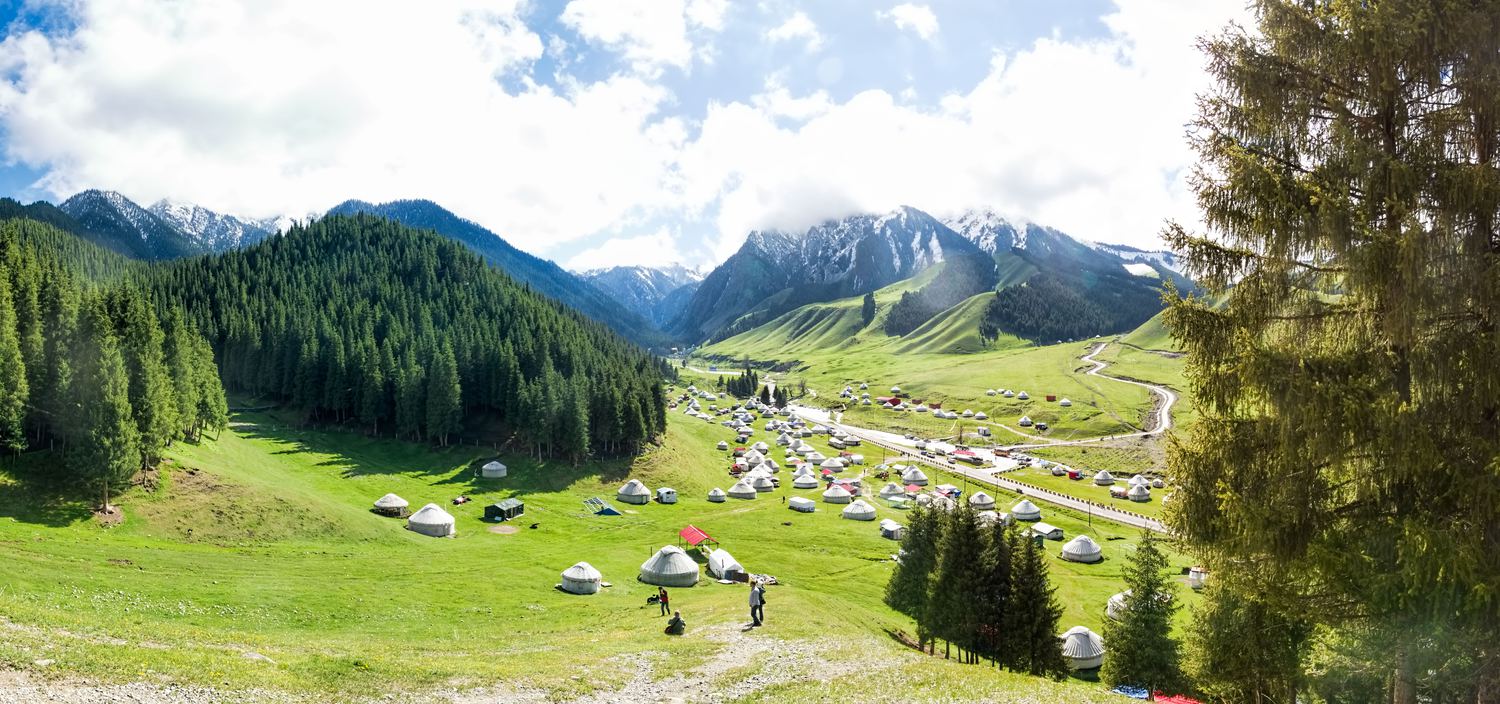
Photo: Dan Lundberg, CC BY-SA 2.0, via Wikimedia Commons
What to see
- The grassland meadows
Rolling Kazakh pastures and spruce forest below the peaks, at their greenest from June to August. - Baiyanggou and its waterfall
The White Poplar Gully with its cascade, a classic Nanshan picnic and horse-riding spot. - Yurt stays and horse rides
Kazakh herders offer horse treks, milk tea, and meals, and some let you stay overnight in a yurt.
Caution
The grasslands are only lush in summer, so time a visit for the warm months. Agree horse-riding and meal prices clearly before you start to avoid surprises later.
Suggested Itineraries
2 Days: City and Lake
Day 1: The city
The Xinjiang Regional Museum in the morning, Hongshan Park in the afternoon, and the International Grand Bazaar in the evening for shopping and dinner.
Day 2: The mountains
A full day out to the Heavenly Lake of Tianshan by tour or car, for the lake, the forest, and the peaks, back to the city by evening.
Adding a day
With a third day, swap in the Nanshan pastures for a gentler day among the grasslands and yurts, or use the day as a Turpan trip by high-speed train, passing the Dabancheng wind farm on the way.
Base for the wider west
Urumqi is really the pivot of a longer Xinjiang trip. From here travelers fan out to Turpan’s deserts, the Ili valley and Sayram Lake around Yining, the lakes of Kanas in the far north, and Kashgar in the deep southwest.
Where to Stay
Almost everyone stays in central Urumqi, which has the full range of hotels within reach of the museum, Hongshan Park, and the metro to the bazaar. Prices below are rough peak-season guides and drop off-season; book ahead for July and August, the busiest months.
Midscale
- Central hotels
Comfortable business and chain hotels around the center and near Hongshan, the handiest base. Often CNY300-700/night in the summer peak, less off-season.
Budget
- Guesthouses and hostels
Simpler rooms and hostels across the center, many with tour desks for the lake and Turpan. Often CNY120-300/night, higher in July and August.
Where to Eat
- International Grand Bazaar and Erdaoqiao: The easiest place for Uyghur food, from skewers to pilaf, plus an evening show.
- Hetian Second Street (和田二街): A local-favorite food street in the west of the city, where the crowds follow the 一把抓 grilled dumplings, fig pilaf, yogurt rice dumplings, and hand-made ice cream; many stalls run late into the night.
- Uyghur and Central Asian cuisine: Lamb, hand-pulled noodles, and naan dominate, with strong Central Asian flavors.
- Night markets and food streets: Streets such as those around the bazaar come alive after dark with grills and cold drinks.
Dishes to Try
- Hand-pulled laghman noodles (拉条子): Thick wheat noodles topped with stir-fried lamb, peppers, and tomato, the regional staple.
- Big-plate chicken (大盘鸡): Chicken braised with potatoes and chillies over wide belt noodles, made for sharing.
- Lamb pilaf (手抓饭): Rice cooked with lamb, carrot, and raisins, eaten across Xinjiang.
- Lamb skewers (烤羊肉串): Cumin-and-chilli mutton grilled over charcoal, the classic street snack.
- Naan bread (馕): The round baked flatbread sold everywhere, plain or topped with sesame and onion.
- Dried fruit and nuts (干果): Xinjiang raisins, apricots, dates, and walnuts, best bought and tasted at the bazaar.
Hero photo: Bernard Gagnon, CC BY-SA 3.0, via Wikimedia Commons.
Help keep this guide accurate
Found something incorrect, outdated, or missing? Tell us what changed and include a source when possible.
Suggest an update