
On this page13 sections
✓ Prices and practical details last verified July 10, 2026
Guangzhou is the great commercial city of the south, a port that has been trading with the wider world for well over a thousand years and has never really stopped. This is the capital of Cantonese culture, which means it is first and foremost a place to eat, from dawn dim sum to late-night congee, and a city where the food alone justifies the trip. It wears its history lightly: a Qing dynasty (1644-1912) merchant hall covered in carved figures, a leafy island of colonial verandas, and an ancient mountain all sit within a modern metropolis of glass towers and one of the world’s busiest metro systems. For most foreign visitors it is also the gateway to the Greater Bay Area, a fast train ride from Shenzhen and Hong Kong.
Highlights
- Ride to the top of the Canton Tower (广州塔), the slender “Slim Waist” tower on the south bank, and watch the Pearl River (珠江) light up at night.
- Study the carved roofs and courtyards of the Chen Clan Ancestral Hall (陈家祠), the finest surviving example of Cantonese folk craft anywhere.
- Walk the shaded colonial streets of Shamian Island (沙面), a quiet enclave of European architecture beside the river.
- Wander Yongqingfang (永庆坊) and the old Xiguan (西关) lanes, where restored arcade houses now hold cafes and craft shops.
- Eat your way through the city, because Cantonese cooking is the real headline attraction and Guangzhou is where it is done best.
Transportation
Getting there
Guangzhou Baiyun International Airport (广州白云国际机场 / CAN) is one of China’s three busiest airports and sits north of the city, now with three terminals after Terminal 3 opened in early 2026. Check current direct routes on FlightConnections. Metro Line 3 connects the airport to the city center in about an hour for around CNY7 to 8 on Metro Line 3 to Airport North (机场北), roughly 60 minutes from the city center. The newer Guangzhou-Foshan circular intercity railway (广佛环线城际) serves all three terminals and runs onward to Panyu and Huadu. One caveat: since mid-2026 the Terminal 1 metro and intercity stations are temporarily closed for a renovation of Terminal 1, and Terminal 3 has no metro link yet - it is reached by the intercity train, a free shuttle from Terminal 2, or a bus from Gaozeng station. A taxi to central Guangzhou takes 45 to 70 minutes depending on traffic and runs roughly CNY100 to 150.
Railway stations
Guangzhounan Railway Station (广州南站) is the main high-speed hub and handles the fastest and most frequent trains to Shenzhen, Hong Kong West Kowloon, Guilin, and beyond. It sits well south of the city, so always budget 40 to 60 minutes on the metro to reach it from a central hotel. Guangzhoudong Railway Station (广州东站) is more central and handles frequent trains to Shenzhen, some high-speed services to Hong Kong West Kowloon, and conventional services. The former conventional through train between Guangzhoudong and Hung Hom no longer operates. A smaller number of trains use Guangzhou Station (广州站) and the newer Guangzhou Baiyun Station (广州白云站). Always check which station your ticket uses, because they are far apart.
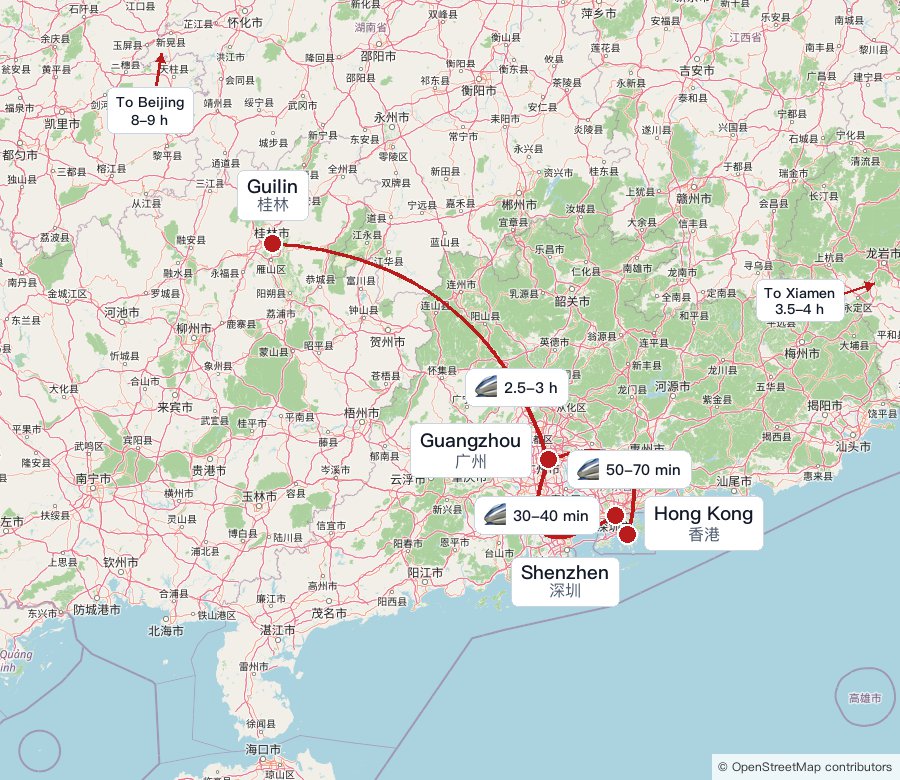
High-speed rail times from Guangzhou to Shenzhen, Hong Kong, Guilin, and Xiamen. Most fast trains leave from Guangzhounan.
Common onward routes
| Route | Best option | Travel Time | Notes |
|---|---|---|---|
| Guangzhou (广州) -> Shenzhen (深圳) | High-speed train | 30-40 minutes | Very frequent, from Guangzhounan or Guangzhoudong. |
| Guangzhou (广州) -> Hong Kong (香港) | High-speed train | 50-70 minutes | To Hong Kong West Kowloon; bring your passport for immigration. |
| Guangzhou (广州) -> Guilin (桂林) | High-speed train | 2.5-3 hours | For the karst scenery covered in our Guilin guide. |
| Guangzhou (广州) -> Xiamen (厦门) | High-speed train | 3.5-4 hours | The coastal line east into Fujian. |
| Guangzhou (广州) -> Beijing (北京) | High-speed train or flight | 8-9 hours by rail | Flying is usually the better choice for this distance. |
Getting around
The metro is fast, cheap, and reaches every sight in this guide except the peak of Baiyun Mountain. Fares are CNY2 for the first 4 km, rising by CNY1 for each additional segment; most trips inside the city cost CNY2 to 8. Pay with a transport QR code in Alipay or WeChat, and note that bags are scanned at station security. Taxis and Didi are useful late at night or for the airport, though traffic in the old center is heavy. For a short hop, the Pearl River ferries between Fangcun and the central piers are a cheap and pleasant way to cross the water.
Key Attractions
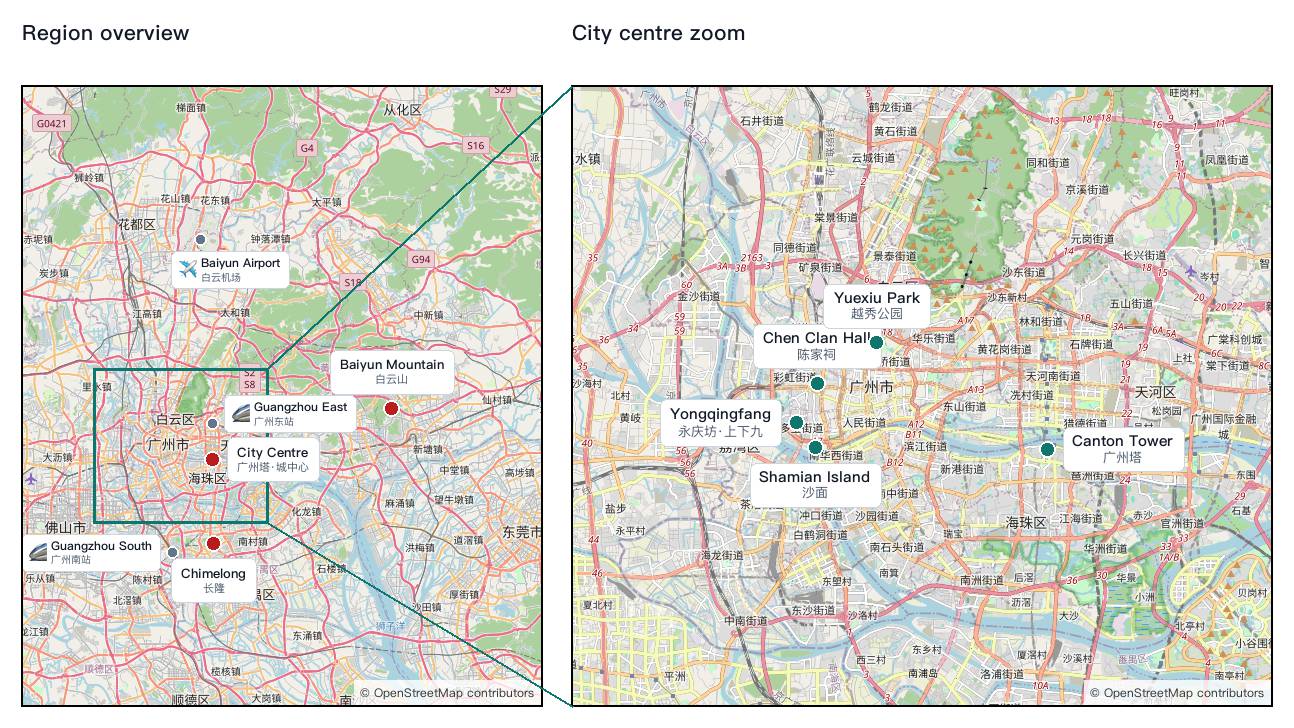
Guangzhou’s sights split into a compact central cluster and a couple of outliers. The core is easy to walk and metro-hop between: the Canton Tower and Pearl River on the water, then Chen Clan Hall, Shamian Island, Yongqingfang, and Yuexiu Park spread across the old city just north. The two outliers each take a half day of their own: Baiyun Mountain on the northern edge of town, and the Chimelong resort complex out to the south for families. The numbers on the map match the sections below; click a numbered dot to jump to it.
1. Canton Tower & the Pearl River (珠江)
Getting there: Metro Line 3 or the APM line to Canton Tower (广州塔) station
Admission: from CNY135 for the 433-metre observation deck (around CNY75 concession), booked by real-name ID
Time needed: An evening, ideally around sunset
The Canton Tower is the city’s signature landmark, a 600-metre latticework spire that narrows to a famously slender waist, which is why locals nicknamed it the Slim Waist (小蛮腰). It stands on the south bank looking across the Pearl River to the new financial district, and the whole stretch of riverfront comes alive after dark, when the towers on both banks turn on their light shows. Going up is optional; the tower is arguably better admired from the ground or the water than climbed.
For a full view of the tower, see it from Zhujiang New Town (珠江新城) on the opposite bank. The riverfront around Huacheng Square gives you enough distance to take in the complete structure, especially once the evening lights come on.
What to see
- The observation decks
Several levels of enclosed and open-air viewing platforms, with the 433-metre deck the standard visit and higher tiers reaching the Bubble Tram and open deck near the top. See from CNY283 for the 460-metre Bubble Tram (the horizontal Ferris wheel at the very top); the 450-metre open-air deck is around CNY228. - A Pearl River night cruise
Boats depart from piers on both banks and loop past the illuminated skyline, the single best way to see the city lit up. Fares are roughly CNY100 to 160 per person for a standard evening sailing, more for dinner cruises; a combined Canton Tower plus cruise ticket starts around CNY198. - Huacheng Square (花城广场)
This long civic plaza in Zhujiang New Town sits opposite Canton Tower. Lined with the opera house, library, and provincial museum, it is the best free vantage point for seeing the tower across the river. - The riverside promenade
Walkable for kilometers along both banks, busiest and prettiest in the couple of hours after the lights come on.
Caution
Tower tickets sell out on weekends and holidays, and the queues for the top decks can be long. Book a timed slot online in advance, and consider skipping the climb in favor of the cruise if your schedule is tight.
2. Chen Clan Ancestral Hall (陈家祠)
Getting there: Metro Line 1 to Chen Clan Academy (陈家祠) station
Admission: CNY10 (half price concession), open 09:00 to 17:30 with ticket sales ending at 17:00, closed Tuesdays except public holidays; reserve through the WeChat account 广东民间工艺博物馆服务号
Time needed: 1.5 to 2 hours
Built in the 1890s as a combined ancestral shrine and study hall for the Chen families of Guangdong, this is the most complete showcase of southern Chinese folk craft you will find. Nearly every surface carries decoration: ceramic figures marching along the roof ridges, carved wood and stone screens, brick reliefs, and iron castings, all executed by the region’s finest workshops. It now houses the Guangdong Folk Art Museum, and the building itself is the exhibit.
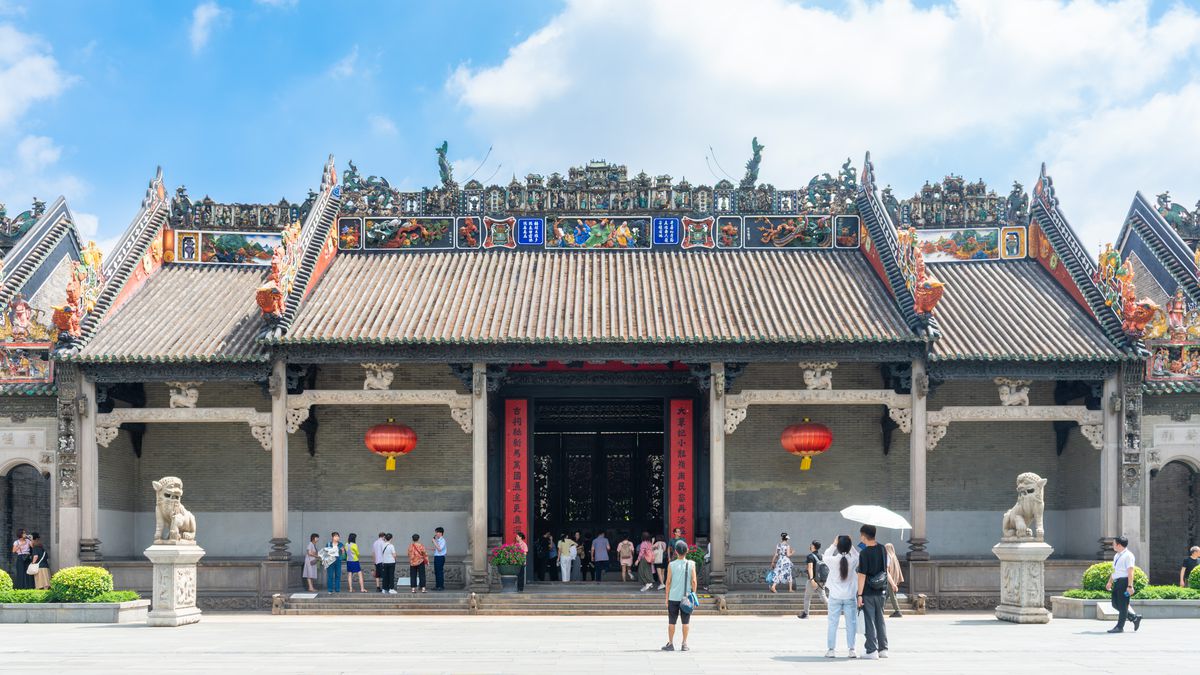
Photo: Shujianyang, CC BY-SA 4.0, via Wikimedia Commons
What to see
- The roof ridge sculptures (灰塑 and 陶塑)
The crowded ceramic friezes along the rooflines depict scenes from opera and legend, best seen in the strong midday light that picks out their color. - The carved screens and doorways
Interior halls are separated by intricately worked wood and stone partitions, each a small masterpiece worth slowing down for. - The folk-craft galleries
Rotating exhibits of Guangdong embroidery, ivory and jade carving, and porcelain, giving context to the building’s own decoration.
Caution
The hall is closed on Tuesdays except public holidays, and every visitor, including children, must reserve through the museum’s official WeChat account (广东民间工艺博物馆服务号) before arriving. Book a day ahead to be safe.
3. Shamian Island (沙面)
Getting there: Metro Line 1 to Huangsha (黄沙) station, then a short walk across the footbridge
Admission: Free, the island’s streets are open at all hours
Time needed: 1.5 to 2 hours
Shamian is a small sandbar in the Pearl River that was carved out as a foreign concession in the 19th century, leaving behind a dense cluster of European-style banks, churches, and consulates. Today it is a quiet, tree-shaded pedestrian enclave, a striking contrast to the busy wholesale markets just across the water, and one of the most pleasant places in the city for an unhurried walk.
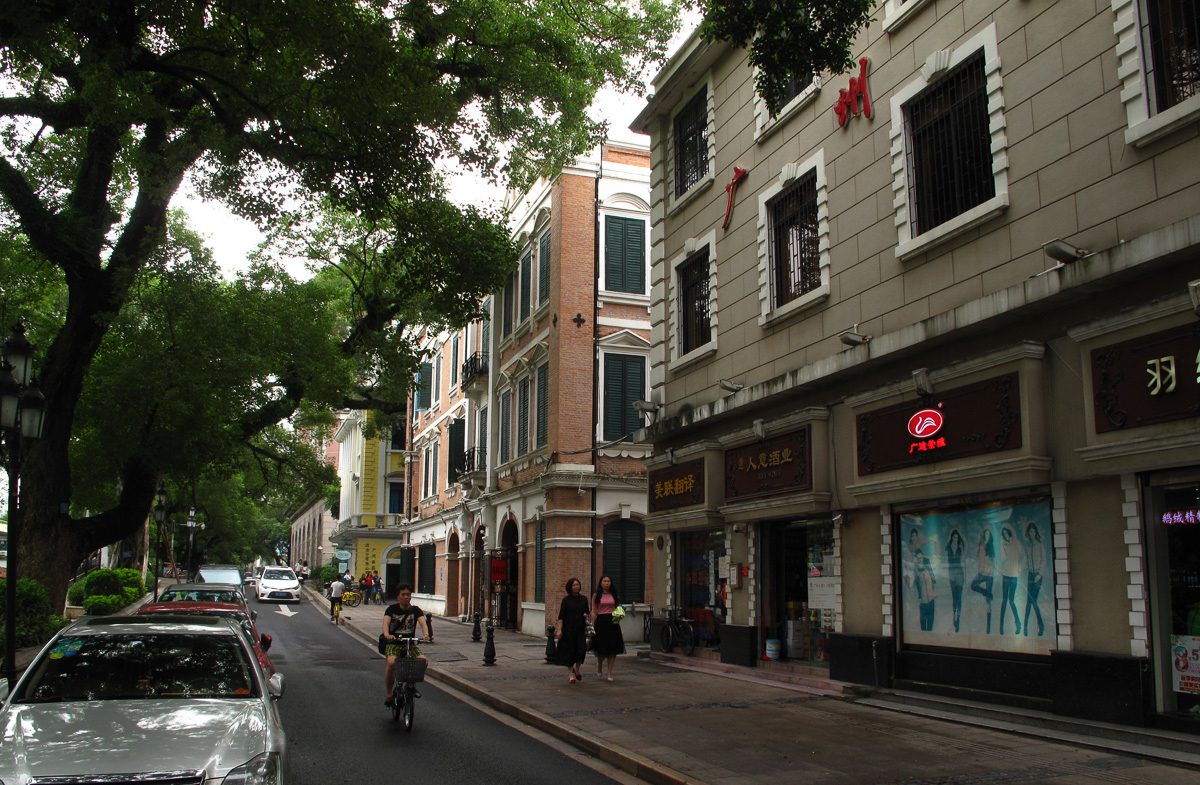
Photo: Rutger van der Maar, CC BY 2.0, via Wikimedia Commons
What to see
- The colonial architecture
Whole streets of restored banks, trading houses, and residences with shuttered windows and shaded verandas, many now cafes, boutique hotels, and consulate buildings. - Our Lady of Lourdes Chapel (露德圣母堂)
A small French Catholic church from 1892, one of the island’s architectural highlights. - The riverside walk
The southern edge faces the White Swan hotel and looks out over the Pearl River, a good spot to sit under the banyan trees.
Caution
Shamian is a popular backdrop for wedding and fashion photography, so mornings can be surprisingly busy with photo shoots. Come earlier or later in the day if you want the streets closer to yourself.
4. Yongqingfang & Xiguan (永庆坊)
Getting there: Metro Line 1 to Changshou Road (长寿路) station
Admission: Free; the Cantonese opera and craft museums inside are ticketed separately
Time needed: Half a day
Xiguan is the historic heart of old Guangzhou, a district of arcade houses (骑楼), narrow lanes, and family shophouses that once held the city’s wealthiest merchants. Yongqingfang is the restored core of it, a cluster of renovated lanes where old grey-brick houses now hold cafes, design studios, and small museums without losing the street pattern. It pairs naturally with the nearby Shangxiajiu (上下九) pedestrian street for a longer wander.
What to see
- The restored lanes of Yongqingfang
Renovated arcade houses and narrow alleys, good for slow browsing, coffee, and street photography. - The Cantonese Opera Art Museum (粤剧艺术博物馆)
A purpose-built garden complex nearby dedicated to the region’s distinctive opera tradition, with performances on some days. - Shangxiajiu pedestrian street (上下九步行街)
A long stretch of classic arcade shopfronts and old Cantonese snack shops, busy and unpolished in the best way. - Enning Road (恩宁路)
The spine of the district, one of the best-preserved arcade streets in the city.
Caution
This is a living neighborhood as much as an attraction, and some lanes are ordinary homes rather than shops. Keep noise down and ask before photographing residents or their doorways.
5. Yuexiu Park (越秀公园)
Getting there: Metro Line 2 to Yuexiu Park (越秀公园) station
Admission: Free
Time needed: 2 to 3 hours
Yuexiu is the city’s largest central park, a green expanse of hills and lakes that also holds several of Guangzhou’s founding symbols. It is where locals come to exercise, sing, and escape the heat, and it makes an easy, shaded contrast to the temples and markets. The Guangzhou Museum sits inside it, housed in an old watchtower with views over the city.
What to see
- The Five Rams Statue (五羊石像)
The city’s emblem, drawn from the legend of five immortals who arrived on rams bearing grain, giving Guangzhou its nickname the Ram City (羊城). - Zhenhai Tower (镇海楼)
A five-story Ming dynasty (1368-1644) watchtower on the hill, now the Guangzhou Museum, with a good overview of the city’s history. - The old city wall (古城墙)
A surviving stretch of Guangzhou’s Ming dynasty (1368-1644) wall runs through the park, one of the few pieces left. - The lakes and banyan groves
Quiet paths, paddle boats, and shaded benches, at their best in the early morning.
Caution
The park is large and hilly, so wear comfortable shoes and carry water in the humid months. Weekend mornings are lively with local activities, which is part of the appeal rather than a drawback.
6. Baiyun Mountain (白云山)
Getting there: Metro Line 2 to Baiyun Park (白云公园), then a bus or taxi to a mountain gate; a cable car runs from the south gate
Admission: CNY5 for the main gate; the cable car up and attractions like Yuntai Garden are ticketed separately
Time needed: Half a day
Baiyun, the White Cloud Mountain, is a range of low green peaks on the northern edge of the city, long treated as Guangzhou’s back garden. On clear days its highest point, Moxing Ridge (摩星岭), gives a sweeping view over the whole metropolis, and the slopes are laced with walking paths, gardens, and tea houses. It is the closest thing the city has to a proper mountain escape, popular with locals for morning hikes.
What to see
- Moxing Ridge (摩星岭)
The summit and highest point in the city, with the widest views, reachable on foot or by a combination of cable car and walking. - Yuntai Garden (云台花园)
A large landscaped flower garden near the south gate, ticketed separately, at its best in spring. - The Mingchun Valley (鸣春谷) and temple paths
Shaded trails and small pavilions across the slopes, a pleasant way up if you prefer walking to the cable car.
Caution
The air is often hazy, so the famous view depends heavily on the weather; go on a clear day after rain for the best chance. The mountain is busiest at weekends and during festivals.
7. Chimelong (长隆)
Getting there: Metro Line 3 or Line 7 to Hanxi Changlong (汉溪长隆) station
Admission: CNY250 full price, around CNY175 to 200 for children, seniors, and students; the Safari Park and Water Park are separate tickets, each priced from around CNY300 on peak days
Time needed: A full day per park
Chimelong is a vast resort complex in the southern district of Panyu, and it is the main reason families with children come to Guangzhou. It bundles several separate attractions, most famously the Safari Park, one of the largest wildlife parks in the country, alongside a big amusement park, a water park, and a circus. Each is a full day in itself, so pick one or two rather than trying to see everything.
What to see
- Chimelong Safari Park (长隆野生动物世界)
A huge drive-through and walk-through wildlife park with giant pandas, big cats, and a well-known population of koalas, the standout for most visitors. - Chimelong Paradise (长隆欢乐世界)
The amusement park, with a strong lineup of roller coasters and thrill rides. - Chimelong Water Park (长隆水上乐园)
A large water park, at its best in the long, hot southern summer. - The Chimelong International Circus (长隆国际大马戏)
A big evening acrobatics and animal show, often booked as an add-on to a park day.
Caution
The parks are enormous and the tickets are separate, so plan which ones you want in advance and buy timed tickets online. Summer brings both heat and afternoon thunderstorms, so start early and carry water.
Suggested Itineraries
2 Days in Guangzhou
Day 1: The old city
Chen Clan Hall in the morning, then Shamian Island and a walk through the Xiguan lanes and Yongqingfang in the afternoon. Finish on the Pearl River with a night cruise and the Canton Tower lit up across the water.
Day 2: Park and river
Yuexiu Park in the morning for the Five Rams and Zhenhai Tower, then a long lunch of dim sum, and the Canton Tower observation decks or Huacheng Square in the late afternoon.
3 Days in Guangzhou
Days 1 to 2 as above, then:
Day 3: Choose your outer sight
Either a half day up Baiyun Mountain for the air and the view, or a full day at one of the Chimelong parks if you are traveling with children. Both are easy metro rides from the center.
4 to 5 Days: Guangzhou as a base
Add a day trip to Foshan for its ancestral temple and Cantonese opera roots, or use the fast trains to spend a day in Shenzhen or Hong Kong, both under about an hour away by high-speed rail.
Where to Stay
Staying in Tianhe (天河) near the Pearl River New Town puts you among the modern towers, the best malls, and easy metro access. The older districts around Shamian, Yuexiu, and Beijing Road trade gleaming newness for character and better street food. Prices below are rough high-season guides; check current rates before booking.
Luxury
- Pearl River New Town five-stars
International brands clustered in Tianhe around the twin towers and Huacheng Square, many with high-floor river views. Often CNY1,000-2,800+/night.
Boutique
- Shamian Island and heritage conversions
Small hotels inside restored colonial buildings on and around Shamian, quieter and full of character. Often CNY500-1,200/night.
Midscale
- Domestic design chains (Atour 亚朵, Ji Hotel 全季, and similar)
Reliable and clean; look for properties near a metro station in Yuexiu or Tianhe. Often CNY300-650/night.
Budget
- Hostels and budget chains around Beijing Road and the old center
Central, walkable to the old-city sights, and close to the best street food. Often CNY150-350/night.
Where to Eat
- Dim sum (早茶): The city’s defining meal, taken from mid-morning with endless small plates and pots of tea. Old teahouses and Cantonese restaurant chains both do it well.
- Beijing Road and Xiguan: The old commercial core, dense with snack shops, roast-meat counters, and dessert stalls for grazing between sights.
- Tianhe malls: As across urban China, upper-floor mall restaurants are reliable, air-conditioned, and where a lot of locals actually eat.
- Night markets and dai pai dong: Open-air street stalls come alive after dark for stir-fries, congee, and grilled skewers, the most local way to eat late.
Dishes to Try
- Dim sum classics (点心): Har gow shrimp dumplings, siu mai, char siu bao, and rice-noodle rolls, the core of any morning tea.
- Roast goose and char siu (烧鹅、叉烧): Cantonese roast meats, hung in the window and chopped to order, best from a busy specialist shop.
- White cut chicken (白切鸡): Poached chicken served plain with a ginger-scallion dip, a benchmark dish for judging a Cantonese kitchen.
- Wonton noodles (云吞面): Thin springy noodles in a clear broth with shrimp wontons, an everyday classic.
- Steamed rice rolls (肠粉): Silky rice-flour sheets rolled around shrimp, beef, or egg, a breakfast staple.
- Double-skin milk and other sweets (双皮奶): A regional milk custard, best sought out in the dessert shops of the old town.
Hero photo: xiquinhosilva, CC BY 2.0, via Wikimedia Commons.
Help keep this guide accurate
Found something incorrect, outdated, or missing? Tell us what changed and include a source when possible.
Suggest an update