
On this page13 sections
✓ Prices and practical details last verified July 25, 2026
Guilin’s scenery is so famous inside China that it appears on the back of the twenty-yuan note: a river winding between hundreds of steep, green limestone peaks that rise straight out of the flat valley floor. The old saying is that “Guilin’s mountains and waters are the finest under heaven” (桂林山水甲天下), and the karst landscape along the Li River and around Yangshuo genuinely lives up to it. The city of Guilin itself is a pleasant, mid-sized base, but the real reason to come is what lies between it and Yangshuo: the slow river cruise, the bamboo rafts, the terraced hills, and the villages tucked among the peaks.
Highlights
- Take the classic Li River cruise (漓江) from Guilin down to Yangshuo, four hours drifting past the most photographed karst peaks in China.
- Base yourself in Yangshuo (阳朔), a riverside town surrounded by peaks, and drift the quieter Yulong River (遇龙河) on a bamboo raft.
- Stand at the bend below Xingping (兴坪), the exact scene printed on the twenty-yuan note.
- Climb into the hills for sunrise over the Longji rice terraces (龙脊梯田), carved into the slopes over centuries by the Zhuang and Yao.
- Wander Guilin’s own peaks and lakes, from Elephant Trunk Hill (象鼻山) to the illuminated pagodas of the city’s lake network.
Transportation
Getting there
Guilin Liangjiang International Airport (桂林两江国际机场 / KWL) sits west of the city with domestic flights and a growing handful of international routes. Check current direct routes on FlightConnections. Guilin Liangjiang Airport (KWL) is about 30 km west of the city; airport buses run to downtown, the railway stations, and directly to Yangshuo (around CNY60), and a taxi to central Guilin is roughly CNY80 to 100. The high-speed rail network also makes Guilin easy to reach overland from Guangzhou, Guiyang, and beyond.
Railway stations
Guilinbei Railway Station (桂林北站) is a major high-speed rail hub and a common arrival point. Guilinxi Railway Station (桂林西站) is also important, particularly for trains using the Guiyang to Guangzhou high-speed corridor, but it sits farther from the city center. Guilin Railway Station (桂林站) is the most central and handles a mix of high-speed and conventional services. There is also a dedicated Yangshuo Railway Station (阳朔站) on the high-speed line, useful if you are heading directly to Yangshuo rather than entering Guilin city. Always check the station printed on your ticket because Guilinbei, Guilinxi, and Guilin Station are not interchangeable.
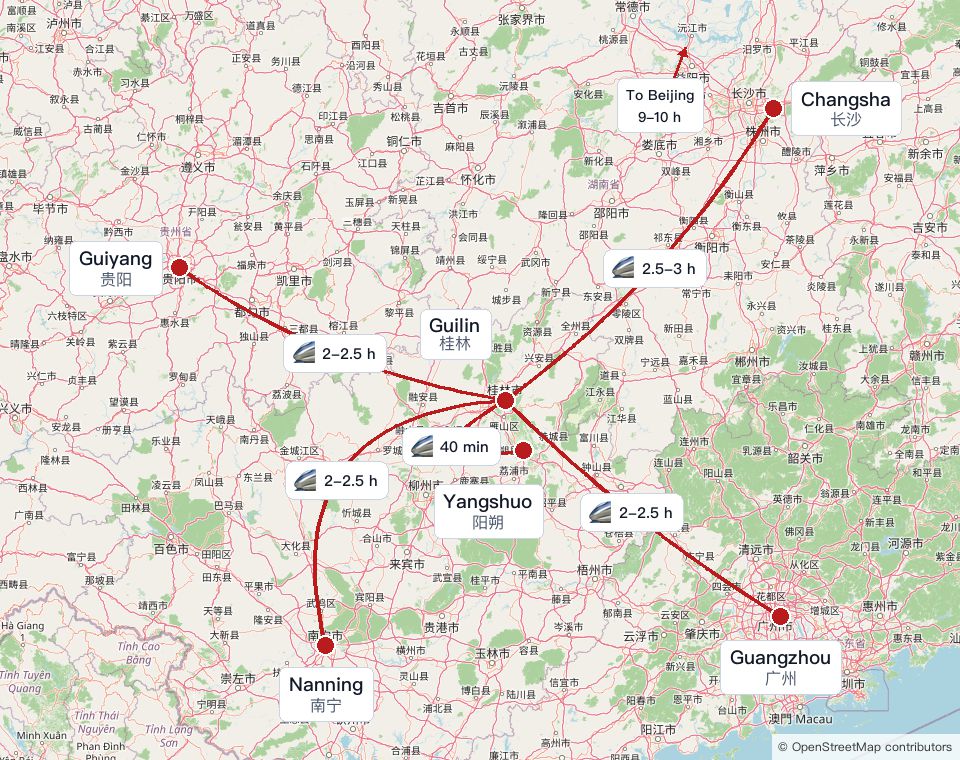
High-speed rail times from Guilin to Yangshuo, Guangzhou, Nanning, Guiyang, and Changsha. Services may use Guilinbei, Guilinxi, or Guilin Station, so check the ticket carefully.
Common onward routes
| Route | Best option | Travel Time | Notes |
|---|---|---|---|
| Guilin (桂林) -> Yangshuo (阳朔) | High-speed train or bus | 40 minutes by rail | Or arrive the scenic way on the Li River cruise. |
| Guilin (桂林) -> Guangzhou (广州) | High-speed train | 2-2.5 hours | The main link to the Greater Bay Area, covered in our Guangzhou guide. |
| Guilin (桂林) -> Nanning (南宁) | High-speed train | 2-2.5 hours | Guangxi’s capital, a hub for onward travel toward Vietnam. |
| Guilin (桂林) -> Guiyang (贵阳) | High-speed train | 2-2.5 hours | Gateway to Guizhou’s waterfalls and villages. |
| Guilin (桂林) -> Changsha (长沙) | High-speed train | 2.5-3 hours | The connection north toward Zhangjiajie and central China. |
Getting around
Guilin city is small enough to cross by bus, taxi, or Didi, and the central sights are close together. The real logistics are about the countryside: the Li River cruise is a one-way trip that leaves you in Yangshuo, so plan to spend at least a night there rather than rushing back. Yangshuo itself is best explored by rented e-bike or scooter, and organized day tours are the simplest way to reach the Longji terraces, which are a couple of hours north by road.
Key Attractions
Guilin’s sights fall into two groups. The countryside is the main event: the Li River cruise and Yangshuo to the south, and the Longji rice terraces up in the hills to the north. These take full days and at least one overnight outside the city. Guilin’s own peaks and lakes are a compact cluster in the city center, easy to see in a spare afternoon before or after the river. The numbers on the map match the sections below; click a numbered dot to jump to it.
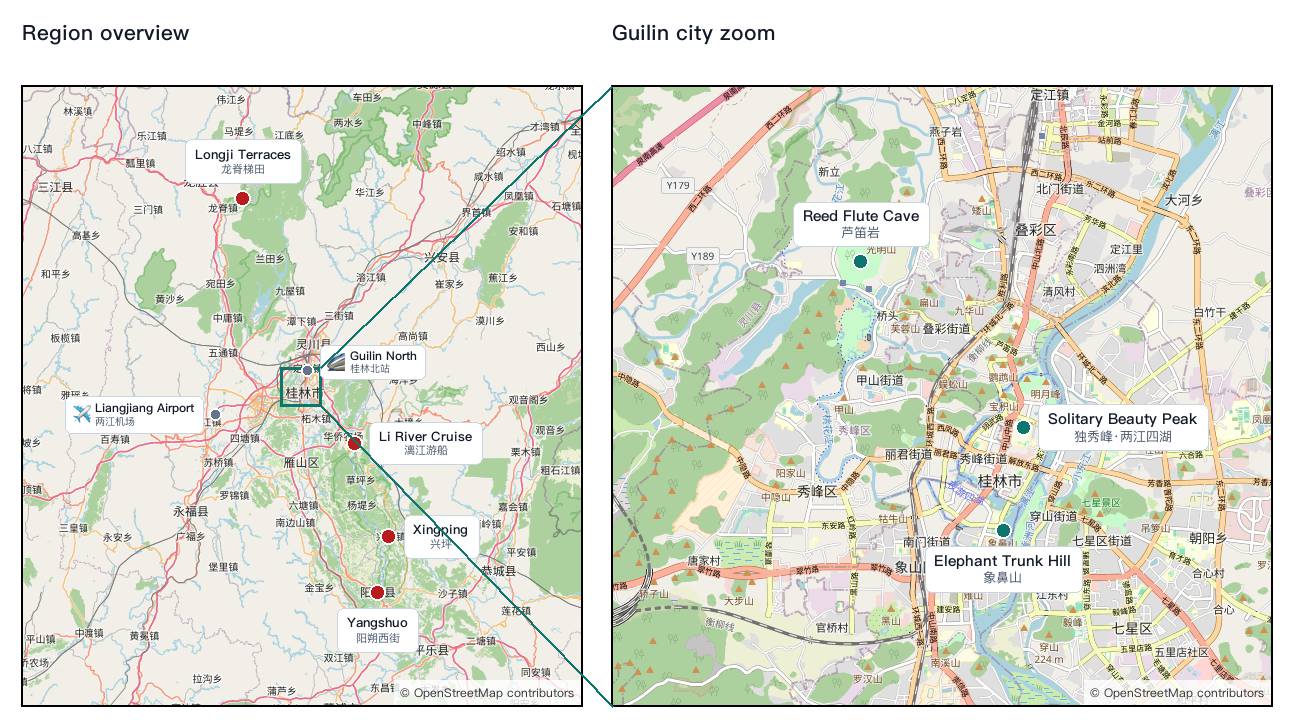
1. Li River Cruise (漓江)
Getting there: Boats depart from the Mopanshan (磨盘山) and Zhujiang (竹江) piers south of Guilin; most hotels and agencies arrange the transfer
Tickets: the four-hour, one-way cruise to Yangshuo Longtoushan Pier costs about CNY215 for a three-star boat from Mopanshan Pier, with food purchased separately or brought aboard, and about CNY360 for a four-star boat from Zhujiang Pier, including a buffet lunch
Time needed: About half a day, plus the onward night in Yangshuo
The cruise down the Li River is the single experience that defines a Guilin trip. For about four hours the boat drifts between hundreds of karst peaks, past fishermen, water buffalo, and bamboo groves, in the scene that generations of Chinese painters have tried to capture. The most celebrated stretch is the lower half approaching Yangshuo, and the boat leaves you there rather than returning, so it doubles as your transfer south.
Choosing a three-star or four-star boat
Both boat classes follow the same river and end at Longtoushan Pier (龙头山码头) in Yangshuo. The difference is comfort rather than scenery:
- Three-star boats leave from Mopanshan Pier (磨盘山码头) and are the sensible value choice. Seating is functional, and food is purchased separately or brought aboard.
- Four-star boats leave from Zhujiang Pier (竹江码头), use more comfortable seating, and include a buffet lunch. A first-class upgrade can provide a less obstructed view, but paying extra merely to sit on the second level of the standard cabin makes little difference once passengers move to the open deck.
Book under each passenger’s real name through the official 漓江售票处 WeChat account. book the Li River cruise one or two days ahead through the official 漓江售票处 WeChat account; peak dates may sell out earlier, while occasional same-day ticket releases are possible but should not be relied on. The piers are well outside central Guilin, so leave time for the road transfer. Mopanshan and Zhujiang piers are roughly 28 km from central Guilin; a taxi or Didi usually takes about 40 minutes and costs around CNY40 to 60, while the official pickup bus costs about CNY30 per person and serves several fixed city stops.
Where to stand for the best views
- Nine-Horse Mural Hill (九马画山): Face forward and use the left side of the deck for the clearest angle toward the patterned cliff.
- Yellow Cloth Reflection (黄布倒影): The onboard announcement comes before the best banknote angle. Use it as a signal to move toward the stern; shortly after passing the reflection, look from the right side of the rear deck for the landscape printed on the twenty-yuan note.
- Food and seats: Standard cabin views are similar across the first two levels because the best photography happens outside. Three-star passengers can bring snacks, and hot water is normally available aboard.
Full cruise or bamboo raft?
The large cruise boat and the shorter Li River motorized bamboo raft (漓江竹筏) are different ways to see the same river. The cruise covers the full Guilin to Yangshuo journey in about four hours and includes indoor seating. The motorized raft normally carries four passengers and concentrates on the most dramatic scenery around Xingping. It is steadier than a hand-poled raft and passengers usually stay dry.
Do not confuse it with the Yulong River bamboo raft (遇龙河竹筏) near Yangshuo. Yulong rafts are hand-poled, normally carry two people, pass through quiet farmland, and descend several small weirs where passengers may get wet. Choose the Li River for monumental karst scenery and the Yulong River for a slower, more intimate countryside experience.
- Classic Xingping route: Chaobanshan Pier (朝板山码头) to Nine-Horse Mural Hill (九马画山) and back takes roughly 50 to 90 minutes. The twenty-yuan note viewpoint is close to the departure area. The trip is roughly CNY140 per person.
- Yangdi section: The 2026 posted total is CNY255 for Yangdi to Xingping Chaobanshan one way in either direction (CNY30 entry plus CNY225 raft; 80 to 100 minutes; 14 km), CNY140 for Yangdi to Mashan one way (CNY15 entry plus CNY125 raft; 50 to 60 minutes; 10 km), and CNY170 for the Yangdi to Laocuntou round trip (CNY15 entry plus CNY155 raft; 80 to 90 minutes; 15 km).
- Sightseeing vehicles: The sightseeing vehicle costs CNY15 per ride from the Xingping raft ticket office to Chaobanshan Pier and CNY20 per ride from Mashan Pier to the Xingping raft ticket office.
- Booking: Reserve through the official 漓江水上游览平台 WeChat account or buy at the pier if spaces remain. Check third-party tickets carefully because some require collection from a distant visitor center.
- Capacity and children: Rafts normally seat four; children under 90 cm cannot board, children between 90 and 130 cm require a child ticket purchased at the pier, and a group wanting a private raft may need to pay roughly CNY35 to 75 for each empty seat.
- Reaching the pier: Chaobanshan Pier is within the Sanqianli (三千漓) area, about a 20-minute walk from Xingping Old Town. Parts of the roadside walk lack a proper sidewalk, so take care with traffic. Drivers can use the designated parking near the pier.
- On the water: Early morning and late afternoon are quieter. Sit in the front row if possible, carry sun protection and a light windproof layer, and keep the required life jacket on. Photography may be restricted while the raft is moving, although the operator normally pauses at designated viewpoints.

The four motorized-raft (排筏) routes posted on the operator's price boards, each drawn as a coloured lane along the real Li River course. Where several share the water they run as parallel lanes. Distances along the drawn river course match the printed board figures within about 10 percent.
Motorized-raft (排筏) fares — Xingping and Yangdi sections. Two piers run the rafts; the coloured lanes on the map match the routes below. Prices are per person as posted on the operator’s boards (朔发改字 / 市发改行审).
| Route | Piers | Trip | Total | Ticket + raft | Time | Distance |
|---|---|---|---|---|---|---|
| ━ A | Yangdi ↔ Xingping (Chaobanshan) | one way, either direction | ¥255 | ¥30 + ¥225 | 80–100 min | 14 km |
| ━ B | Yangdi → Mashan | one way | ¥140 | ¥15 + ¥125 | 50–60 min | 10 km |
| ━ C | Yangdi ↔ Laocuntou | round trip | ¥170 | ¥15 + ¥155 | 80–90 min | 15 km |
| ━ D | Xingping (Chaobanshan) ↔ Nine-Horse Mural Hill | round trip | ¥140 | ¥15 + ¥125 | 50–60 min | 8 km |
The rafts leave from raft docks reached by a short shuttle bus (观光车) from each ticket office: Xingping ticket office ↔ Chaobanshan dock is ¥15 per person, and Xingping ticket office ↔ Mashan dock is ¥20 per person.
What to see
- The karst peaks of the middle river
The densest concentration of the classic pinnacles comes in the middle and lower sections, especially around Yangdi and Xingping. - The twenty-yuan note view
The boat passes the exact bend below Xingping printed on the banknote; have the note ready to compare. - Riverside village life
Cormorant fishermen, bamboo rafts, and farming villages line the banks, a reminder that this is a working landscape and not only a scenic one.
Caution
Do not rely on finding a same-day ticket during busy periods, and arrive at the correct pier for your boat class. The scenery is best in clear weather; a light mist can be atmospheric, but heavy rain flattens the views.
2. Yangshuo & West Street (阳朔西街)
Getting there: The end point of the Li River cruise, or 40 minutes by high-speed train and a short transfer
Admission: Free to explore; individual sights and the Yulong raft are ticketed
Time needed: 1 to 2 days
Yangshuo is the countryside base for the whole region, a small town wrapped in karst peaks where most travelers spend more time than in Guilin itself. Its old core, West Street (西街), is a lively pedestrian lane of bars, cafes, and shops, unashamedly touristy but fun after dark. The real draw is what surrounds the town: rivers, rice fields, and peaks best explored slowly by bike or raft.
What to see
- The Yulong River bamboo raft (遇龙河)
A gentle drift on a two-person raft through the quietest and prettiest stretch of countryside, away from the main river crowds. Fares are a two-person bamboo raft costs about CNY160 to 255 per raft depending on the section, with the Jinlong Bridge to Jiuxian stretch (around CNY255) the most scenic; the drift takes roughly 2.5 hours. - Cycling the countryside
Rented e-bikes reach the rice fields, small villages, and Moon Hill (月亮山) within easy range of town, the best way to see rural Yangshuo. - Impression Liu Sanjie (印象·刘三姐)
A large outdoor light-and-music show staged on the river itself, directed by Zhang Yimou, using the peaks as a backdrop. Tickets are the Impression Liu Sanjie (印象·刘三姐) outdoor light show near Yangshuo runs from around CNY200 for standard seats up to CNY680 for premium. - West Street after dark
The main lane fills with music and food stalls in the evening, the social heart of a Yangshuo stay.
Caution
Yangshuo is heavily geared to tourism, and touts, overpriced tours, and pushy raft operators are common. Book rafts and shows through your hotel or an official channel rather than on the street.
3. Xingping (兴坪)
Getting there: About 40 minutes by bus, hired car, or rental car from Yangshuo, or a stop on some Li River cruises
Admission: Free; short local raft trips are ticketed separately
Time needed: Half a day
Xingping is an old riverside town upstream from Yangshuo, best known for the bend in the river just below it that appears on the back of the twenty-yuan note. The town itself has a quiet, weathered old street, and the surrounding peaks are among the most dramatic on the whole river. It makes an easy half-day trip from Yangshuo and a calmer alternative to West Street.
What to see
- The twenty-yuan note viewpoint
A short walk or a brief local raft trip from the old town reaches the exact spot; early morning light is best, before the day boats arrive. - Xingping Old Street (兴坪古镇)
A short, genuinely old lane of Ming dynasty (1368-1644) and Qing dynasty (1644-1912) shopfronts, quieter and less commercialized than Yangshuo’s West Street. - Laozhai Hill (老寨山)
A steep climb behind the town rewards you with one of the finest panoramas over the river bend and peaks.
Caution
The riverside viewpoint gets busy with tour groups by mid-morning. Come early or late in the day for the calm water and soft light that make the scene worth the trip.
4. Longji Rice Terraces (龙脊梯田)
Getting there: About 2 to 2.5 hours north of Guilin by road; shuttle buses, organized day tours, and rental cars are the main options
Admission: CNY80, covering the Jinkeng, Ping'an, and Gu Zhuang terrace areas; cable cars in the Jinkeng area are ticketed separately
Time needed: A full day, ideally an overnight
The Longji, or Dragon’s Backbone, terraces are hillsides sculpted into stacked ripples of rice paddy over some seven centuries by the Zhuang and Yao peoples. They climb from valley floor to ridgeline in curving contours that catch the light differently in every season: mirror-like when flooded in spring, deep green in summer, and gold before the autumn harvest. Staying overnight in one of the hillside villages lets you catch the terraces at dawn without the day crowds.
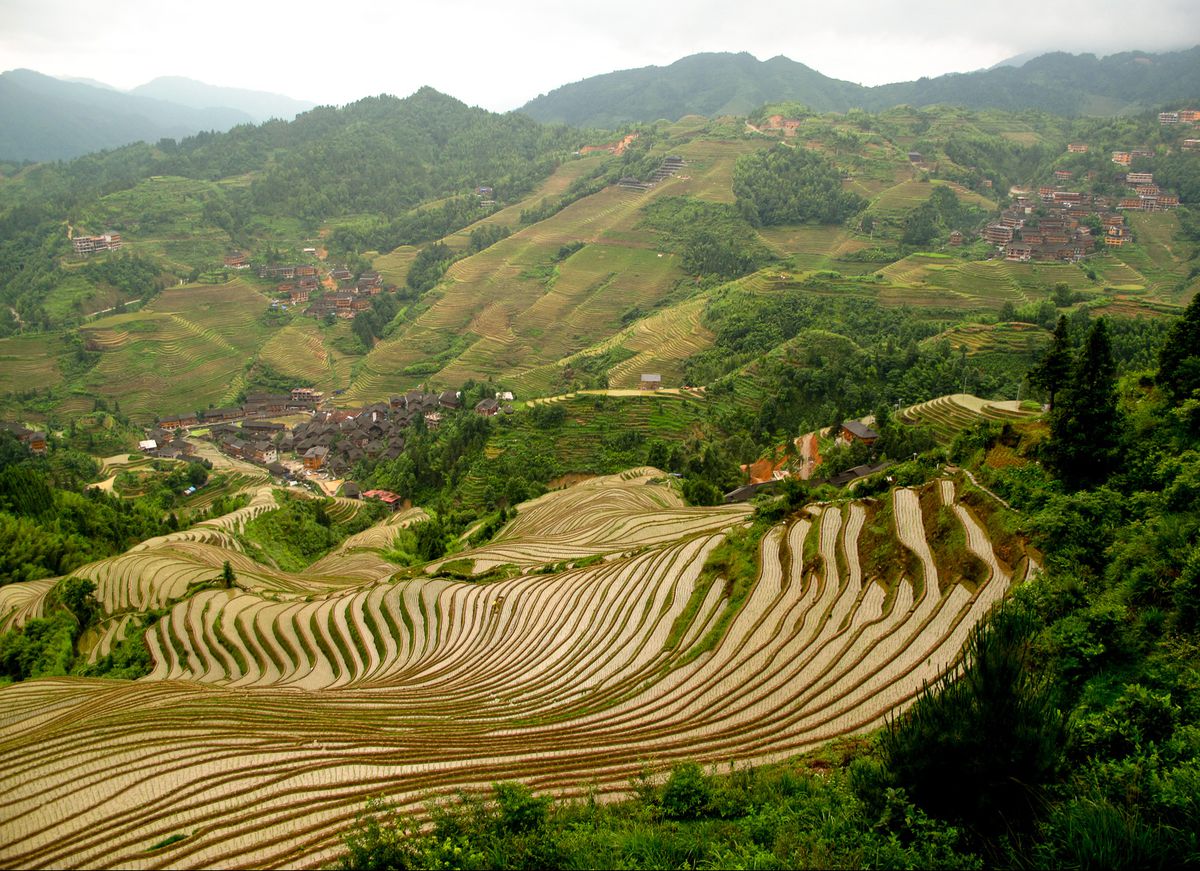
Photo: Rutger van der Maar, CC BY 2.0, via Wikimedia Commons
What to see
- The Jinkeng terraces (金坑梯田)
The larger, higher area, with several famous viewpoints and a cable car; best for the wide, sweeping panoramas. - The Ping’an terraces (平安梯田)
A more compact area around Ping’an village, with the classic “Seven Stars and Moon” and “Nine Dragons and Five Tigers” viewpoints reachable on foot. - The villages themselves
Zhuang and Yao settlements of wooden stilt houses sit among the terraces; the long-haired Yao women of Huangluo are known across the region.
Caution
The best light is at sunrise and sunset, which an overnight stay makes possible; day trips often arrive in flat midday light. Paths between viewpoints are steep and can be slippery, so wear proper shoes.
5. Reed Flute Cave (芦笛岩)
Getting there: In the northwest of Guilin city, about 20 minutes by taxi from the center
Admission: around CNY90 to 110
Time needed: 1.5 hours
Reed Flute Cave is Guilin’s best-known cavern, a large limestone cave hung with stalactites and stone columns and lit with colored floodlights that turn the chambers into something between natural wonder and stage set. It has drawn visitors for over a thousand years, as the ink inscriptions on its walls attest, and remains a reliable option when rain rules out the river.
What to see
- The Crystal Palace
The largest chamber, where the colored lighting and a still pool create the cave’s signature mirrored reflections. - The illuminated formations
Stalactites, stalagmites, and flowstone lit in shifting colors along the walking route through the cave. - The ancient inscriptions
Wall writings dating back over a millennium mark the cave as a long-standing local attraction.
Caution
The colored lighting is divisive: some find it magical, others garish. Treat it as an easy indoor alternative for a rainy afternoon rather than a headline sight in its own right.
6. Elephant Trunk Hill (象鼻山)
Getting there: On the river in central Guilin, walkable or a short taxi from most city hotels
Admission: Free admission
Time needed: 1 to 1.5 hours
Elephant Trunk Hill is Guilin’s civic symbol, a riverside karst formation with a natural arch that looks exactly like an elephant dipping its trunk into the water. It sits where the Li River meets the Peach Blossom River in the middle of the city, and the view of the arch reflected in the water is one of the most recognizable images of Guilin.
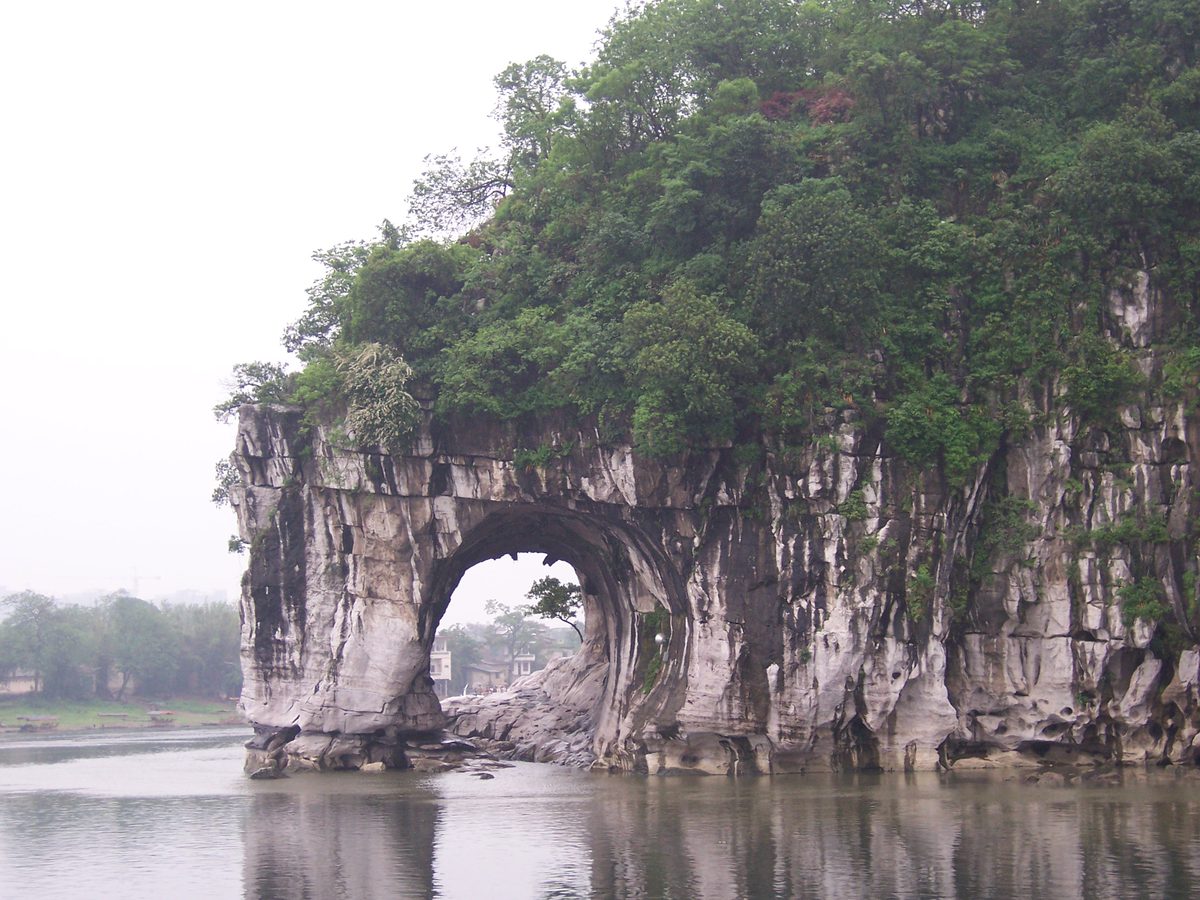
Photo: McKay Savage, CC BY 2.0, via Wikimedia Commons
What to see
- The Water Moon Cave (水月洞)
The natural arch that forms the elephant’s “trunk,” best seen from the riverbank with the hill mirrored below. - Puxian Pagoda (普贤塔)
A small Ming dynasty (1368-1644) pagoda perched on top of the hill, visible from the surrounding park. - The riverside park
Landscaped grounds around the base give the classic photo angles, and the hill is lit at night.
Caution
The classic elephant-shaped profile is easier to appreciate from across the water than from directly beneath the hill. Walk around the riverbank for the clearest angle before entering the busier central part of the park.
7. Solitary Beauty Peak & the City Lakes (独秀峰)
Getting there: In central Guilin, walkable from most city hotels
Admission: CNY65 for the Solitary Beauty Peak and Prince's City (独秀峰·王城) complex; the Two Rivers and Four Lakes waterway around it is free to walk
Time needed: Half a day for the peak and a lakeside walk
Right in the center of Guilin, a single sheer peak rises out of the grounds of a Ming dynasty (1368-1644) prince’s residence, the Jingjiang Prince’s City. Climbing Solitary Beauty Peak gives a fine overview of the city ringed by its karst hills, and the restored prince’s city at its base is a genuine piece of history. Just south, the linked lakes of the Two Rivers and Four Lakes system make a pleasant free walk, especially in the evening when the twin pagodas on Shan Lake are lit.
What to see
- Solitary Beauty Peak (独秀峰)
A steep stone stairway climbs the isolated peak for a 360-degree view over Guilin and the surrounding hills. - Jingjiang Prince’s City (靖江王城)
The walled Ming dynasty (1368-1644) palace grounds at the base, older than the Forbidden City, now part of a university campus. - The Sun and Moon Twin Pagodas (日月双塔)
Two pagodas rising from Shan Lake in the city’s lake network, spectacular when floodlit after dark. - The Two Rivers and Four Lakes walk (两江四湖)
A free waterside circuit through the linked lakes and canals that ring the old town, best in the evening.
Caution
The lake network is genuinely free and pleasant on foot; only the peak and prince’s city carry an admission charge. Evening is the best time for the illuminated pagodas and their reflections.
Suggested Itineraries
3 Days in Guilin and Yangshuo
Day 1: Guilin city
Elephant Trunk Hill and Solitary Beauty Peak in the day, then a lakeside evening walk to the illuminated twin pagodas. Reed Flute Cave fits in if the weather turns.
Day 2: The Li River to Yangshuo
Take the morning cruise from Guilin down to Yangshuo, arriving mid-afternoon. Settle in, then explore West Street after dark.
Day 3: Yangshuo countryside
A morning Yulong River raft, an afternoon cycling the rice fields toward Moon Hill, and optionally the evening Impression Liu Sanjie show.
4 to 5 Days: Adding the terraces
Days 1 to 3 as above, then:
Day 4: Longji rice terraces
Head up to the terraces, ideally staying overnight in a hillside village to catch sunrise and sunset without the day crowds.
Day 5: Xingping and a slower river
Return toward Yangshuo via Xingping for the twenty-yuan view and old street, then a final relaxed evening before moving on.
Where to Stay
Yangshuo is where most travelers base themselves, from riverside resorts to countryside guesthouses among the peaks; it is more scenic and relaxed than the city. Guilin city is convenient for the first or last night and for the airport and stations. An overnight in the Longji terraces is worth it if the timing works. Prices below are rough high-season guides; check current rates before booking.
Luxury
- Riverside resorts around Yangshuo
Design-led resorts set among the karst peaks and rivers outside town, some in restored sugar mills or with infinity pools facing the hills. Often CNY800-2,000+/night.
Boutique
- Countryside guesthouses and terrace lodges
Small, characterful stays in the Yangshuo countryside or up in the Longji villages, often family-run. Often CNY400-1,000/night.
Midscale
- City chains in Guilin and central Yangshuo
Reliable domestic hotels near the stations, the river, or West Street. Often CNY250-550/night.
Budget
- Hostels in Yangshuo and Guilin
A long-established backpacker scene, especially in and around Yangshuo, with cheap dorms and easy tour bookings. Often CNY120-300/night.
Where to Eat
- Yangshuo West Street: Tourist-facing bars and restaurants, fine for a lively evening but not the place for the most authentic local food.
- Guilin’s noodle shops: The city runs on rice noodles; small local shops away from the sights do them best and cheapest.
- Countryside farm meals: Guesthouses in the Yangshuo countryside and Longji villages often cook simple, excellent meals with local ingredients.
- Riverside restaurants: Places on the water trade partly on the view; a short walk inland usually finds better value.
Dishes to Try
- Guilin rice noodles (桂林米粉): The city’s signature dish, rice noodles dressed with pickles, peanuts, and a savory braised sauce, eaten at any hour.
- Beer fish (啤酒鱼): Yangshuo’s best-known dish, fresh river fish braised with beer, tomato, and chili, meant for sharing.
- Stuffed Li River snails (酿田螺): River snails stuffed with a pork-and-herb mince, a local specialty.
- Zhuang and Yao village food: In the Longji terraces, bamboo-tube rice and smoked meats reflect the local minority cuisines.
- Osmanthus sweets (桂花): Guilin means “osmanthus forest,” and the flower flavors local cakes, tea, and wine.
- Taro and countryside vegetables: Simple farm-grown produce, often the highlight of a countryside guesthouse meal.
Hero photo: Chinatravelsavvy, CC BY-SA 3.0, via Wikimedia Commons.
Help keep this guide accurate
Found something incorrect, outdated, or missing? Tell us what changed and include a source when possible.
Suggest an update