
On this page15 sections
✓ Prices and practical details last verified August 3, 2026
Luoyang was the capital of thirteen dynasties, the eastern anchor of ancient China and, for stretches of the Han dynasty (202 BCE-220 CE) and Tang dynasty (618-907), one of the greatest cities on earth. Its glories survive on its edges and under its streets: the Longmen Grottoes’ cliff of carved Buddhas to the south, China’s first Buddhist monastery to the east, and the excavated heart of the Sui dynasty (581-618) and Tang dynasty (618-907) palace city rebuilt in the center. In April the whole city turns out for the peonies it has grown since the Tang dynasty (618-907). Modern Luoyang is an easygoing, mid-sized Henan city, easy to reach by high-speed rail and far less crowded than Xi’an, its great rival in ancient-capital bragging rights.
Highlights
- Stand before the colossal Vairocana Buddha of the Longmen Grottoes (龙门石窟), carved under Wu Zetian.
- Visit the White Horse Temple (白马寺), the first Buddhist monastery in China.
- Wander lantern-lit lanes in hanfu at Luoyi Old Town (洛邑古城), Luoyang’s night-photo favorite.
- Climb the rebuilt Yingtian Gate (应天门) and the Mingtang of Wu Zetian’s palace city.
- Walk through excavated tomb chambers, an Eastern Zhou royal chariot pit, and the Bronze Age finds of Erlitou in three unusually strong specialist museums.
- Catch the city drowning in blooms during April’s peony festival (牡丹文化节).
Transportation
Railway stations
Luoyang Longmen station, on the Zhengzhou to Xi'an high-speed line, is the main gateway: about 40 minutes from Zhengzhou, 1.5 hours from Xi'an, and 4 hours from Beijingxi; the older Luoyang station near the old town handles slower trains, and the small city airport has a handful of domestic routes. Which station you use matters: Longmen station is south near the grottoes, the old station is north near the old town, and the metro links both.
Luoyang Longmen Railway Station (洛阳龙门站) is the main high-speed rail gateway on the Zhengzhou to Xi’an line, with the fastest and most frequent services to Zhengzhou, Xi’an, Beijing, and Shanghai. It sits south of the city, close to the Longmen Grottoes, and connects to metro Line 2. Luoyang Railway Station (洛阳站) is the older station near the old town, handling slower conventional trains. The two are far apart, so always check which station your ticket uses; the metro and local buses link both with the city center.
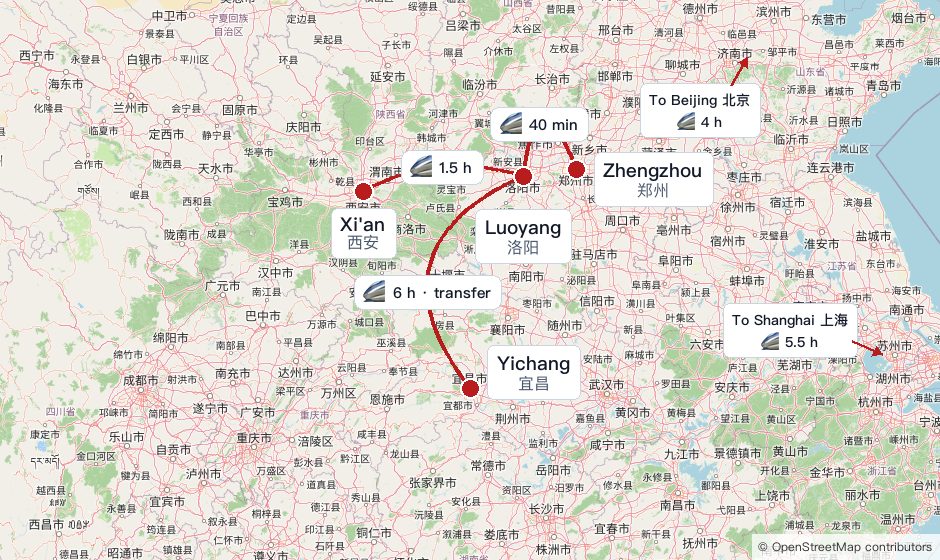
Reaching Luoyang by rail from Zhengzhou, Xi'an, Yichang, Beijing, and Shanghai. The Yichang journey normally requires a transfer.
Airport
Luoyang Beijiao Airport (洛阳北郊机场 / LYA) is a small regional airport north of the city with a limited, largely seasonal set of domestic routes. It is rarely the best way into or out of Luoyang; for most visitors the high-speed rail corridor is faster and better connected to the city. Check current direct routes on FlightConnections.
Common onward routes
| Route | Best option | Travel Time | Notes |
|---|---|---|---|
| Luoyang -> Zhengzhou (郑州) | High-speed train | ~40 minutes | Henan’s capital and hub, with the Shaolin Temple en route. |
| Luoyang -> Xi’an (西安) | High-speed train | ~1.5 hours | The other great ancient capital, west along the Silk Road line. |
| Luoyang -> Yichang (宜昌) | High-speed train with a transfer | ~6 hours | Gateway to the Three Gorges; check the connection before booking. |
| Luoyang -> Beijing (北京) | High-speed train | ~4 hours | Direct trains from Luoyang Longmen station. |
| Luoyang -> Shanghai (上海) | High-speed train | ~5.5 hours | Direct trains east via Zhengzhou. |
Getting around
Luoyang’s two metro lines cover most of what you need: Line 1 runs east-west past the old town and the Sui dynasty (581-618) and Tang dynasty (618-907) sites, Line 2 runs north-south linking the old railway station, the city center, and Longmen high-speed station. The grottoes and White Horse Temple sit outside the metro’s reach, so finish those trips by bus or a short Didi ride.
Every metro station has an entrance security check, so leave a few extra minutes at the main interchange stations. A transit QR code in Alipay or WeChat, or a single-journey ticket from the machine, covers the metro; keep a little cash as backup. Taxis and Didi are cheap and plentiful, but drivers rarely speak English, so carry the Chinese name of your destination. Most city-center sights are close enough to combine on foot with the metro.
Key Attractions
Luoyang’s sights split into a compact city-center cluster and a ring of bigger sites around it. The center holds the old-city night circuit from Guandong Street to Lijing Gate and from Luoyi Old Town to Yingtian Gate, plus Wangcheng Park and the Tianzi Jialiu Museum. The ring holds the Longmen Grottoes to the south, the White Horse Temple and Erlitou to the east, the Ancient Tombs Museum to the north, and Guanlin and the Luoyang Museum in between. The numbered map covers the six core sightseeing sections. Both number 3 markers belong to the same night circuit. The three specialist museums in sections 7 to 9 sit outside this compact map and work best as optional additions.
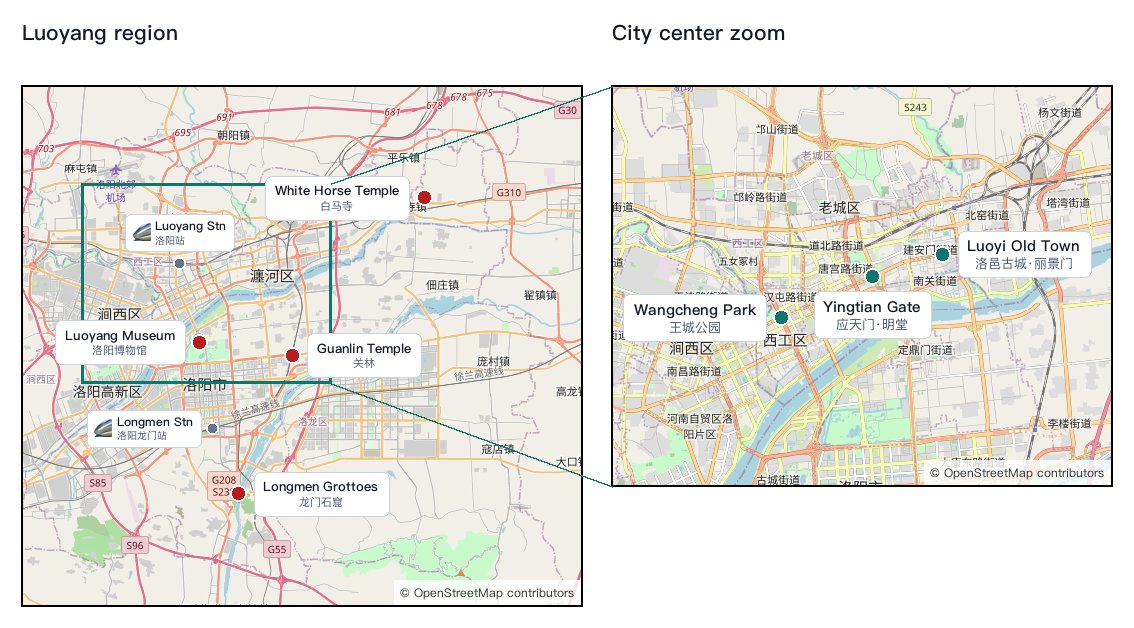
1. Longmen Grottoes (龙门石窟)
Getting there: 12 km south of the center; bus or Didi from Longmen high-speed station or metro Line 2’s southern end
Admission: CNY90, by real-name timed reservation on the official 龙门石窟 channels, bookable up to 7 days ahead (each day's allotment opens just after midnight); in peak weeks book a few days out
Time needed: Half a day
The Longmen Grottoes are one of China’s three great Buddhist cave complexes and a UNESCO World Heritage site: a kilometre of limestone cliff along the Yi River, drilled with some 2,300 caves and niches holding a hundred thousand carved figures, worked from the Northern Wei dynasty (386-534) through the Tang dynasty (618-907). The climax is the Fengxian Temple niche, where the 17-metre Vairocana Buddha, said to have been modelled on Empress Wu Zetian herself, gazes serenely over the river. The main west-bank walk passes all the famous caves; the east bank gives the classic panorama back across the water, especially beautiful when the cliff is lit at night.
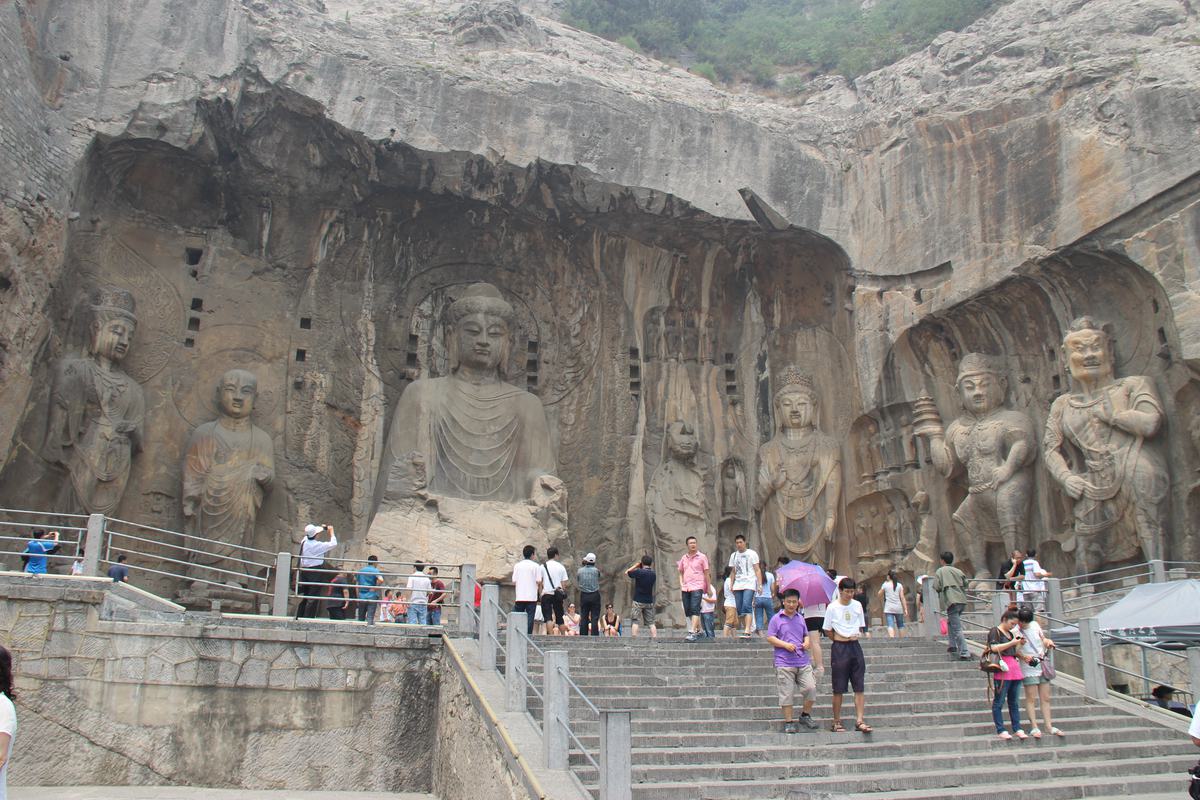
Photo: Gary Todd, CC0, via Wikimedia Commons
What to see
- Fengxian Temple (奉先寺)
The great open niche with the colossal Vairocana Buddha and its guardian kings, the masterpiece of Longmen. - The west-bank caves
Guyang, Binyang, and the Ten Thousand Buddha Cave, spanning Northern Wei dynasty (386-534) to Tang dynasty (618-907) styles. - The east-bank panorama
The full sweep of the carved cliff over the Yi River, and the night illumination in season.
Caution
The site is long and mostly stairs, so allow at least three hours and wear good shoes. Summer middays are hot on the exposed cliff; go early or late, and consider the evening session when the caves are lit.
2. White Horse Temple (白马寺)
Getting there: 13 km east of the center; bus 58 or a Didi ride
Admission: CNY35
Time needed: 2 to 3 hours
The White Horse Temple is held to be the first Buddhist monastery in China, founded in 68 AD when, the story goes, two Indian monks arrived carrying sutras on a white horse. It has been rebuilt many times but remains a serene, working monastery of courtyards, incense, and ancient cypresses, with the tombs of the two founding monks inside and the Qiyun Pagoda a short walk beyond. Its modern twist is the International Buddhist Garden next door, where India, Thailand, and Myanmar have each built a temple in their own style, making a strange and photogenic tour of Asia’s Buddhist architecture in one place.
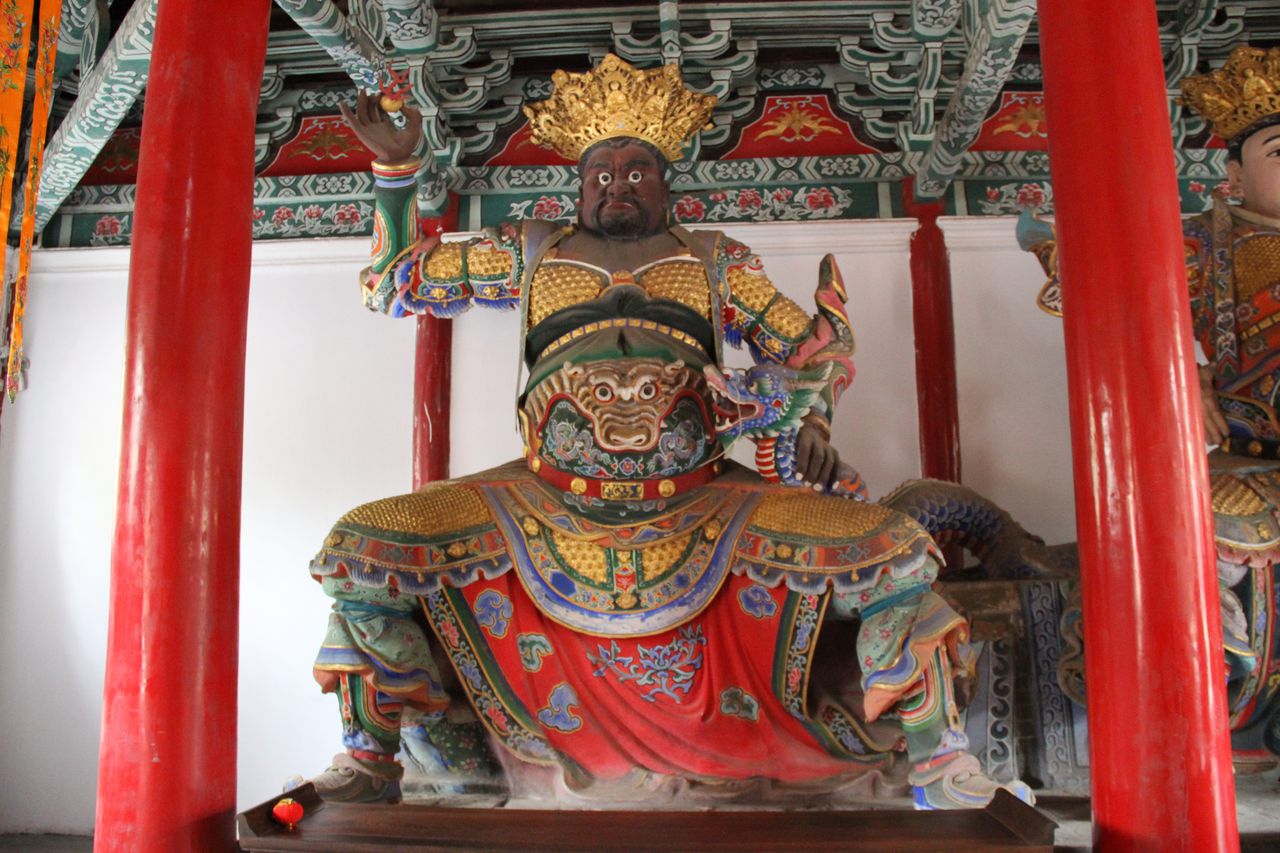
Photo: Gary Todd, CC0, via Wikimedia Commons
What to see
- The ancient monastery
The axis of halls, courtyard cypresses, and the founding monks’ tombs of China’s first temple. - The international gardens
The Indian, Thai, and Burmese-style temples beside the old monastery. - Qiyun Pagoda (齐云塔)
A 12th-century brick pagoda in its own quiet grounds east of the main temple.
Caution
It is a working monastery, so dress modestly and keep voices down in the halls. The site plus the international garden is bigger than it looks; give it a solid half day if you want both.
3. Luoyang Old City at Night (关东街·丽景门·洛邑古城·应天门)
Getting there: Metro Line 1 to Lijingmen, Yingtianmen, or Qingniangong stations
Admission: The outdoor streets and squares are free. Luoyi Old Town is free, but entry is by advance reservation through the official 洛邑古城 WeChat account or Meituan, and evening slots go fast in holiday periods. Yingtian Gate and the palace museums cost about CNY58 for Yingtian Gate alone, or CNY140 for the combo covering the Mingtang and Tiantang halls, Yingtian Gate, and the Jiuzhou Pool gardens
Time needed: One evening
Central Luoyang is best understood as one long night circuit with two very different personalities. From Guandong Street (关东街) to Lijing Gate (丽景门), the route becomes an enormous snack street packed with grills, soup stalls, sweets, and busy storefronts. It is lively and convenient for dinner, but more commercial food market than preserved historic quarter.
From Luoyi Old Town (洛邑古城) to Yingtian Gate (应天门), the atmosphere shifts into something close to a vast open-air hanfu photography set. Visitors in elaborate costumes fill the lantern-lit lanes, bridges, and palace squares, while staged hanfu processions and performances appear on busy evenings. The visible streets, pavilions, Lijing Gate, Yingtian Gate, Mingtang, and Tiantang are mostly new construction or modern reconstruction. Come after dark for photography and spectacle rather than architectural authenticity.
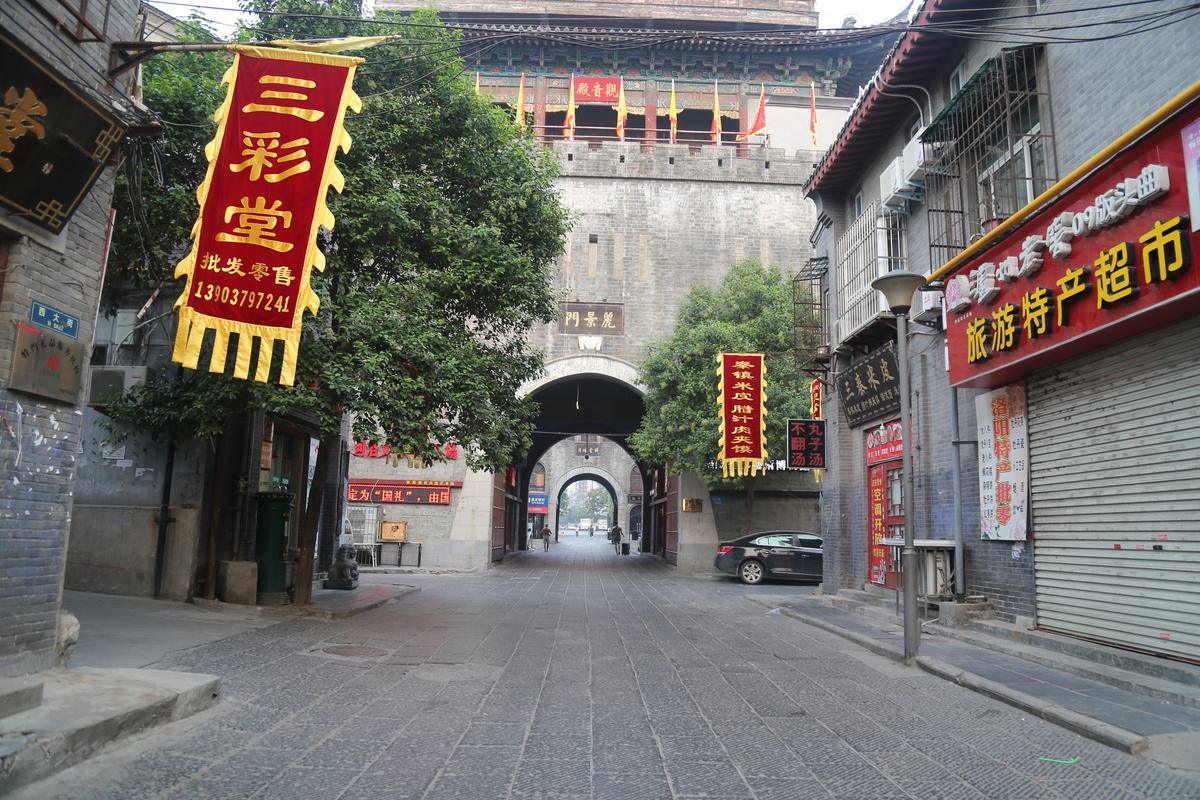
Photo: 江上清风1961, CC BY 3.0, via Wikimedia Commons
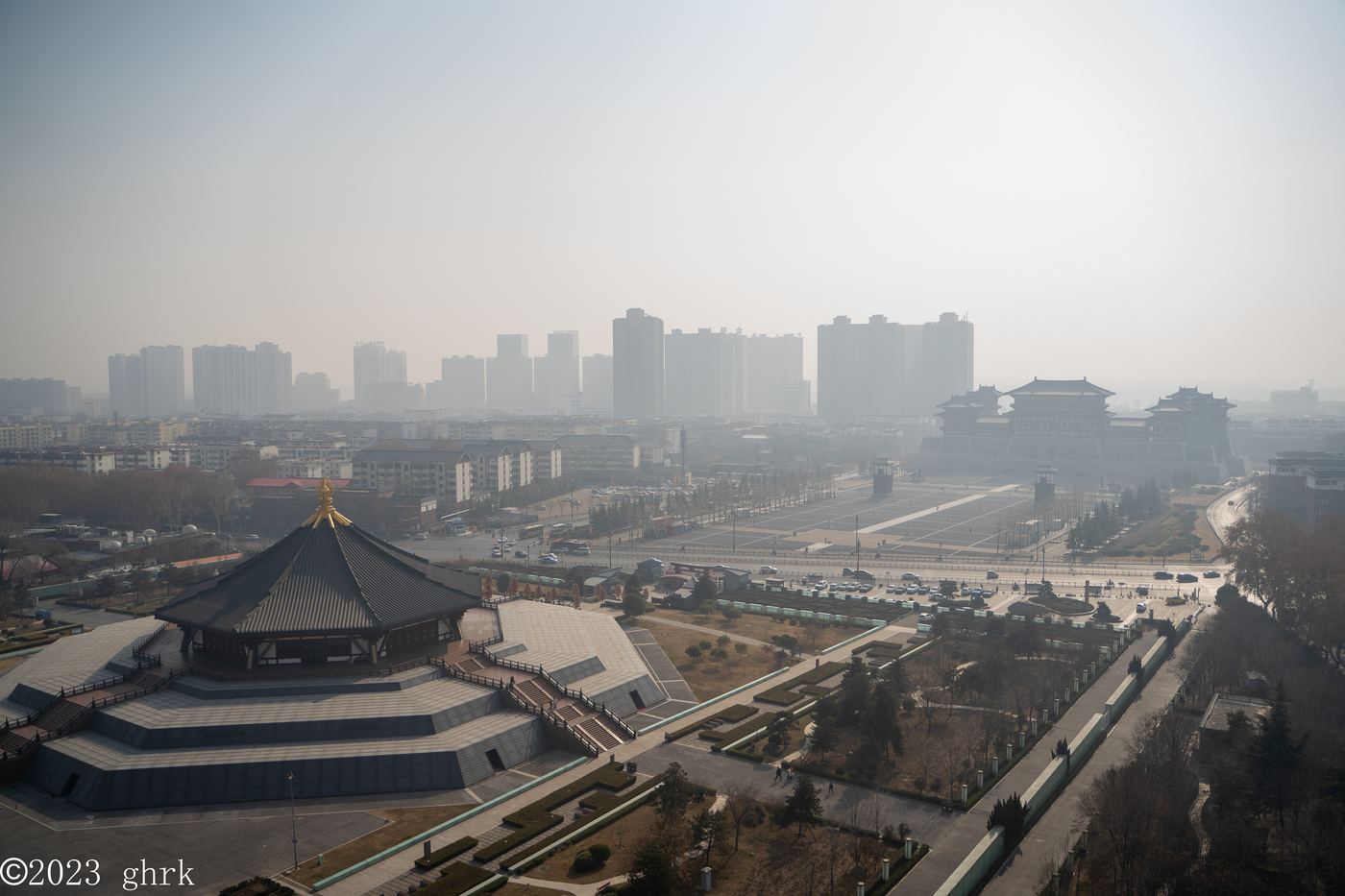
Photo: Ghrkya, CC BY-SA 4.0, via Wikimedia Commons
What to see
- Guandong Street (关东街)
The eastern end of the food section, leading into a long, crowded run of snack stalls and shops. - Lijing Gate (丽景门)
A monumental modern reconstruction marking the western end of the old-city food street. It is most impressive when illuminated after dark. - Luoyi Old Town (洛邑古城)
Lantern-lit lanes, bridges, costume studios, and dense crowds in rented hanfu. This is the heart of Luoyang’s evening photography scene. - Yingtian Gate (应天门)
The rebuilt triple gate stands over Sui dynasty (581-618) and Tang dynasty (618-907) foundations, with museum floors inside and illumination outside. - The Mingtang and Tiantang (明堂·天堂)
Modern structures interpret Wu Zetian’s round audience hall and towering Buddhist pavilion over the excavated palace core.
Caution
This entire circuit can become extremely crowded on weekends and holidays. Reserve Luoyi Old Town ahead when required, and visit on a weekday if you want room for photographs. The reconstructed buildings are visually effective at night, but visitors looking for surviving ancient architecture should prioritize White Horse Temple, Longmen, Guanlin, and Luoyang’s museums.
4. Luoyang Museum (洛阳博物馆)
Getting there: South of the Luo River; metro Line 2 to Luoyang Museum area then a short walk or bus
Admission: free with a real-name reservation on the museum's official WeChat account 洛阳博物馆, released 3 days ahead at 07:00; closed Mondays outside holidays and the peony festival
Time needed: 2 to 3 hours
Thirteen dynasties of capital leave a lot in the ground, and the Luoyang Museum is where the best of it surfaces: Xia dynasty (c. 2070-1600 BCE) and Shang dynasty (c. 1600-1046 BCE) bronzes, Han dynasty (202 BCE-220 CE) tomb figures, Tang dynasty (618-907) sancai camels, and the jade, gold, and Buddhist statuary of a city that was, for centuries, the center of the Chinese world. The building itself, a great bronze-toned slab meant to evoke a ancient ding vessel, holds a chronological main exhibition plus treasure galleries upstairs. It is the ideal first stop for making sense of everything else you will see in Luoyang.
What to see
- The dynastic galleries
The chronological sweep from Neolithic Erlitou through Xia dynasty (c. 2070-1600 BCE), Shang dynasty (c. 1600-1046 BCE), Han dynasty (202 BCE-220 CE), and Tang dynasty (618-907) Luoyang. - The Tang dynasty (618-907) sancai collection
Glazed camels, horses, and court figures, the signature finds of Tang dynasty (618-907) tombs. - The treasure halls
The picked masterpieces upstairs, including palace furniture and Buddhist bronzes.
Caution
Reserve ahead on the museum’s official WeChat account (洛阳博物馆) and remember the Monday closure. Galleries are extensive; pick the main chronology plus one special hall rather than trying to see everything.
5. Guanlin Temple (关林)
Getting there: South of the center near Longmen station; metro Line 2 plus a short walk or bus
Admission: about CNY40
Time needed: 1 to 2 hours
Guanlin is the burial place of the head of Guan Yu, a general of the Three Kingdoms period (220-280) deified as the god of war and loyalty, and one of the three great Guan Yu shrines in China. A processional axis of Ming dynasty (1368-1644) and Qing dynasty (1644-1912) halls, carved stone lions, and old cypresses leads back to the tumulus itself, and the temple hums with worshippers asking Lord Guan for protection and business luck. It is small, atmospheric, and conveniently on the way between the city center and the Longmen Grottoes.
What to see
- The shrine axis
Ming dynasty (1368-1644) and Qing dynasty (1644-1912) halls with vivid Guan Yu statuary and carved dragon pillars. - The stone lion walkway
Dozens of small carved lions, each different, lining the path rails. - The burial mound
The tree-covered tumulus at the rear, resting place of Guan Yu’s head.
Caution
It pairs naturally with Longmen since both are in the south of the city; do Guanlin first, then the grottoes for the afternoon and evening light. Incense sellers at the gate can be pushy; buy inside if you want to make an offering.
6. Wangcheng Park & Peony Season (王城公园)
Getting there: Metro Line 1 to Wangcheng Park station, city center
Admission: Normally a small park fee; higher during the peony festival
Time needed: 2 to 3 hours in season
Luoyang has grown peonies, the “king of flowers,” since the Tang dynasty (618-907), and every April the city stages the Luoyang Peony Culture Festival around them. Wangcheng Park, built over the ruins of the Zhou dynasty (c. 1046-256 BCE) royal city, is the festival’s traditional heart, its beds packed with hundreds of varieties from deep crimson to the famous green and black cultivars, alongside lanterns, performances, and full-city crowds. the 2026 Luoyang Peony Culture Festival ran April 1 to 30, when the whole city blooms and prices spike; Wangcheng Park charged about CNY50 at the gate (less via early-bird online tickets), and hotels and trains sold out weeks ahead. Outside April it is an ordinary, pleasant city park, so this is the one Luoyang sight that is truly seasonal.
What to see
- The peony beds in April
Hundreds of varieties in bloom, with the rare green, black, and multicolor cultivars the connoisseur draws. - The festival scene
Lantern displays, performances, and the whole city out among the flowers. - Other peony gardens
The National Peony Garden and China National Flower Garden bloom on slightly different schedules, useful if you land early or late.
Caution
Bloom timing shifts with the weather; early April is usually safest for peak flowers, and different gardens peak at different weeks. Festival-month hotels and trains sell out well ahead, so book everything early if you come in April.
7. Luoyang Ancient Tombs Museum (洛阳古墓博物馆)
Getting there: On the northern edge of Luoyang near the airport; metro Line 2 to Mangling (邙岭), then bus 83 or Didi
Admission: free with advance real-name reservation through the museum's official website or WeChat account; passport holders reserve online and present the passport plus booking QR code for staff verification; normally closed Mondays outside public holidays
Time needed: 2 to 3 hours
Luoyang’s emperors, officials, merchants, and ordinary families left an extraordinary archaeological record beneath the city. The Ancient Tombs Museum, also called the Henan Ancient Mural Museum, brings that hidden world together in one place. Visitors descend into a sequence of relocated tomb chambers whose architecture, painted walls, carved bricks, and burial layouts span the Western Han dynasty (206 BCE-9 CE) through the Song dynasty (960-1279) and Jin dynasty (1115-1234). It feels very different from a conventional display-case museum and is one of Luoyang’s most distinctive historical experiences.
What to see
- The representative tomb chambers
A chronological underground route through different burial forms, painted ceilings, carved doors, and domestic scenes made for the afterlife. - The Henan ancient mural galleries
Fragile tomb paintings shown with enough context to explain their ritual and social meaning. - The Northern Wei imperial tomb area
The mausoleum of Emperor Xuanwu of the Northern Wei dynasty (386-534), set apart from the main sequence of smaller tombs.
Caution
This is a large site with dim underground passages, steps, and enclosed chambers. Allow more time than the word “museum” suggests, and skip the deepest sections if enclosed spaces make you uncomfortable. Passport holders must reserve through the official system and then have their documents checked by staff at entry.
8. Zhou Royal City Tianzi Jialiu Museum (周王城天子驾六博物馆)
Getting there: Beneath Zhou Wangcheng Square in the city center; metro Line 1 to Zhou Wangcheng Square (周王城广场)
Admission: CNY30; open daily, with the last ticket normally sold before the evening closing time
Time needed: 1 to 1.5 hours
This compact underground museum was built directly over an Eastern Zhou dynasty (770-256 BCE) royal burial complex. Its defining exhibit is the original chariot-and-horse pit in which six horses were buried side by side before a single chariot. Ancient ritual texts associated a six-horse team with the Son of Heaven, so the discovery gave the museum its popular name, “the emperor driving six.” The bones, wheel traces, and arrangement remain in the ground where archaeologists found them, making the site more immediate than a reconstructed display.
What to see
- The six-horse royal chariot pit
The museum’s central archaeological remains, viewed from the edge of the original excavation. - The wider chariot formation
Additional horses and vehicles that show the scale and order of an Eastern Zhou dynasty (770-256 BCE) ceremonial convoy. - The royal-city introduction
A concise exhibition explaining the Zhou dynasty (c. 1046-256 BCE) capital beneath modern central Luoyang.
Caution
The museum is small and focused, so do not plan a separate half day for it. It works best between Wangcheng Park, the city center, and the Sui dynasty (581-618) and Tang dynasty (618-907) palace sites. The original animal remains may be uncomfortable for very young children.
9. Erlitou Site Museum of the Xia Capital (二里头夏都遗址博物馆)
Getting there: In Yanshi District east of Luoyang; use Didi, a hired car, or a rental car. Public transport is possible but slow, and the museum pairs naturally with White Horse Temple on an eastern route
Admission: free; normally open Tuesday to Sunday from 09:00 to 17:00, with holiday and peony-festival arrangements announced separately
Time needed: 2 to 3 hours, plus travel
Erlitou is one of the most important archaeological sites for understanding the emergence of cities, palaces, bronze production, and elite ritual in early China. The museum identifies the site with the Xia dynasty (traditionally c. 2070-1600 BCE), while the exact relationship between the archaeological Erlitou culture and the Xia described in later texts remains debated. That uncertainty is part of what makes the museum worthwhile: the road grid, palace foundations, workshops, turquoise objects, jade blades, and early bronze vessels show a highly organized center regardless of the name attached to it.
What to see
- The turquoise and bronze ritual objects
Delicate turquoise inlay and unusual beast-mask designs associated with elite ceremonial life. - The early bronze vessels
Jue wine vessels and a lattice-pattern ding that place Erlitou near the beginning of China’s bronze ritual tradition. - The city and palace model
A reconstruction of the road network, palace compound, workshops, and controlled urban space revealed by excavation.
Caution
The museum is far enough east that it needs deliberate planning. It is most rewarding for visitors interested in archaeology and early Chinese history; travelers with only two days should prioritize Longmen, White Horse Temple, and the central city. Do not describe Erlitou as conclusively proven to be the Xia capital, since that identification remains an archaeological debate.
Suggested Itineraries
2 Days: The Essentials
Day 1: Grottoes and gods
The Luoyang Museum in the morning for context, Guanlin at midday, then the Longmen Grottoes for the afternoon, staying for the evening illumination before heading back.
Day 2: Temples and the Tang dynasty (618-907) city
The White Horse Temple and its international gardens in the morning, the Yingtian Gate and Mingtang in the afternoon, then Luoyi Old Town and the Lijing Gate night market for the evening.
Peony season
In April, weave the flowers in: Wangcheng Park or the National Peony Garden first thing before the crowds build, then continue the standard route. Expect everything, including Longmen, to be at its busiest.
Add-ons
The Ancient Tombs Museum is the strongest half-day addition for most history-focused visitors, while the Tianzi Jialiu Museum fits easily into a city-center afternoon. With a third day, pair White Horse Temple and the Erlitou museum along the eastern side of Luoyang. The Shaolin Temple is about 1.5 hours east by car or bus toward Zhengzhou and is often done as a separate day trip.
Where to Stay
The most convenient bases are the old town area near Lijing Gate, best for evening atmosphere, and the Wangcheng Square and city-center blocks along metro Line 1 and 2 interchange, best for reaching everything. Staying near Longmen station works for a late arrival or early train, but it is far from the night life. Prices below are rough guides; April peony season is the great exception, when everything spikes and sells out.
Midscale
- City-center and old-town hotels
Comfortable chains and boutique stays near the metro and the old town. Often CNY250-500/night most of the year, but often double during the April peony festival.
Budget
- Guesthouses and budget chains
Simple rooms across the center, many near the old town’s lanes. Often CNY100-250/night, higher in April and holidays.
Where to Eat
- The water-banquet tradition: Luoyang’s signature is the “water banquet” (水席), a parade of soupy courses born of the dry Henan climate.
- Old town snack streets: The lanes around Lijing Gate and the Old Town Cross Street night market are the evening grazing grounds.
- Henan staples: Stewed noodles, soup dumplings, and lamb soups anchor everyday menus.
Dishes to Try
- Luoyang water banquet (洛阳水席): The famous 24-course soup banquet; the peppery “swallow dish” (牡丹燕菜), radish masquerading as bird’s nest with a peony flourish, is the star.
- Beef and lamb soup (牛肉汤/羊肉汤): Luoyang’s breakfast religion, rich broth ladled over shredded meat with flatbread to dunk.
- Buns from the old town (不翻汤/小街锅贴): Sour-peppery “no-flip” soup and crisp potstickers from famous old-town shops.
- Henan stewed noodles (烩面): Wide hand-pulled noodles in mutton broth, the province’s comfort dish.
- Pastry horns (糊涂面/浆面条): Fermented soy-milk noodles, a tangy old Luoyang taste worth one adventurous bowl.
- Peony pastries (牡丹饼): Flower-scented sweet cakes, the edible souvenir of the peony city.
Hero photo: Gary Todd, CC0, via Wikimedia Commons.
Help keep this guide accurate
Found something incorrect, outdated, or missing? Tell us what changed and include a source when possible.
Suggest an update