
On this page13 sections
✓ Prices and practical details last verified July 11, 2026
The Three Gorges are the most famous stretch of the Yangtze, a roughly 200-kilometre run where China’s greatest river cuts through mountain ranges in a succession of sheer-walled canyons. The classic way to see them is by cruise between Chongqing and Yichang, drifting past cliffs, pagodas, and the towns half-drowned by the reservoir behind the Three Gorges Dam. Yichang, at the eastern end, is the practical base: it sits beside the dam and the last gorge, and its high-speed trains and airport make it the natural start or finish point. This is a guide to the river and its sights rather than to a single city.
Highlights
- Take a Yangtze cruise (长江三峡游船) between Chongqing and Yichang, the classic way to see all three gorges from the water.
- Stand above the Three Gorges Dam (三峡大坝), the largest hydroelectric project in the world, just outside Yichang.
- Sail through the sheer cliffs of Qutang Gorge (瞿塘峡), the shortest and most dramatic gorge, printed on the ten-yuan note.
- Look up at the Goddess Peak (神女峰) above Wu Gorge (巫峡), the most poetic of the three.
- Branch off up a tributary on the Lesser Three Gorges (小三峡), a narrower, quieter miniature of the main river.
Transportation
Getting there
Yichang Three Gorges Airport (宜昌三峡机场 / YIH) connects to most major Chinese cities. Check current direct routes on FlightConnections. Yichang Three Gorges Airport (YIH) is east of the city; an airport bus is around CNY20 to 25 and a taxi into central Yichang is roughly CNY60 to 80. Yichangdong is about 19 km from the airport, linked by a half-hour airport bus. Most cruise passengers, though, arrive by high-speed train, either to start a downstream cruise at Chongqing or to join or leave a cruise at Yichang.
Railway stations
Yichangdong Railway Station (宜昌东站) is the high-speed hub and the main arrival point, with fast trains to Wuhan, Chongqing, and beyond on the Zhengzhou to Chongqing high-speed line. Cruises usually board near Maoping (茅坪), just above the dam, rather than in central Yichang, so check exactly where your ship departs and allow time for the transfer from the station or airport.
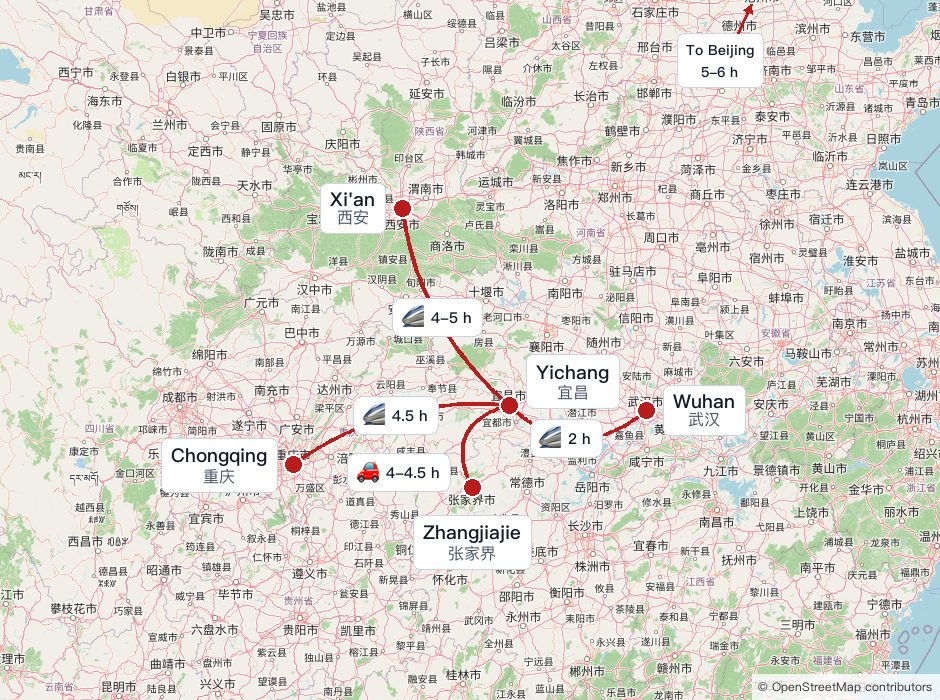
High-speed rail times from Yichang to Wuhan, Chongqing, and Xi'an, plus the 4 to 4.5-hour drive to Zhangjiajie. Most fast trains leave from Yichangdong.
Common onward routes
| Route | Best option | Travel Time | Notes |
|---|---|---|---|
| Yichang (宜昌) -> Wuhan (武汉) | High-speed train | 2 hours | The nearest big hub, with onward trains everywhere. |
| Yichang (宜昌) -> Chongqing (重庆) | High-speed train or cruise | 4.5 hours by rail | The other end of the cruise, on the Zhengzhou to Chongqing line. |
| Yichang (宜昌) -> Zhangjiajie (张家界) | Private car or road transfer | 4-4.5 hours | Usually faster than the indirect rail route, which requires a transfer. |
| Yichang (宜昌) -> Xi’an (西安) | High-speed train | 4-5 hours | North toward the Terracotta Army and the northwest. |
| Yichang (宜昌) -> Beijing (北京) | High-speed train or flight | 5-6 hours by rail | Flying may be simpler for this distance. |
Getting around
The gorges are a linear route, and how you travel them shapes the whole trip. The cruise is the point: you sleep on board and wake up in a new gorge, with shore excursions along the way. Downstream trips from Chongqing to Yichang are shorter and cheaper; upstream trips from Yichang take longer but are gentler on the schedule. If you would rather not cruise, Yichang works as a land base for day trips to the dam, the Three Gorges Tribe, and the eastern gorge, though you miss the heart of the run.
Key Attractions
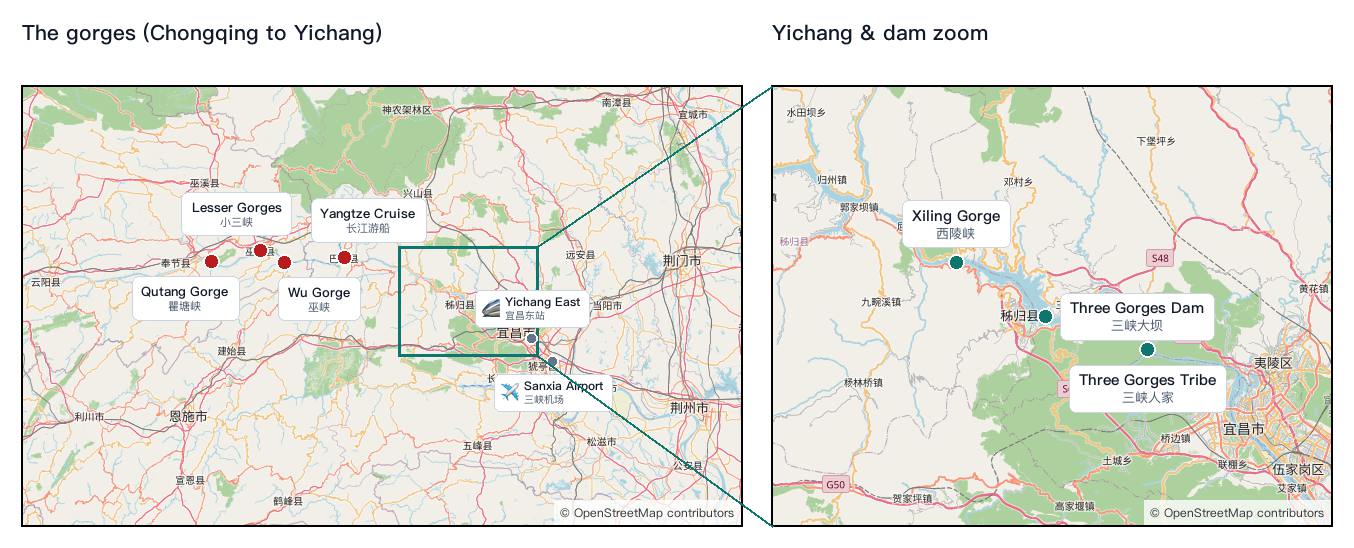
The Three Gorges are strung along the river from Chongqing in the west to Yichang in the east. The three gorges themselves come one after another: Qutang and Wu at the western end near Fengjie and Wushan, then the long Xiling Gorge approaching the dam. The dam, the Three Gorges Tribe, and the eastern gorge cluster near Yichang, which is why the map splits into the wider gorge corridor and a zoom on the Yichang end. The numbers on the map match the sections below; click a numbered dot to jump to it.
1. The Yangtze Cruise (长江三峡游船)
Getting there: Board at Chongqing for a downstream trip or near Yichang for an upstream one
Tickets: multi-day Yangtze cruises between Chongqing and Yichang start around CNY700 per person for a standard cabin on a domestic ship and climb well past CNY2,000 on the top international-standard vessels; downstream (Chongqing to Yichang) runs about 3 to 4 days and upstream 4 to 5
Time needed: 3 to 5 days end to end
The cruise is the reason most people come, and it is genuinely the best way to see the gorges: the canyons reveal themselves slowly from the water in a way no road or railway matches. Ships range from workaday domestic vessels to international-standard boats with balconies and fixed dining, and the itinerary bundles the three gorges with shore excursions to sights like the dam, White Emperor City, and a tributary run. Most nights are spent sailing, so you wake up already deep in a new stretch of the river.
What to see
- The three gorges from the deck
Qutang, Wu, and Xiling pass one after another; the best cliff scenery is worth being on deck for rather than watching from the cabin. - Shore excursions
Cruises stop for the dam, White Emperor City at Qutang, and a smaller-boat trip up a side river, all usually included or offered as add-ons. - The Three Gorges ship lift
A giant vessel elevator beside the dam that raises the whole ship in one lift, an optional experience on many cruises. See the Three Gorges ship lift, a giant elevator that raises vessels past the dam, is a popular optional add-on on many cruises at around CNY290 to 320.
Caution
Ships, standards, and prices vary enormously, so read exactly what a fare includes: which excursions, which meals, and whether the ship lift and side trips are extra. Book through a reputable operator, and note that the scenery can be hazy, which is common along the river.
2. Three Gorges Dam (三峡大坝)
Getting there: About 40 minutes by road from central Yichang, or a cruise shore stop
Admission: the Three Gorges Dam scenic area (Tanziling, the 185 platform, and the Damming memorial park) is free to enter, but the compulsory shuttle bus between the viewpoints is around CNY35; guided day tours from Yichang run about CNY250
Time needed: Half a day
The Three Gorges Dam is the largest hydroelectric power station in the world and the single most-visited sight on the river. The scenic area on the north bank has several viewpoints looking down on the wall of the dam, the ship locks, and the reservoir stretching away upstream. It is as much an engineering and political landmark as a scenic one, and the scale is genuinely hard to grasp from photographs.
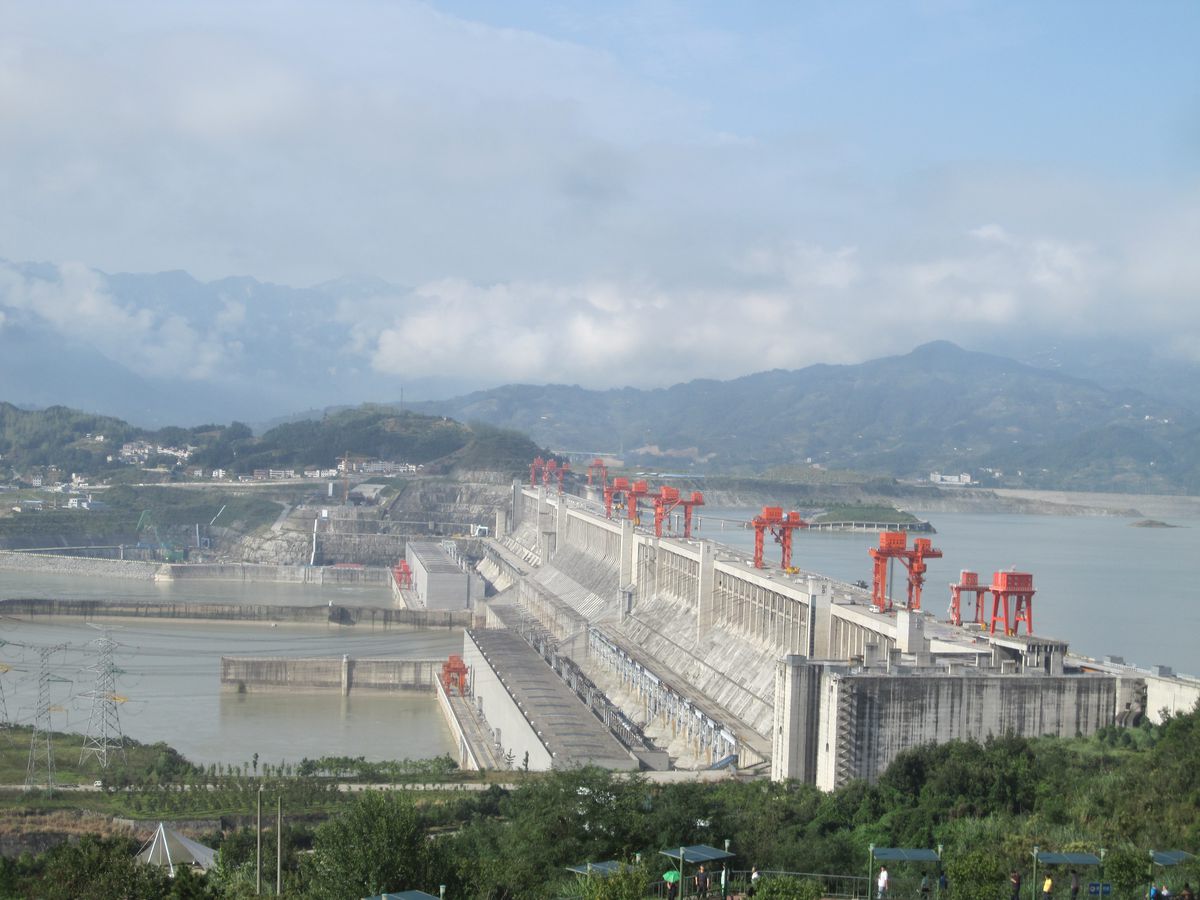
Photo: Le Grand Portage, CC BY 2.0, via Wikimedia Commons
What to see
- Tanziling (坛子岭)
The highest viewpoint, giving the widest overview of the dam and the five-step ship locks below. - The 185 platform (185观景平台)
A viewpoint level with the top of the dam, named for its height in metres above sea level. - The Damming memorial park (截流纪念园)
A riverside park by the water with machinery and displays from the dam’s construction.
Caution
The dam scenic area itself is free, but you must take the shuttle bus between viewpoints and pass a security check, so bring your passport. A guided day tour from Yichang is the simplest way to visit without a cruise.
3. Qutang Gorge & White Emperor City (瞿塘峡)
Getting there: At the western end of the gorges near Fengjie; seen from the cruise or from White Emperor City
Admission: around CNY120 for the White Emperor City island and its Kuimen gorge viewpoint; on cruises it is usually a shore excursion and some packages price it higher
Time needed: A cruise stop, or a half day by land
Qutang is the shortest of the three gorges, only about eight kilometres long, but the most dramatic: the river squeezes between cliffs at Kuimen (夔门), the sheer rock gateway printed on the back of the ten-yuan note. Above it sits White Emperor City (白帝城), a temple complex on what is now an island, famous in Chinese poetry and history as the place where the dying emperor Liu Bei entrusted his kingdom to Zhuge Liang.
What to see
- Kuimen (夔门)
The sheer cliff gateway at the western mouth of Qutang Gorge, the classic ten-yuan-note view, best seen from the water or the White Emperor City viewpoints. - White Emperor City (白帝城)
A hilltop temple complex reached by a bridge, full of Three Kingdoms period (220-280) history and Tang dynasty (618-907) poetry, with fine views down the gorge. - The poetry connection
Li Bai’s most famous river poem was written setting off from here; the site leans into its literary fame.
Caution
By land this is a longer trip from Yichang and is usually done as part of a cruise instead. Check whether your cruise includes the White Emperor City excursion or offers it as a paid add-on.
4. Wu Gorge & the Goddess Peaks (巫峡)
Getting there: Between Wushan and Badong; seen from the cruise
Admission: Included in the cruise; the Lesser Three Gorges side trip is separate
Time needed: A cruise passage
Wu Gorge is the middle and most classically beautiful of the three, some 40 kilometres of green, mist-wrapped peaks lining a deep, quiet stretch of river. Its most famous feature is the Goddess Peak (神女峰), a slender pinnacle high on the northern bank, tied to an old legend of a goddess who watches over the passing boats. This is the stretch where the Three Gorges look most like the classical paintings they inspired.
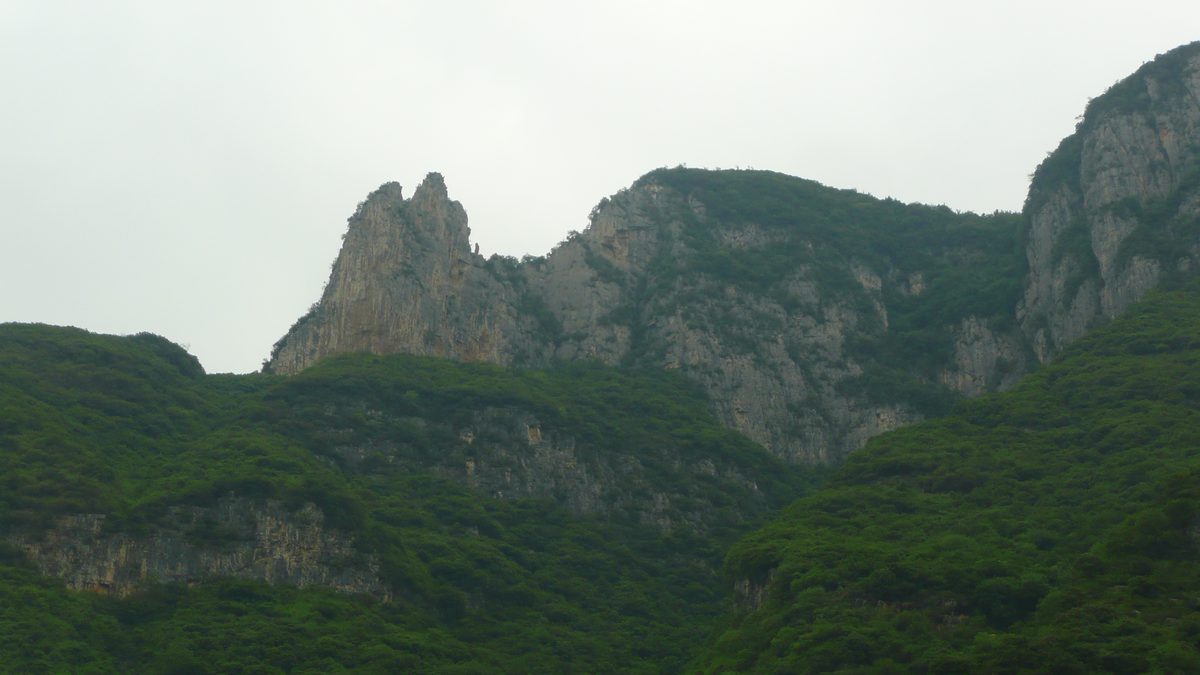
Photo: Peter Tritthart, CC BY 3.0, via Wikimedia Commons
What to see
- The Goddess Peak (神女峰)
The slim pinnacle on the north side, best spotted with the crew’s help as the ship passes below it. - The twelve peaks (巫山十二峰)
A famous series of summits along the gorge, each with its own name and legend. - The mist and morning light
Wu Gorge is at its most atmospheric in early morning or after rain, when cloud clings to the peaks.
Caution
The peaks pass by from the moving ship, so keep an eye on the deck announcements and have your camera ready rather than expecting a stop. Views depend on the weather, and low cloud can hide the higher summits.
5. Xiling Gorge (西陵峡)
Getting there: The easternmost gorge, closest to Yichang and the dam
Admission: Seen from the cruise, or from land viewpoints near Yichang
Time needed: A cruise passage, or a half day by land
Xiling is the longest of the three gorges, running some 70 kilometres from near Zigui down toward Yichang, and historically the most treacherous, once full of rapids and shoals that the reservoir has since calmed. Today it is the gorge closest to Yichang, which makes parts of it reachable by land, and it is the last stretch before the dam on a downstream cruise.
What to see
- The gorge from the water
Long walls of cliff and terraced slopes, the final gorge before the dam when heading downstream. - Land viewpoints near Yichang
Sections of Xiling can be seen from scenic spots on the outskirts of the city without a cruise. - The approach to the dam
The eastern end of Xiling runs right up to the Three Gorges Dam, tying the two sights together.
Caution
Because the reservoir has raised the water level, the gorge is gentler and wider than in its rapids-and-trackers past; come for the scale and history rather than white water.
6. Lesser Three Gorges (小三峡)
Getting there: Up the Daning River at Wushan, by smaller boat from the main cruise
Admission: the Lesser Three Gorges side trip up the Daning River at Wushan is a common optional excursion, often bundled at around CNY290 with the Mini Three Gorges
Time needed: Half a day as a side trip
The Lesser Three Gorges are a set of narrower canyons on the Daning River, a tributary that joins the Yangtze at Wushan. Transferring to a smaller boat, you head up a much tighter, clearer, and quieter waterway than the main river, with steep green walls close on either side. Many travelers rate this side trip as a highlight, precisely because the scale is more intimate than the broad main channel.
What to see
- The Daning River canyons
Three narrow gorges in miniature, greener and closer than the main Yangtze, on a smaller excursion boat. - The Mini Three Gorges (小小三峡)
An even narrower stretch further up, sometimes offered as an extension by sampan. - Hanging coffins and wildlife
Ancient cliff coffins and, often, monkeys and waterbirds along the quieter tributary.
Caution
This is usually an optional add-on rather than part of the base fare, so check the price and whether your cruise schedules it. It adds several hours, so factor it into a busy shore day.
7. Three Gorges Tribe (三峡人家)
Getting there: In Xiling Gorge west of Yichang, about an hour by road; a day trip without a cruise
Admission: CNY210 for the Three Gorges Tribe scenic area (a CNY150 gate ticket plus the ferry and shuttle), reachable as a day trip from Yichang without a cruise
Time needed: Most of a day
The Three Gorges Tribe is a land-based scenic area in Xiling Gorge that recreates the traditional riverside life of the region, with stilt houses, a restored old street, and boat people and folk performances in a genuinely scenic setting of cliffs and a clear side stream. It is the easiest way to get a taste of the gorges for travelers based in Yichang who are not taking a cruise.
What to see
- The riverside stilt village (吊脚楼)
Reconstructed Tujia wooden houses on the water, with folk-life displays and performances. - The Longjin Stream (龙进溪)
A clear side stream with sampans and a picturesque waterside setting, the scenic heart of the area. - The clifftop and gorge views
Paths and a cable car give views over the Xiling Gorge cliffs and the Yangtze below.
Caution
It is a polished, staged attraction rather than a working village, so treat it as scenery and folk display rather than authentic daily life. The combined ticket covers the gate, a ferry, and a shuttle, so keep it for the whole visit.
Suggested Itineraries
The classic cruise (3 to 5 days)
Board at Chongqing for a downstream trip of three to four days, or at Yichang for a slightly longer upstream one, letting the ship’s itinerary carry you through all three gorges with stops at the dam, White Emperor City, and a tributary side trip. This is the standard way to do the Three Gorges and needs little planning beyond choosing a ship.
Yichang as a land base (1 to 2 days)
If you would rather not cruise, base yourself in Yichang and day-trip to the Three Gorges Dam and the Three Gorges Tribe in Xiling Gorge, seeing the eastern end of the river by road. You miss the western gorges and the overnight sailing, but it fits a short stopover between high-speed trains.
Combining with the region
The gorges pair naturally with the cities at either end: Chongqing for hotpot and the Sichuan basin to the west, and a train east to Wuhan or south toward Zhangjiajie and Hunan. Many travelers treat the cruise as the link between Chongqing and central China rather than a there-and-back trip.
Where to Stay
On a cruise your cabin is your hotel, and the main choice is the ship’s class rather than a location. For nights before or after, Yichang city has the fullest range of hotels and is convenient for the station, airport, and dam; Chongqing is the base at the western end. Prices below are rough high-season guides for hotels in Yichang; check current rates before booking.
Comfort
- Higher-end Yichang hotels
International and domestic four- and five-star properties in the city, handy for a night before or after a cruise. Often CNY600-1,500+/night.
Midscale
- Domestic chains in Yichang
Reliable business hotels near Yichangdong station and the city center. Often CNY250-500/night.
Budget
- Guesthouses and budget hotels
Simple, cheap rooms in Yichang, fine for a short stopover. Often CNY120-280/night.
Where to Eat
- On board: Cruise meals are usually buffets or set menus included in the fare; standards rise sharply with the class of ship.
- Yichang city: The best independent eating is in the city, with Hubei home cooking and plenty of spicy river-fish dishes.
- Riverside snacks: Small towns along the route sell local snacks at the shore stops, though quality varies.
- Chongqing at the far end: If your trip starts or ends in Chongqing, its hotpot is a highlight in its own right.
Dishes to Try
- Yangtze river fish (长江鱼): Freshwater fish from the river, steamed or braised, a staple of the region’s tables.
- Hubei-style hot dishes (湖北菜): The local cooking is savory and moderately spicy, distinct from Sichuan to the west.
- Zigui navel oranges (秭归脐橙): The gorge slopes around Zigui are famous for citrus, sold fresh along the river in season.
- Chongqing hotpot (重庆火锅): If your cruise touches Chongqing, the fiery hotpot there is worth a meal on its own.
- Cured river-town fare: Smoked and preserved meats and pickles reflect the mountain-and-river life of the gorge towns.
Hero photo: Tan Wei Liang Byorn, CC BY 3.0, via Wikimedia Commons.
Help keep this guide accurate
Found something incorrect, outdated, or missing? Tell us what changed and include a source when possible.
Suggest an update