
On this page13 sections
✓ Prices and practical details last verified July 25, 2026
Zhangjiajie is the reason so many photographs of China show impossible stone towers rising out of the mist. Its quartz-sandstone pillars, thousands of them, some over 300 metres tall, inspired the floating Hallelujah Mountains in the film Avatar, and the core of the area became one of China’s first national forest parks. The pillars sit inside the wider Wulingyuan scenic area, a couple of hours north of Zhangjiajie city; the city itself is mostly a transport base and the gateway to a second attraction, the cliff-hanging Tianmen Mountain. This is a place for landscapes rather than cities, and the trip rewards good weather and a couple of unhurried days.
Highlights
- Ride up to Yuanjiajie (袁家界) in the National Forest Park for the pillar that became Avatar’s floating mountain.
- Walk the valley floor along Golden Whip Stream (金鞭溪), the gentlest and prettiest way to be among the peaks.
- Take in the high viewpoints of Tianzi Mountain (天子山), a sea of pillars stretching to the horizon.
- Ride the long cable car up Tianmen Mountain (天门山) to the cliff walkways and the natural arch of Heaven’s Gate.
- Walk the glass bridge over the Zhangjiajie Grand Canyon (大峡谷), one of the highest and longest in the world.
Transportation
Getting there
Zhangjiajie Hehua International Airport (张家界荷花国际机场 / DYG) sits just outside the city with domestic flights from most major Chinese cities and a few regional international routes. Check current direct routes on FlightConnections. Zhangjiajie Hehua International Airport (DYG) is just southwest of the city; an airport bus into town is around CNY10 and takes about 15 minutes, and a taxi is roughly CNY20 to 30.
Railway stations
Zhangjiajiexi Railway Station (张家界西站) is the high-speed hub and the main arrival point for most visitors, connecting to Changsha, Chongqing, and the coastal cities. The older Zhangjiajie Railway Station (张家界站) handles a mix of conventional and some high-speed services closer to the city center. From either, it is another 40 minutes to an hour by bus or car up to Wulingyuan, where the forest park sits, so plan your first day around the transfer.
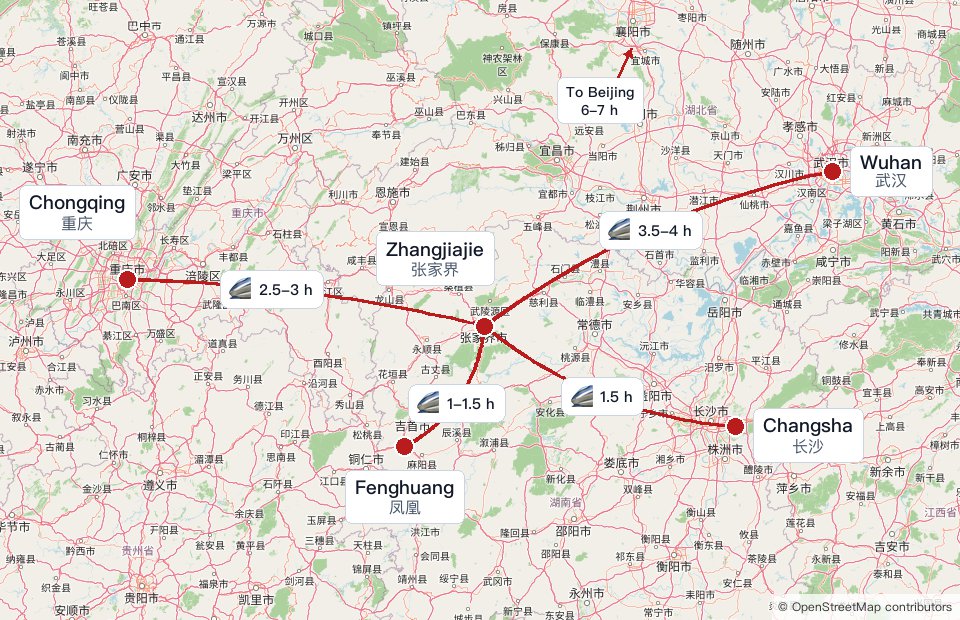
High-speed rail times from Zhangjiajie to Changsha, Wuhan, Chongqing, and Fenghuang. Most fast trains leave from Zhangjiajiexi.
Common onward routes
| Route | Best option | Travel Time | Notes |
|---|---|---|---|
| Zhangjiajie (张家界) -> Changsha (长沙) | High-speed train | 1.5 hours | The main gateway; Hunan’s capital and a big transfer hub. |
| Zhangjiajie (张家界) -> Fenghuang (凤凰) | High-speed train or bus | 1-1.5 hours by rail | The classic pairing, an old riverside town covered below. |
| Zhangjiajie (张家界) -> Chongqing (重庆) | High-speed train | 2.5-3 hours | West toward Sichuan and the Three Gorges cruises. |
| Zhangjiajie (张家界) -> Wuhan (武汉) | High-speed train | 3.5-4 hours | The major hub on the Yangtze, with onward connections everywhere. |
| Zhangjiajie (张家界) -> Beijing (北京) | High-speed train or flight | 6-7 hours by rail | Flying is often the better choice for this distance. |
Getting around
Inside the National Forest Park, a network of eco-shuttle buses, cable cars, and outdoor lifts connects the scattered viewpoints, so you rarely have to backtrack on foot. The shuttle requires the combined ticket but is practically essential because the park is genuinely large. Pace yourself across two days rather than trying to see everything in one. Tianmen Mountain, the Grand Canyon glass bridge, and Baofeng Lake are separate ticketed sights outside the park, best reached by taxi, day tour, or local bus from Zhangjiajie city or Wulingyuan town.
Key Attractions
Zhangjiajie’s sights split cleanly. The National Forest Park in Wulingyuan is the main event and needs two days: Yuanjiajie, Golden Whip Stream, and Tianzi Mountain are all inside it, linked by shuttle buses and cable cars. Outside the park sit the separate ticketed attractions: Tianmen Mountain right by the city, and the Grand Canyon glass bridge, Baofeng Lake, and Yellow Dragon Cave scattered around Wulingyuan. The numbered dots on the region overview match the main sections below. On the park zoom, A, B, and C link to the three areas within Section 1.

1. Zhangjiajie National Forest Park (张家界国家森林公园)
Getting there: Most visitors enter through the East Gate (东门) or South Gate (南门), both served by buses from central Zhangjiajie; the paid eco-shuttle network connects the widely separated areas inside the park
Admission: CNY165 for admission only or CNY236 including the in-park eco-shuttle, valid for four consecutive days; because the park is vast and its main areas are widely separated, the eco-shuttle is practically essential for most visitors. Book tickets on Trip.com
Time needed: Two days for the park as a whole, or one day for selected attractions.
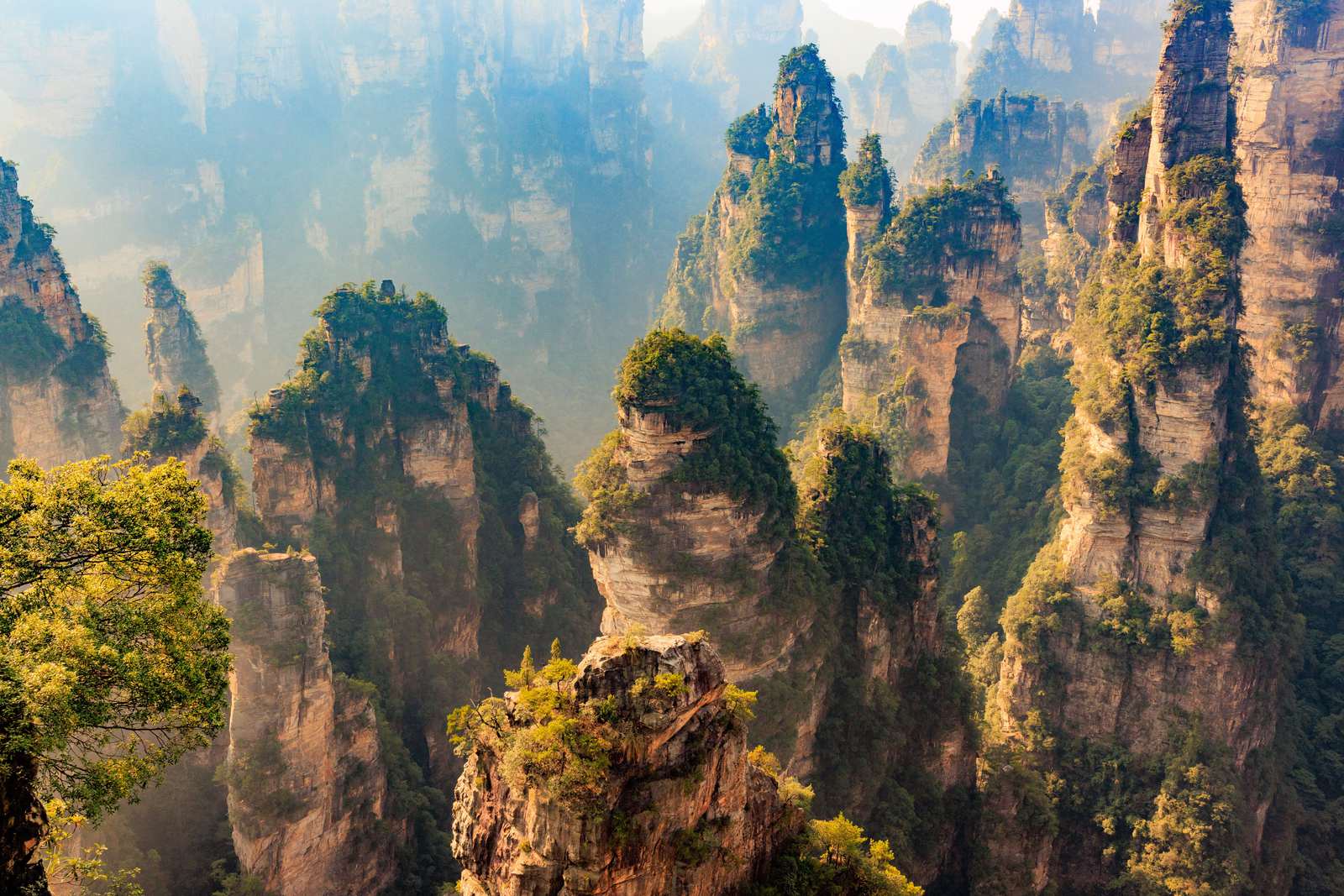
Photo: David Tran

The National Forest Park is the heart of Zhangjiajie, a maze of sandstone pillars, gorges, and viewpoints that forms the core of the wider Wulingyuan World Heritage area. Its three most useful areas for a first visit are Yuanjiajie, Golden Whip Stream, and Tianzi Mountain. Together they combine the signature cliff-top viewpoints, an easy valley walk, and the park’s widest high-mountain panoramas.
For travelers without a car, the East Gate (东门, 武陵源标志门) and South Gate (南门, 森林公园门票站) are the practical entrances. The East Gate opens directly onto Wulingyuan town, with a large choice of restaurants, family-run guesthouses, and mainstream chain hotels, making it the easiest base for a multi-day visit. The other gates are more useful for travelers with a rental car. Taxis and Didi may take you there, but finding a return ride can be difficult, especially later in the day.
Reaching the East Gate
- From Zhangjiajiexi Station: Follow the underpass across the station forecourt to the sightseeing-bus stop. Buses to Wulingyuan cost about CNY13 and take roughly 30 to 50 minutes, depending on traffic.
- From central Zhangjiajie: Use Zhangjiajie Central Bus Station or the stop outside Vienna 3 Best Hotel (维也纳3好酒店) near the railway and bus stations. Both regular coaches and smaller shuttle vans serve Wulingyuan.
- At Wulingyuan: Services terminate at Wulingyuan Bus Station (武陵源汽车客运站), about 1.2 kilometres or a 10 to 15 minute walk from the East Gate. Local Bus 1 also links the station with the entrance.
- Returning to the city: Board at Wulingyuan Bus Station for central Zhangjiajie or Zhangjiajiexi Station, usually for about CNY13. Waiting at the station is more reliable than trying to flag down a passing service.
- Parking: Drivers can try the free lot near the junction of Jundi Road and Yuquan Road (军邸路与玉泉路), about five minutes on foot from the entrance. The paid lot at Zhangjiajie Workers’ Sanatorium (张家界职工休养所) is closer and has been reported at up to CNY30 per 24 hours. Arrive early during peak periods.
The East Gate is the easiest all-round base because accommodation, restaurants, onward buses, and the park entrance are close together. When purchasing or reserving an East Gate ticket, you must choose either Route A (A线, East Gate to the lower Tianzi Mountain cable-car station) or Route B (B线, East Gate to the lower Bailong Elevator station). Choose the route that matches your planned first stop. Book the four-day park ticket and entry time through the official mini-program before arrival. The eco-shuttles are covered by the CNY236 combined ticket, while the Bailong Elevator, Tianzi Mountain cable car, and other mechanical rides require separate tickets. Check the final shuttle time before heading deep into the park.
Reaching the South Gate
- From central Zhangjiajie: Go to Zhangjiajie Central Bus Station (张家界汽车中心站) beside the older Zhangjiajie Railway Station, not Zhangjiajiexi Station. Buses marked for the National Forest Park cost about CNY12, take 40 to 50 minutes, and generally run every 30 minutes. Tell the driver you are getting off at the South Gate.
- From Zhangjiajiexi Station or the city: A taxi or Didi usually takes about 40 minutes and costs roughly CNY50 to 90. A cheaper option is the blue sightseeing bus to Laomuyu Village (老木峪村), around CNY13, followed by a short taxi ride to the gate, often around CNY20.
- From the East Gate: Walk about 1 kilometre to Wulingyuan Bus Station (武陵源汽车客运站) and take the South Gate shuttle. It usually costs about CNY8, takes 20 to 40 minutes, and often departs when full. A taxi or Didi takes about 20 to 25 minutes and commonly costs CNY30 to 60.
- By car: Navigate to Zhangjiajie National Forest Park South Gate (张家界国家森林公园南门). Parking is available outside the entrance.
The South Gate gives direct access to Huangshizhai (黄石寨) and the Golden Whip Stream (金鞭溪) trail, making the two easy to combine. Transport becomes sparse toward evening, and ride-hailing pickups can be difficult, so finish early or plan a route that exits through the East Gate. Entry is tied to a reserved time slot and facial verification. If your arrival time changes, ask at the service window beside the entrance whether the booking can be adjusted.
Recommended Park Routes
One day: East Gate Route B
This is the most efficient first-visit route and minimizes backtracking. Reserve Route B when buying the ticket, then follow:
East Gate → Bailong Elevator → Yuanjiajie → Tianzi Mountain → Tianzi Mountain cable car → Ten-Mile Gallery → East Gate
Take the eco-shuttle from the East Gate to the Bailong Elevator, then ride the elevator to the plateau. The elevator has been around CNY65 one way. Continue by shuttle to Yuanjiajie for the Avatar Hallelujah Mountain, Mihun Terrace (迷魂台), and the First Bridge Under Heaven. In the afternoon, take the plateau shuttle to Tianzi Mountain for Helong Park (贺龙公园), Imperial Brush Peak (御笔峰), and Fairy Scattering Flowers (仙女散花). Descend by the Tianzi Mountain cable car, around CNY72 one way, then continue to Ten-Mile Gallery. Its sightseeing tram has been around CNY38 one way, but the valley can also be explored on foot. Finish by eco-shuttle to the East Gate.
This route suits travelers with limited time or moderate mobility, but queues can make the day long. Start early and confirm the final shuttle and cable-car times.
Two days: mountain and valley
- Day 1, high viewpoints: Follow the one-day Route B itinerary at a slower pace. Add Yangjiajie (杨家界) and the Natural Great Wall (天然长城) if time and energy allow.
- Day 2, South Gate valley: Enter through the South Gate, take the Huangshizhai cable car or hike up, complete the summit circuit, then descend and walk Golden Whip Stream. The full stream trail is about 7.5 kilometres. Keep all food packed away because macaques commonly grab visible bags and snacks.
North Gate driving option
Drivers seeking a quieter entrance can make a North Gate loop. Take the eco-shuttle to Sancha Junction (三岔路口), visit Tianzi Mountain, descend by cable car, continue through Ten-Mile Gallery and Shuiraosimen (水绕四门), then use the Bailong Elevator to reach Yuanjiajie before returning by plateau shuttle to the North Gate. This route uses the park’s mechanical transport to reduce climbing, but the North Gate is a poor choice without a private car because return taxis can be difficult to arrange.
Yuanjiajie (袁家界)
Yuanjiajie is a plateau reached by shuttle and the Bailong Elevator, home to the pillar officially renamed after Avatar’s Hallelujah Mountain. From the railed platforms, the towers drop away into the mist below in a view that genuinely lives up to the pictures.
What to see
- The Avatar Hallelujah Mountain (乾坤柱)
The slender pillar on Yuanjiajie that lent its shape to the film’s floating mountains, with a signed viewing platform. - The First Bridge Under Heaven (天下第一桥)
A natural stone arch bridging two pillars high above the valley, a short walk from the main Yuanjiajie viewpoints. - The Bailong Elevator (百龙天梯)
A glass lift bolted to a 326-metre cliff face, the fastest way up to Yuanjiajie and a minor attraction in itself. - Yangjiajie (杨家界)
A quieter cluster of viewpoints northwest of Yuanjiajie, reached by its own cable car, with fewer crowds and equally dramatic scenery.
Caution
The park is huge and the viewpoints are spread far apart, so study the shuttle routes before you set out. The ticket remains valid for four consecutive days, although two full days are enough for most first visits. Weekends, holidays, and summer bring long queues for the Bailong Elevator and cable cars, so go early rather than trying to cover the park in a single sprint.
Golden Whip Stream (金鞭溪)
Getting there: On the valley floor inside the Forest Park, walkable from the south gate
Time needed: 2 to 3 hours at an easy pace
Golden Whip Stream is a nearly flat, 5 to 7 kilometre walking path that follows a clear stream along the valley floor, with the pillars rising sheer on either side. It is the gentlest way to experience the park, a complete contrast to the cable cars and cliff-top platforms, and the shaded, level trail makes it the most relaxing few hours in Zhangjiajie. Wild macaques are a common sight along the way.
What to see
- The streamside trail
A level, well-made path beside the water, passing named pillars and rock formations the whole way along. - Golden Whip Rock (金鞭岩)
The tall, slender pillar the stream is named for, one of the most photographed formations at valley level. - The macaques
Troops of wild monkeys live along the stream and are used to people; enjoy them from a distance and keep food out of sight.
Caution
The monkeys will snatch food and loose bags, so keep snacks packed away and do not feed them. The path can be walked in either direction.
Tianzi Mountain (天子山)
Getting there: Northern end of the Forest Park, reached by cable car or shuttle bus
Time needed: Half a day
Tianzi Mountain, the Son of Heaven Mountain, occupies the northern reach of the park and offers some of its widest views, with pillars stretching to the horizon in every direction. Its viewpoints look out over the same sea of stone towers as Yuanjiajie but from a higher, more open vantage, and the summit is often above a layer of cloud that turns the pillars into islands.
What to see
- The main summit viewpoints
Platforms like He Long Park and the Helong viewpoint give the broadest panoramas of the pillar forest. - The Tianzi Mountain cable car
A scenic ride up or down the mountain, worth taking at least one way for the changing perspective. - Cloud and mist after rain
The classic Zhangjiajie scene of pillars floating in cloud is most likely here in the hours after rain, so build in flexibility if you can.
Caution
Views here depend entirely on the weather; in thick fog you may see almost nothing. If your schedule allows, keep this viewpoint flexible and save it for the clearest morning of your visit.
2. Tianmen Mountain (天门山)
Getting there: Start at the Tianmen Mountain Cableway lower station (天门山索道下站) in central Zhangjiajie, close to Zhangjiajie Railway Station and the central bus station. Your ticket and the current operating notice determine whether you begin on the lower cableway or take a road shuttle to the mountain gate
Admission: CNY285 for a standard adult ticket, the same on Routes A, B, and C, covering admission and the scenic-area transport it requires; the Tianmen Cave escalator (CNY32), the summit forest sightseeing cable car (CNY25), and glass-walkway shoe covers (CNY5) are charged separately. Book on Trip.com, which is where the scenic area’s own WeChat account sends buyers
Time needed: A half day
Tianmen Mountain rises directly above Zhangjiajie city and is completely separate from the National Forest Park in Wulingyuan. Its transport system is part of the experience. The middle-to-top section of the Tianmen Mountain Cableway is closed for reconstruction, scheduled to run until 31 August 2026; the lower city-to-middle section remains in service, while bus and express-cableway transfers are adjusted around the closure. The express cableway links the mountain gate with the area below Tianmen Cave, while escalators connect the cave with the summit trails. The blue line shows the city shuttle to the mountain gate. The cyan line follows the tightly folded section of Tongtian Avenue from the cableway middle station to Tianmen Cave Plaza.

Choose the route before booking
Tickets are sold as Route A, B, or C rather than plain admission, and the three are not interchangeable:
- Routes A and B are the same circuit in opposite directions. A is the popular default; B runs it the other way round and is usually the quieter of the two.
- Route C uses the express cableway in both directions. It spends the least time on the mountain road, which makes it the one to pick if anyone in your group gets carsick.
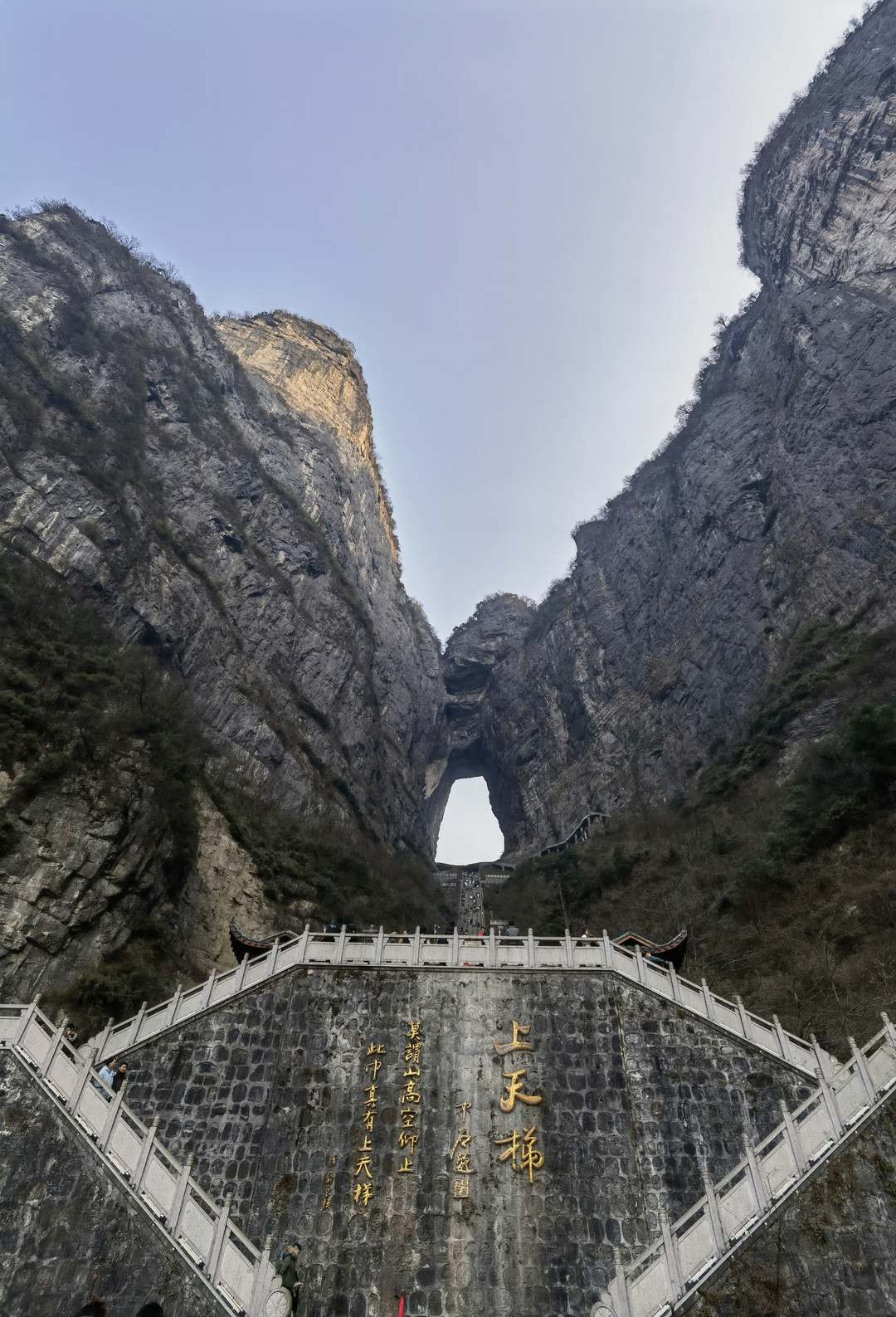
Photo: Zheng Xue
What to see
- Heaven’s Gate (天门洞)
The huge natural arch high in the mountain, reached by escalators from the base of the cliff or the 999-step staircase for the energetic. - The cliff-edge glass walkways (玻璃栈道)
Sections of glass-floored path bolted to vertical cliff faces, with the valley far below your feet. - The 99-bend road (通天大道)
The dramatically switchbacked road up to Heaven’s Gate, seen from above on the way up. - The clifftop trails and temple
The east and west cliff circuits can be combined into a summit loop. Tianmen Mountain Temple sits at the southern end, away from the busiest cave and cableway transfer points.
Caution
Cloud can erase the cliff views and even hide Tianmen Cave from nearby viewpoints, so use the clearest day in your Zhangjiajie forecast. Trip.com notes that Tianmen Cave and the 99-bend road may close during winter snow and ice. Glass walkways can also close in ice or high wind. There is no accommodation inside the attraction, so complete the route and return to the city the same day.
3. Zhangjiajie Grand Canyon Glass Bridge (大峡谷玻璃桥)
Getting there: In Cili county east of Wulingyuan, about an hour by hired car, rental car, or organized day tour
Admission: CNY145 for the Zhangjiajie Grand Canyon, which includes the glass bridge, the canyon walk, and the zipline and slide
Time needed: Half a day
The Zhangjiajie Grand Canyon glass bridge spans a deep gorge some 300 metres above the canyon floor, and when it opened it was among the highest and longest glass-bottomed bridges in the world. Walking across the transparent deck, with the canyon dropping away beneath your feet, is the headline thrill, but the wider Grand Canyon scenic area also has a pleasant walk down through the gorge itself, past waterfalls to a boat ride at the bottom.
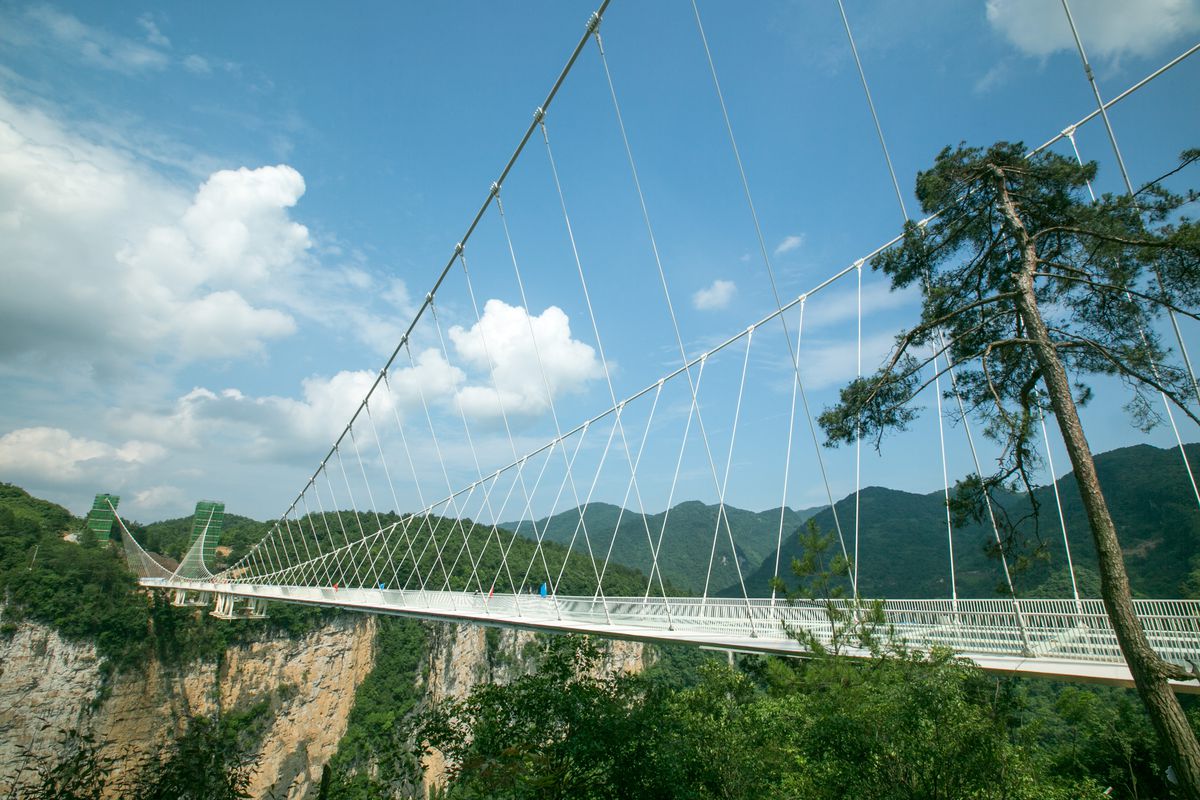
Photo: CC BY-SA 4.0, via Wikimedia Commons
What to see
- The glass bridge itself
The transparent-decked span across the canyon, with a zipline and a bungee point for those who want more. - The canyon walk
A trail down through the gorge past waterfalls and pools, ending at a short boat ride along the canyon river. - The views back up
From the canyon floor the bridge and cliffs look entirely different, a good reason to do the full loop rather than just the bridge.
Caution
Timed-entry tickets are enforced and the bridge caps daily numbers, so book ahead in busy periods. The glass deck can close in bad weather, and cameras and selfie sticks are sometimes restricted on the bridge for safety.
4. Baofeng Lake (宝峰湖)
Getting there: Near Wulingyuan town, a short taxi or bus ride from the forest park gate
Admission: around CNY98, including the lake boat ride
Time needed: 2 hours
Baofeng Lake is a small, clear lake held high among the peaks by a dam, a gentle counterpoint to the strenuous cliff-top sights. A boat glides across the still green water between karst pillars and forested slopes, with folk singers stationed along the shore, and the whole visit is short and easy, a good choice for a lighter half-day or when the weather rules out the high viewpoints.
What to see
- The lake boat ride
The main reason to come, a slow circuit of the lake between the peaks, included in the ticket. - The clifftop setting
The lake sits high above the valley, so the surrounding pillars rise directly from the waterline. - The lakeside walk
Short paths around part of the shore give a few quiet viewpoints away from the boat crowds.
Caution
This is a light, short visit rather than a headline sight, best paired with something else in the same half-day. It is a good rainy-weather fallback when the cliff viewpoints are fogged in.
5. Yellow Dragon Cave (黄龙洞)
Getting there: Near Wulingyuan town, close to Baofeng Lake
Admission: around CNY100
Time needed: 2 hours
Yellow Dragon Cave is one of the largest limestone caverns open to visitors in China, a multi-level system of chambers, underground rivers, and forests of stalactites and stalagmites. A set route leads through the illuminated halls and includes a short boat ride along an underground river, and it pairs naturally with Baofeng Lake next door for a full day away from the cliffs.
What to see
- The underground river boat ride
A short cruise along a subterranean waterway, part of the standard route through the cave. - The Definite Sea Needle (定海神针)
A remarkably tall, slender stalagmite that has become the cave’s signature formation. - The illuminated chambers
Vast halls of stone formations lit to bring out their shapes, on a walking route that climbs and descends through the levels.
Caution
The cave is cool and damp year round, so bring a light layer, and the walking route has plenty of steps. As with Baofeng Lake, treat it as a good option for a rainy day or a change of pace from the mountains.
6. Seven Star Mountain via Ferrata (七星山飞拉达)
Getting there: Drive or taxi to the Seven Star Mountain visitor centre (张家界七星山游客中心), about 40 minutes from Zhangjiajiexi Railway Station. The area is remote, so arrange your return ride before you set off
Admission: CNY780 per person for the via ferrata package, covering scenic-area admission, the return cableway, the shuttle bus, all safety equipment, and an instructor
Time needed: About three hours on the route, most of a day including the drive
Seven Star Mountain sits southwest of the city, and its draw is not the view but the via ferrata bolted onto the cliff face: a 1,200-metre course of climbing, traversing, and hanging that takes around three hours. The section everyone comes for is the Lingyun Sky Ladder (凌云天梯), a 168-metre steel stair pitched at 51 degrees up the outside of a cliff at 1,480 metres, with open treads underfoot and a drop that runs out of sight below them. It is a genuine adventure activity rather than a walk with a handrail, and it has become the single most photographed thing in Zhangjiajie outside the Forest Park. This Seven Star Mountain video gives a useful sense of the exposure and difficulty before you decide whether to book.
What to see
- The Lingyun Sky Ladder (凌云天梯)
The signature pitch, a vertical rise equivalent to a 56-storey building on open steel treads. Route 1 includes it and is the standard choice for first-timers. - The full via ferrata circuit
About 1,200 metres of alternating climbing, walking, and hanging sections, with the ladder as the crux rather than the whole outing. - The cliff-edge views
Clear days give enormous range over the surrounding ridges; mist changes the experience rather than ruining it, though rain makes the rock slick and the climbing harder.
Caution
There are hard eligibility limits, not just recommendations: Route 1 requires ages 12 to 60, a height of at least 1.4 metres, and a weight under 100 kilograms, and it is not advised for anyone with heart conditions or high blood pressure. Book ahead, since entry for the via ferrata closes at 13:00 and walk-ups are not the norm. Wear grippy trainers, long sleeves and trousers, and gloves, and put your phone on a lanyard, because a dropped phone is gone. Go early for thinner queues and take the summit weather seriously, as it is windy and changeable. The safety line is doubled throughout and staff will assist anyone who wants to stop partway.
7. 72 Qilou (七十二奇楼)
Getting there: In Zhangjiajie city, easiest by taxi or Didi
Time needed: 30 to 60 minutes after dark
72 Qilou is a newly built and deliberately eccentric landmark combining an enormous stilt-house facade with shops, restaurants, performances, and decorative lighting. It is not a historic building, and the architecture can feel more like a theatrical commercial complex than a cultural sight.
The exterior is most striking after dark, when the whole structure is illuminated. It can be worth stopping by for a short evening walk and a few photos if you are staying in the city, but there is little reason to make a special trip or pay to enter. Seeing the night view from outside is enough for most visitors.
Suggested Itineraries
3 Days in Zhangjiajie
Day 1: Into the Forest Park
Reserve East Gate Route B and follow the efficient high-viewpoint circuit: Bailong Elevator, Yuanjiajie, Tianzi Mountain, the Tianzi Mountain cable car, and Ten-Mile Gallery. Stay in Wulingyuan near the East Gate.
Day 2: Huangshizhai and Golden Whip Stream
Enter through the South Gate for Huangshizhai and the Golden Whip Stream valley trail. Use the cable car for Huangshizhai if you want to preserve energy for the 7.5 kilometre stream walk.
Day 3: Tianmen Mountain
Head back to the city for Tianmen Mountain: the long cable car up, the cliff-edge glass walkways, and Heaven’s Gate, before an evening train or flight out.
4 to 5 Days: Adding the canyon and Fenghuang
Days 1 to 3 as above, then choose between two additions. For a conventional sightseeing day, visit the Grand Canyon glass bridge and pair it with Baofeng Lake or Yellow Dragon Cave. For an active day, book the Seven Star Mountain via ferrata instead. Seven Star Mountain is primarily worthwhile for the via ferrata; travelers who only want the scenery can skip it. With a spare day, continue south to Fenghuang.
Fenghuang Ancient Town (凤凰古城)
The old Miao and Tujia riverside town of Fenghuang, about an hour or so away by high-speed train, is the classic add-on to Zhangjiajie: stilt houses along the Tuo River, old bridges, and a lively night scene reflected in the water. entering Fenghuang Ancient Town is free; a combined ticket for its nine historic sights is around CNY128 (roughly CNY35 for students), and the Tuo River night boat is separate. An overnight lets you see it both by day and lit up after dark.
Where to Stay
Wulingyuan town, immediately outside the East Gate, is the most convenient base for the National Forest Park. It has plenty of restaurants as well as family-run guesthouses, hostels, boutique stays, and mainstream chain hotels.
Zhangjiajie city is best for the first or last night and for Tianmen Mountain. Prices below are rough high-season guides; check current rates before booking.
Luxury
- Resorts around Wulingyuan
A growing set of higher-end hotels and resorts near the park gate, some with mountain views. Often CNY700-1,800+/night.
Boutique
- Guesthouses and lodges near the park
Smaller, characterful stays in and around Wulingyuan, some run by local families. Often CNY400-900/night.
Midscale
- City and town chains
Reliable domestic hotels in Zhangjiajie city and Wulingyuan town, handy for the stations and shuttle stops. Often CNY250-550/night.
Budget
- Hostels and guesthouses
Cheap, simple rooms in Wulingyuan and the city, with easy tour and transfer bookings. Often CNY120-300/night.
Where to Eat
- Wulingyuan town: The most restaurant choice near the park, from Hunan home cooking to tourist-facing hotpot and barbecue.
- Inside the park: Food on the mountain is limited and pricier, so carry snacks and water for the long days between viewpoints.
- Zhangjiajie city: Better everyday local food away from the sights, especially the small Hunan restaurants and noodle shops.
- Tujia and Miao flavors: The local minority cooking leans on cured and smoked meats, pickles, and plenty of chili.
Dishes to Try
- Tujia sour-and-spicy dishes (土家酸辣): The local cooking is built on fermented, sour, and fiercely spicy flavors, a Hunan hallmark.
- Cured pork and bacon (腊肉): Smoked and air-dried pork is a mountain staple, often stir-fried with local vegetables.
- Three-piece pot (三下锅): A local Zhangjiajie specialty of several ingredients braised together in one spicy pot.
- Rice tofu and cold jelly (米豆腐): Cool, soft snacks served with a chili-and-vinegar dressing, common in the towns.
- Wild mountain vegetables (山野菜): Foraged greens and ferns that show up on most local tables, especially in spring.
- Glutinous rice cakes (糍粑): Pounded sticky-rice cakes, a traditional Tujia food often grilled or fried.
Hero photo: chensiyuan, CC BY-SA 4.0, via Wikimedia Commons.
Help keep this guide accurate
Found something incorrect, outdated, or missing? Tell us what changed and include a source when possible.
Suggest an update