
On this page10 sections
✓ Prices and practical details last verified July 10, 2026
Huangshan, the Yellow Mountain, is the peak that shaped how China imagines mountains. Its granite spires, twisted pines rooted in bare rock, and seas of cloud rolling between the summits have been painted and photographed for centuries, and the classic ink-wash landscape you picture when you think of Chinese scenery was very often painted here. It is a genuine mountain rather than a viewpoint you drive up to: reaching the summit means a cable car or a long stone staircase, and most visitors sleep at the top to catch both sunset and sunrise. Combined with the old Huizhou merchant villages of Hongcun and Xidi in the valleys below, it makes one of the most complete two-to-three-day trips in eastern China.
Highlights
- Ride a cable car up Yellow Mountain (黄山) and walk the summit ridges between granite peaks, twisted pines, and cloud.
- Descend into the West Sea Grand Canyon (西海大峡谷), a cliff-hugging stairway loop that is the mountain’s most dramatic single walk.
- Sleep on the summit to catch sunrise from Bright Summit (光明顶) or one of the other viewing peaks.
- Wander the moon-pond reflections and lane houses of Hongcun (宏村), the best preserved of the old Huizhou villages.
- Slow down over Huizhou food and architecture in Xidi (西递) and on Tunxi Old Street (屯溪老街).
Transportation
Getting there
Most visitors arrive by high-speed rail at Huangshanbei Railway Station (黄山北站). Frequent trains connect it with Hangzhou, Shanghai, Nanjing, Wuyuan, and Beijing. Huangshan Tunxi International Airport (黄山屯溪国际机场 / TXN) handles a smaller selection of domestic flights; check current routes on FlightConnections. The older Huangshan Railway Station (黄山站) serves conventional trains in Tunxi but is less useful for most visitors.
Railway station and the mountain
The single most important thing to understand about Huangshan logistics is that the train station, the city, the mountain, and the villages are all separate places spread across a wide area. Budget travel time between them rather than assuming they are close.
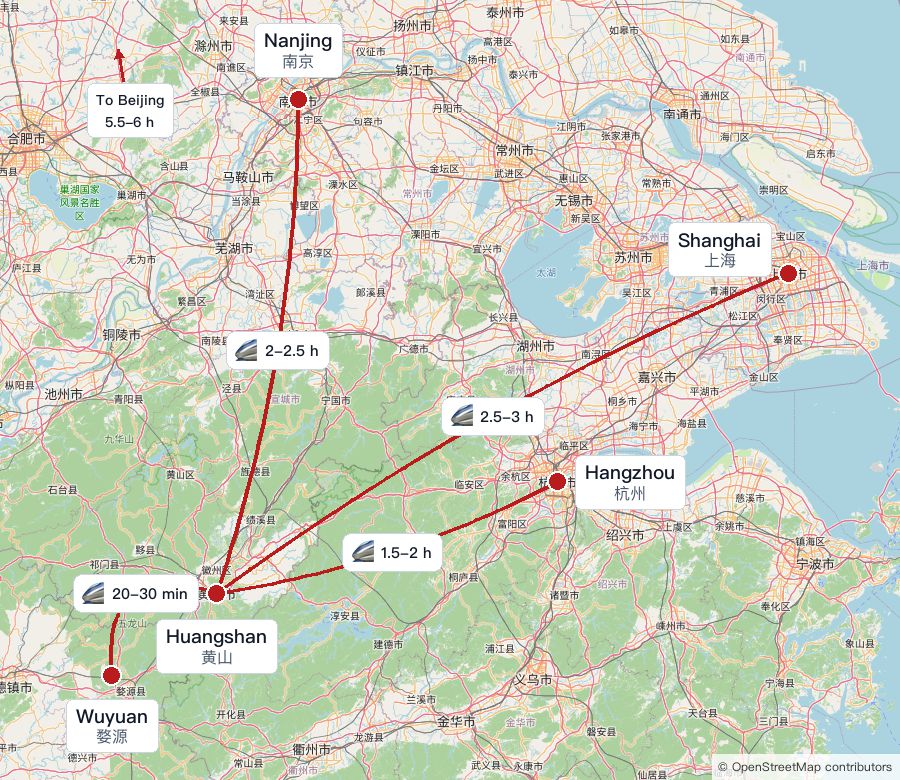
High-speed rail times from Huangshanbei to Hangzhou, Shanghai, Nanjing, and Wuyuan. Beijing is 5.5 to 6 hours away.
Common onward routes
| Route | Best option | Travel Time | Notes |
|---|---|---|---|
| Huangshan (黄山) -> Hangzhou (杭州) | High-speed train | 1.5-2 hours | The most useful connection, often from Hangzhouxi. |
| Huangshan (黄山) -> Shanghai (上海) | High-speed train | 2.5-3 hours | Direct trains to Shanghai Hongqiao. |
| Huangshan (黄山) -> Nanjing (南京) | High-speed train | 2-2.5 hours | For onward travel north and west. |
| Huangshan (黄山) -> Wuyuan (婺源) | High-speed train | 20-30 minutes | For the terraced villages and rapeseed fields of Jiangxi. |
| Huangshan (黄山) -> Beijing (北京) | High-speed train | 5.5-6 hours | Long but direct; flying is faster door to door. |
Getting around
Tangkou (汤口镇), at the mountain’s south entrance, is the main base for most Huangshan visits. Stay here the night before an early ascent. The city, railway stations, airport, villages, Tangkou, and mountain gates are spread across a wide area, so plan each transfer separately.
Huangshanbei to Tangkou
From Huangshanbei Railway Station (黄山北站), turn right after leaving the station and follow signs through the covered walkway to the tourist bus center. Buses to Tangkou generally cost CNY20 to 30 and take about 50 to 60 minutes, with frequent departures during the day. A taxi or private transfer takes roughly 40 minutes and may cost around CNY150 per car, making it practical for a small group or passengers with substantial luggage.
Airport and central Huangshan to Tangkou
- From Huangshan Tunxi International Airport: Take an airport bus to the Tunxi coach station for roughly CNY20, then change to a Tangkou bus for about CNY30. Allow around 2.5 hours plus waiting time for the connection.
- From Huangshan Railway Station: Walk to the nearby bus station and take a direct Tangkou bus. The trip is roughly CNY20 and takes about 1.5 hours.
- From Tunxi Old Street: Use the Tunxi coach station or Huangshan long-distance bus station. Buses generally cost CNY16 to 30 and take around 70 minutes.
Schedules and departure points can change. Confirm the last bus on the day of travel, especially if arriving in the evening. Services from Huangshanbei often finish around 19:30 to 20:00. If your train lands later, ask your hotel to arrange a shared transfer rather than negotiating with unlicensed drivers outside the station.
Tangkou to the mountain gates
Private cars and ordinary taxis cannot continue into the scenic area. Use the official New National Line (新国线) shuttle from the Huangshan South Gate Transfer Center (黄山风景区南大门换乘中心) or, when operating, Xiaoyaoxi Transfer Center (逍遥溪换乘中心). The shuttle goes to Ciguang Pavilion (慈光阁) for the front route and Yuping cable car, or Yungu Temple (云谷寺) for the rear route and Yungu cable car. The one-way fare is CNY19 one-way between the Tangkou transfer center and either mountain gate.
The South Gate transfer center is the easiest default and has the largest concentration of hotels and restaurants. Xiaoyaoxi can have shorter queues during busy periods, but confirm that it is operating for your route. Use only the official scenic-area shuttle.
Driving and local travel
Drivers should navigate to Huangshan South Gate Transfer Center and leave the car in its parking area before boarding the mountain shuttle. Some roads in the older part of Tangkou operate one way during the day, commonly from 07:00 to 19:00, so follow current signs rather than relying entirely on navigation apps.
There is no metro. Buses connect Tangkou with Huangshanbei, Hongcun, and Xidi, while Didi and taxis are useful for shorter trips around Tunxi and private transfers between scattered sights. Once on the summit, travel is on foot along paved stone paths, with cable cars available only for ascending or descending the mountain.
Key Attractions
Huangshan splits cleanly into the mountain itself and the valley below it. The mountain fills a full day or two: the summit peaks, the West Sea Grand Canyon, and a sunrise if you sleep at the top. The valley is the old Huizhou country, where Hongcun and Xidi preserve the whitewashed, black-tiled merchant architecture that gives this whole region its look, with Tunxi Old Street in the city as an easy final stop. The numbers on the map match the sections below; click a numbered dot to jump to it.

1. Yellow Mountain (黄山)
Getting there: Bus from Tangkou to the Ciguang Pavilion (front) or Yungu Temple (rear) gate, then cable car or stairs to the summit
Admission: CNY190 in peak season (March to November), CNY150 off-season; the ticket is now valid for three days
Time needed: One to two full days, ideally with a night on the summit
Yellow Mountain is a summit plateau of granite peaks connected by paved stone paths, and the standard visit is to go up one side, spend a night at the top, and come down the other. The two most-used gates are Ciguang Pavilion (慈光阁) on the front, served by the Yuping cable car, and Yungu Temple (云谷寺) on the rear, served by the Yungu cable car. Fit hikers can climb the stairs instead, a serious multi-hour effort that most people skip in at least one direction by taking the cable car.
Getting up and down
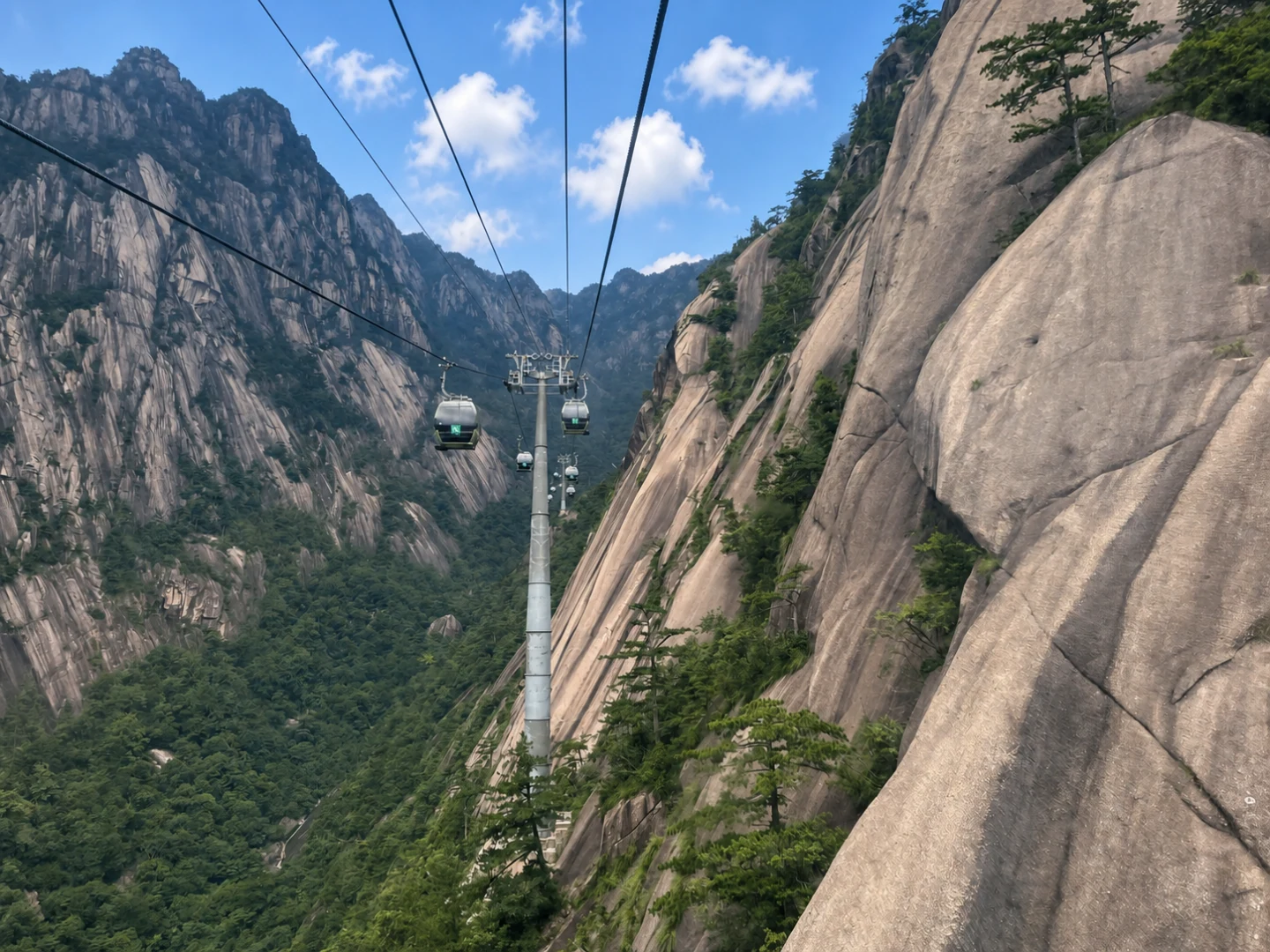
- Yuping cable car (玉屏索道)
Rises from the front gate to the Jade Screen area near the Welcoming Pine. Fare is CNY90 one-way in peak season, CNY75 off-season. - Yungu cable car (云谷索道)
Rises from the rear gate to White Goose Ridge, closest to the Beginning-to-Believe Peak and the northern summit hotels. Fare is CNY80 one-way in peak season, CNY65 off-season (same for the Taiping cable car). - Climbing on foot
Both sides have stone staircases running the full height of the mountain, thousands of steps each. Doing one leg on foot and one by cable car is a common compromise. - Luggage
Leave large bags at your Tangkou or city hotel, or at the gate. You do not want to carry a suitcase up the mountain, and summit hotels are cramped.
The classic route
The classic Huangshan traverse is a two-day, one-night trip with one night in a summit hotel. It works in either direction: enter at Ciguang Pavilion (慈光阁) and leave through Yungu Temple (云谷寺), or enter at Yungu Temple and descend through Ciguang Pavilion. The Yungu-to-Ciguang direction is common because it places Beginning-to-Believe Peak and the northern viewpoints early in the trip, but the reverse direction is equally practical. Choose according to your hotel location, available cable-car times, weather, and which sunrise or sunset viewpoint matters most to you.
Both ends have cable cars that save substantial time and energy. The Yungu cable car (云谷索道) connects the Yungu Temple side with White Goose Ridge, while the Yuping cable car (玉屏索道) connects the Ciguang Pavilion side with the Jade Screen and Welcoming Pine area. Using both avoids thousands of stone steps and leaves more energy for the summit paths. Hikers can still walk either side, or climb one side and use the cable car on the other as a compromise.
The West Sea Grand Canyon has a separate ground-rail funicular (西海大峡谷观光缆车) between Paiyunxi Station (排云溪站) at the canyon floor and Tianhai Station (天海站) near the upper summit route. Riding it avoids the hardest climb out of the canyon. It is separate from the Yungu and Yuping cable cars, requires its own ticket, and may close during winter maintenance or severe weather.
On the map, Ciguang Pavilion is stop 1 and Yungu Temple is stop 14. The main summit route links the Welcoming Pine (3), Aoyu Peak (4), Bright Summit (5), the West Sea Grand Canyon (6 to 9), Stone Monkey Gazing at the Sea (10), Beginning-to-Believe Peak (11), and White Goose Ridge (13). You can follow these stops in either direction. Tiandu Peak (2, the orange dot) is a steep optional side climb that requires a separate advance reservation and closes on a rotating basis.

Summit peaks and sunrise
The reason to sleep on the mountain is to have the summit to yourself at dawn and dusk, when the day-trippers have gone and the light does its work on the peaks and clouds. The named peaks and viewpoints are strung along the summit paths, and which ones you reach depends on your route and energy.
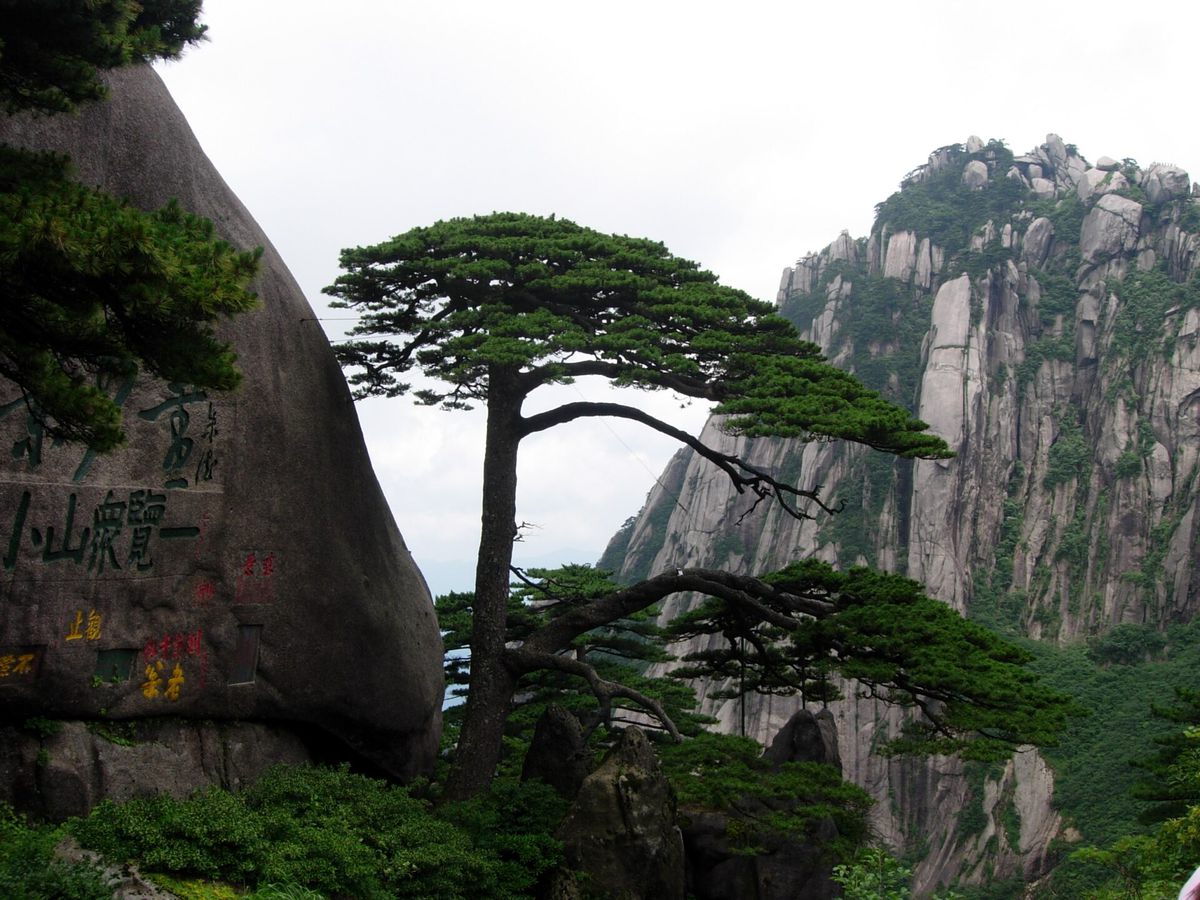
Photo: memes, CC BY-SA 3.0, via Wikimedia Commons
- Bright Summit (光明顶)
One of the highest and most central points, a broad open platform that is a prime sunrise and sunset spot and a natural hub of the summit trails. - Welcoming Pine (迎客松)
The single most famous tree in China, growing from the rock at the Jade Screen area, its branches reaching out like an arm extended in welcome. Expect crowds during the day. - Beginning-to-Believe Peak (始信峰)
A cluster of spires and pines near the rear cable car, named for the idea that only here do you begin to believe the scenery is real. One of the best short walks up top. - Lotus Peak and Celestial Capital Peak (莲花峰 / 天都峰)
The two highest climbable peaks, each a steep add-on from the main paths. They close on a rotating basis for rest and safety, and Celestial Capital Peak (天都峰) requires a separate advance reservation, so check which is open before you plan around them.
The West Sea Grand Canyon (西海大峡谷)
The West Sea Grand Canyon is the single most spectacular walk on the mountain, a stairway cut into and around the cliffs of a deep valley, with viewing platforms hanging over sheer drops. The full loop descends one side and climbs the other, and a small ground-rail funicular (地轨缆车) at the bottom saves the steepest climb back out for those who want it, for CNY100 one-way in peak season, CNY80 off-season. Allow three to five hours for the full loop, entered near Paiyun Pavilion (排云亭).
- The cliff stairways
Narrow paths bolted to vertical rock, with the best sense of Huangshan’s scale and drama. Not for anyone with a serious fear of heights. - The ground-rail funicular (地轨缆车)
A short inclined railway at the base of the canyon that lifts you back toward the summit ridge, avoiding the hardest climb out. - Paiyun Pavilion (排云亭) at sunset
The main entrance point doubles as one of the mountain’s best sunset viewpoints, looking out over the canyon’s spires.
Caution
Weather on the summit changes fast and is often completely different from the valley. Cloud can erase the views entirely, and cable cars occasionally close in high wind. Build a flexible day or two into your plans rather than betting a single afternoon on clear skies, and bring a warm layer even in summer. The West Sea Grand Canyon loop is long and strenuous, with a lot of steps in both directions even if you take the funicular; check that it is open (it closes in bad weather and for winter maintenance) and start early enough to finish in daylight. For sunrise, arrive at the viewpoint early to claim a spot, and treat the basic, expensive summit accommodation as the price of the dawn view rather than a comfortable stay.
2. Hongcun (宏村)
Getting there: Bus from Huangshanbei or Tangkou, about an hour
Admission: CNY104 (around CNY94 booked online); the ticket is valid for repeat entry over three days
Time needed: Half a day, or a night to see it empty
Hongcun is the best preserved of the Huizhou merchant villages, a UNESCO World Heritage site laid out in the shape of an ox, with a water system of channels running past every house to two ponds: the crescent Moon Pond (月沼) in the center and the larger South Lake (南湖) at the edge. The reflections of the whitewashed, black-tiled houses in still water are the image that draws photographers and painters, and the village was a filming location for Crouching Tiger, Hidden Dragon.
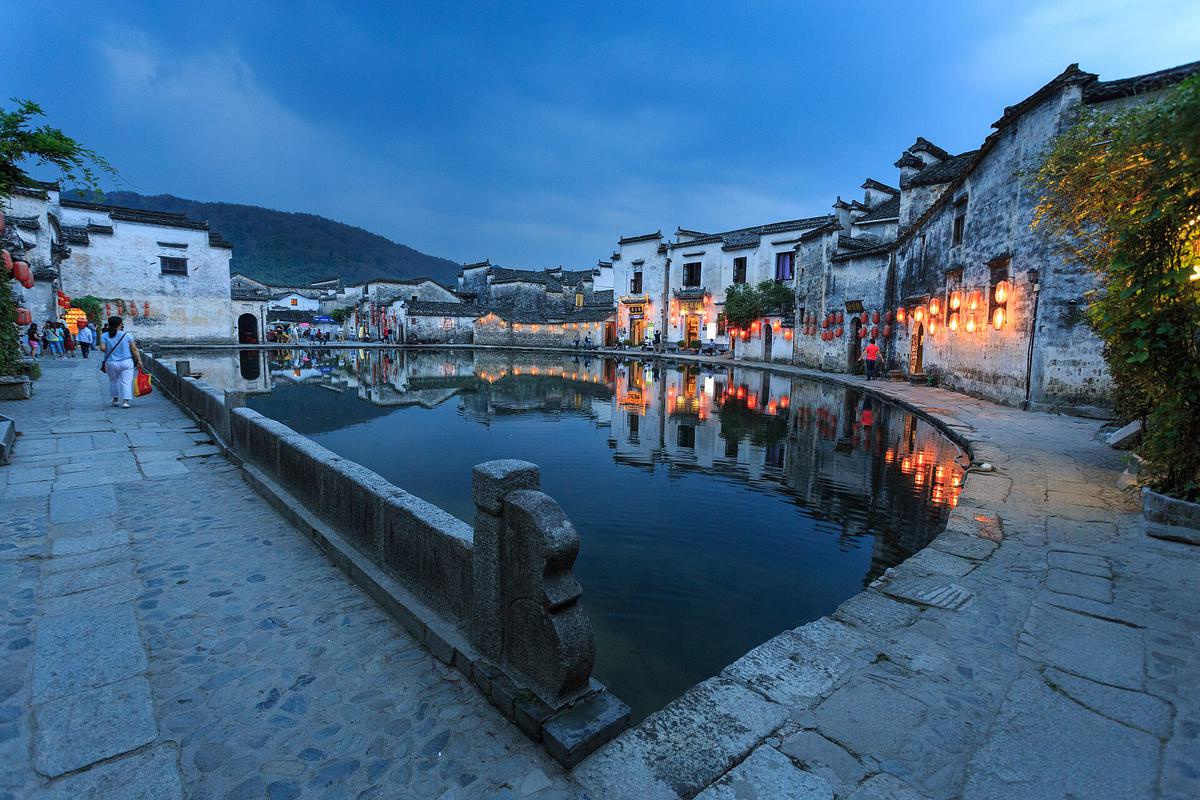
Photo: Zhangzhugang, CC BY-SA 4.0, via Wikimedia Commons
What to see
- Moon Pond (月沼)
The crescent pool at the village’s heart, ringed by old houses, best in the early morning or after the day crowds leave. - South Lake (南湖)
The larger pond at the entrance, crossed by a picture-perfect arched causeway, the classic Hongcun postcard. - The old merchant houses
Several grand former residences are open to visitors, with carved wooden screens, courtyards, and ancestral halls that show the wealth of the Huizhou trading families. - Staying overnight
Hongcun has guesthouses inside the village walls. Staying the night lets you see the ponds without the day-trip crowds, which is when the place is at its best.
Caution
Hongcun is fully commercialized during the day, packed with tour groups and art students at their easels. The ticket is valid for three days with repeat entry, so if you stay overnight you can come and go and time your visits for the quiet hours.
3. Xidi (西递)
Getting there: Bus from Huangshanbei or a short hop from Hongcun
Admission: CNY104 (around CNY94 booked online)
Time needed: Two to three hours
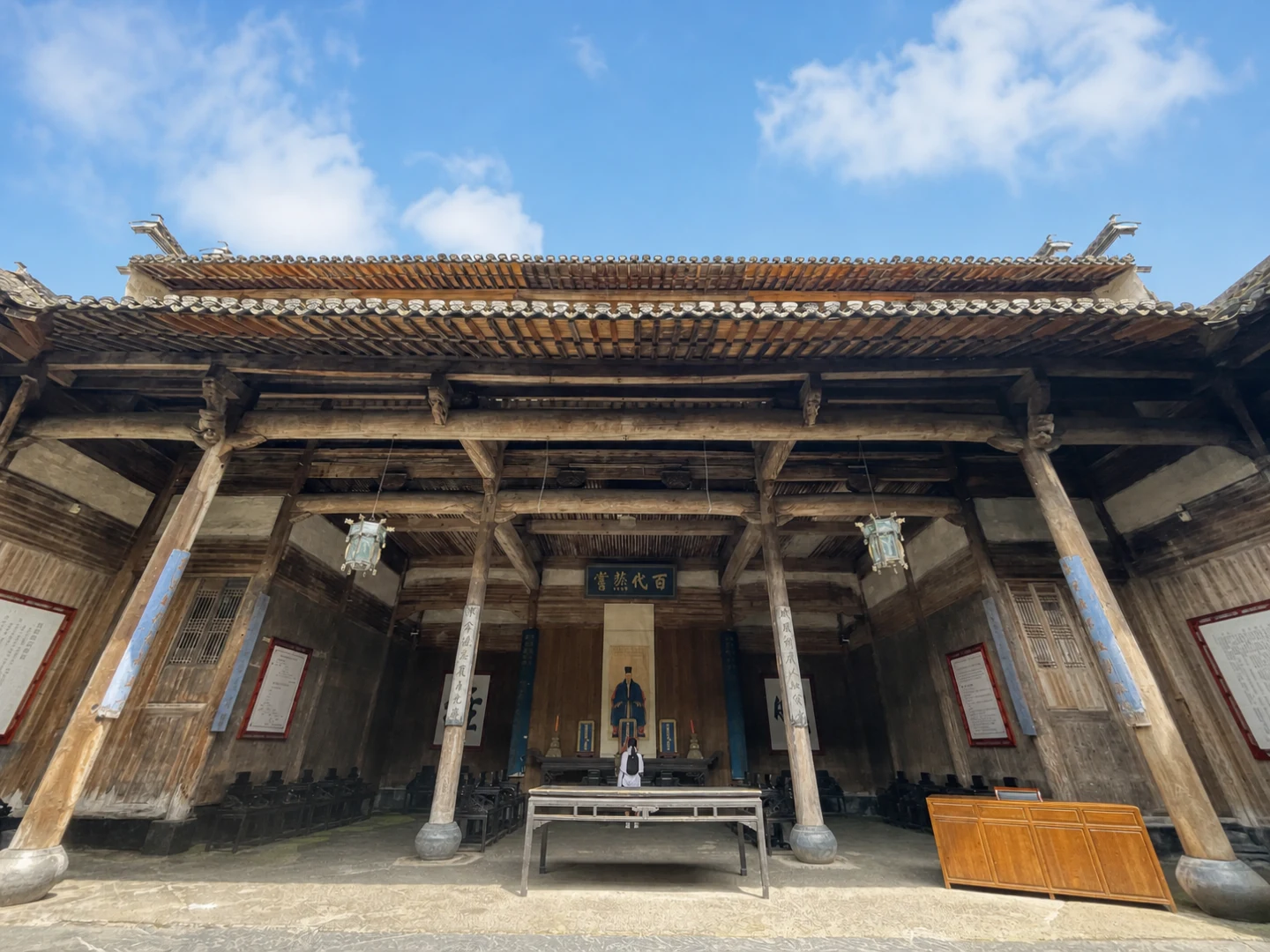
Xidi is the other UNESCO-listed Huizhou village, close to Hongcun and often visited on the same trip. Where Hongcun is defined by its water and ponds, Xidi is a village of grand houses and memorial archways strung along a linear lane, with an even denser concentration of intact Ming dynasty (1368-1644) and Qing dynasty (1644-1912) merchant architecture. It is slightly less photogenic than Hongcun and, for exactly that reason, often a little calmer.
What to see
- The stone memorial archway (胡文光牌坊)
A large 16th-century ceremonial gate at the village entrance, the grandest of its kind still standing in the region. - The old residences
Dozens of preserved merchant houses line the main lanes, many open to visitors, with carved beams, courtyards, and the couplets and calligraphy that decorated scholar-merchant homes. - The overall streetscape
Xidi rewards slow wandering more than ticking off specific sights; the intact lanes themselves are the attraction.
Caution
Hongcun and Xidi are close enough to combine, but doing both plus the mountain in a single day is too much. Give the villages their own half-day or day rather than squeezing them around a mountain descent.
4. Tunxi Old Street (屯溪老街)
Getting there: In central Huangshan City, walkable from many city hotels
Admission: Free
Time needed: One to two hours
Tunxi Old Street is the restored old commercial street in the heart of Huangshan City, a stone-paved lane of Song dynasty (960-1279) and Ming dynasty (1368-1644) style shopfronts selling tea, ink stones, calligraphy brushes, and Huizhou snacks. It is touristy but genuinely old in parts, and it is the most convenient stop for anyone with a spare evening in the city before or after the mountain.
What to see
- The street itself
A kilometer of two-story timber shopfronts, best in the evening when the lanterns are lit and the crowds thin slightly. - Huizhou crafts
The area is known for the “four treasures of the study” (brushes, ink, paper, and ink stones), and Tunxi is a reasonable place to see and buy them, if you know what you are looking at. - Local snacks
Stalls and small restaurants along and just off the street serve Huizhou specialties, a good low-commitment introduction to the regional food.
Caution
As with any restored old street, prices are inflated and quality is uneven, especially for tea and “antiques.” Enjoy it as an evening stroll rather than a serious shopping trip.
Suggested Itineraries
2 Days: Mountain focus
Day 1: Up the mountain
Morning train to Huangshanbei, transfer through Tangkou, and take the cable car up in the early afternoon. Walk to your summit hotel, then out to Bright Summit or Paiyun Pavilion for sunset.
Day 2: Sunrise and down
Sunrise from a summit viewpoint, then the West Sea Grand Canyon loop in the morning while you still have energy. Descend by the other cable car in the afternoon and continue onward, or overnight in the city.
2 Days: Completely on foot, no cable cars
This is a demanding traverse for experienced hikers who are comfortable with relentless stone stairs. It uses the Yungu Temple ascent and the Ciguang Pavilion descent, without riding the Yungu or Yuping cable cars. Inside the West Sea Grand Canyon, the route passes the Paiyunxi and Tianhai funicular stations as landmarks but does not use the funicular.
Getting in and out
- Huangshanbei Station to Yungu Temple: After leaving the station, turn right and follow the covered walkway to the Tourist Passenger Transport Center. Take the bus to the South Gate transfer center (CNY30 one-way, taking about 50 minutes), then the official mountain shuttle to Yungu Temple (CNY19 one-way between the Tangkou transfer center and either mountain gate).
- Ciguang Pavilion to Huangshanbei Station: Take the official shuttle from Ciguang Pavilion to the South Gate transfer center (CNY19 one-way between the Tangkou transfer center and either mountain gate), then the CNY30 bus back to Huangshanbei. The gate shuttle may run at roughly 30 minute intervals, but confirm the day’s final departures before starting the descent.
Overnight on the summit
White Goose Lodge (白鹅山庄) is convenient for this route and has access to nearby sunrise and sunset viewpoints. A bed in its ten-person dorm is about CNY355 per bed in a ten-person dorm, including breakfast and access to a shower. Bring a lightweight sleeping liner or disposable sheet set if you are particular about dorm bedding. A summit tent may also be available for around CNY130, generally reserved in person and subject to same-day availability, but this option is seasonal, weather dependent, and less reliable than a confirmed indoor bed.
Day 1: Yungu ascent and sunset
Yungu Temple (云谷寺) → White Goose Lodge (白鹅山庄) → Beginning-to-Believe Peak (始信峰) → Bright Summit (光明顶)
Start from Yungu Temple early in the morning and allow roughly 2.5 to 3.5 hours for the continuous stair climb to White Goose Ridge and White Goose Lodge. Check in or leave your overnight bag at the lodge, take a proper break, then continue to Beginning-to-Believe Peak and the nearby Beihai viewpoints. Reaching Bright Summit on foot the same afternoon is reasonable for a fit visitor who started early, but the complete route from Yungu Temple through Beginning-to-Believe Peak and Beihai to Bright Summit can take around 6 to 7 hours before longer breaks and photography. If daylight is running short, watch sunset from a nearer viewpoint recommended by the lodge and leave Bright Summit for the next morning. Carry a headlamp and return before the mountain paths become difficult to follow in darkness.
Day 2: Sunrise, West Sea Grand Canyon, and the front descent
Start before dawn from White Goose Lodge and walk about 1.5 hours to Refreshing Terrace (清凉台) and Stone Monkey Gazing at the Sea (猴子观海) for sunrise, then return for breakfast. Continue on this full route:
Lodge → Bright Summit → Flying-over Rock (飞来石) → Paiyunxi funicular station (排云溪站) → Sanxikou (三溪口) → Buxian Bridge (步仙桥) → Tianhai funicular station (天海站) → Bright Summit → Aoyu Peak (鳌鱼峰) → Welcoming Pine (迎客松) → Ciguang Pavilion (慈光阁)
A very fast recorded time for the post-breakfast section was about 5 hours 16 minutes. Do not treat that as a general estimate. This itinerary combines the canyon floor, a major climb back to the summit ridge, and the full front-side staircase descent. Allow a large daylight margin, carry enough food and water, and abandon the canyon loop if weather, fatigue, knee pain, or the day’s closure notices make the full route unsafe.
3 Days: Mountain and villages
Days 1 to 2 as above, then:
Day 3: Huizhou villages
Hongcun in the morning and Xidi in the early afternoon, or a slower single-village day if you would rather linger. Tunxi Old Street works as an evening stop before your onward train.
4 to 5 Days: The full Huizhou circuit
Add an overnight in Hongcun to see the ponds at dawn, a day trip to Wuyuan for its terraced villages (spectacular during the spring rapeseed bloom).
Where to Stay
Huangshan is really four different places to sleep, and where you stay depends entirely on your plan. Prices below are rough high-season guides; check current rates before booking.
On the summit
- Mountain-top hotels (北海, 西海, 白云 and others)
Basic, cramped, and expensive, but the only way to catch both sunset and sunrise without a punishing schedule. Book weeks ahead, especially for weekends and holidays. Often CNY1,000-2,500+/night, and often more on weekends; book weeks ahead.
The eight summit hotels sit directly on the route network, so pick by where you want to be at dawn: Beihai, Shilin, and Bai’e Villa are closest to the sunrise viewpoints around the Beihai area and Stone Monkey Gazing at the Sea; Xihai and Paiyun sit by the West Sea Grand Canyon entrance for sunset at Paiyun Pavilion; Bright Summit Villa and Baiyun put you steps from the Bright Summit sunrise platform; and Yupinglou, next to the Welcoming Pine, is the only option on the front (Yuping) side.

At the foot of the mountain
- Tangkou (汤口) guesthouses and hotels
The transfer town at the mountain base, convenient for an early start or a late finish without committing to a summit night. Often CNY200-600/night. Tangkou has a broad choice of Chinese chains, including JI Hotel (全季酒店), Hanting (汉庭酒店), and Atour (亚朵酒店), as well as hotels under IHG and Hilton brands. Chain hotels are useful for travelers who prefer standardized rooms and predictable facilities. Compare each property’s exact location with the South Gate transfer center before booking, since Tangkou stretches along the valley.
In the villages
- Hongcun and Xidi guesthouses
Converted old houses inside the village walls, the way to experience the villages after the day crowds leave. Often CNY200-500/night.
In the city
- Huangshan City (Tunxi) hotels
The most convenient base for arrivals and departures by train, near Tunxi Old Street and the station. Most domestic and international chain hotels are avaiable. Often CNY250-700/night.
Where to Eat
- On the summit: Food is limited and expensive, carried up by porters. Bring snacks and water rather than relying on what is up there.
- In the villages: Hongcun and Xidi guesthouses often serve home-style Huizhou meals, usually better value and quality than the tourist restaurants on the main lanes.
- In the city: Huangshan City has the best and cheapest food, from local Huizhou restaurants to the usual urban options.
- Tunxi Old Street: Fine for snacks and a casual meal, less so for a serious dinner.
Dishes to Try
- Stinky mandarin fish (臭鳜鱼): The signature Huizhou dish, a lightly fermented freshwater fish that smells strong and tastes far milder and richer than the name suggests. Worth trying once.
- Huangshan braised pigeon (黄山炖鸽): A clear, slow-cooked pigeon soup, a warming mountain-country dish.
- Maofengcha (黄山毛峰): One of China’s famous green teas, grown on these hillsides, worth drinking properly at the source.
- Huizhou preserved-vegetable pork (梅菜扣肉): Braised pork belly layered with dried mustard greens, a rich regional staple.
- Grilled shaobing and local snacks (黄山烧饼): Crisp sesame flatbreads filled with preserved vegetable and pork, sold from street stalls, a good cheap breakfast or snack.
- Bamboo shoots and mountain vegetables (山笋): The wooded hills produce excellent seasonal bamboo and wild greens that show up across Huizhou cooking.
Hero photo: JesseW900, CC BY-SA 4.0, via Wikimedia Commons.
Help keep this guide accurate
Found something incorrect, outdated, or missing? Tell us what changed and include a source when possible.
Suggest an update