
On this page13 sections
✓ Prices and practical details last verified July 8, 2026
Suzhou has been a byword for refined living in China for close to a thousand years. As the old saying goes, “上有天堂,下有苏杭” (above there is heaven, below there is Suzhou and Hangzhou). What that refinement looks like on the ground is a walled old city of canals and whitewashed lane houses, dotted with the private gardens that UNESCO now protects as a single World Heritage listing, plus a silk-weaving and scholar-official heritage that shaped Chinese aesthetics far beyond the city limits. It is also, in practical terms, one of the easiest add-ons to a Shanghai trip: 25-40 minutes by high-speed train, with a compact old town that rewards a single well-planned day or comfortably fills two.
Highlights
- Walk the winding covered corridors of the Humble Administrator’s Garden (拙政园), the largest and most celebrated of Suzhou’s classical gardens.
- Climb the leaning Tiger Hill Pagoda (虎丘塔), tilting further off vertical than Pisa’s, on an artificial hill wrapped in legend.
- Wander Pingjiang Road (平江路) at canal level, one of the last stretches of old Suzhou where the street plan still follows Song dynasty (960-1279) water lanes.
- See a garden built for evening light at Lingering Garden (留园), whose sequence of framed views is the genre’s most-studied example.
- Take a half-day trip to Zhouzhuang (周庄), the water town that gave the whole Jiangnan-canal-town genre its postcard image.
Transportation
Getting there
Suzhou has no major airport of its own. Most visitors arrive from Shanghai’s Pudong (PVG) or Hongqiao (SHA) airports by high-speed train, or fly into Sunan Shuofang Airport (苏南硕放机场) in neighboring Wuxi, connected to Suzhou by a direct shuttle bus for CNY19.9. Check current flight routes on FlightConnections if arriving via Wuxi.
Railway stations
Suzhou Railway Station (苏州站), just north of the old city, is the main stop for Shanghai-Nanjing line trains and the most convenient for the sights in this guide. Suzhoubei Station (苏州北站), further out, serves the Beijing-Shanghai high-speed corridor. Always check which station your ticket uses before booking a hotel.
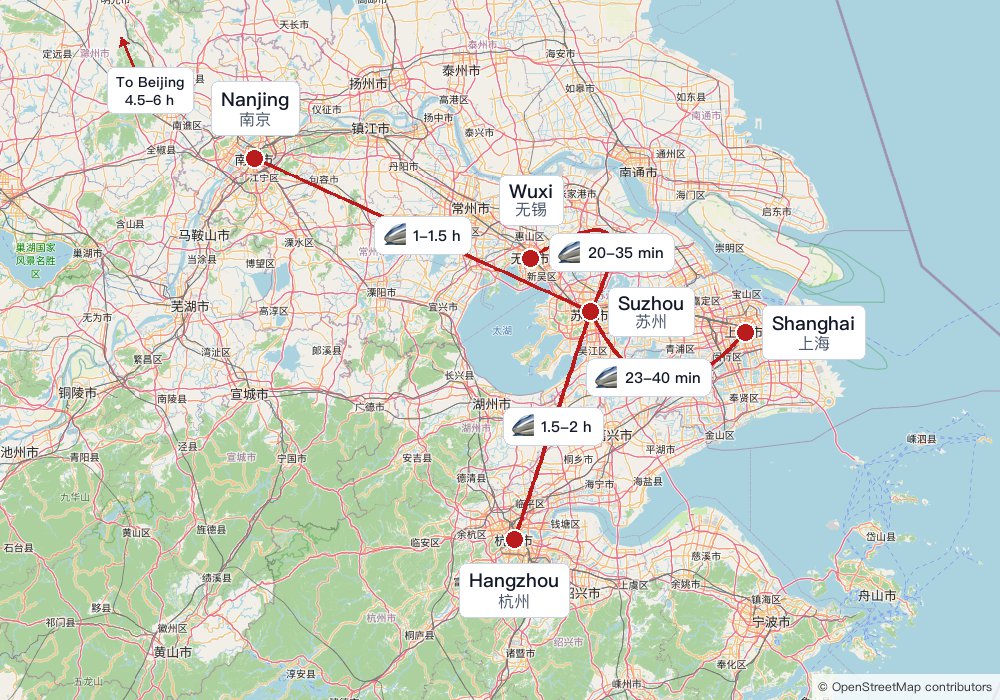
High-speed rail times from Suzhou to Wuxi, Nanjing, Hangzhou, and Shanghai. Shanghai is the most common day-trip direction; Beijing is 4.5-6 hours away.
Common onward routes
| Route | Best option | Travel Time | Notes |
|---|---|---|---|
| Suzhou (苏州) -> Shanghai (上海) | High-speed train | 23-40 minutes | The most frequent and easiest day-trip line in the Yangtze Delta. |
| Suzhou (苏州) -> Wuxi (无锡) | High-speed train | 20-35 minutes | For Lake Tai (太湖) scenery and Sunan Shuofang Airport. |
| Suzhou (苏州) -> Nanjing (南京) | High-speed train | 1-1.5 hours | On the Shanghai-Nanjing corridor. |
| Suzhou (苏州) -> Hangzhou (杭州) | High-speed train | 1.5-2 hours | No direct high-speed line runs straight between the two; most trains route via Shanghai or Huzhou. |
| Suzhou (苏州) -> Beijing (北京) | High-speed train | 4.5-6 hours | From Suzhoubei Station, on the Beijing-Shanghai corridor. |
Getting around
The metro covers the old city and most sights in this guide; fares are CNY2 to start (covers 6 km), rising with distance — most inner-city trips run CNY2-6. Pay with a transport QR code in Alipay or WeChat. Contactless bank cards also work at the gates, but coverage is less consistent than Beijing or Shanghai: UnionPay 闪付 (QuickPass) cards tap directly at the gate; broad international Visa/Mastercard acceptance isn't consistently confirmed. Inside the old city, the historic core is only about 2-3 km across, and the canal-side streets are genuinely pleasant on foot. Shared bikes are everywhere and cheap. Didi works well for the longer hop out to Zhouzhuang if you’d rather not take the bus.
Key Attractions
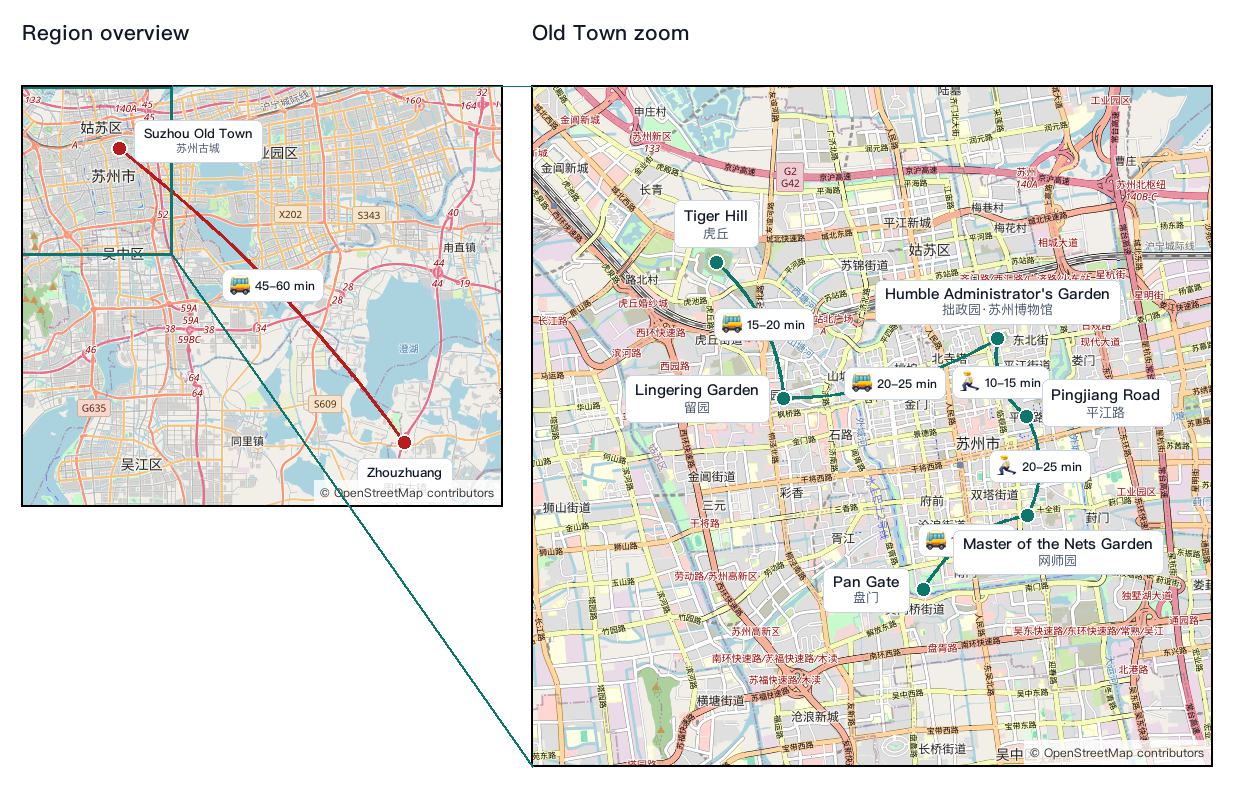
Suzhou’s sights fall into a tight old-town cluster and one outer trip. The cluster (the Humble Administrator’s Garden, Suzhou Museum, Lion Grove Garden, Pingjiang Road, Master of the Nets Garden, Lingering Garden, Tiger Hill, and Pan Gate) sits inside or just outside the old city moat and is small enough to cover on foot and by short bus hops in two days. The outer trip is Zhouzhuang, a water town about 45-60 minutes southeast by road. The numbers on the map match the sections below. Click a numbered dot to jump to it.
1. Humble Administrator’s Garden & Suzhou Museum (拙政园与苏州博物馆)
Getting there: Metro Line 4 to Beisita (北寺塔), then a 10-15 minute walk, or bus to the Humble Administrator’s Garden stop
Admission: CNY80 in peak season (April, May, July-October), CNY70 off-season. Book through the official 苏州园林旅游 WeChat mini-program or 苏州园林官微 WeChat account, or use Trip.com for tickets and details. Suzhou Museum free, but requires a reservation released daily at 08:00, up to seven days ahead
Time needed: Half a day for both
The Humble Administrator’s Garden is the largest of Suzhou’s classical gardens and the standard by which the others are judged. Its five hectares of ponds, covered corridors, and pavilions were first laid out in 1509 by a retired official who, per the garden’s ironic name, claimed only to be “tending vegetables” in retirement. Next door, the Suzhou Museum occupies a 2006 building by I. M. Pei, whose family roots were in Suzhou and who spent part of his childhood at the neighboring Lion Grove Garden. The building reinterprets the local white-walled, black-tiled vernacular in cool grey stone and glass.
What to see
- The central pond section
The garden’s heart consists of islands, zigzag bridges, and the Hall of Distant Fragrance (远香堂), positioned to catch the scent of lotus in summer. - Covered corridors and framed views
Suzhou gardens work like a sequence of paintings: walk slowly, and every window and doorway is cut to frame a specific composition of rock, water, and plant. - Suzhou Museum’s permanent collection
Jade, ceramics, and a room of Ming dynasty (1368-1644) and Qing dynasty (1644-1912) scholar furniture, all lit through the museum’s signature geometric skylights. - The garden in each season
Spring brings peonies, summer lotus, autumn the osmanthus scent that perfumes the whole old city, winter a starker, more architectural version of the same views.
Additional option: Lion Grove Garden (狮子林)
Lion Grove Garden is a short walk east of the Suzhou Museum and easy to add while you are already in this area. Founded in 1342 during the Yuan dynasty (1271-1368), it is best known for its dense maze of Taihu limestone rockeries, narrow passages, and artificial caves. Allow another 1-1.5 hours. It can also become crowded, so treat it as an additional option rather than an essential stop if the Humble Administrator’s Garden has already used most of your time or patience.
Caution
This is Suzhou’s most-visited garden and can become extremely crowded, especially on weekends and Chinese public holidays. Arrive at opening (typically 07:30) if you want the central pond views without a crowd in every frame. Much of the garden’s value lies in subtle cultural details, including controlled sightlines, literary references, borrowed scenery, and the relationship between halls, rocks, water, and plants. An audio guide, a human guide, or some advance reading makes a real difference. Without that interpretation, the garden can feel surprisingly ordinary amid heavy crowds.
Do not feel that this is the only Suzhou garden worth seeing. If you dislike crowds or find the admission price too high, the Lingering Garden (留园), Master of the Nets Garden (网师园), and other gardens later in this guide can provide an equally rewarding and often calmer introduction to Suzhou garden design. Book the Suzhou Museum separately and in advance; it uses a different queue and its own daily ticket release.
2. Pingjiang Road (平江路)
Getting there: Metro Line 1 to Xiangmen (相门), then a 5-10 minute walk; or walk directly from the Humble Administrator’s Garden area
Admission: Free
Time needed: 1-2 hours, longer with stops
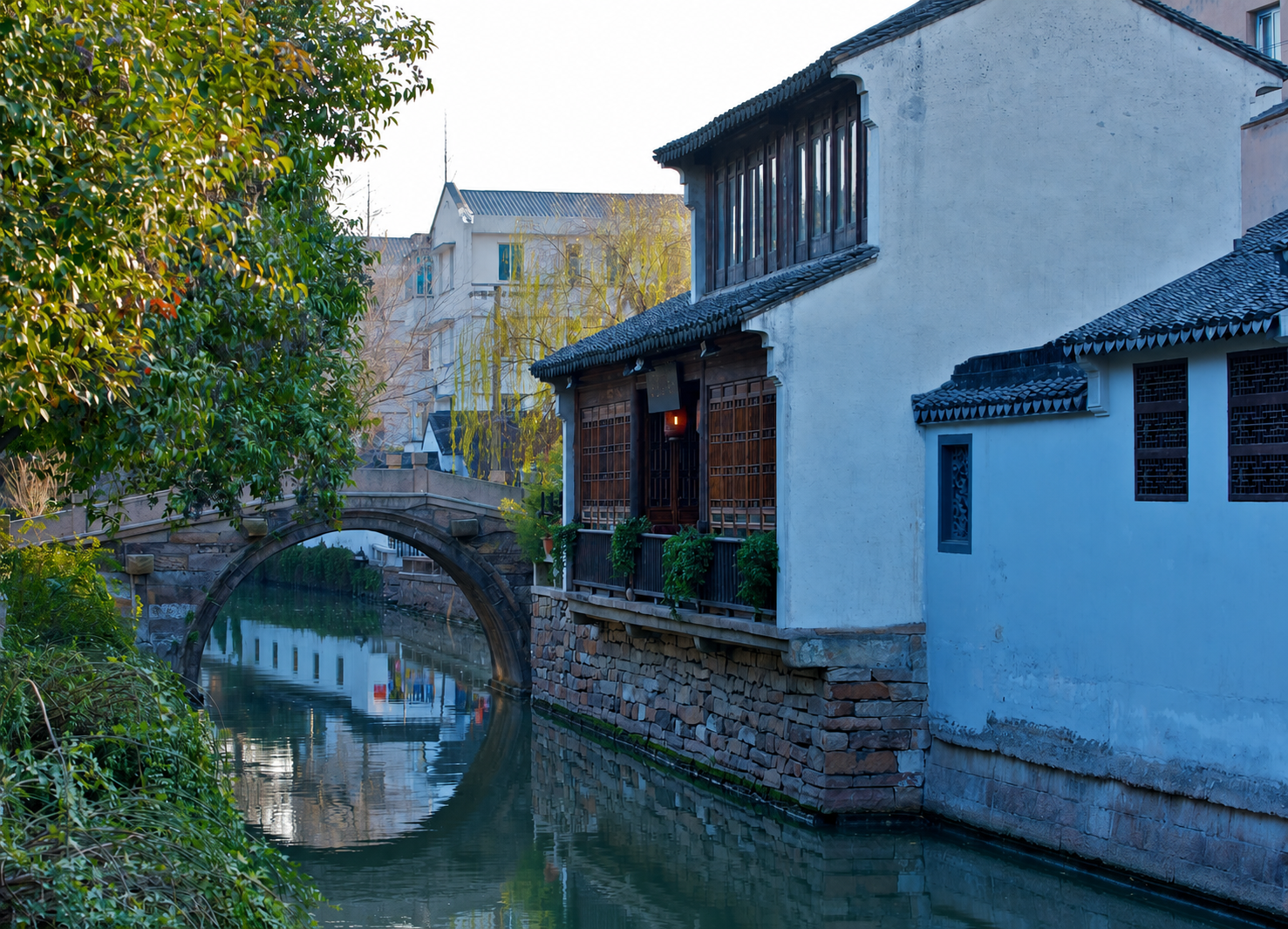
Pingjiang Road is the best-preserved of Suzhou’s historic canal streets, its layout essentially unchanged since a Song dynasty (960-1279) city map from 1229. A straight canal is flanked by a pedestrian lane on one side, punctuated by small stone bridges and side alleys leading deeper into the old residential quarter. It has been thoroughly gentrified with cafes, teahouses, and craft shops, but the bones underneath are genuinely eight centuries old.
What to see
- The main canal walk
Simply walking the length of it at a slow pace is the point, because the small bridges and reflections in the water are the reason this street photographs so well. - Side alleys
Duck off the main lane into the narrower residential alleys for a quieter, less commercial version of the same streetscape. - Kunqu opera teahouses
Several small venues along the road stage short Kunqu (昆曲) performances, the UNESCO-recognized opera style native to this region. They offer a good low-commitment introduction to the art form. - Pingjiang History Museum (平江历史街区展示馆)
A small, free museum explaining the 800-year continuity of the street grid, worth ten minutes for context.
Caution
Evenings bring lantern light and a livelier atmosphere but also the thickest crowds; a weekday morning gives the calmer, more contemplative version of the same street.
3. Master of the Nets Garden (网师园)
Getting there: A 10-15 minute walk south from the Humble Administrator’s Garden area, near Shiquan Street (十全街)
Admission: CNY40 in peak season, CNY30 off-season (half-price for students and seniors)
Time needed: 1-1.5 hours
The Master of the Nets Garden is the smallest of Suzhou’s classical gardens open to the public, and for many visitors the most satisfying. Its compact scale (under a hectare) forces a concentration of good design that larger gardens can dilute. The name is a fisherman’s pun, claimed by a retired official who wished to trade a career for a simple net and a boat.
What to see
- The central courtyard
Proof that a Suzhou garden does not need scale to work. Every rock and sightline here is calculated within a genuinely small footprint. - The Peony Study (殿春簃)
A studio courtyard so admired that the Metropolitan Museum of Art in New York built a full-scale replica of it, the Astor Court, in the 1980s. - Evening garden tours
In peak season the garden sometimes opens for ticketed evening visits with traditional music and opera excerpts performed inside the halls. Check current dates if visiting in warmer months.
Caution
The evening program (if running) sells a separate, more expensive ticket from the daytime entry and is not available year-round; confirm before planning an evening visit specifically for it.
4. Lingering Garden (留园)
Getting there: Metro Line 2 to Shilu (石路) or Shantang Street (山塘街), followed by a 15-20 minute walk or a short bus or Didi ride. Lingering Garden is easy to combine with Shantang Street
Admission: CNY55 in peak season, CNY45 off-season
Time needed: 1.5-2 hours
Lingering Garden is smaller than the Humble Administrator’s Garden but denser in incident. Scholars and garden historians often rate its sequence of framed views as the most sophisticated of the four great Suzhou gardens. Its centerpiece, the towering, wrinkled Cloud-Capped Peak (冠云峰) limestone rock, is one of the most celebrated single rocks in Chinese garden history.
What to see
- The entrance corridor
A deliberately narrow, winding approach compresses and controls your first views. The garden reveals itself in calculated fragments before opening into the main pond. - Cloud-Capped Peak (冠云峰)
A six-meter limestone scholar’s rock, prized for its perforations and silhouette, said to have been destined for an imperial garden before it ended up here. - The Mandarin Duck Hall (鸳鸯厅)
A hall split by a screen into two distinct spaces: one for men and one for women, per the social conventions of the household that built it. - Autumn light on the central pond
Late afternoon is when the pond section reads best; the crowds thin markedly by mid-afternoon.
Nearby: Shantang Street (山塘街)
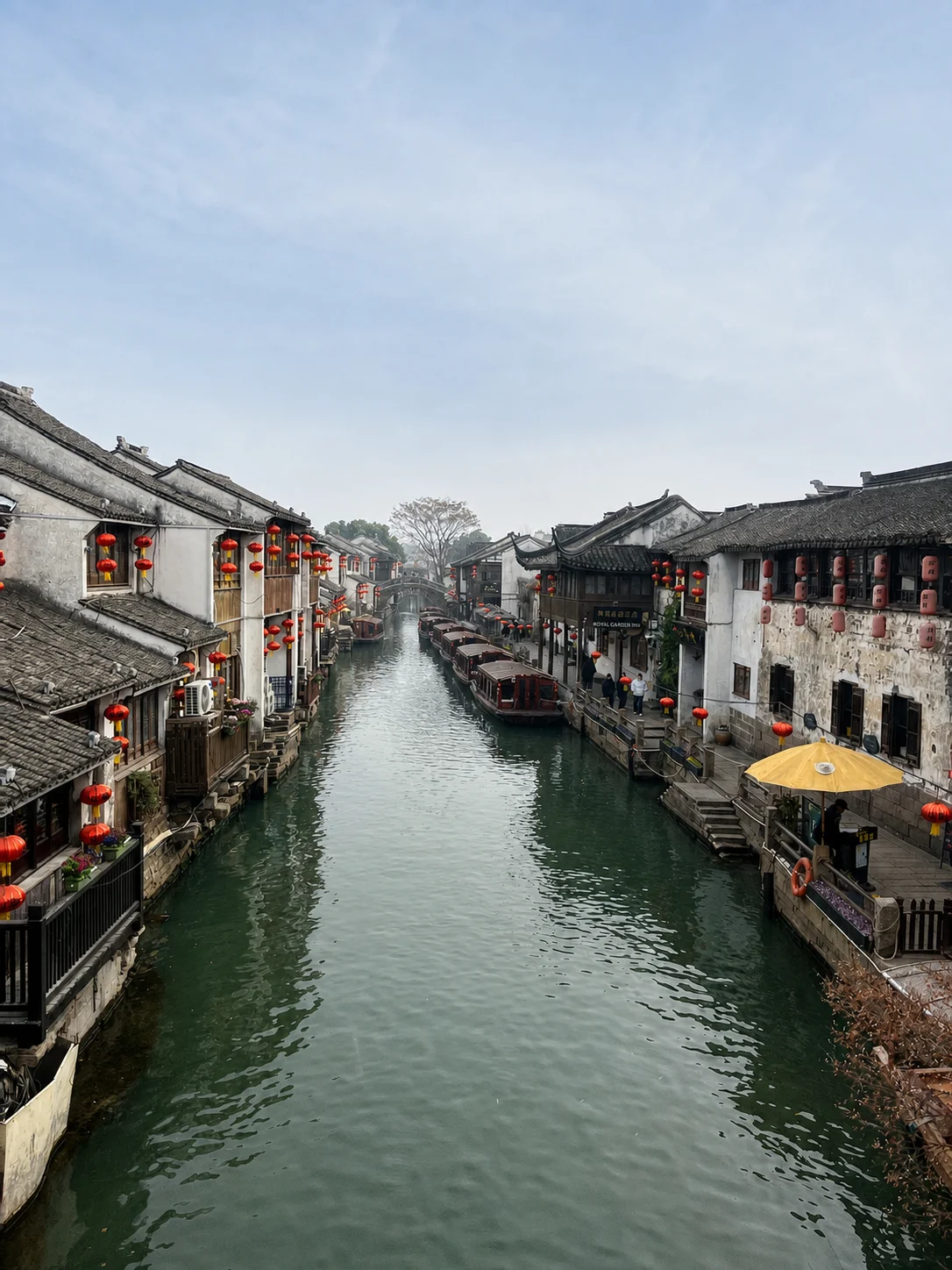
The canal-side street connecting Tiger Hill back toward the old city is a quieter, less commercial alternative to Pingjiang Road, especially in its western stretches. It is easy to combine with Lingering Garden.
Additional option: Xiyuan Temple (西园寺)
Xiyuan Temple is about a 15-minute walk west of Lingering Garden and easy to add on the same outing. It is an active Buddhist monastery with quiet courtyards, old trees, and many resident cats that roam the grounds. Allow about 45-60 minutes, and keep noise low around the prayer halls.
Caution
Lingering Garden is further from the old-city core than the other gardens. Build in transit time and pair it with Tiger Hill, which sits along the same side of town.
Suzhou MixC World (苏州万象天地) is nearby and makes a practical rest stop before or after Lingering Garden. It has air conditioning, toilets, coffee shops, and a wide choice of restaurants.
5. Tiger Hill (虎丘)
Getting there: Metro Line 6 to Huqiu (虎丘) station, then follow signs north to the Tiger Hill scenic area entrance
Admission: CNY70 in peak season (April-May, July-October), CNY60 off-season
Time needed: 2 hours
Tiger Hill is a modest artificial hill wrapped in two and a half thousand years of legend: the burial site of the King of Wu, the sword-testing rock split by a mythical blade, and, at the summit, the Yunyan Pagoda (云岩寺塔), a 47-meter seven-story brick tower that has leaned progressively off vertical since the 10th century and now tilts further than the Leaning Tower of Pisa. It is sometimes billed as the “First scenic spot south of the Yangtze.” The claim is hyperbolic, but the pagoda silhouette is genuinely one of Suzhou’s iconic images.
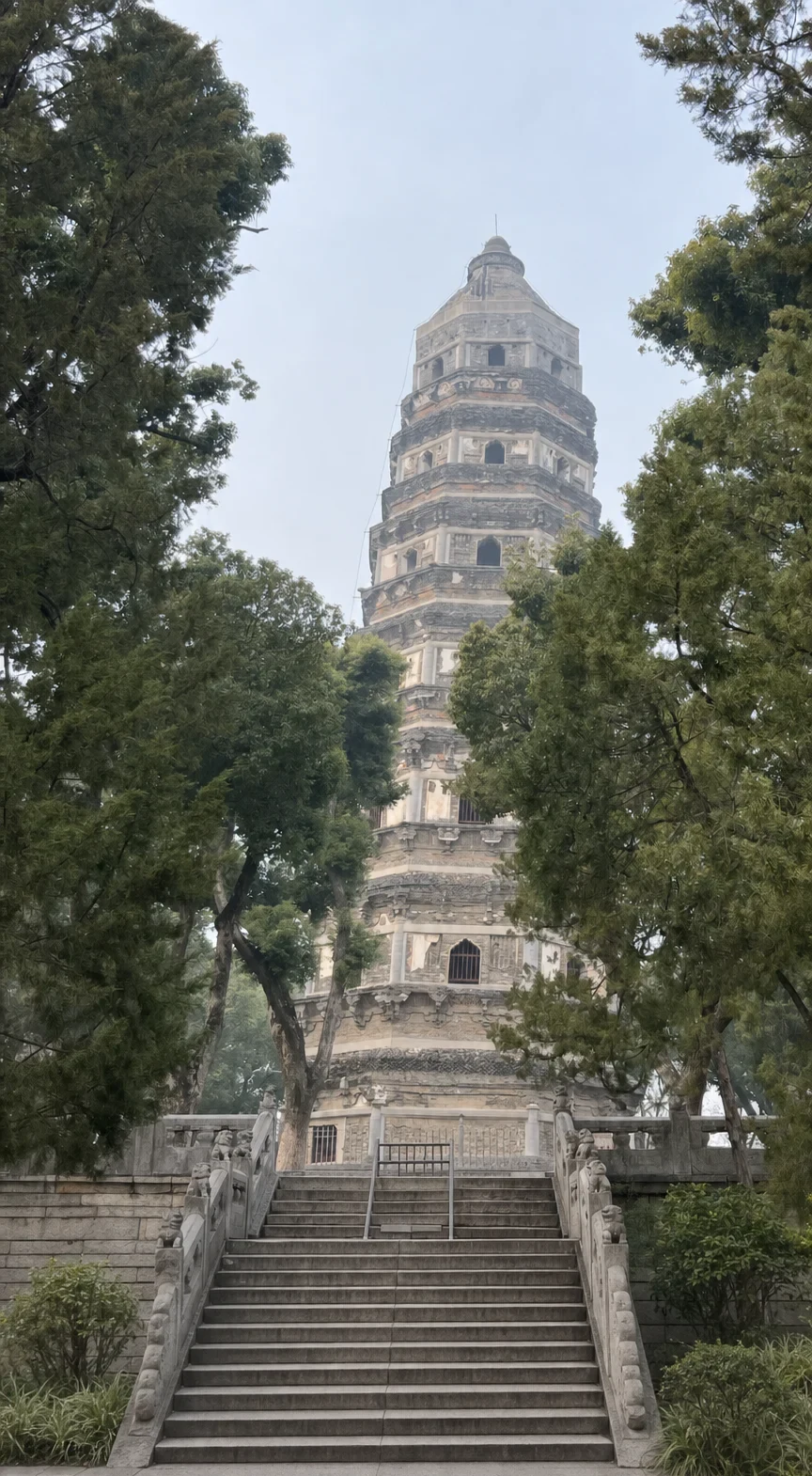
Entering Yunyan Pagoda
Yunyan Pagoda (云岩寺塔) itself is not normally open for free roaming, but limited first-floor visits are sometimes available by advance reservation. Search WeChat for the official Suzhou garden accounts Suzhou Garden Tourism (苏州园林旅游) or Suzhou Gardens Official WeChat (苏州园林官微), then look under garden tickets for Tiger Hill (虎丘) and the Yunyan Pagoda first-floor reservation ticket (云岩寺塔一层参观预约票). The reservation is usually free, but slots are limited and can disappear quickly on weekends and holidays.
If you get a slot, arrive about 10 minutes early at the security booth or service point beside the pagoda. Visits are staff-led, usually around 10 minutes, and only the first floor is open. Phones, bags, umbrellas, photography, video, and touching the walls are not allowed because of the old murals and painted decoration inside. Occasional summer night-entry arrangements may differ, but do not rely on them as the normal process.
What to see
- Yunyan Pagoda (云岩寺塔)
The tilt is visible to the naked eye and more dramatic in photos taken from its low side. The tower is closed to climbing for structural reasons, but worth circling slowly. - Sword Testing Rock (试剑石) and Thousand People Rock (千人石)
A cleft boulder and a broad flat outcrop, both wrapped in Wu-kingdom legend explained on-site. - Sword Pond (剑池)
A narrow, deep pool below the summit, said to hide the burial chamber and swords of the King of Wu. It has deliberately never been excavated.
Caution
The hill itself is low and the site compact. Pace expectations accordingly, and do not skip Shantang Street on the way in or out, since some visitors treat Tiger Hill as a taxi-in-taxi-out stop and miss it entirely.
6. Pan Gate (盘门)
Getting there: Bus or Didi to the Pan Gate (盘门) scenic area, southwest corner of the old city; about 20-25 minutes from the Humble Administrator’s Garden area
Admission: CNY40 in peak season, CNY30 off-season
Time needed: 1.5-2 hours
Pan Gate is the only place in China where a complete water gate and land gate survive side by side in an old city wall. The fortifications originated in the Spring and Autumn period, while the surviving gate complex is principally Yuan dynasty (1271-1368) fabric with later repairs. It receives far fewer visitors than Suzhou’s famous gardens or Tiger Hill, making it one of the city’s most relaxed major sights. The combination of a real, walkable city wall, the unique dual gate, and Ruiguang Pagoda (瑞光塔) makes it well worth the detour.
What to see
- Water and land gates (水陆城门)
The adjoining but staggered gates controlled boats and overland traffic through a single fortified chokepoint. A barbican added after Zhang Shicheng took Suzhou created a deadly enclosed court: once attackers passed the first gate, its heavy barrier could fall behind them while defenders fired from the wall above. This is the literal logic behind “catching a turtle in a jar” (瓮中捉鳖). - Ruiguang Pagoda (瑞光塔)
First founded in 247 during the Three Kingdoms period (220-280), the present brick core dates to 1004 in the Northern Song dynasty (960-1127); its wooden outer eaves are later restorations. The 53 m, seven-storey octagonal tower is notable for its rare column-frame structure and remarkably detailed brick imitation of wooden interiors: the lower five floors use ring corridors, while the upper two form a connected chamber. In the late 1970s, children reaching into the tower found a hidden reliquary chamber containing the celebrated Pearl Pillar of the Buddhist Shrine (真珠舍利宝幢) and its wooden case. A third-floor chamber yielded further treasures, including a lacquered nanmu sutra box inlaid with mother-of-pearl, Buddhist manuscripts and early printed texts, statues, reliquary towers, and an amber seal. Entering the pagoda costs an additional CNY 6, but definitly worth it. - Wumen Bridge (吴门桥)
Suzhou’s tallest surviving stone arch bridge, immediately south of the gate, with a good elevated view back over the moat and wall. - Evening light and lantern shows
Pan Gate runs occasional evening illumination events on the wall and water. Check current schedules if visiting after dark.
Why it is worth the detour
Despite its historical importance, Pan Gate is rarely crowded. You can usually explore the wall, gates, and pagoda without the tour-group congestion common at Suzhou’s headline gardens, so it is strongly recommended for anyone with more than a single rushed day in the city.
7. Zhouzhuang Water Town (周庄古镇)
Getting there: From Shanghai, take a high-speed train to Suzhounan Railway Station (苏州南站), then continue by taxi or Didi to Zhouzhuang. Suzhounan is much closer to Zhouzhuang than the main stations in central Suzhou. From central Suzhou, use a direct bus or Didi
Admission: CNY100 full price (CNY50 on weekday half-price promotions); one full-price visit with ID registration unlocks free repeat entry
Time needed: A full day, or a relaxed half-day with an early start
Zhouzhuang is a 900-year-old canal town about 30 km southeast of central Suzhou, technically inside the neighboring city of Kunshan (昆山) but universally treated as a Suzhou day trip. It is the water town that launched the genre in the popular imagination, with stone bridges, waterside houses on stilts, and gondola-style boats. It remains the most visited, which is both the appeal and the catch: come prepared for crowds, or come very early.
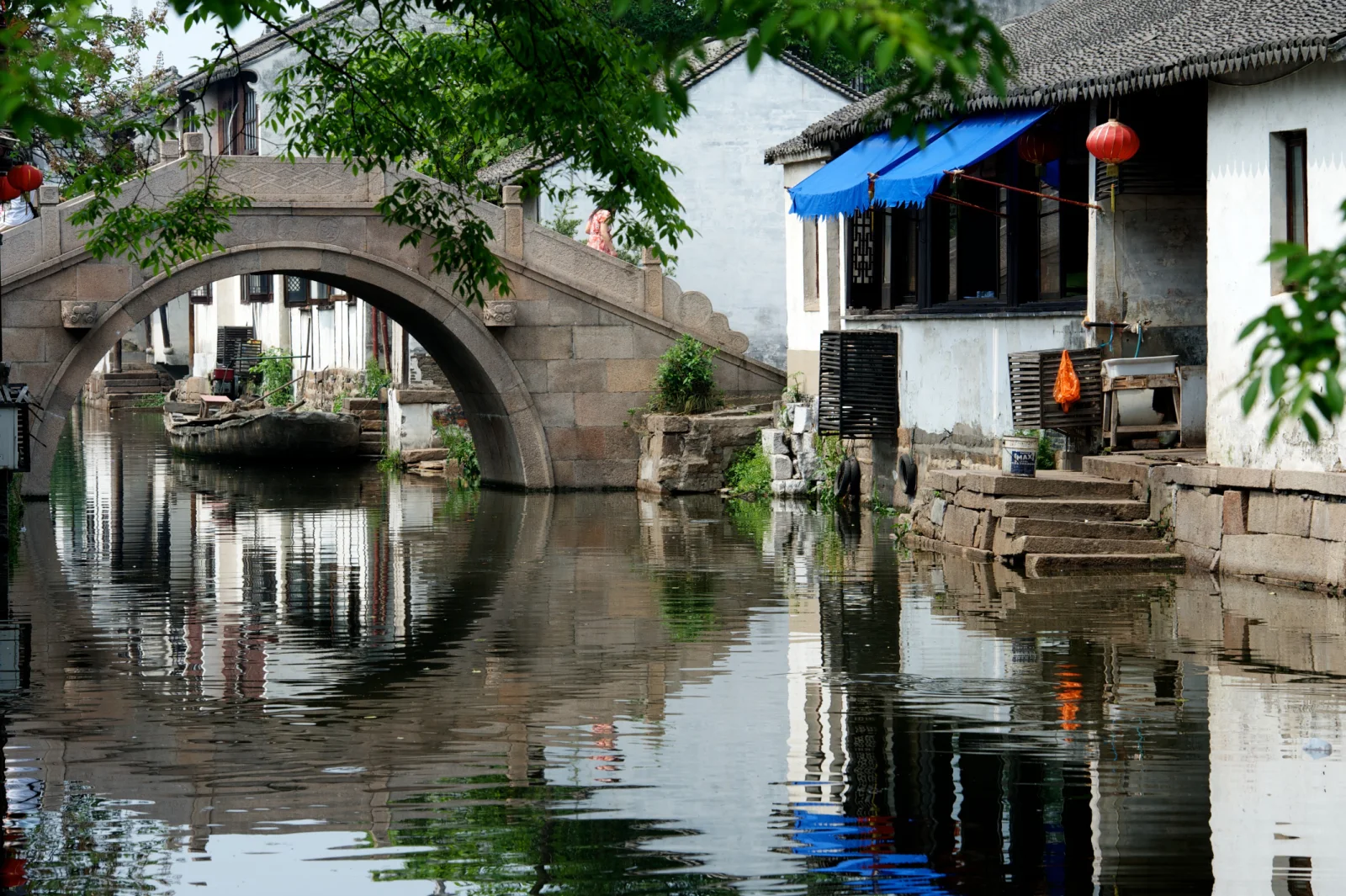
Jiangnan has many broadly similar water towns, including Zhujiajiao (朱家角), Wuzhen (乌镇), and Tongli (同里). Their canals, stone bridges, old houses, boat rides, and commercial streets overlap considerably. For most itineraries, choose the one that best fits your route rather than trying to visit several.
What to see
- Twin Bridges (双桥)
An L-shaped pair of stone bridges over a canal junction, made internationally famous by the painter Chen Yifei. This is the single most photographed corner of the town. - Shen’s House (沈厅) and Zhang’s House (张厅)
Two large merchant residences open to visitors, giving a sense of the wealth that Ming dynasty (1368-1644) and Qing dynasty (1644-1912) water trade brought to towns like this one. - A canal boat ride
Traditional gondola-style boats, poled rather than rowed, cross the town’s main channels. The ride is worth doing once, ideally away from the midday rush. - Fuan Bridge (富安桥)
A combined bridge-and-shop structure offers a Ming dynasty (1368-1644) solution for maximizing waterfront commercial space that still functions the same way today.
Caution
Zhouzhuang’s ticketing has changed repeatedly in recent years. Real-name registration and weekday discounts have both been introduced, so check the current price and rules before you go rather than relying on what a guidebook or a friend’s last visit told you. Arrive at opening or plan to stay past the day-tripper wave for any hope of quiet.
Suggested Itineraries
1 Day in Suzhou (from Shanghai)
Take an early train in, go straight to the Humble Administrator’s Garden and the Suzhou Museum, walk to the Master of the Nets Garden or over to Pingjiang Road for lunch and a canal walk, then head back for an evening train. It is a full but very doable day trip.
2 Days in Suzhou
Day 1: Gardens and old streets
Humble Administrator’s Garden and Suzhou Museum in the morning, Pingjiang Road for lunch and an afternoon wander, Master of the Nets Garden late afternoon when the light softens.
Day 2: Tiger Hill and the walls
Tiger Hill and Shantang Street in the morning, Lingering Garden after lunch, Pan Gate in the late afternoon for the quietest close to the day.
3 Days: Add Zhouzhuang
Days 1-2 as above, then take a full day trip to Zhouzhuang, ideally on an early bus to beat the crowds. Alternatively, swap it for a half-day in the city’s silk museum and Guanqian Street (观前街) shopping district if water towns are not a priority.
Where to Stay
Staying inside or just outside the old-city moat puts every sight in this guide within a short bus ride or a walk; staying near the modern SIP (Suzhou Industrial Park) business district trades that convenience for a more contemporary, mall-heavy stay. Prices below are rough high-season guides; check current rates before booking.
Luxury
- Five-stars around Jinji Lake (金鸡湖) in SIP
Modern towers with lake views, a 15-20 minute taxi from the old town. Often CNY1,200-3,000+/night.
Boutique / garden-side
- Small hotels around Pingjiang Road and the old city
Converted courtyard buildings and boutique inns put you inside the canal streets themselves. This is the most atmospheric way to stay in Suzhou. Often CNY600-1,500/night.
Midscale
- Domestic design chains (Atour 亚朵, Ji Hotel 全季, and similar)
Reliable and clean; look for properties near Guanqian Street or a Line 1/4 metro station. Often CNY350-700/night.
Budget
- Hostels and budget chains around Pingjiang Road and Guanqian Street
Both put the whole old-town cluster within walking range. Often CNY180-400/night.
Where to Eat
- Pingjiang Road and Shantang Street: The most touristy but also the most convenient food streets, heavy on snacks and teahouses.
- Guanqian Street (观前街): The old commercial heart of the city, with century-old restaurants alongside modern chains.
- Shiquan Street (十全街): A quieter, more local strip near the Master of the Nets Garden, good for an evening meal after the gardens close.
- Malls everywhere: As across urban China, upper-floor mall food courts are where locals actually eat well and cheaply. They are never a bad fallback.
Dishes to Try
- Songshu Gui (松鼠鳜鱼), Squirrel-Shaped Mandarin Fish: Suzhou’s showpiece dish is a whole mandarin fish scored, fried until the flesh curls like fur, and finished with a sweet-and-sour sauce. Order it once at a proper restaurant; it is theatre as much as food.
- Suzhou-style noodles (苏式汤面): A clear, deeply savory broth built from pork bones and river shrimp shells, topped with one of dozens of possible toppings (浇头) chosen at the counter.
- Zhouzhuang’s Wansan Hoof (万三蹄): A whole braised pork hock, named for a Ming dynasty (1368-1644) merchant, and the signature dish of the water town. Order it to share.
- Water shield soup and lake specialties (莼菜羹, 太湖三白): Suzhou’s Jiangnan setting shows up on the plate through a mild, silky vegetable soup and the “three whites” of Lake Tai (whitebait, white shrimp, silver fish).
- Suzhou-style mooncakes (苏式月饼): Flaky, layered pastry (as opposed to Cantonese-style dense mooncakes), traditionally pork-and-scallion or sweet lard-and-sugar filled.
- Osmanthus-flavored sweets (桂花糕, 桂花糖藕): Suzhou’s autumn osmanthus blossoms flavor everything from steamed rice cakes to sugared lotus root. These sweets are worth seeking out in September and October.
- Pingjiang-style tea and snacks: Suzhou takes afternoon tea seriously. A pot of local green tea (碧螺春, Biluochun, grown just outside the city) with a plate of small savory snacks is a proper way to break up a day of walking.
Hero photo: King of Hearts, CC BY-SA 4.0, via Wikimedia Commons.
Help keep this guide accurate
Found something incorrect, outdated, or missing? Tell us what changed and include a source when possible.
Suggest an update