
On this page13 sections
✓ Prices and practical details last verified August 2, 2026
Nanjing, the “Southern Capital,” has carried more of China’s history than almost any other city: capital of six early dynasties, of the founding Ming dynasty (1368-1644), of the Taiping rebels, and of the Republic of China. That layered past is everywhere, from the world’s longest surviving city wall to the tomb of the first Ming dynasty (1368-1644) emperor on Purple Mountain, the Republican-era boulevards and the mausoleum of Sun Yat-sen above them, and the sobering memorial to the darkest chapter of 1937. Yet it wears the weight lightly: a green, tree-lined, university city on the Yangtze, an hour from Shanghai, with lively lantern-lit nights along the Qinhuai River.
Highlights
- Climb the great stair to the Sun Yat-sen Mausoleum (中山陵) on Purple Mountain.
- Walk the stone-animal sacred way of Ming Xiaoling (明孝陵), tomb of the first Ming dynasty (1368-1644) emperor.
- Cruise the lantern-lit Qinhuai River (秦淮河) past the Confucius Temple at night.
- Pay respects at the Nanjing Massacre Memorial (遇难同胞纪念馆).
- Walk the 600-year-old Ming city wall (明城墙) above Xuanwu Lake.
Transportation
Getting there
Nanjing is one of eastern China’s great rail hubs. Nanjingnan station is a major stop on the Beijing-Shanghai high-speed line, about 1 to 1.5 hours from Shanghai, 3.5 hours from Beijing on the fastest trains, and about an hour from Hangzhou or Suzhou; the older Nanjing station sits by Xuanwu Lake for some services, and Lukou airport is 40 km south. Note which station your train uses: Nanjingnan is the high-speed hub on metro Lines 1 and 3, while the older Nanjing station sits scenically on Xuanwu Lake’s north shore.
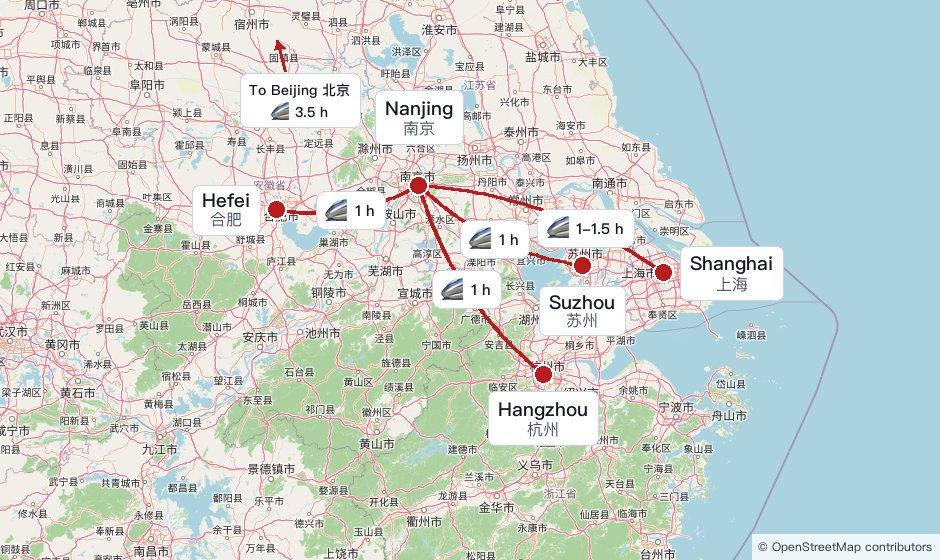
Reaching Nanjing: high-speed rail into Nanjingnan from Shanghai, Suzhou, Hangzhou, and Hefei, with Beijing about 3.5 hours up the trunk line.
Common onward routes
| Route | Best option | Travel Time | Notes |
|---|---|---|---|
| Nanjing -> Shanghai (上海) | High-speed train | 1-1.5 hours | Constant departures on the busiest line in China. |
| Nanjing -> Suzhou (苏州) | High-speed train | ~1 hour | Gardens and canals en route to Shanghai. |
| Nanjing -> Hangzhou (杭州) | High-speed train | ~1 hour | Direct to West Lake on the Ninghang line. |
| Nanjing -> Hefei (合肥) | High-speed train | ~1 hour | West toward Anhui and Huangshan connections. |
| Nanjing -> Beijing (北京) | High-speed train | ~3.5 hours | The fastest G trains run nonstop up the trunk line. |
Getting around
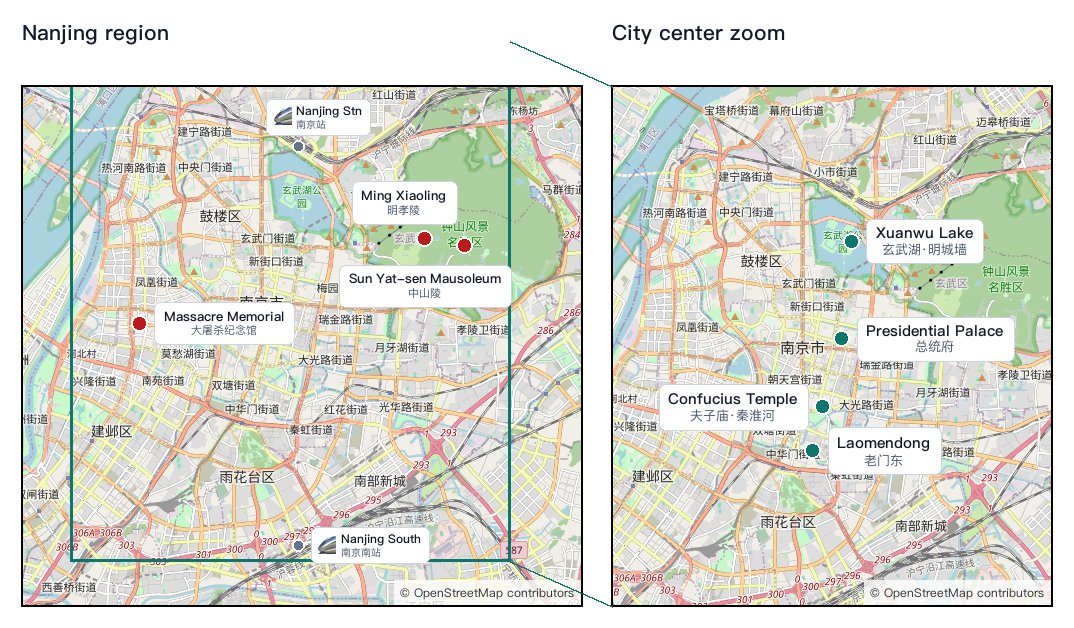
Nanjing’s metro is extensive and easy: Line 1 and Line 3 link the two railway stations with the city center, Line 2 runs east under Zhongshan Road to the Purple Mountain scenic area, and Line 3 passes near the Confucius Temple. On Purple Mountain itself, an internal shuttle links the Sun Yat-sen Mausoleum, Ming Xiaoling, and the other sights, saving a lot of walking in the forest. Elsewhere taxis and Didi are cheap, and the walled old city rewards walking.
Key Attractions
Nanjing’s sights fall into two groups. Purple Mountain in the east holds the Sun Yat-sen Mausoleum and Ming Xiaoling in one forested scenic area, with the Massacre Memorial across town to the west. The city center cluster runs down the old axis: Xuanwu Lake and the Ming dynasty (1368-1644) wall in the north, the Presidential Palace in the middle, and the Confucius Temple, Qinhuai River, and Laomendong in the walled south. The numbers on the map match the sections below; click a numbered dot to jump to it.
1. Sun Yat-sen Mausoleum (中山陵)
Getting there: Purple Mountain scenic area; metro Line 2 to Muxuyuan then the scenic shuttle or a walk
Admission: free, but by real-name timed reservation (four daily time bands) on the 钟山风景区 official WeChat account, mini-program, or website; closed Mondays outside holidays
Time needed: 2 to 3 hours
The mausoleum of Sun Yat-sen, father of modern China, climbs the southern slope of Purple Mountain in one monumental sweep: a tree-lined approach, a great marble gateway, and then 392 stone steps rising to the blue-tiled memorial hall where his marble statue sits beneath the Nationalist sun emblem. Built in the 1920s, it fuses imperial tomb tradition with Republican symbolism, and the view back down the stairway over the forest canopy is one of Nanjing’s defining images. It is a place of genuine national reverence, busy every day of the year.
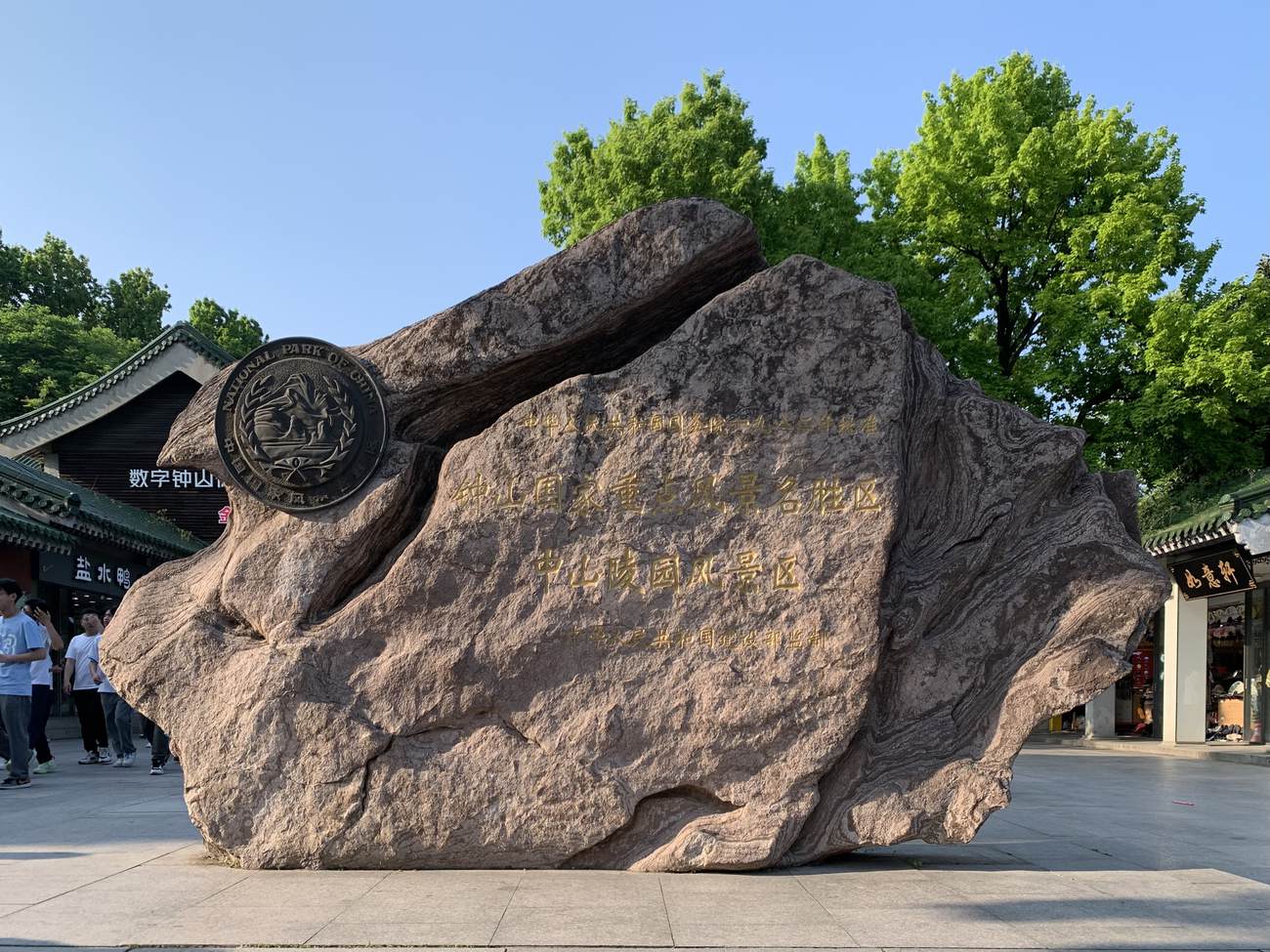
Photo: Chainwit., CC BY 4.0, via Wikimedia Commons
What to see
- The 392 steps
The grand ceremonial stairway, designed so that looking up you see only steps, and looking down only platforms. - The memorial hall and crypt
The seated marble statue of Sun Yat-sen beneath the star-blue dome, with the recumbent effigy behind. - The view over the forest
The sweep back down the axis across Purple Mountain’s woods to the city.
Caution
Book the free timed slot ahead and remember the Monday closure. The climb is exposed in summer; go early, carry water, and combine it with Ming Xiaoling next door via the scenic shuttle.
2. Ming Xiaoling Mausoleum (明孝陵)
Getting there: Purple Mountain scenic area, one shuttle stop or a forest walk from the Sun Yat-sen Mausoleum
Admission: CNY70, with combo tickets covering other Purple Mountain sights often the better value
Time needed: 2 to 3 hours
Ming Xiaoling is the tomb of Zhu Yuanzhang, the peasant-turned-emperor who founded the Ming dynasty (1368-1644) and made Nanjing his capital, and it set the template every later Ming dynasty (1368-1644) and Qing dynasty (1644-1912) imperial tomb followed. Its glory is the Sacred Way: a long, winding avenue guarded by paired stone elephants, camels, lions, and mythical beasts, then robed ministers and generals, leading through the forest to the great brick Soul Tower against the mountainside. The emperor lies unexcavated in the hill behind. In late winter the neighboring Meihua Hill explodes into plum blossom, Nanjing’s loveliest seasonal show.
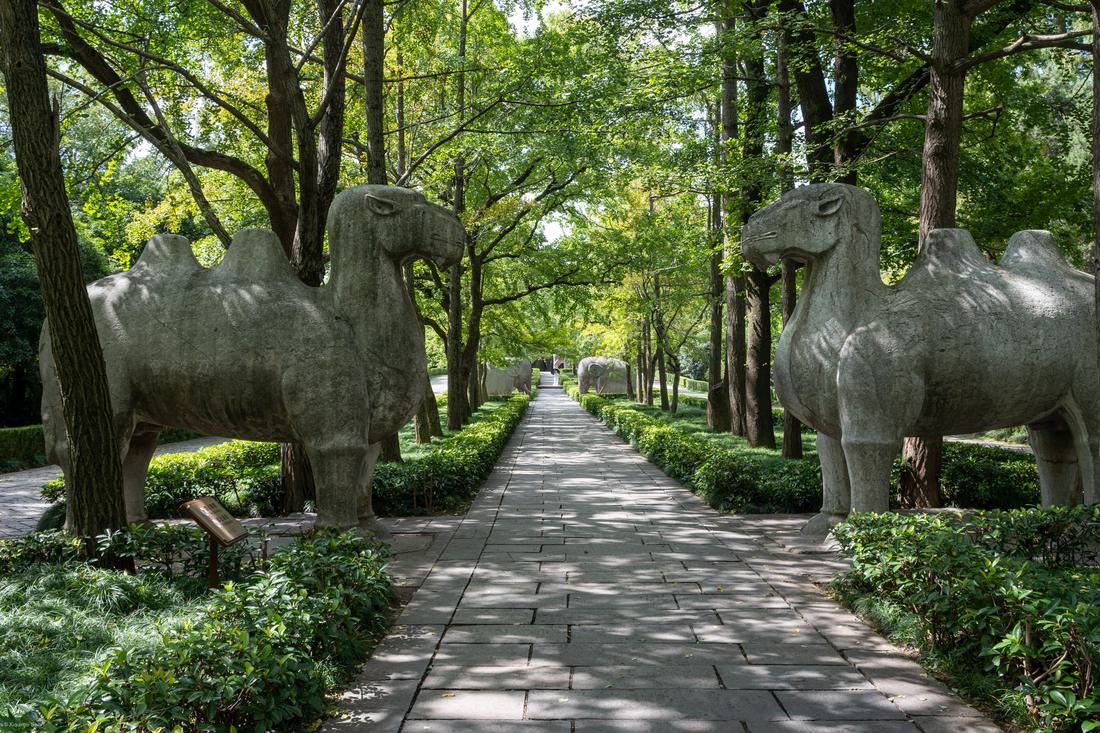
Photo: xiquinhosilva, CC BY 2.0, via Wikimedia Commons
What to see
- The Sacred Way (石象路)
The avenue of monumental stone animals and officials, especially photogenic under autumn ginkgo and maple. - The Soul Tower and mound
The great brick tower and the forested tumulus of the founding Ming dynasty (1368-1644) emperor behind it. - Meihua Hill (梅花山)
The plum-blossom hill beside the Sacred Way, at its peak roughly late February to mid March.
Caution
It is a UNESCO site and deservedly popular; mornings are calmer. The full circuit involves a few kilometres of walking, so use the scenic shuttle between it, the Sun Yat-sen Mausoleum, and the other Purple Mountain sights.
3. Confucius Temple & Qinhuai River (夫子庙·秦淮河)
Getting there: Metro Line 3 to Fuzimiao station, south of the center
Admission: the streets and river banks are free; the Confucius Temple itself and a few historic houses charge modest separate admissions of about CNY30 or less
Time needed: An evening
The Confucius Temple quarter along the Qinhuai River has been Nanjing’s pleasure district for six centuries, where imperial examination candidates from the vast Jiangnan Examination Hall next door blew off steam among the teahouses. Today it is the city’s great night scene: whitewashed halls and lantern strings doubled in the dark river, the huge dragon screen wall glowing across the water, snack streets in every direction, and painted pleasure boats sliding beneath arched bridges. in 2026 the classic painted-boat cruise from the Confucius Temple wharf runs CNY100 by day and CNY120 after dark in the main season (slightly less in deep winter), and the night ride is the one worth taking.
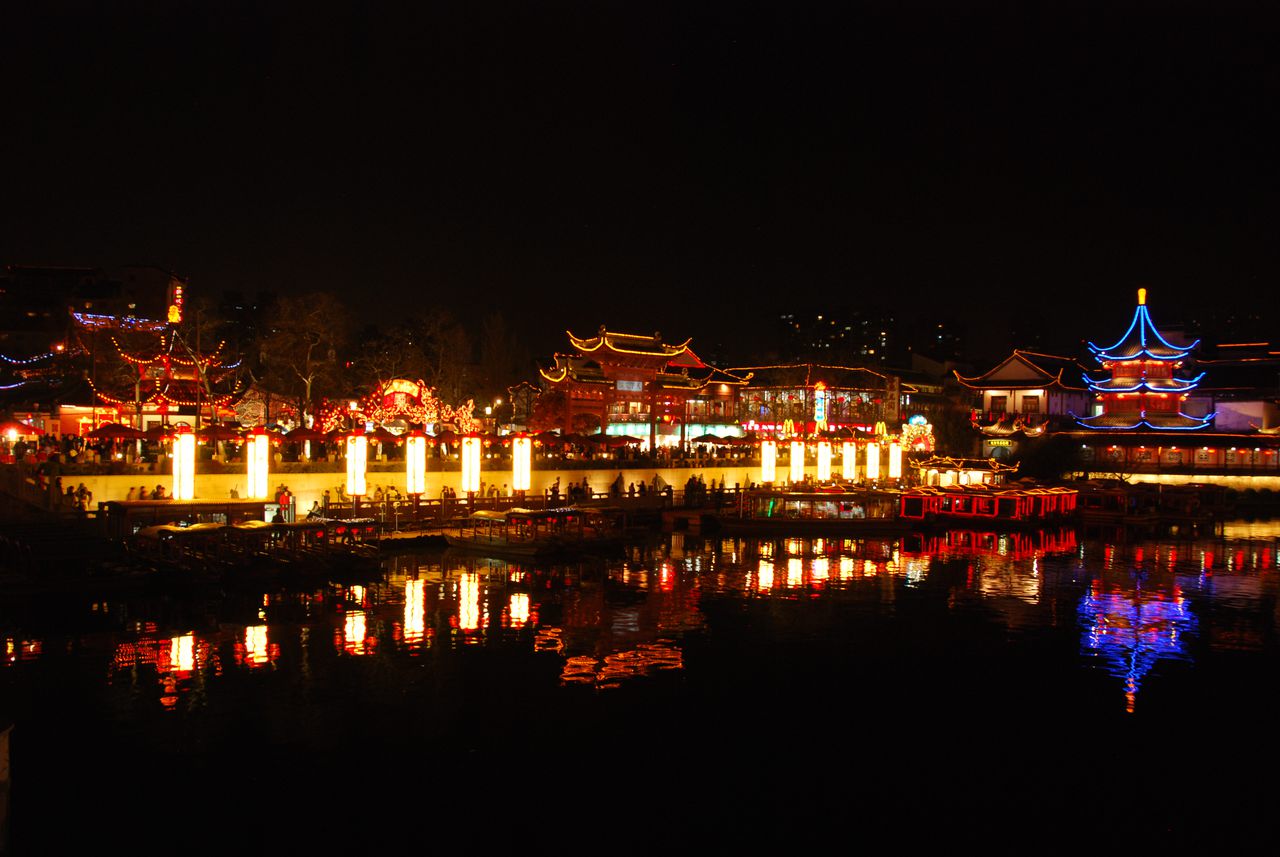
Photo: Dick Rochester, CC BY-SA 2.0, via Wikimedia Commons
What to see
- The night river cruise
The classic painted-boat loop past lit bridges, screen walls, and waterside houses. - The Confucius Temple and Examination Hall
The restored temple axis and the Jiangnan Examination Hall museum on the old testing grounds. - The snack streets
Duck blood soup, tangbao, and the “Eight Beauties of Qinhuai” snack sets in the lanes around the temple.
Caution
It is at its magical best after dark and at its most crowded on weekend and holiday nights; a weeknight visit is far calmer. The quarter is unabashedly commercial, so treat the shops as scenery and pick eating spots with local queues.
4. Nanjing Massacre Memorial (遇难同胞纪念馆)
Getting there: Metro Line 2 to Yunjinlu station, west of the center
Admission: free with a real-name reservation on the memorial's official WeChat account 侵华日军南京大屠杀遇难同胞纪念馆, bookable 1 to 7 days ahead with tickets released at 08:00; closed Mondays
Time needed: 2 to 3 hours
The Memorial Hall for the Victims of the Nanjing Massacre stands on one of the 1937 execution and burial grounds, and it is one of the most affecting museums in China. Grey stone, water, and sculpture set the tone outside; inside, documents, photographs, survivor testimony, and an excavated mass grave record the killing of some 300,000 people during the Japanese occupation of the city. It ends deliberately in a hall of peace. It is not an easy visit, and it should not be, but it is essential to understanding modern Nanjing and modern China.
What to see
- The sculpture court and names wall
The harrowing entry sculptures and the wall of victims’ names by the reflecting pool. - The historical exhibition
The documentary record of December 1937, built from artifacts, film, and survivor accounts. - The site of bones
The preserved excavation of a mass grave, left in place as evidence and memorial.
Caution
Reserve the free entry ahead and note the Monday closure. Keep voices low, dress respectfully, and think carefully before bringing young children; the material is graphic.
5. Presidential Palace (总统府)
Getting there: Metro Line 2 or 3 to Daxinggong station, city center
Admission: CNY35, with tickets released at midnight and bookable up to 2 days ahead on the official channels; book ahead for weekends
Time needed: 2 to 3 hours
The Presidential Palace compresses five centuries of power into one walled compound: a Ming dynasty (1368-1644) princely mansion, the Qing dynasty (1644-1912) viceroy’s yamen of Jiangnan, the palace of the Taiping Heavenly King, and finally the seat of the Republic of China, where Sun Yat-sen took office as provisional president in 1912 and Chiang Kai-shek governed until 1949. You wander from ceremonial halls into 1930s offices frozen mid-century, then out into a lovely Jiangnan garden with a stone boat. Few places anywhere let you walk through so many regimes in an afternoon.
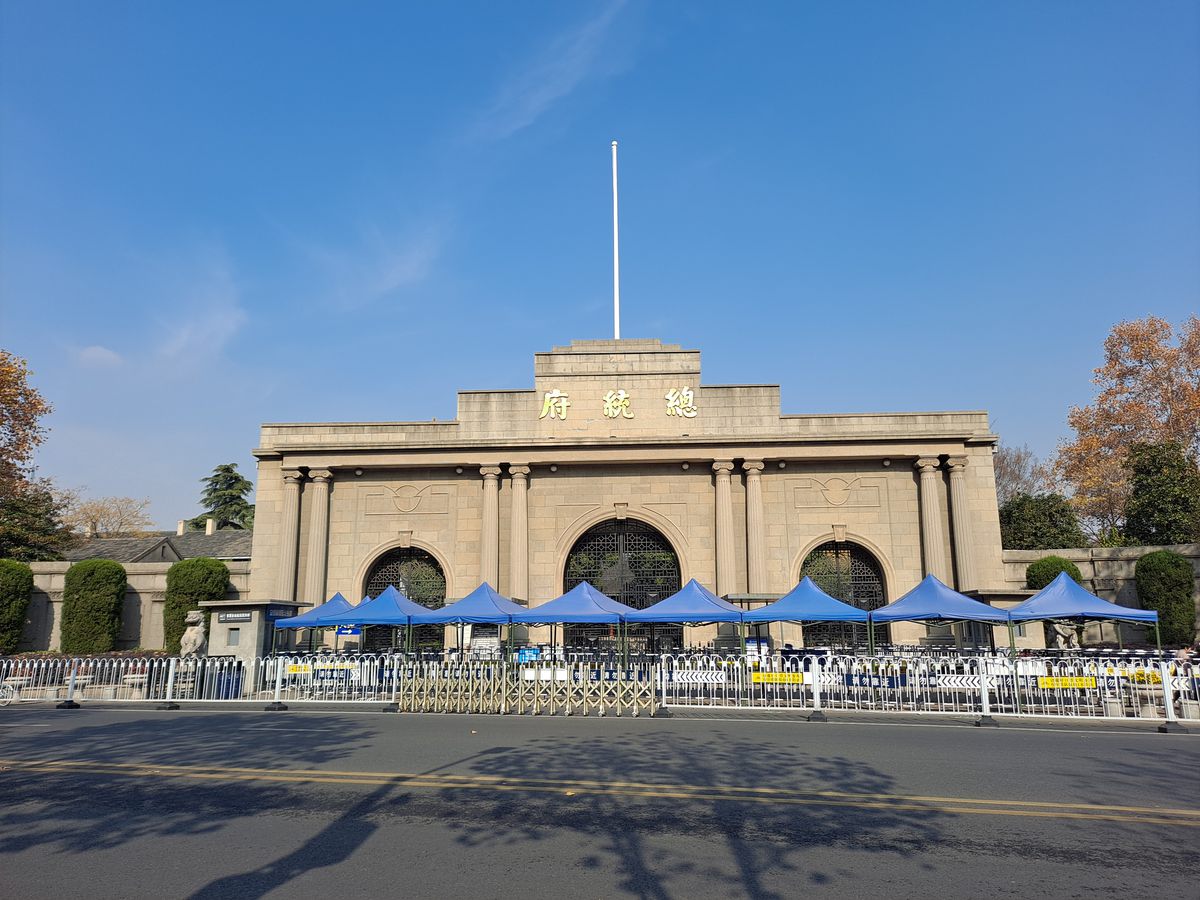
Photo: 钉钉, CC BY-SA 4.0, via Wikimedia Commons
What to see
- The Republican offices
Chiang Kai-shek’s and the cabinet’s preserved working rooms, and Sun Yat-sen’s provisional president’s office. - The Taiping and Qing dynasty (1644-1912) halls
The audience halls of the Taiping Heavenly Kingdom and the Liangjiang viceroys. - Xu Garden (煦园)
The classical garden at the west side, with its stone boat on the pond.
Caution
Tickets release at midnight and weekends sell out, so book a day or two ahead. Allow more time than you expect; the compound is far deeper than the gate suggests.
6. Ming City Wall & Xuanwu Lake (明城墙·玄武湖)
Getting there: Metro Line 1 to Xuanwumen station for the lakeside wall section
Admission: Xuanwu Lake park is free; the lakeside Xuanwumen-Taicheng stretch charges about CNY30, other segments CNY10-30, and evening sessions on lit sections cost about CNY30
Time needed: Half a day
Nanjing’s Ming dynasty (1368-1644) city wall is the longest surviving city wall on earth, over 25 kilometres of 600-year-old brick still standing where Zhu Yuanzhang’s builders raised it, each brick stamped with its maker’s name as a quality guarantee. The finest stretch runs along Xuanwu Lake: climb at Xuanwumen or Jiefangmen and walk the ramparts between the water and the towers of the modern city, with Purple Mountain floating beyond. Below, Xuanwu Lake itself is a vast free park of causeways, lotus beds, and willow islands, the old imperial lake turned city playground.
What to see
- The wall-top walk
The Xuanwumen to Taicheng ramparts above the lake, the classic lake-wall-mountain-city panorama. - The stamped bricks
Maker’s-mark inscriptions still legible in the 600-year-old brickwork. - Xuanwu Lake’s causeways
The five islets and willow embankments, best by rented boat or a slow evening walk.
Caution
The lake park is big; pick one or two islets rather than trying to loop the whole shore. On the wall there is little shade, so bring sun cover in summer and consider the lit evening session in hot months.
7. Laomendong (老门东)
Getting there: South of the Confucius Temple quarter, inside the Zhonghua Gate area; metro Line 3 to Wudingmen or a walk from Fuzimiao
Admission: Free to wander
Time needed: 2 to 3 hours
Laomendong, “Old East of the Gate,” is the restored historic quarter tucked inside the city wall by the colossal Zhonghua Gate, its grey-brick lanes, carved gateways, and courtyard houses rebuilt into Nanjing’s favorite strolling neighborhood. It is the calmer, more tasteful sibling of the Confucius Temple crowds: teahouses, craft shops, a famous bookstore in a converted bathhouse, street snacks, and rooftop views of the wall. Zhonghua Gate itself, a gigantic four-layered barbican with arrow towers and hidden soldier vaults, anchors the western end and deserves a visit in its own right.
What to see
- The lanes and courtyards
Restored Qing dynasty (1644-1912) style streets full of teahouses, studios, and snack shops, prettiest under evening lanterns. - Zhonghua Gate (中华门)
The immense Ming dynasty (1368-1644) barbican beside the quarter, the largest city gate complex in China. - Wall views
Rooftop terraces and the adjacent wall section looking over the grey-tiled sea of the old south city.
Caution
It pairs naturally with the Confucius Temple, a 10-15 minute walk north, for one southern old-city evening. Popular restaurants queue on weekends; go early or book.
Suggested Itineraries
2 Days: The Essentials
Day 1: Purple Mountain and the Qinhuai night
The Sun Yat-sen Mausoleum first thing on your booked slot, Ming Xiaoling and the Sacred Way after, then down into the city for the Confucius Temple, a Qinhuai night cruise, and Laomendong for dinner.
Day 2: The Republic and remembrance
The Massacre Memorial in the morning, the Presidential Palace after lunch, then the Ming dynasty (1368-1644) wall and Xuanwu Lake for the late afternoon and sunset.
With a third day
Add the Nanjing Museum (free, superb, near Zhongshan Gate), Jiming Temple and the Taicheng wall walk, or the 1912 district’s cafes. Plum-blossom season adds Meihua Hill; deep summer adds lotus on Xuanwu Lake.
As part of a Jiangnan loop
Nanjing slots easily into a Shanghai, Suzhou, and Hangzhou circuit by high-speed rail, each hop about an hour, and makes the natural history-heavy counterweight to the gardens and lakes.
Where to Stay
The most convenient bases are Xinjiekou, the central shopping hub where metro lines cross, and the Confucius Temple and Laomendong area for atmospheric evenings. Business hotels cluster near Nanjingnan station but leave you far from the night scenes. Prices below are rough guides; holiday weekends and blossom season run higher.
Midscale
- Xinjiekou and Fuzimiao hotels
Comfortable chains and boutiques in the center and by the river quarter. Often CNY300-600/night, higher on holiday weekends.
Budget
- Hostels and budget chains
Simple rooms across the old city, several near the Confucius Temple lanes. Often CNY120-300/night.
Where to Eat
- Duck first: Nanjing is China’s duck capital; locals joke no duck escapes the city alive.
- Qinhuai snacks: The lanes around the Confucius Temple serve the classic “Eight Beauties” snack canon.
- Laomendong and Shiziqiao: The restored quarter and the Shiziqiao food street are the other big grazing grounds.
Dishes to Try
- Salted duck (盐水鸭): The city’s signature, brined and poached, served cool, delicate, and addictive.
- Duck blood vermicelli soup (鸭血粉丝汤): Nanjing’s everyday bowl, duck blood, liver, and glass noodles in rich broth.
- Tangbao soup dumplings (汤包): Thin-skinned dumplings full of hot broth, eaten with a straw-first sip.
- Pan-fried beef dumplings (牛肉锅贴): Crescent potstickers, crisp-bottomed and juicy, a Qinhuai staple.
- Sesame duck oil pastry (鸭油酥烧饼): Flaky sesame flatbreads made with duck fat, best fresh from the oven.
- Sweet osmanthus lotus root (桂花糖芋苗/糯米藕): The city’s beloved sweet bowls, fragrant with osmanthus.
Hero photo: Chainwit., CC BY 4.0, via Wikimedia Commons.
Help keep this guide accurate
Found something incorrect, outdated, or missing? Tell us what changed and include a source when possible.
Suggest an update