
On this page12 sections
✓ Prices and practical details last verified July 11, 2026
Chengdu is the easygoing capital of Sichuan, a city that runs on tea, mahjong, and slow afternoons as much as on its famous fiery food. It is best known abroad as the home of the giant panda, with a research base on the edge of town where you can watch them up close, but the city itself rewards a relaxed few days: leafy old lanes, temple teahouses, and some of the best eating in China. It is also the launch pad for a run of Sichuan day trips, from the ancient waterworks at Dujiangyan to the colossal Leshan Giant Buddha carved into a river cliff.
Highlights
- Watch giant pandas at the Chengdu Research Base of Giant Panda Breeding (大熊猫繁育研究基地), best in the active morning hours.
- Sip tea in the courtyards of Wuhou Shrine (武侯祠) and browse the restored Jinli (锦里) old street beside it.
- Slow down over tea and snacks in the lanes of Kuanzhai Alley (宽窄巷子) and People’s Park (人民公园).
- Day-trip to the 2,200-year-old Dujiangyan (都江堰) irrigation works and the Taoist slopes of Mount Qingcheng (青城山).
- Use Chengdu as a base for a day trip to the Leshan Giant Buddha (乐山大佛).
Transportation
Getting there
Chengdu has two airports. The newer Tianfu International Airport (天府国际机场 / TFU) handles most long-haul and international flights, while the older Shuangliu (双流 / CTU) is closer to the city and mostly domestic. Check current direct routes on FlightConnections. the newer Tianfu International Airport (TFU) is southeast of the city on Metro Lines 18 and 19 (around 45 to 60 minutes to the center), while the older Shuangliu (CTU) is closer, on Line 10. Chengdu is also a major high-speed rail hub, an hour from Chongqing and about three from Xi’an.
Railway stations
Chengdudong (成都东站) is the main high-speed hub and the busiest arrival point, with trains in every direction. Chengdunan (成都南站) handles the frequent line out to Dujiangyan and Qingcheng, and Chengdu Railway Station (成都站), the older north station, is being rebuilt. Always check which station your ticket uses, as they sit on opposite sides of the city.
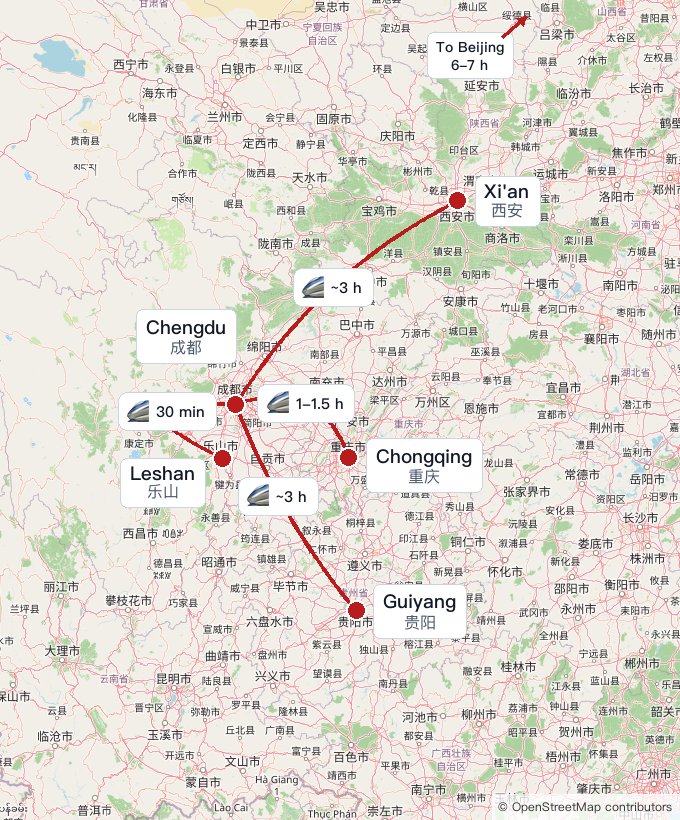
High-speed rail times from Chengdu to Chongqing, Xi'an, Guiyang, and Leshan. Most fast trains leave from Chengdudong.
Common onward routes
| Route | Best option | Travel Time | Notes |
|---|---|---|---|
| Chengdu (成都) -> Leshan (乐山) | High-speed train | 30 minutes | For the Giant Buddha, an easy half-day or day trip. |
| Chengdu (成都) -> Chongqing (重庆) | High-speed train | 1-1.5 hours | The other Sichuan-basin giant, very frequent. |
| Chengdu (成都) -> Xi’an (西安) | High-speed train | around 3 hours | North to the Terracotta Army, covered in our Xi’an guide. |
| Chengdu (成都) -> Guiyang (贵阳) | High-speed train | around 3 hours | Southeast into Guizhou’s mountains and villages. |
| Chengdu (成都) -> Beijing (北京) | Flight or high-speed train | 6-7 hours by rail | Flying is usually the better choice for this distance. |
Getting around
The metro covers the city sights well and reaches both airports; fares are CNY2 to start, rising with distance; most trips in the city cost CNY2 to 7, paid with a transport QR code in Alipay or WeChat. Chengdu is flat and cyclable, and shared bikes are everywhere for short hops. For the panda base, get there at opening time and take the metro or a taxi rather than counting on tour buses. The Dujiangyan and Leshan day trips are both easy by high-speed train from the city.
Key Attractions
Chengdu’s sights split into a compact inner city and day trips to Dujiangyan and Mount Qingcheng. The regional overview places the panda base and People’s Park in relation to the two day trips; the city zoom separates the central sights that would otherwise overlap. The numbered points link to the sections below. Leshan is covered in the separate Leshan and Mount Emei guide.

1. Chengdu Panda Base (大熊猫基地)
Getting there: Metro Line 3 to Panda Avenue (熊猫大道), then a shuttle, or a taxi from the center
Admission: CNY55 (around CNY27 for students); it uses timed, real-name online booking, and mornings are far better since the pandas are most active and feeding then
Time needed: Half a day, arriving at opening
The Chengdu Research Base of Giant Panda Breeding is a large, garden-like reserve on the northeastern edge of the city, home to dozens of giant pandas along with the smaller red pandas. It is a genuine breeding and research center rather than a zoo, with the animals in spacious bamboo enclosures, and seeing them tumble and munch at close range is the single most popular thing to do in Chengdu. Timing is everything: come at opening, when the pandas are fed and active, because by midday they mostly sleep.
What to see
- The giant pandas
Adults and, in season, cubs across several enclosures and a nursery, most active in the cool early morning. - The red pandas
The smaller, russet red pandas roam parts of the base and are often easier to see up close. - The gardens and museum
Bamboo groves, lakes, and a small museum spread across a genuinely pleasant park worth the walk between enclosures.
Caution
The base uses timed, real-name online booking and caps daily numbers, so reserve ahead. It is far busier and hotter by late morning, and the pandas sleep through midday; an early start is the difference between a great visit and a crowded one.
2. Wuhou Shrine & Jinli (武侯祠)
Getting there: Metro Line 3 to Gaoshengqiao (高升桥), or a short taxi from the center
Admission: CNY50 (around CNY25 concession); the adjoining Jinli old street is free
Time needed: Half a day
Wuhou Shrine is China’s most important memorial to the heroes of the Three Kingdoms period (220-280), dedicated to the brilliant strategist Zhuge Liang and the ruler Liu Bei, set among red walls, old cypresses, and quiet courtyards. Right beside it, Jinli is a restored Qing dynasty (1644-1912) style street of shops, snack stalls, and teahouses, touristy but atmospheric, especially in the evening when the lanterns come on. Together they make an easy half-day of history and grazing.
What to see
- The shrine halls and gardens
Statues and steles honoring the figures from the Three Kingdoms period (220-280), in a tranquil temple complex of red walls and bamboo. - Jinli old street (锦里)
A lantern-lit lane of snacks, tea, and craft shops next to the shrine, best in the early evening. - The teahouses
Both the shrine grounds and Jinli have traditional teahouses, a good place to slow down over a covered bowl of tea.
Caution
Jinli is squarely aimed at tourists, so treat the food and the atmosphere as the draw rather than expecting bargains. It is busiest at night and on holidays; go earlier for a calmer wander through the shrine itself.
3. Kuanzhai Alley (宽窄巷子)
Getting there: Metro Line 4 to Kuanzhai Alley (宽窄巷子)
Admission: Free
Time needed: 2 to 3 hours
Kuanzhai Alley, the “Wide and Narrow Alleys,” is a restored district of old courtyard houses from the Qing dynasty (1644-1912), now filled with teahouses, restaurants, bars, and boutiques along three parallel lanes. It is one of Chengdu’s most popular strolls, packaging the city’s laid-back teahouse culture into a compact, walkable set of grey-brick lanes. Like Jinli it is polished and commercial, but the architecture is genuine and the people-watching is good.
What to see
- The Wide Alley (宽巷子)
The most traditional of the three lanes, lined with teahouses and courtyard restaurants. - The Narrow Alley (窄巷子)
A slightly more upscale lane of cafes, bars, and design shops. - The Well Alley (井巷子)
The liveliest, with snack stalls and a wall display on old Chengdu life.
Caution
The lanes are packed on weekends and holidays, and prices run high for the area. Come on a weekday and treat it as a stroll and a tea stop rather than a place for a serious meal.
4. People’s Park & Teahouses (人民公园)
Getting there: Metro Line 2 to People’s Park (人民公园)
Admission: Free
Time needed: 2 to 3 hours
People’s Park is where Chengdu’s famous slow pace is on fullest display: a leafy public park where locals drink tea, play mahjong and cards, dance, sing, and doze the afternoon away. The open-air Heming Teahouse (鹤鸣茶社) by the lake is an institution, with bamboo chairs, bottomless bowls of tea, and roving ear-cleaners plying an old Chengdu trade. It is the single best place to understand how the city actually spends its time.
What to see
- Heming Teahouse (鹤鸣茶社)
The classic lakeside teahouse, all bamboo chairs and refillable tea, and the heart of the park’s social life. - The lake and gardens
Paddle boats, bonsai displays, and shaded paths busy with locals exercising and relaxing. - The 1911 railway memorial
A monument marking the protest movement that helped spark the fall of the Qing dynasty (1644-1912).
Caution
The teahouse gets busy in the afternoons, which is part of the fun, but come mid-morning if you want a quieter seat. The ear-cleaning is a genuine local tradition rather than a scam, though you can wave it away with a smile.
5. Wenshu Monastery (文殊院)
Getting there: Metro Line 1 to Wenshu Monastery (文殊院)
Admission: Free
Time needed: 1 to 2 hours
Wenshu Monastery is Chengdu’s best-preserved Buddhist temple, an active monastery of quiet halls, incense smoke, and old trees in the middle of the city. Its vegetarian restaurant and teahouse are well loved, and the surrounding restored lanes make a calmer, more genuinely spiritual counterpoint to the commercial old streets elsewhere. It is a good place to slow down between the busier sights.
What to see
- The temple halls
A sequence of well-kept Buddhist halls with statuary and relics, still an active place of worship. - The tea garden and vegetarian hall
A tranquil courtyard teahouse and a popular Buddhist vegetarian restaurant on the grounds. - The surrounding lanes
Restored streets around the temple with snacks, tea, and craft shops, quieter than Jinli or Kuanzhai.
Caution
It is a working temple, so keep noise down and dress modestly in the halls. The vegetarian hall and teahouse are popular at lunch, so go a little early or late.
6. Dujiangyan & Mount Qingcheng (都江堰)
Getting there: High-speed train from Chengdu, about 30 to 40 minutes, then local transport
Admission: CNY80 for the Dujiangyan irrigation works; Mount Qingcheng is a separate ticket, around CNY80 for the front mountain and CNY20 for the quieter back mountain
Time needed: A full day for both, or a half day each
Dujiangyan is a 2,200-year-old irrigation system on the Min River, still in use, that tamed the floods of the Chengdu plain without a dam and made Sichuan the fertile “land of abundance.” It is an understated but genuinely remarkable piece of ancient engineering, now a UNESCO site with riverside walkways and a hilltop temple. Nearby, Mount Qingcheng is one of the birthplaces of Taoism, a green mountain of temples, forest paths, and mist that pairs naturally with the waterworks.
What to see
- The Dujiangyan waterworks (都江堰水利工程)
The Fish Mouth levee, Flying Sand weir, and Bottle-Neck channel that split and control the river, seen from riverside paths and the Anlan suspension bridge. - Mount Qingcheng front mountain (青城前山)
The classic temple route up a forested Taoist mountain, walkable or aided by a cable car and lake ferry. - Qingcheng back mountain (青城后山)
A quieter, wilder area of streams and trails for those with more time and energy.
Caution
Doing both Dujiangyan and Qingcheng in one day is a full, tiring schedule, so consider picking one if you want a relaxed pace. The mountain involves real walking and can be wet and misty, so bring proper shoes and a light rain layer.
Suggested Itineraries
2 Days in Chengdu
Day 1: Pandas and the old city
The panda base first thing in the morning, then downtown for Wuhou Shrine and Jinli, and an evening in Kuanzhai Alley for tea and food.
Day 2: Teahouses and temples
A slow morning of tea and people-watching in People’s Park, Wenshu Monastery and its lanes around midday, then the Jinsha Site Museum or more teahouse time in the afternoon.
3 to 4 Days: Adding day trips
Days 1 to 2 as above, then add a day trip to Leshan and Mount Emei to the south, or Dujiangyan with Mount Qingcheng to the northwest.
Chengdu as a base
Chengdu is the gateway to western Sichuan’s mountains and the launch point for longer trips to Jiuzhaigou, the Tibetan highlands, and beyond. It pairs easily with Chongqing an hour away, and with Xi’an about three hours north by fast train.
Where to Stay
Staying near Chunxi Road and Taikoo Li puts you in the shopping and dining heart of the city with good metro access; the areas around Wuhou Shrine, Kuanzhai Alley, and Wenshu Monastery trade some convenience for old-city character. Prices below are rough high-season guides; check current rates before booking.
Luxury
- Downtown five-stars
International brands around Chunxi Road and Taikoo Li, in the middle of the shopping and eating. Often CNY700-1,800+/night.
Boutique
- Courtyard and design hotels
Smaller stays near Kuanzhai Alley and the old lanes, with more local character. Often CNY400-900/night.
Midscale
- Domestic chains (Atour 亚朵, Ji Hotel 全季, and similar)
Reliable and central; look for a property near a metro stop downtown. Often CNY250-550/night.
Budget
- Hostels and budget hotels
Chengdu has a long-established backpacker scene with cheap, sociable hostels near the sights. Often CNY120-300/night.
Where to Eat
- Sichuan hotpot: The city’s signature meal, a numbing-spicy broth for cooking at the table; Chengdu’s style is a touch less fierce than Chongqing’s but just as beloved.
- Teahouse snacks: People’s Park, Wenshu, and the old streets are the place for small plates and endless tea, the heart of local life.
- Chuan chuan and street food: Skewers cooked in spicy broth and a huge range of street snacks are everywhere, cheap and excellent.
- Taikoo Li and the malls: The modern dining district around Chunxi Road has everything from refined Sichuan to international food.
Dishes to Try
- Mapo tofu (麻婆豆腐): Soft tofu in a fiery, numbing bean-and-chili sauce, a Chengdu classic done best in the city that created it.
- Sichuan hotpot (四川火锅): The communal chili-and-pepper cauldron for cooking meats and vegetables, a whole evening’s meal.
- Dan dan noodles (担担面): Springy noodles in a spicy, nutty sauce, a signature small bowl.
- Sweet water noodles (甜水面): Thick chewy noodles in a sweet, garlicky, spicy sauce, a local street favorite.
- Zhong dumplings and long chao shou (钟水饺 / 龙抄手): Two famous old-brand dumpling and wonton shops worth seeking out.
- Rabbit, done many ways (兔头): Spicy braised rabbit heads and other rabbit dishes are a genuine Chengdu specialty for the adventurous.
Hero photo: George Lu, CC BY 2.0, via Wikimedia Commons.
Help keep this guide accurate
Found something incorrect, outdated, or missing? Tell us what changed and include a source when possible.
Suggest an update