
On this page14 sections
✓ Prices and practical details last verified June 29, 2026
Behind the backpacker buzzword lies a chain of Bai minority villages, temple courtyards, mountain trails, and one of China’s most beautiful lake loops. Dali (大理) is not just the Old Town. The real rhythm of the place runs between Cangshan Mountain (苍山) and Erhai Lake (洱海), through Xizhou’s courtyards, lakeside cycling paths, morning markets, and quiet villages. In recent years, the area has even been dubbed “Dalifornia,” a nickname reflecting its laid-back lifestyle, cafe culture, and influx of creatives and remote workers drawn by the scenery and slower pace.
Highlights
- Cycle a section of the Erhai Ecological Corridor (洱海生态廊道), with Cangshan rising behind the lake.
- See the Three Pagodas of Chongsheng Temple (崇圣寺三塔), Dali’s most iconic skyline.
- Ride the Gantong cable car (感通索道) up Cangshan and stop for a vegetarian lunch at Jizhao Nunnery (寂照庵).
- Check old towns like Xizhou (喜洲), Caicun (才村), Longkan (龙龛), or Shuanglang (双廊).
- Day-trip to Weishan (巍山) or overnight in Shaxi (沙溪) for a more old-Yunnan, time-capsule experience.
Transportation
Dali Airport
Dali Fengyi Airport (大理凤仪机场 / DLU) mainly handles domestic flights and covers major Chinese hubs. Check current direct routes on FlightConnections. Kunming (昆明) and Lijiang (丽江) are often alternative entry points for Dali/Yunnan because they usually have more flight options.
Airport Shuttle
Dali airport shuttles are useful if you are traveling between the airport, Dali Old Town, and Xiaguan. Check current times before relying on them, but the main routes are:
- Dali Old Town -> airport: From Fenghuaxueyue Hotel / airport city terminal (风花雪月酒店·机场城市候机楼), about CNY25, around 90 minutes. Scheduled departures include 7:00, 8:00, 9:00, 10:00, 12:00, 14:00, 16:00, and 18:00, via Dali Port airport city terminal.
- Xiaguan city area -> airport: From Dali Port Pier / airport city terminal (大理港码头·机场城市候机楼), about CNY15, around 40 minutes. Scheduled departures include 7:00, 7:40, 8:00, 8:40, 9:30, 10:40, 12:40, 14:40, and 16:40.
- Airport -> Dali Railway Station / Old Town: From the airport arrival hall shuttle stop. Around CNY15 to Dali Railway Station and CNY25 to Fenghuaxueyue Hotel in the Old Town. Buses usually follow flight arrivals from the first landing to the final flight of the day.
For departures from town, arrive about 10 minutes early. Before a flight, leave 1.5-2 hours for the airport because Dali airport expansion works may cause traffic delays.
Dali Railway Station
Dali Railway Station (大理站) is in Xiaguan (下关), the modern urban center of Dali. It is not inside Dali Old Town. From the station to Dali Old Town, allow about 40-60 minutes by taxi or ride-hailing depending on traffic; Bus No. 8 and tourist shuttles are cheaper but slower with luggage.
This is the main station for high-speed and intercity trains to Kunming, Lijiang, Weishan, and other Yunnan destinations.
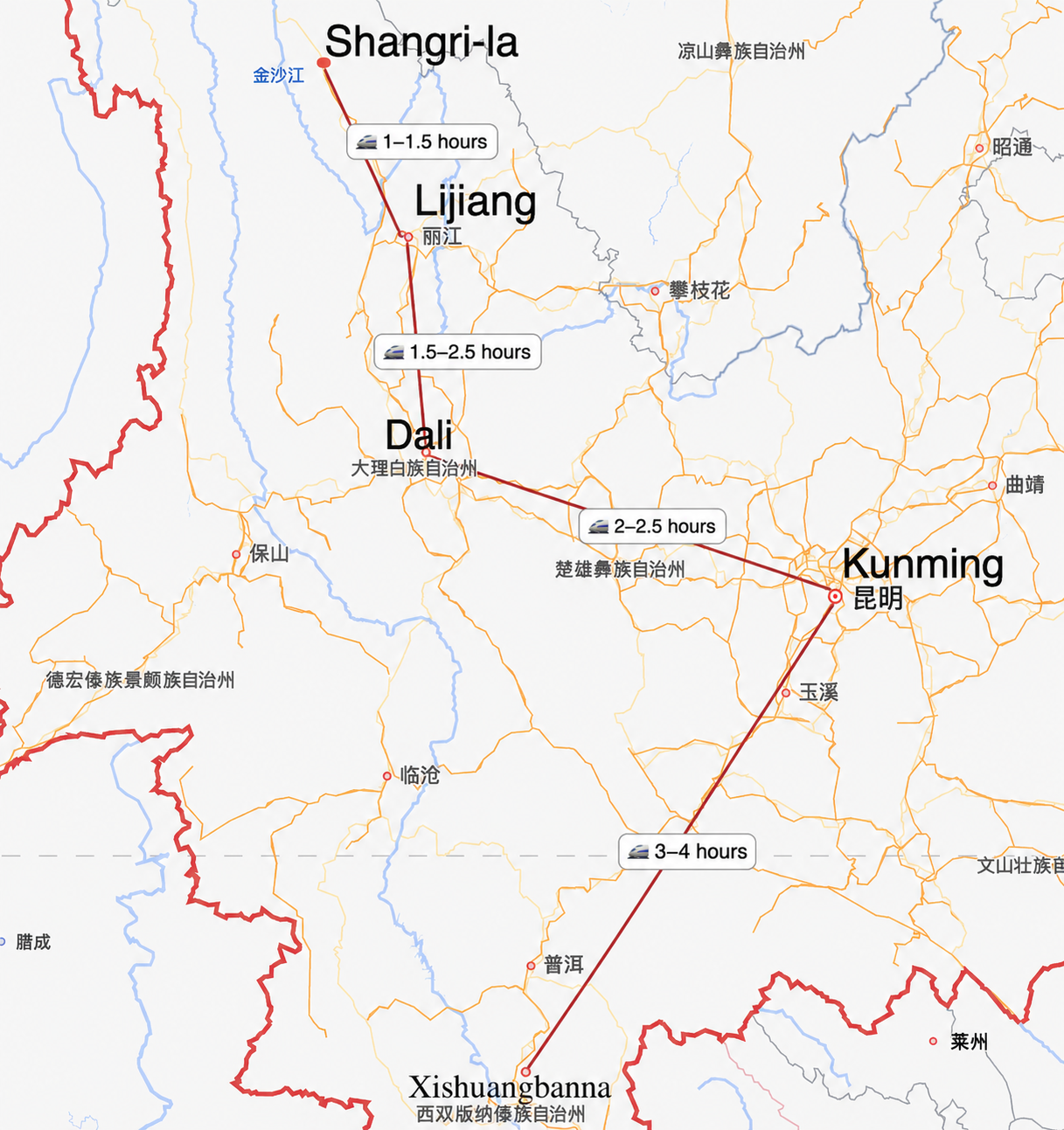
Interactive map of Yunnan rail travel times between Shangri-La, Lijiang, Dali, Kunming, and Xishuangbanna.
Common onward routes
| Route | Best option | Travel Time | Notes |
|---|---|---|---|
| Dali (大理) -> Kunming (昆明) | High-speed train | About 2-2.5 hours | Kunming is the main gateway for most travelers entering Yunnan. |
| Dali (大理) -> Lijiang (丽江) | Train or private car | Train about 1.5-2.5 hours; car about 2.5 hours | The train is fastest if you are staying near Dali Railway Station or in southern Dali. A car is more convenient if you are staying in northern Dali or want to stop at Shaxi or other towns along the way. |
| Dali (大理) -> Shangri-La (香格里拉) | Train via Lijiang, or private car | Usually half a day or longer | Many travelers break up the journey with a stop in Lijiang or Shaxi. |
| Dali (大理) -> Xishuangbanna (西双版纳) | Flight | About 1 hour | Fly if the fare is reasonable. By train, you need to transfer in Kunming. |
Key Attractions
Dali’s attractions split into two clusters: a tight group around the city (Old Town, the Three Pagodas, Cangshan, Erhai) and a handful of outlying towns that each need their own half-day-plus trip (Xizhou, Shuanglang, Shaxi, Weishan). The static map below works as a quick index: click a numbered point to jump to that section.
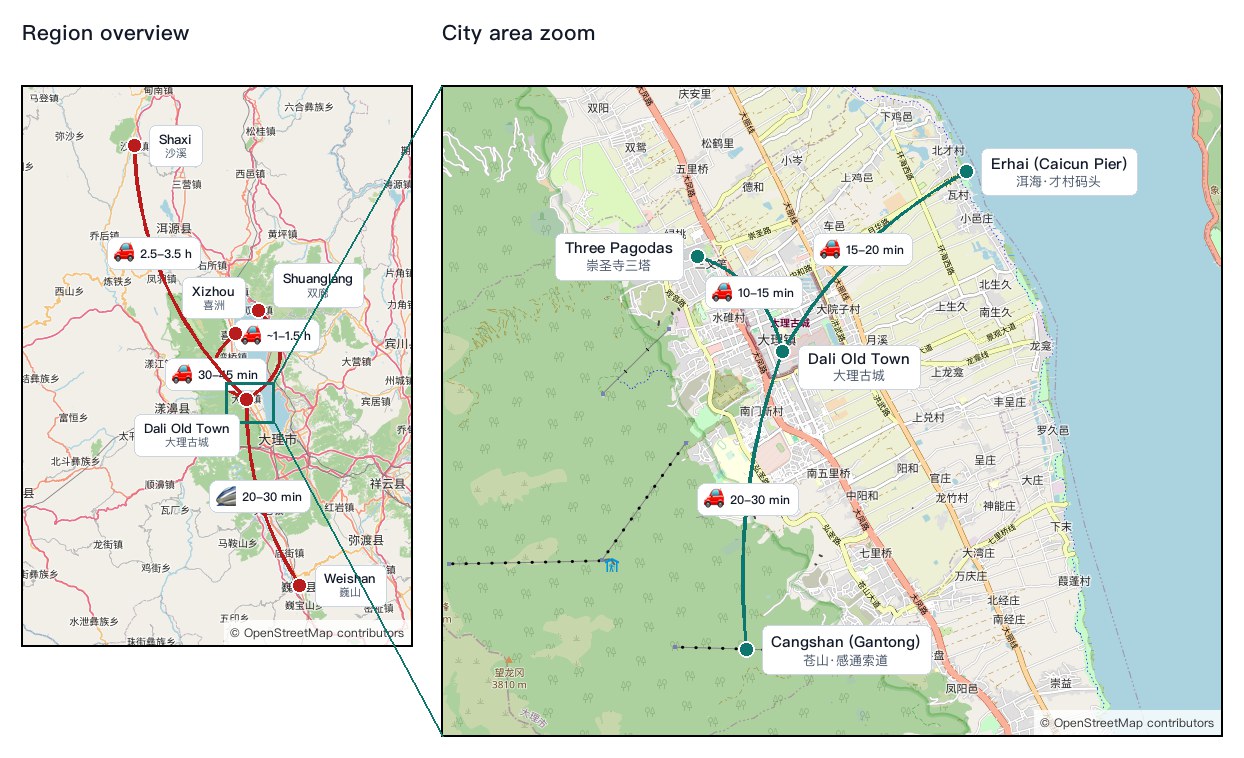
1. Dali Old Town (大理古城)
Getting there: Bus No. 8 from Dali Railway Station, or taxi / ride-hailing.
Admission: Free
Time needed: 2 hours
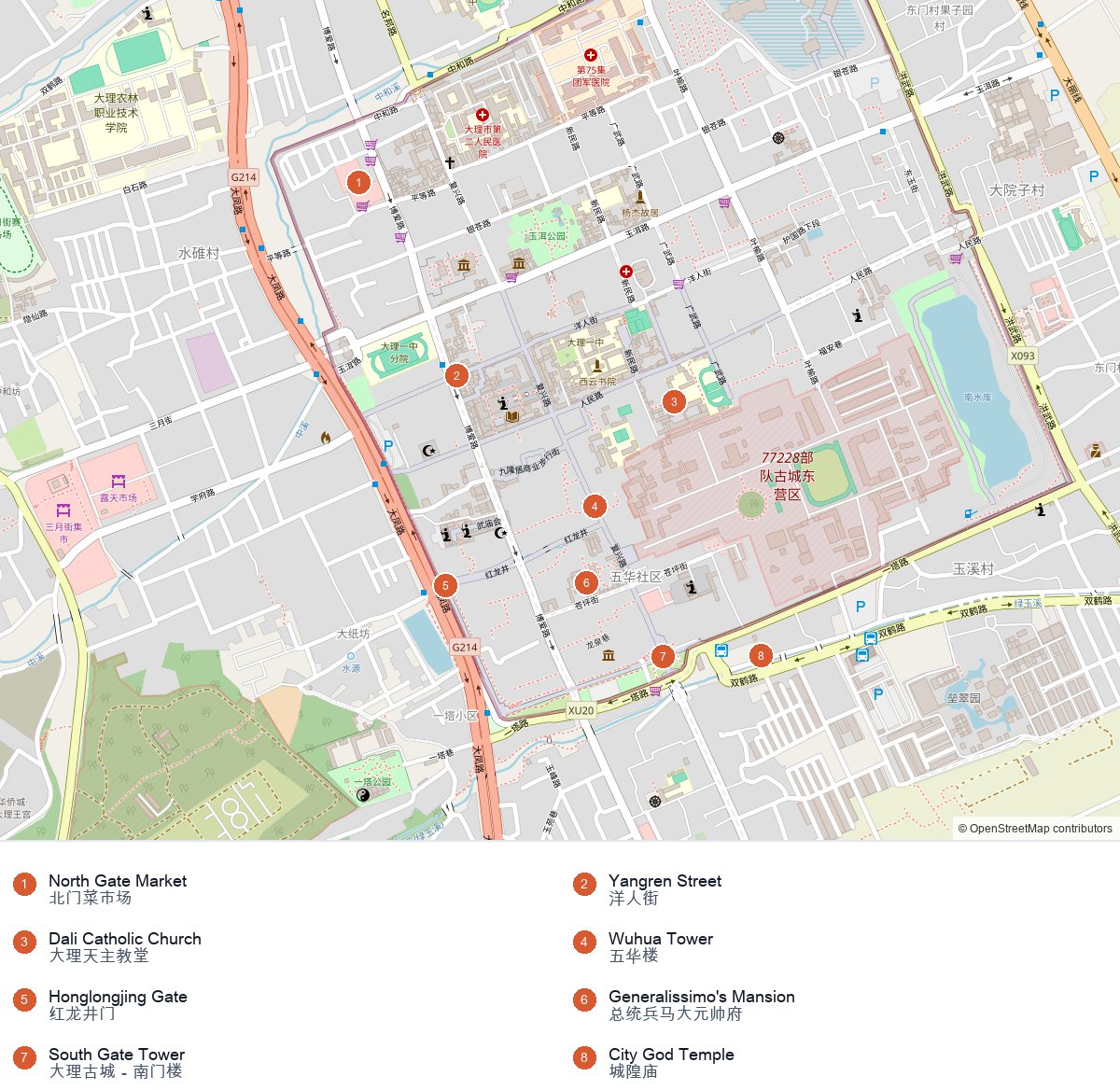
Interactive map of key spots inside Dali Old Town.
The map above marks 8 useful points for a short old-town walk:
- North Gate Market (北门菜市场): Best in the morning for breakfast and local market life.
- Yangren Street (洋人街): The most touristy bar/souvenir zone; pass through rather than lingering.
- Dali Catholic Church (大理天主教堂): The most distinctive single building inside the old town.
- Wuhua Tower (五华楼): Central landmark and easy orientation point.
- Honglongjing Gate (红龙井门): Good for entering the quieter western side streets.
- Generalissimo’s Mansion (总统兵马大元帅府): Historic compound near the old-town core.
- South Gate Tower (大理古城南门楼): Good at dusk for views over rooftops and Cangshan.
- City God Temple (城隍庙): A quieter stop near the southern part of the old town.
Dali Old Town is usually the first stop, but it rewards selective wandering. The main tourist streets are busy with bars, souvenir shops, cafes, and travel photographers. The better experience is slightly off the main drag.
Be realistic about the Old Town: it is heavily commercialized, and many old-looking buildings are reconstructions rather than surviving historic architecture. If this is your first trip to China, it can still be worth a look for orientation, food, cafes, and the evening atmosphere. But for a more rewarding old-Yunnan experience, Shaxi (沙溪) and Weishan (巍山) are stronger choices.
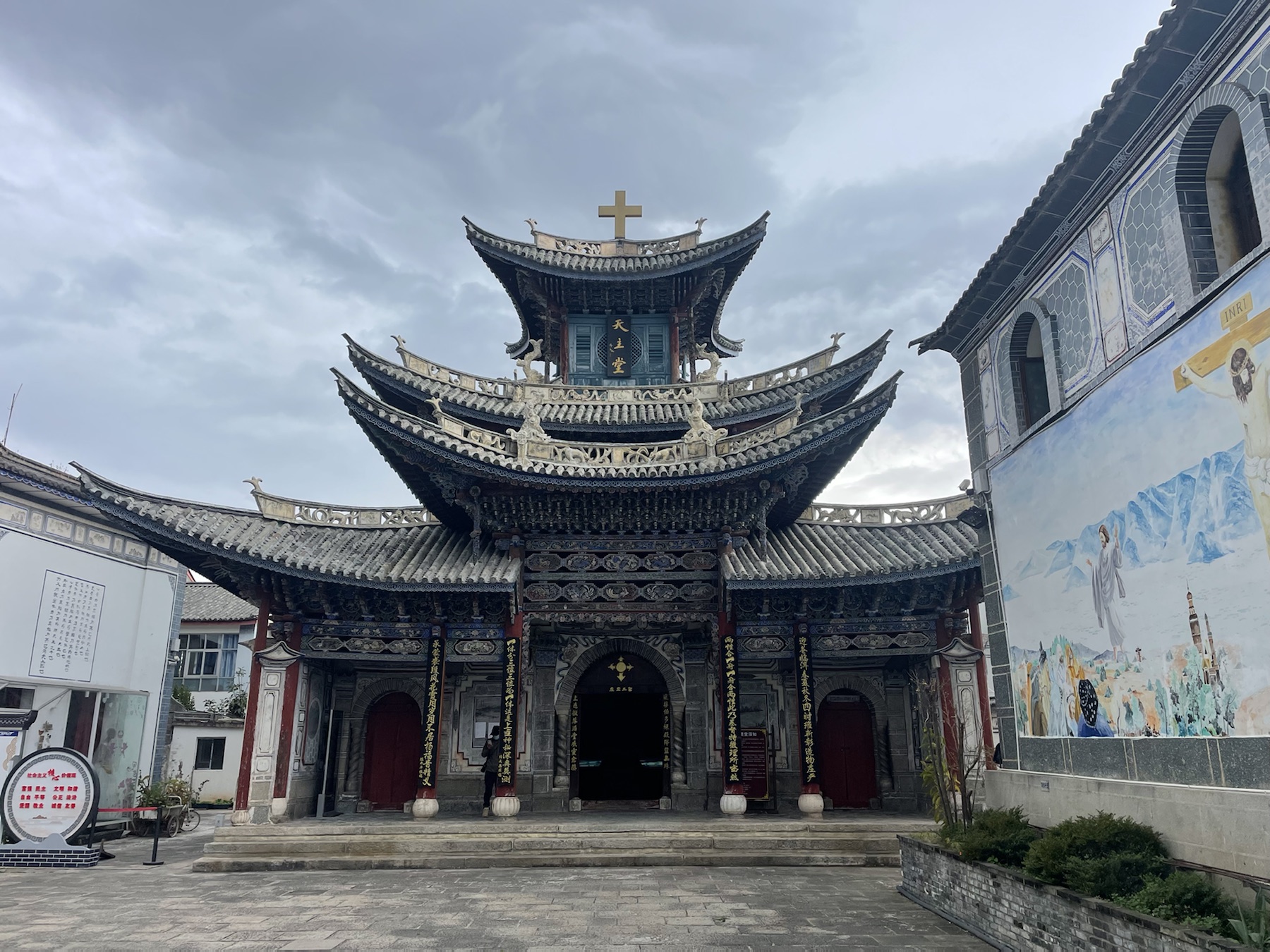
One sight inside the Old Town that is genuinely worth seeking out is the Dali Catholic Church (大理天主教堂). It blends local Bai architectural details with a Catholic church layout, making it more distinctive than most of the souvenir streets around it.
Caution
Avoid pushy bar touts around Yangren Street. Costumed “Bai maidens” asking for photos usually expect payment. Some boutique shops sell generic souvenirs, not local crafts. Check quality before buying.
2. Chongsheng Temple & Three Pagodas (崇圣寺三塔)
Getting there: About 1.5-2 km north of Dali Old Town; taxi, bike, bus, or a long walk
Admission: Approx. CNY75-120 depending on season/platform/package
Electric cart: Optional, approx. CNY25
Time needed: 1-1.5 hours for the pagodas and photo spots; add about 2 hours if you continue into the rear temple complex
The Three Pagodas (三塔) are Dali’s most recognizable landmark: three slender towers standing between Cangshan and Erhai. The main Qianxun Pagoda (千寻塔) is usually dated to the Nanzhao period, around 823-840 CE, while the two smaller pagodas are later and are generally associated with the Dali Kingdom in the 10th century.
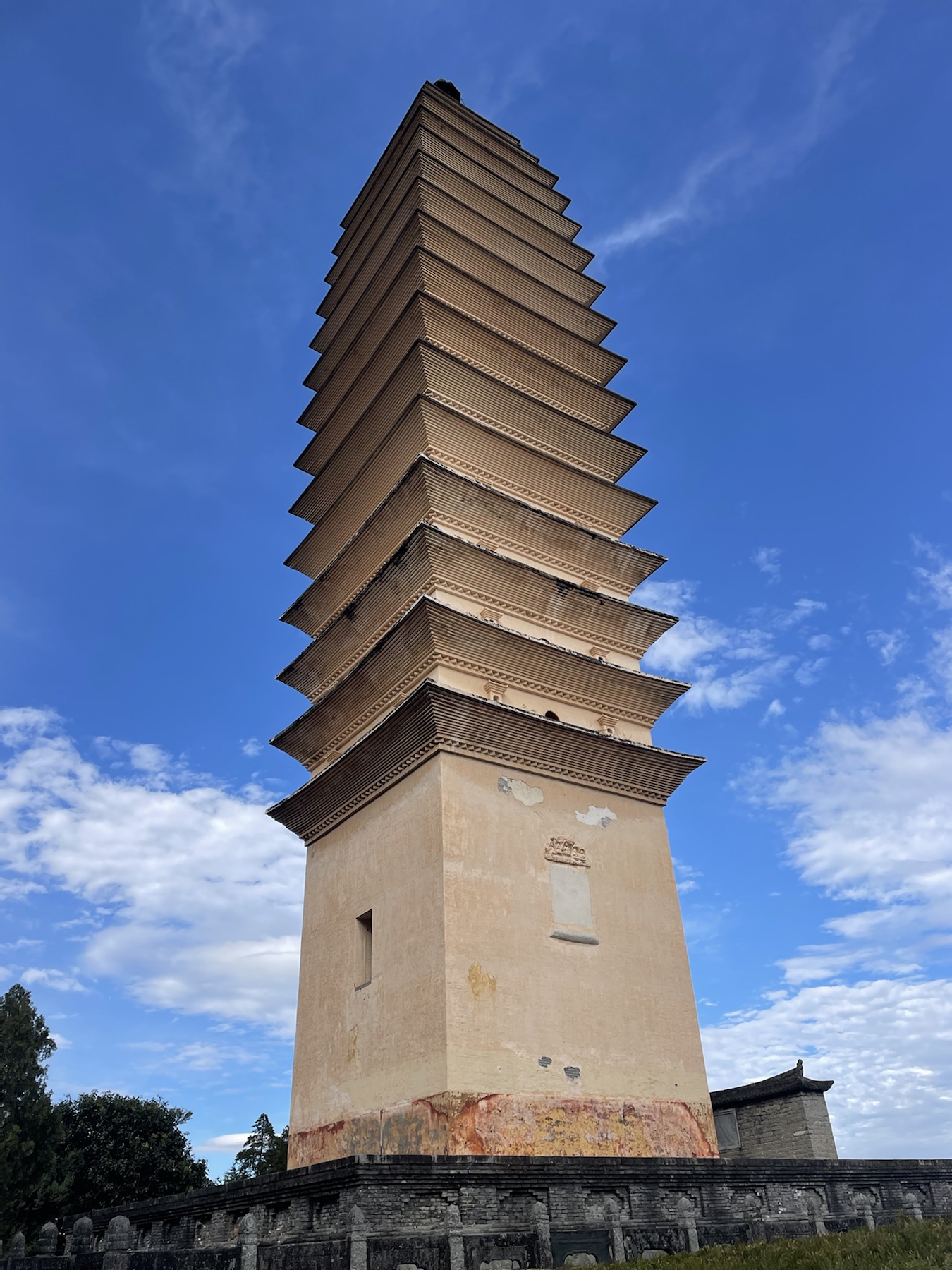
The pagodas are the real historical core. The large temple complex behind them is a modern reconstruction rather than the original ancient monastery. It can still be impressive if you like big Buddhist temple axes, but it is optional and can be skipped if your main goal is history, photography, or a lighter day.
Caution
The site is larger than it looks. The rear temple axis is newly built and can feel repetitive if you are not interested in Buddhist architecture. In hot weather, bring water and sun protection.
If you are on a tight budget, you can also see the pagodas from outside, but the best composed views are inside the scenic area.
3. Erhai Lake & Ecological Corridor (洱海 / 洱海生态廊道)
Getting there: Caicun (才村), Longkan (龙龛), Xizhou (喜洲), and other lakeside villages are reachable by hired car, rental car, bike, e-bike, or bus.
Admission: Free for most public lakeside areas
Bike rental: Approx. CNY20-60/day depending on bike type and location
Best time: Morning for the west bank; late afternoon / sunset for the east bank
Time needed: Half day to full day
Erhai is the soul of Dali. The west-bank Erhai Ecological Corridor (洱海生态廊道) is the easiest way to experience it: lake views, water cypresses, fields, villages, and Cangshan behind you. Do not try to circle the whole lake casually. Choose one section and leave time to stop.
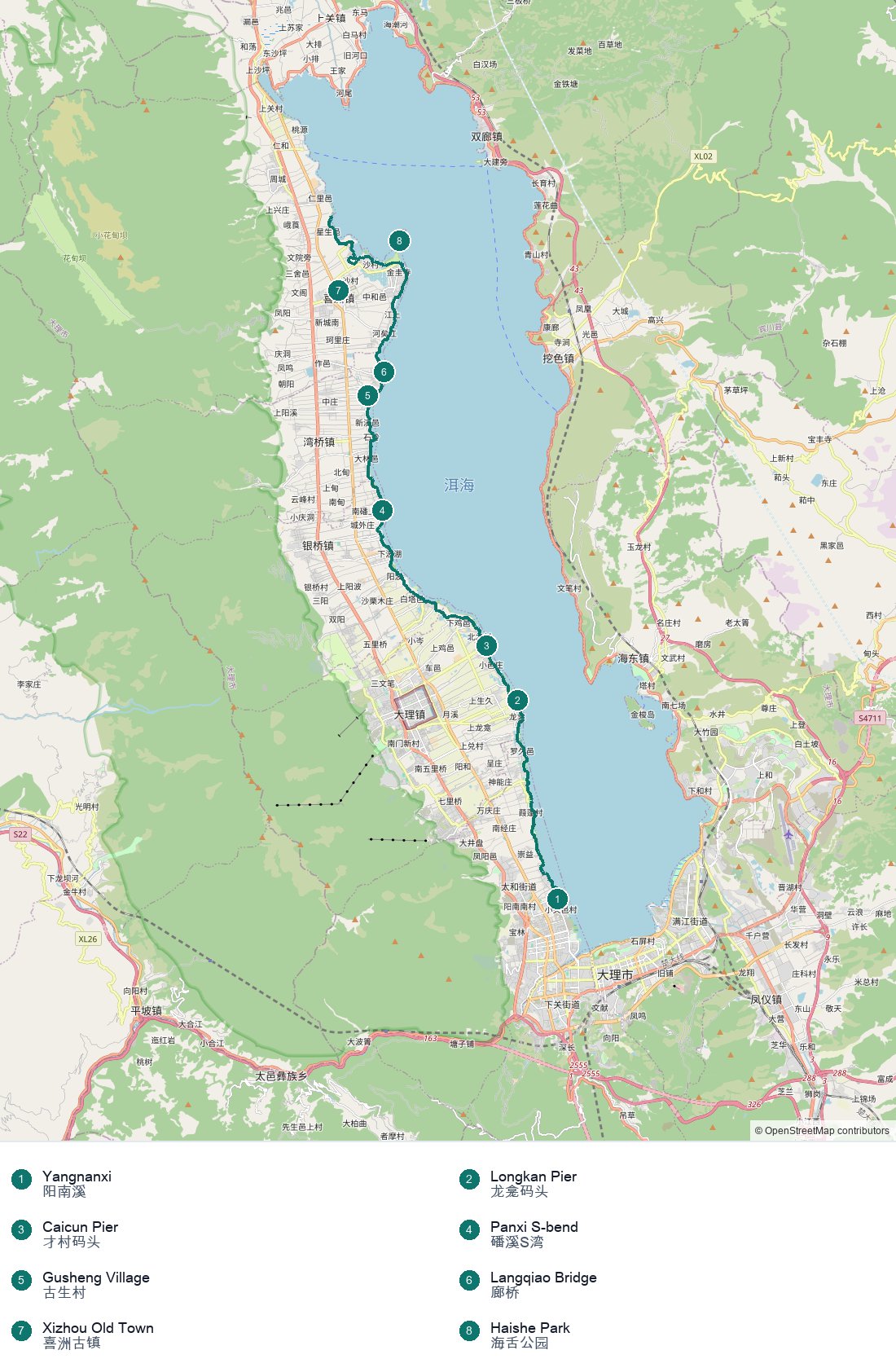
Interactive map showing the Erhai Ecological Corridor path from Yangnanxi to Haishe Park, with key stops marked.
Choose your wheels
The key rule: outside motor vehicles and outside e-bikes are not allowed inside the Ecological Corridor. If you want wheels inside the corridor, rent them from official or in-corridor rental points.
- Shared e-bikes: The easiest option. Usually around CNY15-20/hour, with many return points and one-way return possible. They are speed-limited and can be slower than expected; check battery before riding.
- Novelty e-bikes: Cute Snoopy/Harley-style scooters are fun for photos and families, often around CNY60/hour. They can be very slow, and condition varies, so test brakes and handling first.
- Shared bicycles: Best if you actually want to cycle. Often charged by time, such as CNY2 for the first 15 minutes and CNY1.5-2 per 15 minutes after that. Cheaper and less restricted by speed, but tiring over long distances.
- Village-rented bicycles: Usually the cheapest, around CNY10-20/day, often with flower baskets for photos. The trade-off is that you normally must return them to the original shop.
- Sightseeing electric carts: Best for families with kids, older travelers, or anyone who does not want to ride. They stop at fixed points, often around CNY10 per short segment, but you lose the freedom to stop whenever you like.
Best route options
The west-bank corridor is more than 40 km long, but the most useful scenery for travelers is between Longkan Pier (龙龛码头) and Langqiao Bridge (廊桥).
-
Classic easy section: Longkan Pier (龙龛码头) -> Caicun (才村) -> Panxi S-bend (磻溪S湾). This is the best first-time route: smooth road, lake views, and enough scenery in 1.5-2 hours.
-
Longer ride to Xizhou: Start from Longkan Pier (龙龛码头) or Gusheng Village (古生村) and ride north to Xizhou Old Town (喜洲古镇). Allow 3-4 hours with stops, and expect around 20+ km depending on where you start.
-
Full west-bank section: Yangnanxi (阳南溪) -> Haishe Park (海舌公园). This is the fullest corridor ride for travelers who want the complete west-bank scenery in one day. Expect a long ride with many stops; use an official shared e-bike or split the route if you are not used to cycling.
-
Quieter photo section: If you want fewer crowds, start around Gusheng Village (古生村) and ride north. The redwood-lined road, fields, and quieter lake views are often better than the busiest viral spots.
Stops worth marking
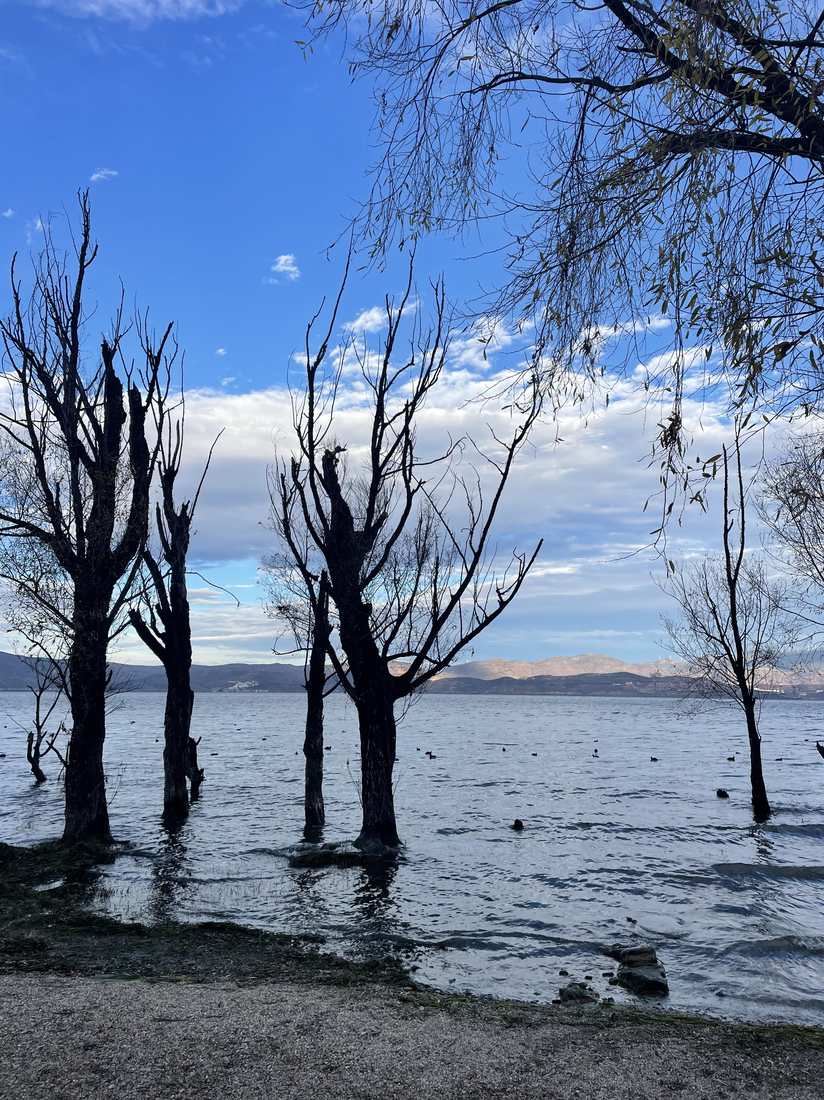
- Longkan Pier (龙龛码头): The most popular sunrise area, especially in winter when there are water cypresses and seagulls. Go early if you want photos.
- Caicun Pier (才村码头): A convenient starting point where the corridor begins to feel scenic, with white buildings, small pavilions, and easy lake access.
- Panxi S-bend (磻溪S湾): Famous online and often crowded. The nearby water groves and the so-called “most beautiful kilometer of Erhai” can be nicer and less packed.
- Langqiao Bridge (廊桥): Known from Meet Yourself (去有风的地方). The bridge arch is a strong photo spot for sunrise, sunset, and lake framing.
- Haishe Park (海舌公园): One of the best Erhai-area stops if you like open grass, redwoods, and a quieter landscape. Worth a dedicated visit.
Riding cautions
- Bring serious sun protection: hat, sunglasses, sunscreen, and water.
- Carry a light layer. The lakeside can turn cold quickly when clouds or wind arrive.
- Check e-bike battery and brakes before leaving the rental point.
- Read the return rules in the mini-program. Parking outside designated return zones may trigger extra relocation fees.
4. Cangshan Mountain (苍山)
Getting there: Cable car stations are west of Dali Old Town; taxi/ride-hailing is easiest
Park admission: Approx. CNY35-40
Cable cars: See below
Best time: Morning; clouds often build later
Time needed: Half day to full day
Cangshan is not just a backdrop. The mountain range defines Dali’s climate, water, temples, and views. Most visitors use one of the cable cars rather than hiking from the base.
Three cable cars compared
| Cable car | Top elevation | Highlights | Approx. round trip price | Notes |
|---|---|---|---|---|
| Gantong Cable Car (感通索道) | ~2,600 m | Qingbi Stream (清碧溪), access toward Jizhao Nunnery (寂照庵) | CNY80-100 | Best all-round choice for first-time visitors |
| Zhonghe Cable Car (中和索道) | ~1,600 m | Rustic open chairlift, Zhonghe Temple (中和寺), forest trail | CNY90-100 | More old-school; avoid if afraid of heights |
| Ximatan Cable Car (洗马潭索道) | ~3,900 m | Alpine views, rhododendrons, high mountain scenery | CNY260-300 | High altitude; bring warm layers, weather dependent |
Recommended route: Gantong + Jizhao Nunnery
For most foreign visitors, the Gantong cable car (感通索道) is the best balance of scenery, access, cost, and comfort. Combine it with Jizhao Nunnery (寂照庵), a peaceful Buddhist nunnery near the cable car base station, known for flowers, quiet courtyards, and simple vegetarian meals.
Jizhao Nunnery vegetarian lunch: Often around CNY20-30, usually starting around late morning. Expect queues during peak season.
Ximatan warning
The Ximatan route reaches high elevation (3900m+) and is very weather dependent. It can be cold, windy, or closed. Do not choose it on your first day at altitude, and bring warm layers even in summer.
Caution
Cable cars may close due to wind or weather. Check the same morning before committing. The different cable cars are run separately; tickets are generally not interchangeable. Bring layers, water, and sun protection.
5. Xizhou (喜洲)
Getting there: About 30-45 minutes north of Dali Old Town by hired car or rental car; also reachable by bike via sections of the Erhai corridor
Admission: Free to enter the town; some compounds charge separately
Time needed: Half day, or one night for a slower stay
Xizhou is the best easy side trip from Dali Old Town. It is a Bai minority town known for old courtyard houses, rice fields, morning markets, and the famous Xizhou baba.
It is compact, walkable, and more culturally interesting than many lakeside villages.
What to see
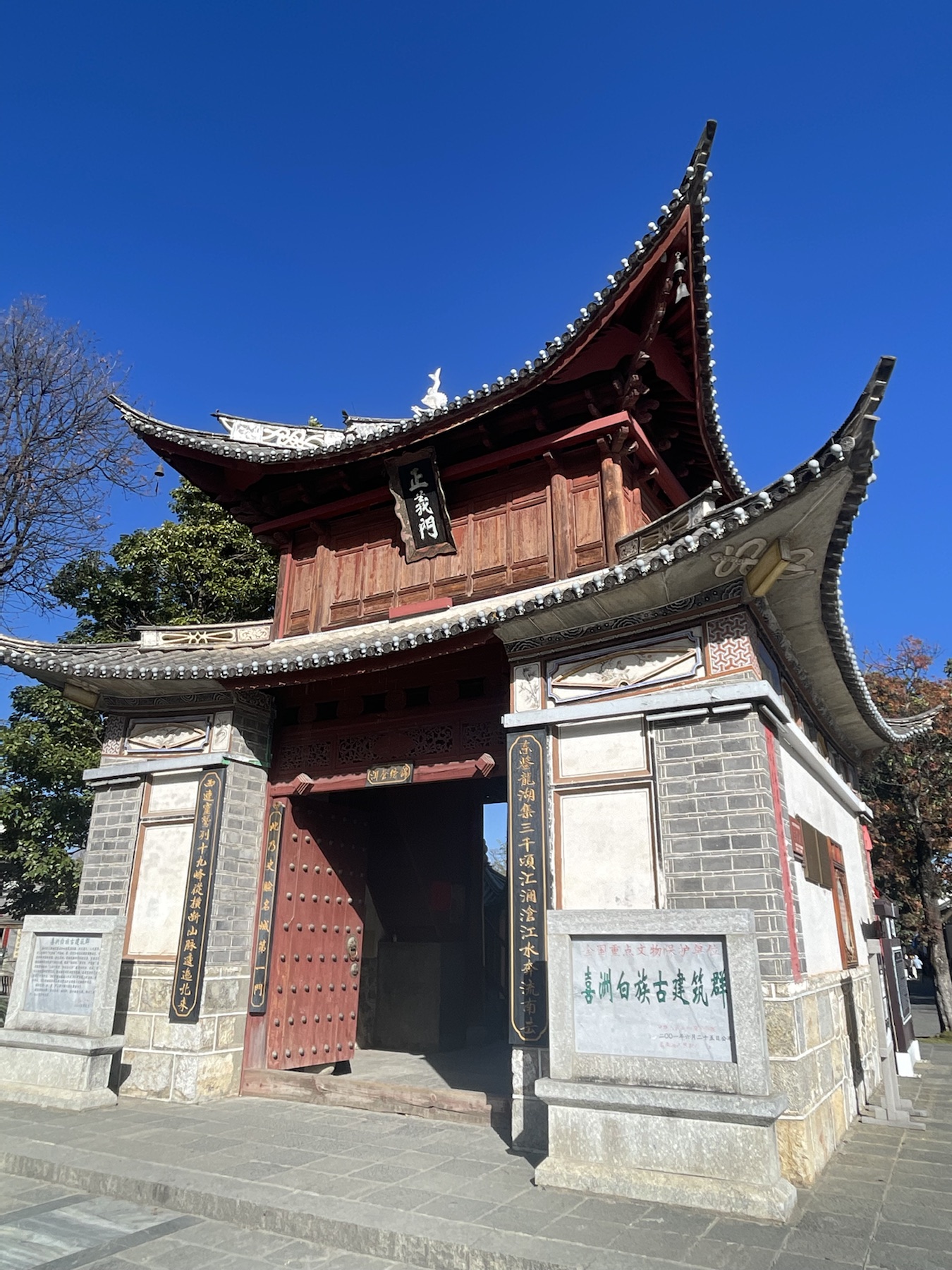
- Zhengyi Gate (正义门)
The usual entrance to Xizhou Old Town and an easy first landmark. - Corner Tower (转角楼) / old town streets
Good for orientation and photos. - Yan Family Compound (严家大院博物馆)
A classic Bai courtyard complex. Worth visiting if you are interested in architecture. - Rice paddies
Seasonal, but beautiful when green or golden. - Morning market
Best for local life and breakfast snacks.
What to eat
Xizhou baba is the essential snack. It is a baked flatbread, either sweet or savory, with a flaky surface and hot filling. Try one fresh from the oven.
Caution
Xizhou has become more popular, so arrive early if you want atmosphere before the day-trip crowd. Some newly renovated lanes feel more boutique than local.
6. Shuanglang (双廊)
Getting there: East bank of Erhai; best by hired car or rental car, or by e-scooter if experienced
Admission: Free
Time needed: Half day, or one night if you want lake-view accommodation
Shuanglang sits on the east side of Erhai and is known for wide lake views, sunset light, boutique inns, cafes, and photo platforms. It is scenic but commercial, so expectations matter.
This is not the best place for deep culture. It is best for lake views and a relaxed overnight stay.
What to do
Walk the lakeside lanes, find a cafe terrace, and watch the light move across Cangshan. If you are staying overnight, book a room with a lake view and avoid properties too close to noisy roads or construction.
Caution
Shuanglang can feel overbuilt and expensive compared with Xizhou or Caicun. Traffic on the east bank can also be slower than expected. Choose accommodation carefully and read recent reviews.
7. Shaxi (沙溪)
Getting there: From Dali or Lijiang by direct shuttle, bus transfer, hired car, or rental car
Travel time: Approx. 2.5-3.5 hours from Dali, 1.5-2 hours from Lijiang, depending on transport
Admission: Free to enter the old town
Time needed: Day trip possible, but 1 night is much better
Shaxi is one of Yunnan’s most rewarding small towns. Once a stop on the Tea Horse Road, it still has a market-square atmosphere that Dali and Lijiang have largely lost. The center is Sideng Square (寺登街 / 四方街), with an old theatre stage, temple buildings, ancient trees, and stone lanes.
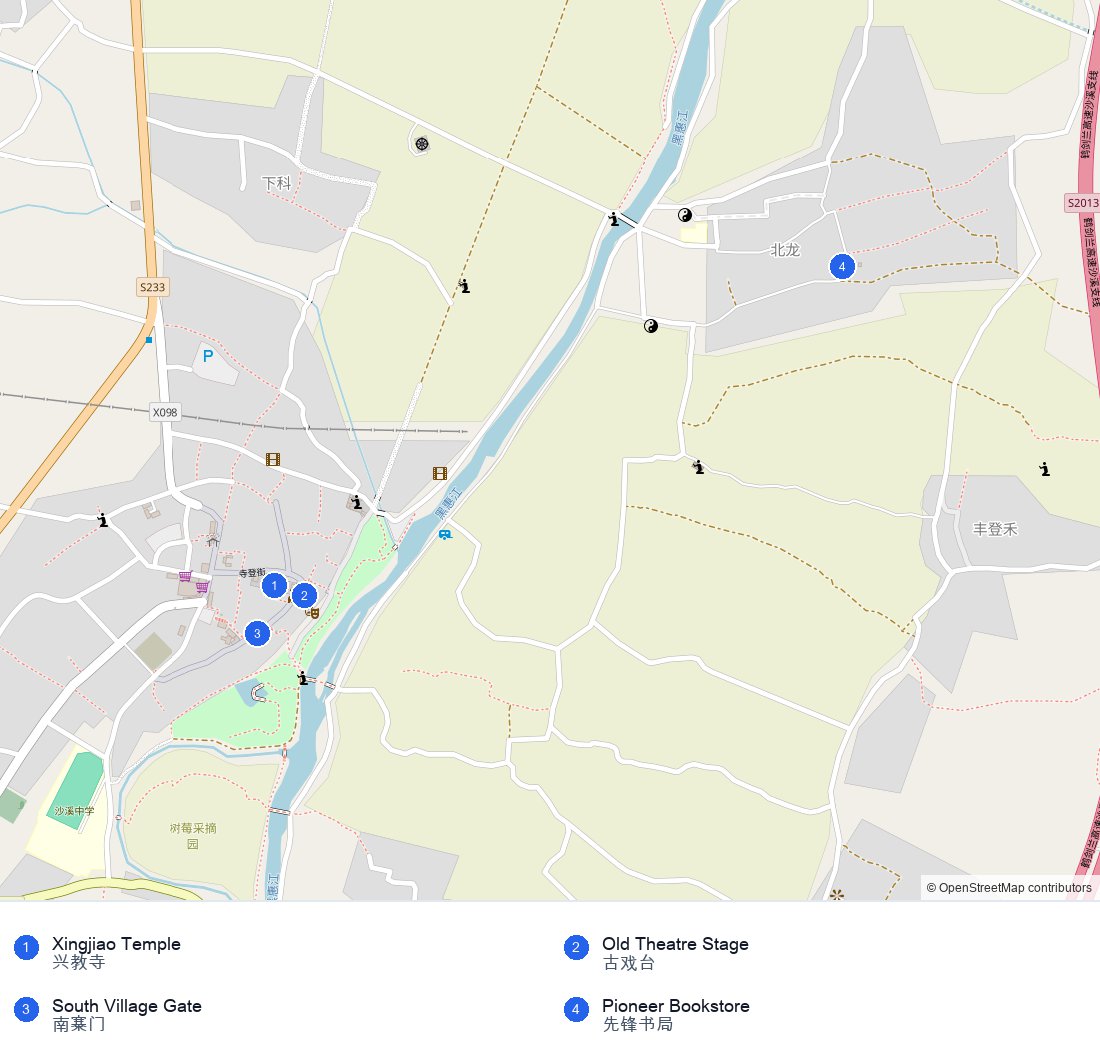
Interactive map of Xingjiao Temple, the Old Theatre Stage, South Village Gate, and Pioneer Bookstore in Shaxi.
The reason Shaxi feels better preserved than many old towns in Yunnan is not accidental. Sideng market area was listed by the World Monuments Fund in 2001, and the town later benefited from a conservation and rehabilitation project involving ETH Zurich and the Government of Jianchuan County. The result is still touristy in places, but the historic scale, square, theatre stage, temple frontage, and village rhythm have been protected far more carefully than in many rebuilt “ancient towns.”
Although Shaxi can be visited as a long day trip from Dali, it deserves an overnight stay. The mood changes in the early morning and evening, after most visitors leave.
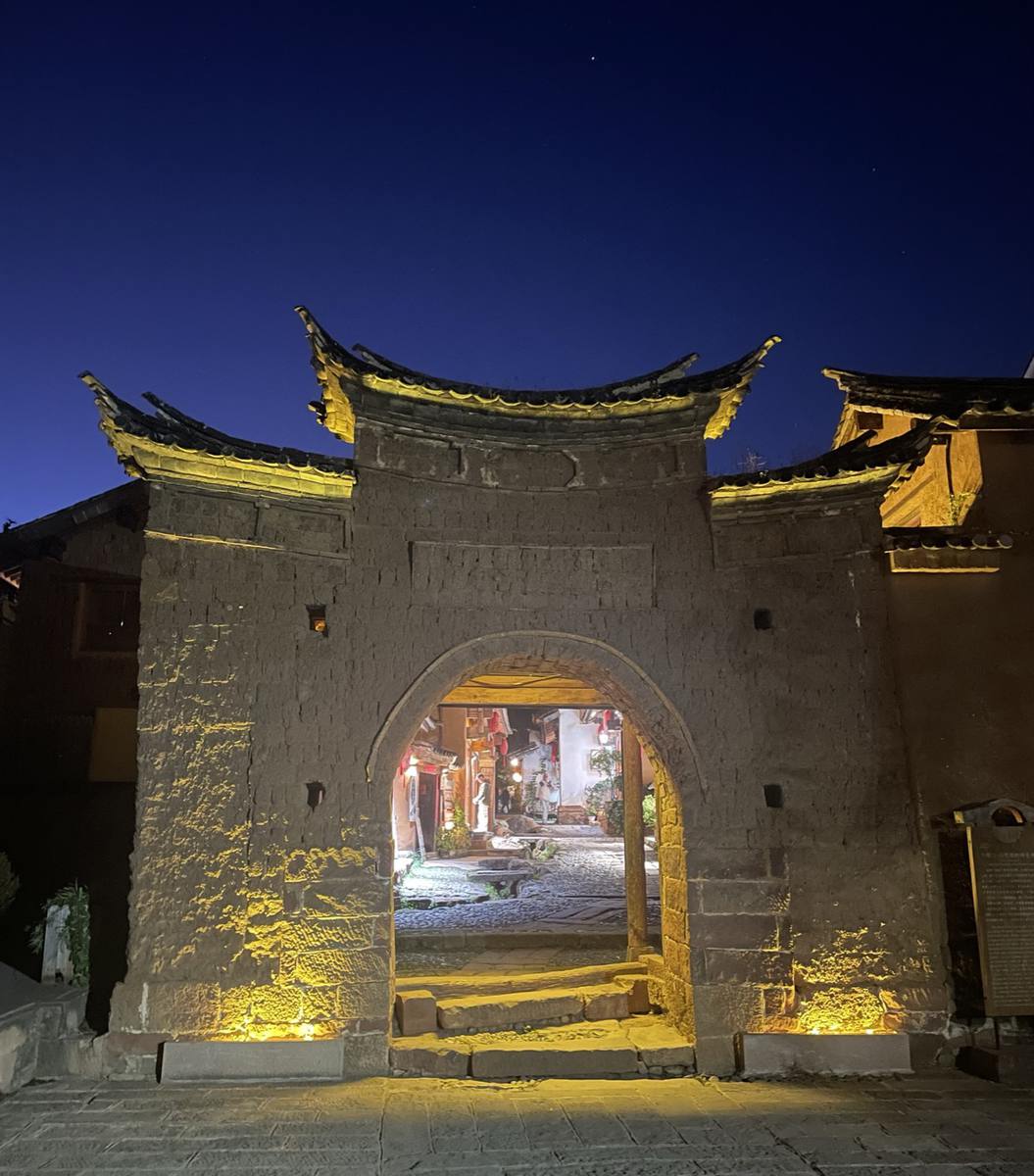
What to see
- Sideng Square
The heart of Shaxi. Sit for a while rather than just taking photos. - Old Theatre Stage (古戏台)
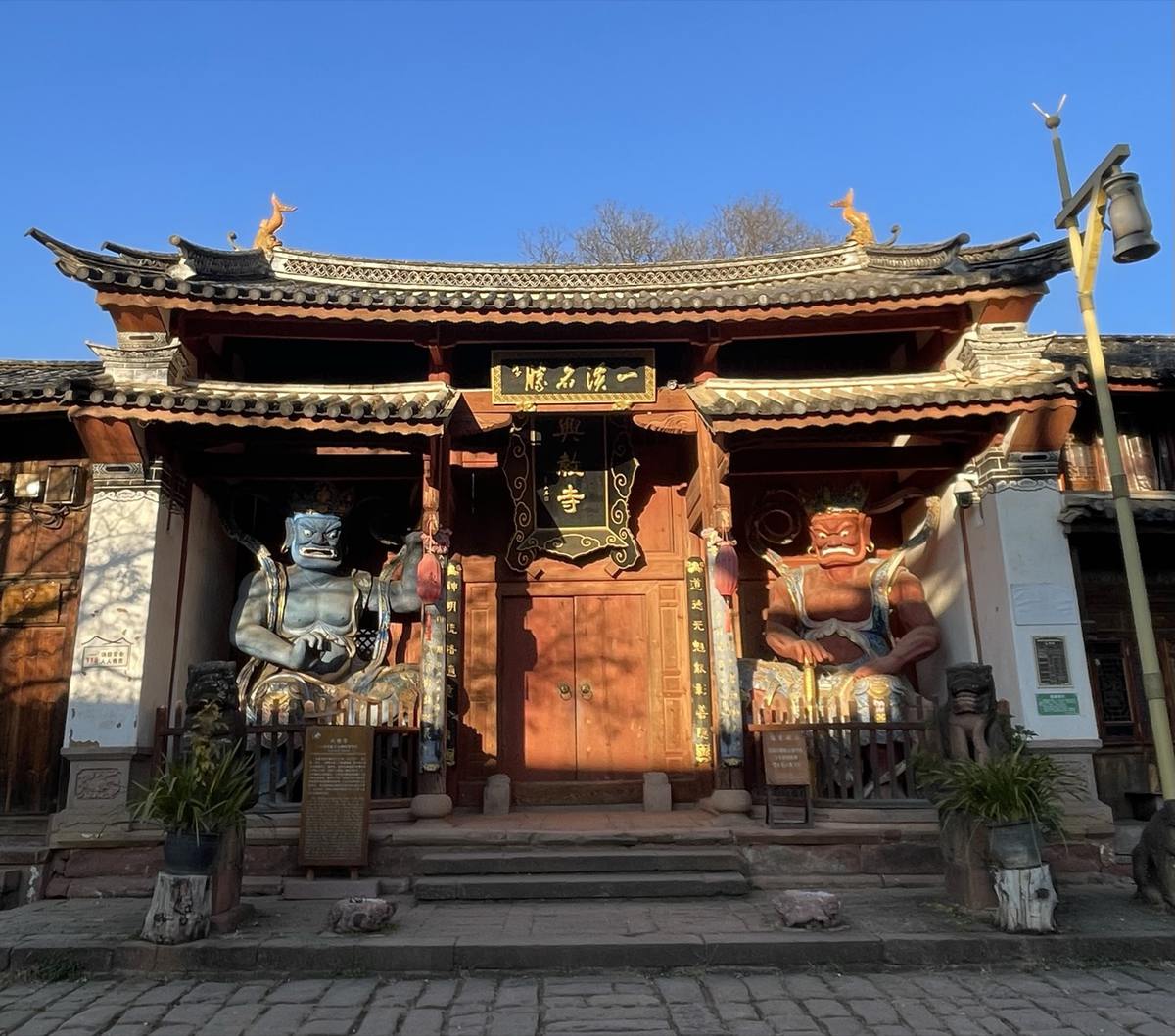
One of the town’s signature landmarks. - Xingjiao Temple (兴教寺)
A historic temple beside the square, with a striking entrance flanked by two large guardian statues. - Village walks
Walk out beyond the old town into fields and nearby villages. - Friday Market
If your schedule allows, Friday is the best day to see Shaxi as a living market town.
Add-on: Shibaoshan
Shibaoshan (石宝山) is a mountain temple and grotto area near Shaxi. Its Shizhongshan Grottoes (石钟山石窟) preserve Buddhist carvings from the Nanzhao and Dali Kingdom periods, with a history often described as more than 1,300 years. The site is especially valuable because the images are not just generic Buddhist sculpture: they preserve local Yunnan Buddhist traditions, royal and court imagery, and Bai cultural elements that are hard to see elsewhere.
For history-minded travelers, Shibaoshan is one of the strongest reasons to stay overnight in Shaxi rather than treating it as a quick old-town photo stop. It is best done as a half-day trip from Shaxi with a local driver.
Shibaoshan is bigger than it looks on a map: a sprawling site above 2,000 m elevation, split across four separate hilltops. Driving between them is not straightforward, and visiting without a plan can mean a lot of repeated climbing. The four zones:
- Baoxiang Temple (宝相寺): home of the well-known “suspended temple” (悬空寺); Jinding Temple (金顶寺) is further up at the summit.
- Shizhong Temple (石钟寺): the highlight of the site, with Grottoes 1-8.
- Shiziguan (狮子关): on the hill facing Shizhong Temple, with Grottoes 9-11.
- Shadengqing (沙登箐): behind and above Shizhong Temple, with Grottoes 12-17.
To see all the grottoes: buy a one-way shuttle ticket and go in this order: entrance -> Baoxiang Temple -> Shiziguan -> Shizhong Temple -> Shadengqing -> down to Shaxi Old Town. A few things that matter:
- Visit Shiziguan before Shizhong Temple. The entrance to Shadengqing is at the top of Shizhong Temple, so visiting Shizhong Temple first means climbing up and down the mountain twice.
- At Shiziguan, Grotto 10 is directly overhead: look up rather than scrambling up the rock face to find it. Coming from Shiziguan toward Shizhong Temple, detour right first for the murals, then double back to enter the temple.
- After Shadengqing, walk down to Shaxi Old Town rather than back to the entrance. Shizhong Temple to Shadengqing is a roughly 3.5 km downhill walk (about 1 hour); climbing back up to the entrance can take 2+ hours with little shade, while Shadengqing down to Shaxi Old Town is a flat 3 km.
- If you finish late, have your Shaxi guesthouse arrange a pickup rather than backtracking. The next morning, see Yujin Bridge (玉津桥) and Xingjiao Temple, then take the roughly CNY4 shuttle from the visitor center (around 9:30am) back to the scenic entrance to collect your car. This is the most efficient way to see every grotto while still getting Shaxi’s quiet morning and evening atmosphere.
For a more relaxed visit: skip Shadengqing. It is a long detour and most of its grottoes can only be viewed through gaps in locked doors. The detour is worthwhile mainly for the pine-forest walk and one photo spot reminiscent of Maijishan, rather than the carvings themselves. Treat Shiziguan as optional depending on stamina: it has only three grottoes (two are locked, and the carvings are simple), so its main value is the scenery and a good photo angle of Shizhong Temple.
Caution
Public transport requires planning. English is limited. For a smooth trip, arrange a driver or shuttle through your hotel. Do not feed monkeys at Shibaoshan.
8. Weishan (巍山)
Getting there: High-speed train, Didi intercity bus, hired car, or rental car from Dali
Train time: Approx. 22-30 minutes
Admission: Free to enter the old town
Best time: Day trip from Dali
Time needed: Half day to full day
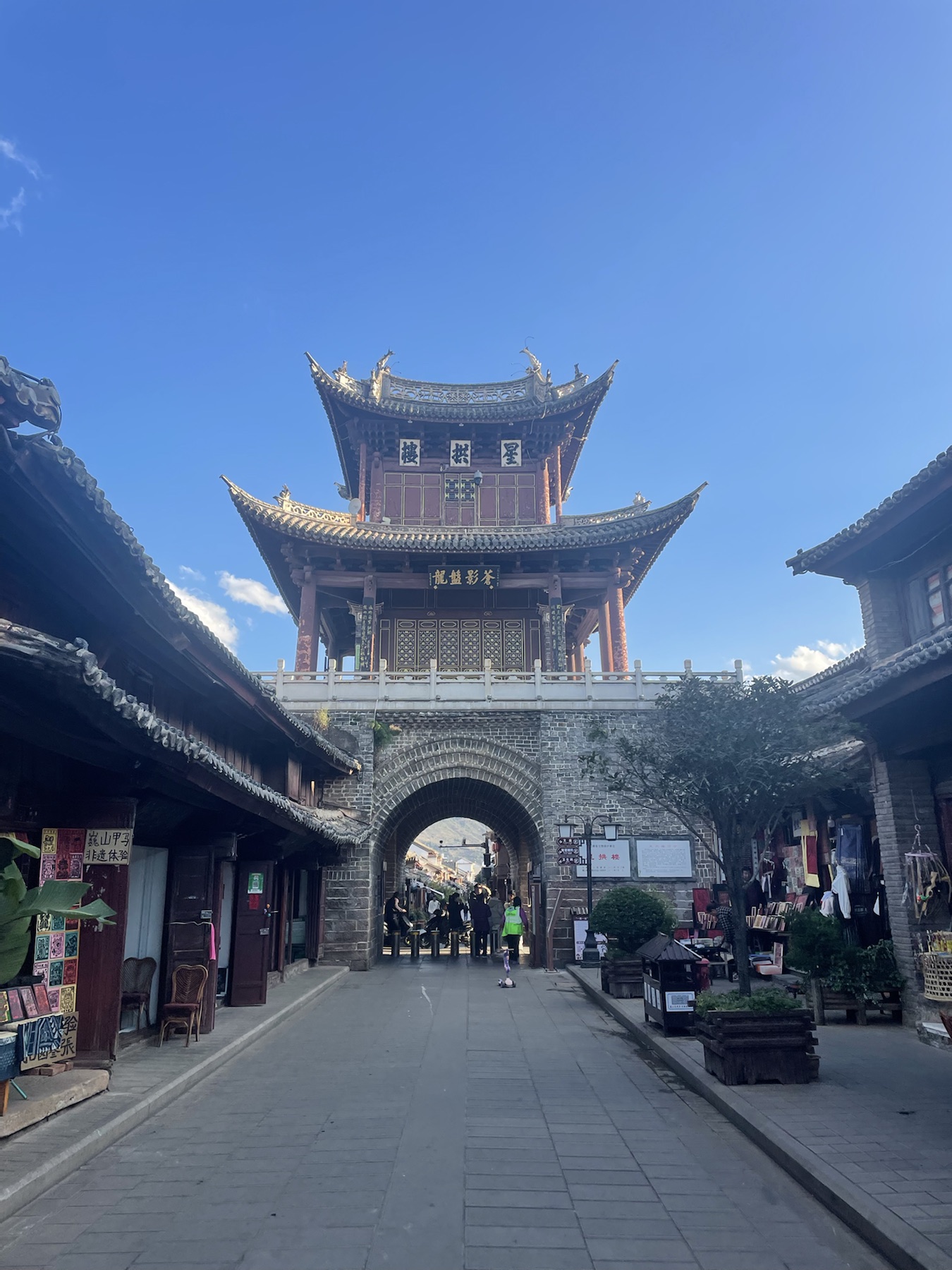
Weishan is the best easy “old Yunnan” day trip from Dali. It is one of the origin places of Nanzhao culture and retains a traditional layout with gates, towers, temples, and snack streets. It also has a pop-culture footnote as a place associated with the “Crown Prince Hall” setting from Heaven Official’s Blessing.
Commercial tourism is still relatively light here. Many storefronts are local noodle shops, hardware stores, tea sellers, tailors, small groceries, designer bookshops, independent cafes, and everyday family businesses rather than souvenir chains. The streets are quieter than Dali Old Town, and the pleasure is a slower kind of travel: walking, looking at old facades, stopping for tea, and noticing small details.
Getting there from Dali
- High-speed train: Dali Station to Weishan Station takes about 20-30 minutes, then a taxi to the old town takes about 10 minutes (1.7 km).
- Didi bus / intercity shuttle: Buses may run from Dali Old Town Bus Station, Dali University, and the March Street area; tickets are often around CNY25 per person.
- Rental / private car: About 1 hour from Dali. Navigate to Weishan Old Town Parking Lot (巍山古城停车场).
Suggested city walk
Pioneer Bookstore Chongzheng Academy (先锋书店崇正书院) -> Old Town main street -> Mengyang Park (蒙阳公园) -> Nanzhao Museum (南诏博物馆)
This route works well as a relaxed one-day walk. Do not rush it; Weishan is best when you leave time for side lanes, snacks, and quiet courtyards.
What to see
- Weishan Old Town (巍山古城)
Walk slowly through the old streets. The town is less polished than Dali and more interesting because of it. Around Gongchen Tower, the street grid still feels legible, with north-south and east-west axes and many Ming dynasty (1368-1644) and Qing dynasty (1644-1912) style residential buildings along the main streets. - Gongchen Tower (拱辰楼)
A central landmark and good orientation point. - Pioneer Bookstore Chongzheng Academy (先锋书店崇正书院)
A designer bookstore converted from an old courtyard residence dating back to the Hongzhi era of the Ming dynasty (1368-1644). It has become one of Weishan’s cultural landmarks and is a good first stop for understanding the town’s slower, more literary atmosphere. - Mengyang Park (蒙阳公园)
A quiet local park inside the old town, with remains of a Ming dynasty (1368-1644) Confucian temple and Republican-era garden atmosphere. It is free to enter and feels like a neighborhood back garden, with old trees, local life, and a slower rhythm. - Nanzhao Museum (南诏博物馆)
Located around Baoguo Street, this garden-style museum introduces the history and cultural legacy of the Nanzhao Kingdom. It is useful context before or after walking the old town. - Dengjue Temple Twin Pagodas (等觉寺双塔)
Two elegant pagodas near the old town that are worth seeking out if you like quieter historic sites. They add another layer to Weishan beyond the main street and are a good reminder that the town’s religious and architectural history is not limited to the city gates. - Jimu Coffee (积慕咖啡)
A cafe converted from an old temple-like building. It is more photogenic than essential, but it fits well at the end of a slow walk. - Local temples and old gates
Look for smaller courtyards and side streets rather than staying only on the main road. - Old wall notices
On some old walls, you may see handwritten or printed funeral notices. They are not a tourist attraction in the usual sense, but they quietly show how local community life still uses the old town’s public spaces. - Wamao roof cats (瓦猫)
Wamao are small roof ornaments, often shaped like fierce cats or beasts, traditionally used in parts of Yunnan to guard houses and ward off bad luck. In Weishan, they are interesting as both folk belief and local craft. - Jiama paper prints (甲马)
Jiama are traditional woodblock prints used in local ritual life. They often show protective deities, horses, symbols, and auspicious imagery. Even a quick look helps explain how folk religion, household protection, and visual design overlap in rural Yunnan. - Weibaoshan (巍宝山)
A temple mountain outside town, historically connected with Daoist and Nanzhao culture. Best with a hired driver.
What to eat
Weishan is excellent for snacks:
- Weishan noodles
- Baba flatbread
- Grilled tofu
- Pickles and small dishes
- Local rice noodles
- Street-side sweets and pastries
- Roasted tea (烤茶), a local tea preparation where tea leaves are heated before water is added, giving the drink a smoky, warm aroma
For roasted tea, ask locally for places such as Li Ji Weishan Roasted Tea (李记巍山烤茶) around the old town area.
Caution
English is limited, and some of the charm is simply everyday street life. Save Chinese names and return train times in advance.
Suggested Itineraries
2 Days in Dali
Day 1: Erhai West Bank + Xizhou
Morning cycle from Caicun or Longkan along the Erhai Ecological Corridor. Continue toward Xizhou for baba, old courtyards, and rice fields. Return to Dali Old Town for dinner.
Day 2: Cangshan + Dali Old Town
Take the Gantong cable car in the morning and visit Jizhao Nunnery if time allows. Spend the afternoon in Dali Old Town, avoiding the busiest streets. Sunset near the South Gate or a rooftop cafe.
3 Days in Dali
Day 1: Dali Old Town + Chongsheng Temple
Explore Dali Old Town in the morning, then visit the Three Pagodas and Chongsheng Temple in the afternoon.
Day 2: Erhai + Xizhou
Cycle the west-bank ecological corridor and spend the afternoon in Xizhou.
Day 3: Cangshan or Shuanglang
Choose Cangshan if you want mountain air and temples. Choose Shuanglang if you want lake views, cafes, and sunset.
4 Days in Dali
Day 1: Dali Old Town
Arrive, settle in, local dinner.
Day 2: Erhai West Bank + Xizhou
Cycle or hire a car for Caicun, Longkan, and Xizhou.
Day 3: Cangshan + Chongsheng Temple
Gantong cable car, Jizhao Nunnery, then Three Pagodas.
Day 4: Weishan Day Trip
Take the train to Weishan for old town streets, snacks, and a slower local atmosphere.
5-6 Days: Dali with Shaxi
Day 1: Dali Old Town
Arrival and easy walk.
Day 2: Erhai + Xizhou
West-bank cycling and Bai villages.
Day 3: Cangshan + Chongsheng Temple
Mountain and pagodas.
Day 4: Weishan
Day trip by train.
Day 5: Dali to Shaxi
Transfer to Shaxi, explore Sideng Square, overnight.
Day 6: Shibaoshan to Lijiang or return to Dali
Visit Shibaoshan in the morning, then continue toward Lijiang or return to Dali.
Where to Stay
Where you base yourself changes the trip. Dali Old Town is the most convenient, but it is busy and has the least atmosphere at night. The Erhai lakeshore towns (Shuanglang, Caicun, Longkan) and Xizhou trade some convenience for quiet mornings and lake views. Prices below are rough high-season guides; check current rates before booking.
Luxury
- The Edition Dali (大理艾迪逊酒店)
A newly opened design-led lakeside resort on Erhai from Marriott’s EDITION brand, and the third EDITION hotel in China. Large lake-view rooms, a strong spa, and some of the best pool and lounge design in the area. Often CNY1,800-3,500+/night. Best for travelers who want a full resort stay rather than a village guesthouse.
Premium
-
Hilton Dali Resort (大理希尔顿酒店)
A full-service international resort set on the Cangshan hillside rather than directly on Erhai. It is close to the Gantong Cable Car area, so it works well if you want mountain access, quieter surroundings, and dependable international-standard rooms and service. Often CNY1,200-2,500/night. A safe choice if you want brand consistency over a boutique gamble.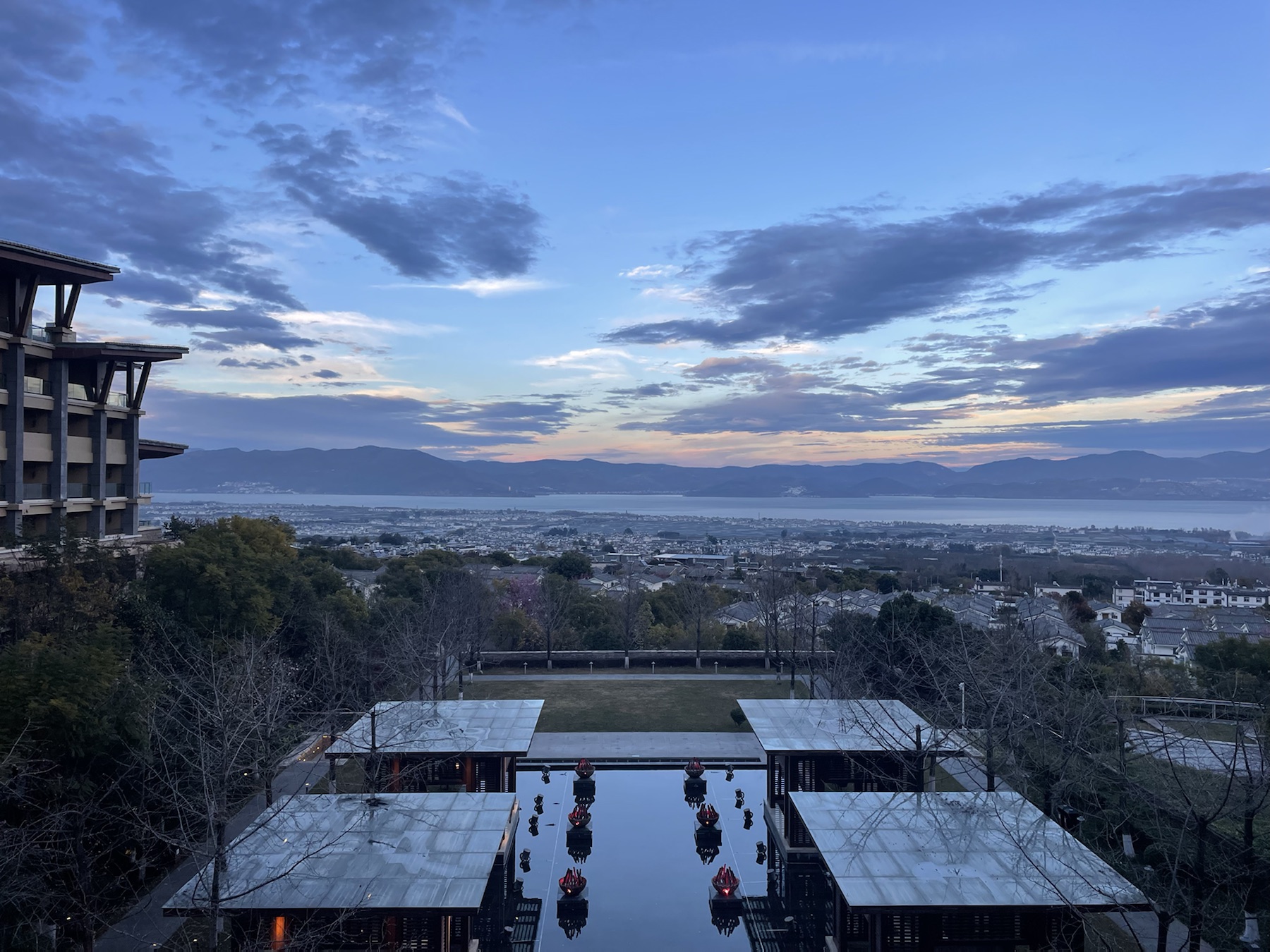
-
Hotel Indigo Dali Erhai (大理洱海英迪格酒店)
An IHG boutique-style property on the lake, generally a notch below the EDITION and Hilton in price but still with strong lake-view rooms and contemporary design. Often CNY700-1,400/night. A good middle ground between international comfort and local character.
Upper-Midscale
-
Four Points by Sheraton Dali (大理福朋喜来登酒店)
A reliable Marriott mid-scale option for familiar international standards without full luxury pricing. It is a high-rise hotel, so some rooms and upper-floor public areas can offer broad Erhai lake views. Often CNY500-900/night. Better suited to travelers based more centrally (Old Town / Xiaguan) than a lakeside-only stay.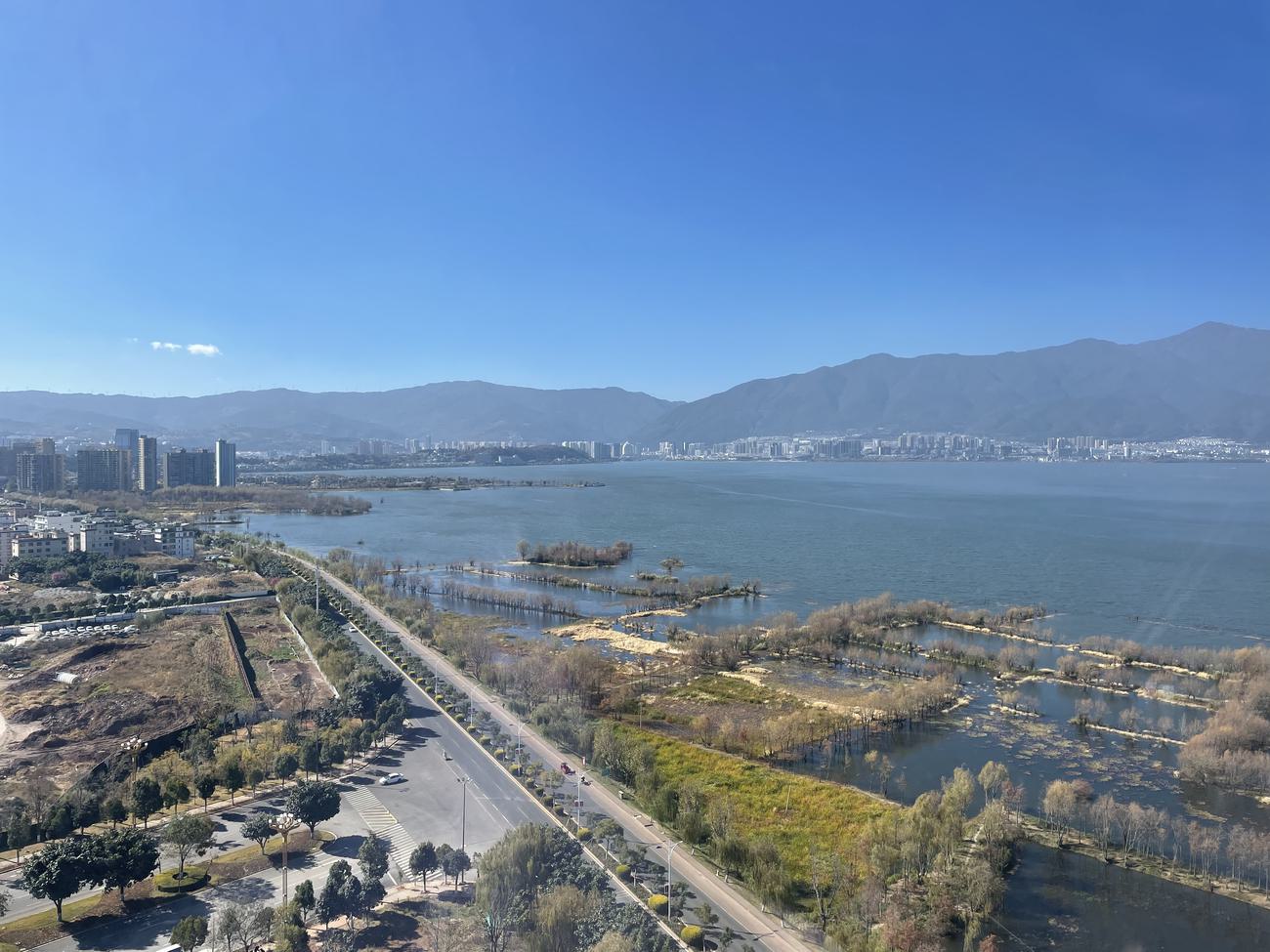
Guesthouses (民宿)
Don’t overlook guesthouses (independently run guesthouses and boutique inns). Around Erhai, especially in Shuanglang, Caicun, Longkan, and Xizhou, guesthouses are often the best value in Dali: a fraction of the price of the international chains, frequently with private lake-view terraces or courtyards, and a level of individual character and hospitality the big hotels can’t match. Often CNY150-500/night, though the best lake-view rooms can go higher in peak season.
Quality varies a lot between properties, so check recent reviews and photos before booking. The best guesthouses rival the luxury resorts for views at a much lower price; the weakest are just basic rooms with thin walls.
How to choose:
- For lake views on a budget, a well-reviewed guesthouse on the east or west Erhai shore usually beats a cheap in-town hotel.
- For zero booking risk on a first trip to China, the international chains (EDITION, Hilton, Indigo, Four Points) are the safer bet.
- For atmosphere and courtyard architecture, Xizhou and Shaxi both have well-regarded boutique guesthouses in restored Bai and Tea-Horse-Road buildings.
Where to Eat
- Dali Old Town: Good for variety: Bai food, cafes, bars, vegetarian food, bakeries, and Yunnan fusion restaurants.
- Xizhou: Best for Xizhou baba, market snacks, and Bai home-style cooking.
- Xiaguan / Longwei Street: Better for local nibbles and less tourist-focused eating.
- Around Erhai: Good for fish dishes, lakeside cafes, and simple guesthouse meals.
Dishes to Try
- Xizhou baba (喜洲粑粑): A charcoal-grilled flatbread, crisp outside and soft inside. Sweet versions have a rose-sugar filling, while savory ones use scallion and minced pork. Best eaten hot; it turns tough once it cools. North Gate Market sells it for a few yuan; stalls on the main tourist streets charge more for the same thing.
- Grilled rushan (烤乳扇): Dali’s signature dairy snack, grilled until the outside is crisp and the inside chewy, with a rich milky flavor similar to cheese. Often wrapped in a rose-petal sauce to soften the milky tang. Eat it hot because it hardens and gets tough to chew once cool. If you’re unsure about the flavor, order a small portion first.
- Xi doufen (稀豆粉): A thick, savory pea-flour porridge, usually eaten with youtiao or ersi noodles and topped with peanuts and chili oil. Flavor varies a lot between vendors, so it’s worth trying more than once before deciding. North Gate Market has honest bowls for a few yuan; skip pricier versions elsewhere.
- Baojiang tofu (包浆豆腐): Tofu squares grilled on a hot stone until the outside is crisp and the inside turns soft and custardy. Ask for the spicy dipping sauce, which cuts the beany smell. Eat it straight off the grill; it loses its texture once it cools.
- Liangji mixian (凉鸡米线): Soft rice noodles in a tangy, mildly sweet-and-sour chili sauce with shredded chicken, crushed peanuts, and chili oil. The dish is refreshing rather than heavy. Skip it if you don’t like sweet-sour flavors, and note that noodle thickness and quality vary a lot between vendors.
- Sour-and-spicy fish (酸辣鱼): The sourness usually comes from local pickled papaya rather than vinegar, giving a lighter, fruitier tang with only mild heat. Good on its own with rice, or ask for tofu or potato cooked in the broth. Whole crucian carp comes with plenty of small bones, and some restaurants oversalt the broth.
- Mint pork ribs (薄荷排骨): A Bai dish of deep-fried ribs with fresh mint to cut the richness, usually served alongside “grandma’s potatoes.” Opinions are mixed: some kitchens serve it dry or overly salty, so order a small portion first if you’re unsure.
- Grandma’s potatoes (老奶洋芋): Mashed potato pan-fried until dense and slightly crisp, often mixed with pickled greens for tang. It is a reliable, filling side for rice. It can be oily, so go easy if you have a sensitive stomach.
- Wild mushroom hot pot (野生菌火锅): A rich broth, often slow-cooked chicken stock, packed with a mix of foraged mushrooms; many restaurants also offer stone-grilled meat alongside. Always boil the mushrooms for at least 20 minutes before eating. Undercooked wild mushrooms are a genuine poisoning risk. Outside mushroom season (roughly June-October), some restaurants substitute frozen or farmed mushrooms.
- Ěrkuài (饵块) and ěrsī (饵丝): Both are made from the same pounded rice dough. The process is similar to making mochi, but savory rather than sweet. Ěrkuài is cut into a chewy block, usually grilled and stuffed with sauce, egg, and pickles, or sliced and stir-fried. Ěrsī is cut into noodle-like strips instead and served in broth, a common Yunnan breakfast with a chewier bite than thin rice noodles (米线). A standout version is Weishan pork ersi (巍山耙肉饵丝): tender, falling-apart braised pork over soft ersi noodles in a mildly sweet pork-bone broth. Order to eat in rather than take away, since the noodles clump once packed, and check the broth isn’t watered down before committing.
Help keep this guide accurate
Found something incorrect, outdated, or missing? Tell us what changed and include a source when possible.
Suggest an update