On this page14 sections
✓ Prices and practical details last verified July 3, 2026
Lijiang (丽江) is usually sold as one photogenic old town, but the real draw is everything around it. The Naxi minority capital sits at the foot of Jade Dragon Snow Mountain (玉龙雪山), and the whole area unfolds outward from there: three old towns of very different character, a snow-capped massif with cable cars and alpine meadows, a wetland lake for horseback rides, and two serious side trips (Tiger Leaping Gorge (虎跳峡) and Lugu Lake (泸沽湖)) that reward travelers willing to leave the old town behind for a few days.
Highlights
- Watch the nightly bonfire dance at Sifang Street (四方街), then climb Lion Hill’s Wangu Tower (狮子山万古楼) for a 360° view over Lijiang Old Town’s rooftops.
- Ride the big cable car up Jade Dragon Snow Mountain (玉龙雪山) to Ice Glacier Park at 4,680 m, then cool off at the Tiffany-blue water of Blue Moon Valley (蓝月谷).
- Compare the three old towns: Baisha (白沙) for the least commercialized Naxi atmosphere, Shuhe (束河) for quiet stone lanes, and Lijiang Old Town itself for energy, food, and nightlife.
- Hike the classic 2-day, 1-night high trail through Tiger Leaping Gorge (虎跳峡), one of the world’s deepest canyons.
- Take a multi-day side trip to Lugu Lake (泸沽湖) for Mosuo culture, the heart-shaped bay at Lige Peninsula, and the June-September water-lily bloom.
Transportation
Lijiang Airport
Lijiang Sanyi Airport (丽江三义机场 / LJG) mainly handles domestic flights. Check current direct routes on FlightConnections. Kunming (昆明) is a common alternative entry point if you can’t find a convenient direct flight.
The airport bus costs about CNY20 and drops off at three points: Lijiang Old Town South Gate (古城南门), North Gate (古城北门), and Blue Sky Hotel (蓝天宾馆). Confirm your guesthouse is close to one of these before relying on it.
Lijiang Railway Station
Lijiang Railway Station (丽江站) connects to Kunming by high-speed train (about 4 hours) and to Dali, Shangri-La, and other Yunnan destinations. It is outside the old town, so budget time for a taxi or bus transfer with luggage.
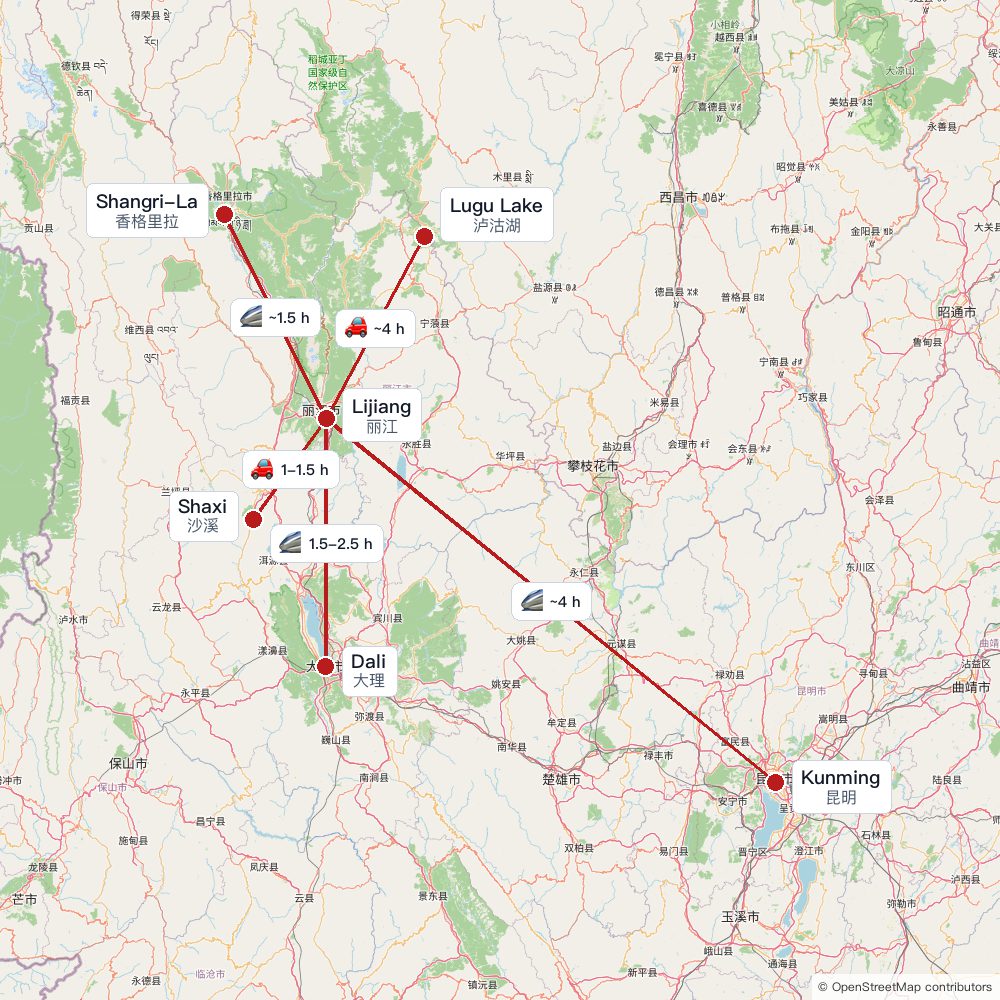
Interactive map of travel times from Lijiang to Kunming, Dali, Shangri-La, Lugu Lake, and Shaxi.
Common onward routes
| Route | Best option | Travel Time | Notes |
|---|---|---|---|
| Lijiang (丽江) -> Kunming (昆明) | Train | About 4 hours | Main gateway for onward domestic and international flights. |
| Lijiang (丽江) -> Dali (大理) | Train or car | About 1.5-2.5 hours | The train is fastest if you are in the southern part; a car lets you stop at towns along the way. |
| Lijiang (丽江) -> Shangri-La (香格里拉) | Train | About 1.5 hours (fastest service 1h18min) | The Lijiang-Shangri-La railway opened in 2023; car via Tiger Leaping Gorge is still popular if you want a scenic stop or overnight hike along the way. |
| Lijiang (丽江) -> Lugu Lake (泸沽湖) | Bus from Lijiang bus station, or car/charter | About 4 hours | Bus is about CNY71, booked via the “丽江郊云” mini-program; a rental or chartered car via the scenic but winding Lining Highway (丽宁公路) is the other main option. |
| Lijiang (丽江) -> Shaxi (沙溪) | Bus or car | About 1-1.5 hours | Easy to combine with a Dali itinerary. |
Getting around town
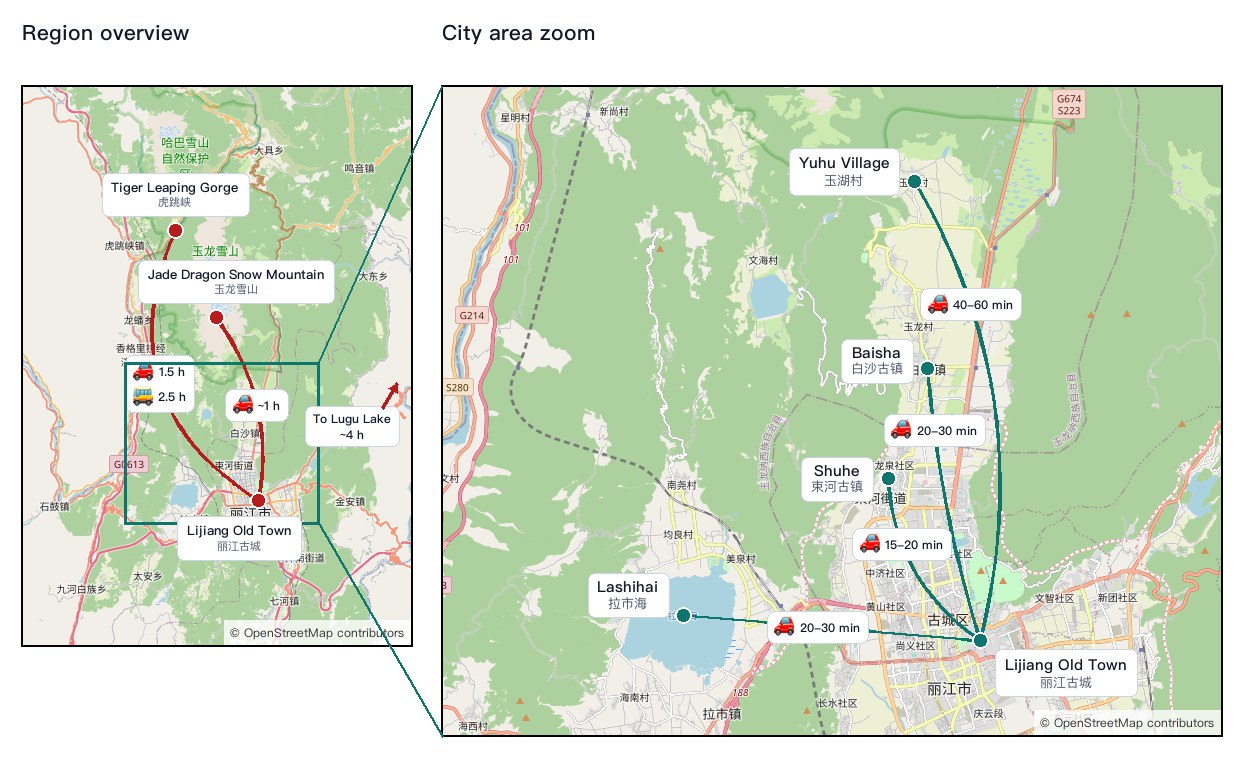
Lijiang Old Town, Baisha, and Shuhe are close enough to connect by a tourist express bus (about CNY5 per ride, or CNY19.9 for a 48-hour unlimited pass). A separate direct tourist bus (丽江旅游直通车) runs from the Old Town South Gate through Shuhe and Baisha to Yuhu Village (玉湖村) for about CNY15. Shared e-bikes are also available around town, but they are geo-fenced and lose power outside their operating zone. Do not ride one out toward the snow mountain or Lashihai expecting it to keep working.
Key Attractions
Lijiang’s sights fall into a few natural clusters. Lijiang Old Town, Shuhe, and Baisha work well as one loose old-town route, but the distances between them are not really walkable; use short taxi, bus, or e-bike rides between stops. Jade Dragon Snow Mountain and Yuhu Village sit north of town and need at least a full day between them. Black Dragon Pool and Lashihai are closer-in stops that fit around the edges of an itinerary. Tiger Leaping Gorge and Lugu Lake are both worth a dedicated multi-day trip rather than a rushed add-on. The static map below works as a quick index: click a numbered point to jump to that section.
1. Lijiang Old Town (丽江古城)
Getting there: About 40 minutes by airport bus from Sanyi Airport, or a short taxi from Lijiang Railway Station
Admission: Free to enter
Time needed: Half a day, better with an evening
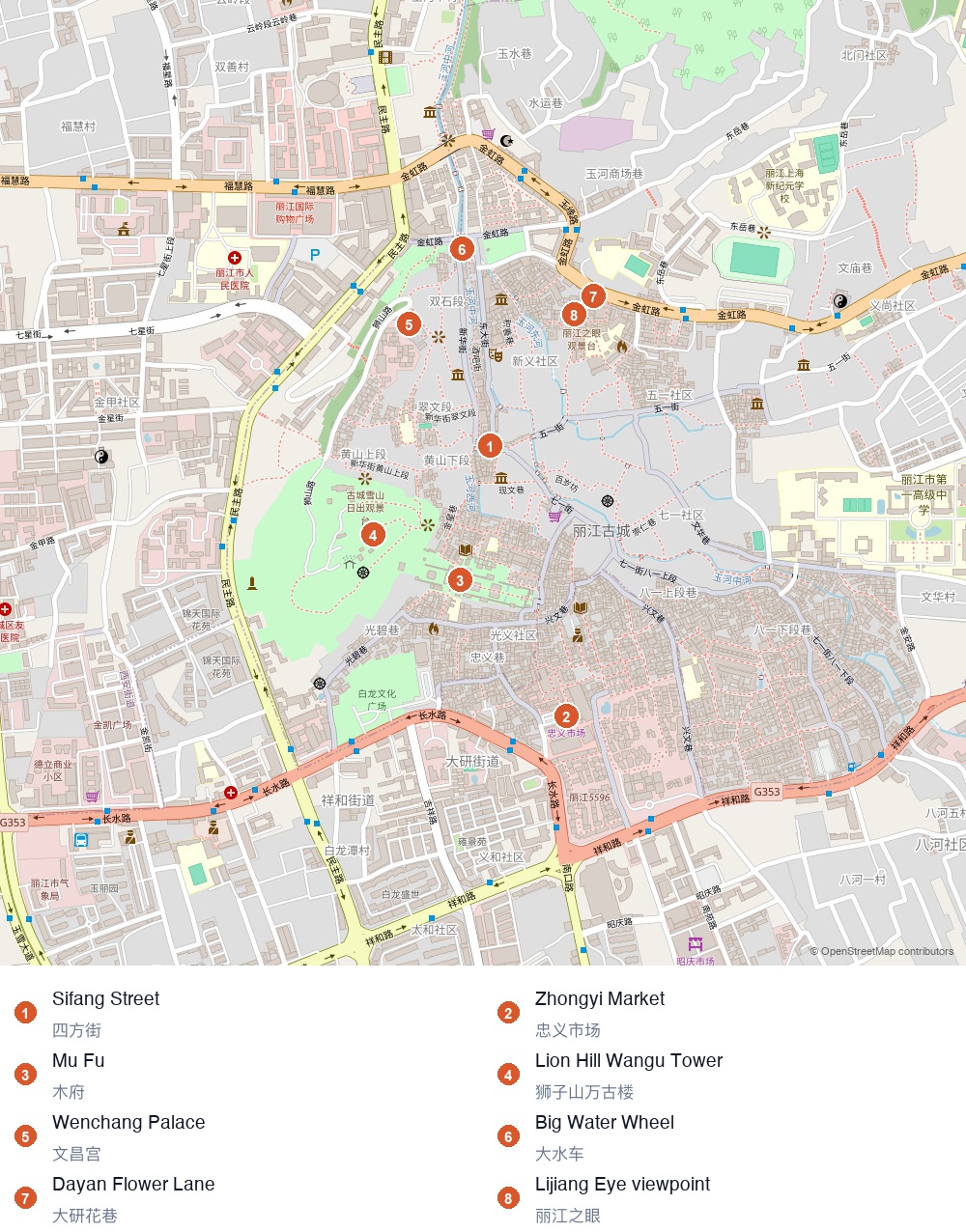
Interactive map of key spots inside Lijiang Old Town.
Lijiang Old Town, also known as Dayan Old Town (大研古镇), is the largest and busiest of the three old towns, and the most convenient base. Everything from the airport bus to onward buses to Baisha, Shuhe, and the snow mountain touches it. It is part of the UNESCO-listed Old Town of Lijiang World Cultural Heritage site, but it is also the most heavily commercialized: reconstructed storefronts, souvenir shops, and clubs. From October, a chrysanthemum flower display is strung through the lanes.
What to see
- Sifang Street (四方街)
The old town’s central square, with a nightly bonfire dance from 20:00-21:00. After dark the surrounding bars and clubs get loud with singing and dancing. The mood is lively, but it is not the quiet acoustic-guitar atmosphere some travelers expect. - Zhongyi Market (忠义市场)
One of Lijiang’s largest markets, good for Yunnan specialty goods, handicrafts, and a night market in the evening. Also the best place in town for a cheap bowl of Yunnan rice noodles. - Mu Fu (木府)
The former mansion of the Naxi Mu clan chieftains, sometimes called the “Forbidden City of Lijiang.” Admission is about CNY40. Free guided commentary is available, and a full loop takes a bit over an hour. It is worthwhile for the history of Yunnan’s hereditary tusi (native chieftain) system, which most of the rest of the old town does not explain. - Lion Hill Wangu Tower (狮子山万古楼)
Admission is about CNY40. Climb it for a 360° view over the old town’s rooftops toward the mountains. - Wenchang Palace (文昌宫)
There is a free viewing platform just below it with good views over the old town on clear days. - Big Water Wheel (大水车)
Lijiang’s most recognizable landmark and a common meeting point near one of the main entrances. - Dayan Flower Lane (大研花巷)
A flower-decorated lane worth a slow walk, especially toward evening. - Snow Mountain Academy (雪山书院)
Free to enter. A quieter cultural site connected to the Ming dynasty (1368-1644) scholar Yang Shen (杨慎), and a good stop if you want one substantial historic site beyond Mu Fu. - Lijiang Eye viewpoint (丽江之眼)
A free rooftop viewing platform above the Zhazha Rice Noodle restaurant (渣渣米线). The second floor has the better view.
What to eat
Zhongyi Market is the easiest spot for breakfast: Yunnan rice noodles (云南米线) and grilled rushan (烤乳扇) from local stalls, cheaper and more authentic than the tourist-street versions. Restaurants outside the old-town tourist lanes can be better for proper meals, though occasional indoor smoking can be a challenge.
Caution
The stone-paved lanes are hard on wheeled luggage. Pack light or use a backpack for the last stretch into your guesthouse. If you’ve already visited other well-known “ancient towns” in China (Dali, Fenghuang, Pingyao, Zhouzhuang, and similar), Lijiang Old Town’s souvenir shops and photo studios will feel very familiar; treat it as a base and a food stop rather than the main event.
2. Baisha & Shuhe Old Towns (白沙古镇 & 束河古镇)
Getting there: Baisha is about 15 minutes north of Lijiang Old Town by tourist bus, hired car, or rental car; Shuhe sits between the two and is an easy stop on the way
Admission: Free to enter both
Time needed: Half a day for both together
Baisha and Shuhe are the other two of Lijiang’s three old towns, and each solves a different problem with Lijiang Old Town’s crowds and commercialization.
Baisha (白沙) sits directly under Jade Dragon Snow Mountain and keeps more of its original Naxi character, with lower commercialization and quiet cafes where you can look up and see the mountain from your table. That said, it has its own growing “photo spot” economy of tents, hanging flower baskets, and rooftop viewpoints that charge a fee to use as a backdrop. The narrow roads in and out of town also bottleneck easily, so expect some traffic getting there.
Shuhe (束河) sits between Lijiang Old Town and Baisha and has its own stone-paved lanes and a stream running through the center. It is smaller and less polished than Lijiang Old Town, with fewer shops open and everything closing earlier in the evening. Some travelers have found it quiet enough to feel isolated after dark. This is worth factoring in if you are traveling solo and choosing where to spend the night.
Caution
None of the three old towns are wheelchair- or wheeled-luggage-friendly because all are stone-paved. In Baisha, treat the staged photo spots (balloons, tents, rooftops) as optional paid extras, not included sights.
3. Jade Dragon Snow Mountain (玉龙雪山)
Getting there: Bus 101 from Zhongyi Market (忠义市场), about 1 hour, CNY15, departing roughly every 30 minutes from about 7:00 to 16:00; alternatively, use a hired car or drive to the visitor center
Mountain entry: CNY100/person (student half price), valid 7 days with re-entry, includes Blue Moon Valley
Ice Glacier Park big cable car: CNY140
Spruce Meadow small cable car: CNY60 (CNY40 if bought together with the big cable car)
Yak Meadow cable car: CNY65
Time needed: A full day
Jade Dragon Snow Mountain is Lijiang’s headline attraction and the reason most itineraries build a full day around it. The mountain complex has several distinct zones, connected by a scenic shuttle bus once you’re past the entrance, and visiting all of them in one day is realistic if you plan the cable car bookings in advance.
The main zones
- Ganhaizi (甘海子)
A sunrise viewpoint for “sunlit golden mountain” (日照金山), reachable by Bus 101 from Zhongyi Market. Arrive early. - Dongba Valley (东巴谷)
A second sunrise viewpoint, also reachable by Bus 101 (about 40 minutes, CNY15, first bus around 6:50). - Ice Glacier Park (冰川公园)
Reached by the big cable car, climbing to about 4,680 m. This is the mountain’s signature experience, with the glacier close enough to feel its scale. - Spruce Meadow (云杉坪)
A forest meadow with boardwalks, best photographed in good weather. Reached by its own small cable car, usually visited after Ice Glacier Park. - Yak Meadow (牦牛坪)
Wide grasslands with prayer flags and a direct view of the mountain face. Visit in the morning because afternoon light is backlit for photos. In winter, the grassland is bare aside from a couple of yaks kept near the entrance for photos, but the mountain view is still striking. - Blue Moon Valley (蓝月谷)
Tiffany-blue glacial-melt water is included with the mountain entry ticket at no separate charge. It is best photographed around midday (12:00-13:00), when the water reads bluest; walk out to the boardwalk section to frame the lake and the mountain together.
Booking cable car tickets
Cable car tickets are released the day before, through the “Lijiang Tourism Group” (丽江旅游集团) WeChat mini-program: the Ice Glacier Park big cable car goes on sale at 20:00, and both the Spruce Meadow and Yak Meadow small cable cars go on sale at 21:00. The big cable car in particular sells out fast. Have your details filled in and be ready at the exact release time. Cable car tickets include the CNY20 scenic-area shuttle bus fee, deducted automatically if you buy more than one.
Altitude precautions
- Buy an oxygen canister before you go. Typical prices are about CNY10-15 in the old town or via a delivery app, versus about CNY39 inside the scenic area.
- Don’t wash your hair or attempt the mountain on your first day at altitude; give your body time to adjust first.
- Dress in three layers and bring a hat for wind, even in summer.
- Move slowly on inclines, avoid shouting or running, and take a hit of oxygen at the first sign of shortness of breath rather than waiting.
- For the best chance at “sunlit golden mountain,” aim for October-March.
Caution
Weather on the mountain changes quickly and cable cars can close for wind with little notice. Check conditions the same morning. Bring warm layers regardless of season, especially for Ice Glacier Park.
4. Yuhu Village (玉湖村)
Getting there: North of Baisha, closer to the mountain; reachable by the direct tourist bus from Lijiang Old Town South Gate (via Shuhe and Baisha), hired car, or rental car
Admission: Free to walk in before 7:00 or after 18:00; otherwise a sightseeing vehicle fee applies (around CNY30-39 round trip in peak season)
Time needed: Half a day
Yuhu is a Naxi stone village built from local rock, sitting closer to Jade Dragon Snow Mountain than any of the old towns. It is the quietest of Lijiang’s village stops, good for an unhurried walk rather than a checklist of sights. Many houses are under renovation, so keep expectations modest.
Dragon Maiden Lake (龙女湖) is a small artificial lake at the edge of the village. On clear days it reflects the snow mountain; spring and summer bring flowers along the shore, while the water reads bluer in autumn and winter. It is small enough that a short walk covers it, so treat it as a quiet add-on rather than a destination in its own right.
5. Black Dragon Pool (黑龙潭公园)
Getting there: At the north edge of Lijiang Old Town, an easy walk
Admission: About CNY50; free if you enter before 7:30
Time needed: 1-1.5 hours
Black Dragon Pool is Lijiang’s classic postcard shot: on a clear day, De Yue Lou (得月楼) and the Wukong Bridge (五孔桥) reflect Jade Dragon Snow Mountain in the water behind them. Suocui Bridge (锁翠桥) is the other popular photo spot inside the park.
Go early for two reasons: entry is free before 7:30, and the reflection shot depends on clear morning air rather than the afternoon haze that often builds up later. If you’d rather skip the entrance fee, walking the park’s outer perimeter toward the reservoir side gives distant mountain views over a string of smaller ponds without paying to go in.
The Lijiang Museum (丽江博物馆), covering Naxi Dongba culture, sits right beside the park and is a quick, low-key add-on if you have time. A little further on, Qingxi Reservoir Park (清溪水库公园) offers another distant snow mountain view, with a stand of dawn redwoods (落羽杉) that turn red in season on the park’s south side.
Caution
The reflection shot only works on clear days. Check the weather before planning a special trip around it.
6. Lashihai (拉市海)
Getting there: About 15-20 km west of Lijiang Old Town, by hired car, rental car, or organized tour
Admission: A small wetland park entry fee applies
Time needed: Half a day
Lashihai is a wetland lake best known as a stop on the old Tea Horse Road (茶马古道). The standard activity is a roughly 30-minute horseback ride along a stretch of the old trade route, with an optional forest slide nearby. Inside the horseback riding area, staff commonly try to sell shoe covers for about CNY20. They are not required, so treat them as an optional upsell rather than a mandatory cost. Navigate toward Fishing Village (打渔村), which has cafes and easy lake access.
The adjoining Lashihai Wetland Park (拉市海湿地公园) has a long boardwalk; stick to the sections closer to the water rather than pushing further into the wetland itself, and go on a clear day for the best views.
Caution
Drivers and tour operators sometimes push extra paid add-ons once you’re on site. Agree on what is included before you commit to a package.
7. Tiger Leaping Gorge (虎跳峡)
Getting there: Carpool from Lijiang, often combined with continuing on to Shangri-La, about CNY150/person
Admission: No fee for the classic high-trail hike unless you enter Upper Tiger Leaping Gorge (上虎跳景区). The Yixiantian / Middle Gorge riverside trails are closed, so do not plan the hike around that exit.
Time needed: 2 days, 1 night for the classic high-trail hike; much less if you only want the Upper Tiger Gorge viewpoint by car
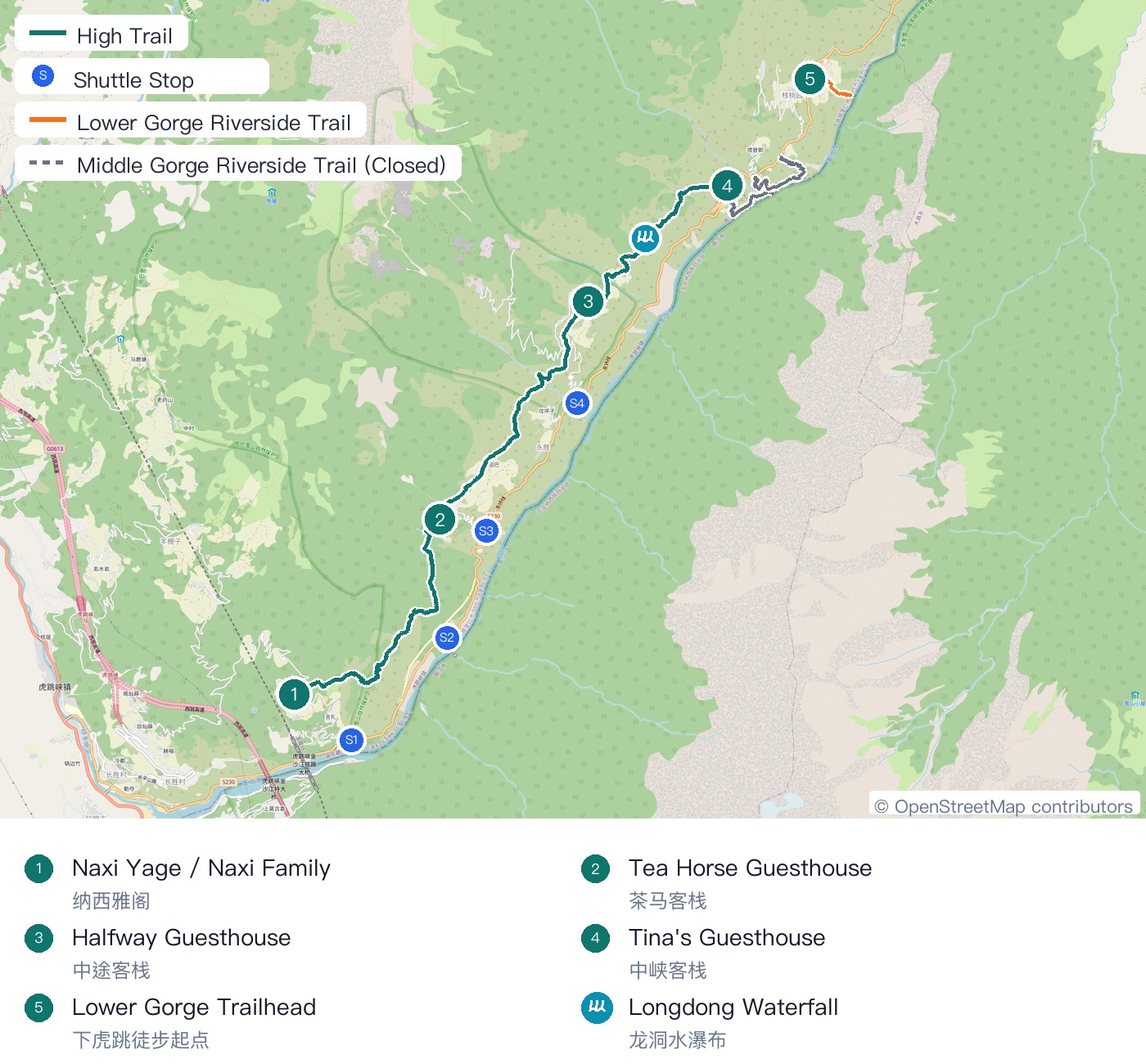
Tiger Leaping Gorge is one of the deepest canyons in the world, and the high trail above it is regularly ranked among the world’s best short treks. The classic route runs:
Upper Tiger Leaping Gorge (上虎跳景区) is a separate easy-access scenic-area stop near the highway, with convenient vehicle access and an elevator. It works well for tour groups, older travelers, or anyone with very limited time who just wants to see the gorge quickly. If you are doing the high-trail hike, you can skip it without losing the main trekking experience.
Day 1: Naxi Yage (纳西雅阁, starting point) → 28 Bends (28道拐) → Tea Horse Guesthouse (茶马客栈, food stop) → Halfway Guesthouse (Halfway客栈), overnight
Day 2: Halfway → Longdong Waterfall (龙洞水瀑布) → Tina’s Guesthouse (中峡客栈), or turn back at Longdong Waterfall and arrange a vehicle down
Halfway’s CNY20 entry fee can be redeemed against a coffee at its cafe, so do not forget to use it. If Halfway itself is fully booked, Banshanju Guesthouse (半山居客栈) next door is a solid backup, with dorm beds around CNY70/person and rooms that look straight out at the snow mountain.
Turn back at Longdong Waterfall
This is the single most important piece of trail advice: after Longdong Waterfall, the trail toward Tina’s Guesthouse drops down a long, very steep descent. Hikers without real trekking experience or fitness should turn back to Halfway from Longdong Waterfall and arrange a taxi down from there, rather than push on. The Yixiantian / Middle Gorge riverside routes are closed, so do not plan to continue through Yixiantian, Fadaishi, or Teacher Zhang’s Trail.
Old Yao Mountain alternative
Old Yao Mountain (老药山) is a separate scenic area near the gorge, reached by a mountain road that tests driving skill. Hire a local driver rather than driving yourself if you’re not confident on switchbacks. Inside, travelers who don’t want to walk the full route can go up by horse for about CNY120 one-way and walk back down at an easy pace.
What to pack
Quick-dry thermal base layers, a softshell jacket, quick-dry pants, wool socks, and hiking boots (size up from your usual size) are the baseline. Bring gloves and sunscreen even on a clear day. A full day of hiking without them can leave your hands visibly sun-damaged.
Caution
Public transport to the trailhead is limited; a carpool or arranged shuttle is the practical option. Do not plan an exit via Yixiantian or Teacher Zhang’s Trail; that riverside section is closed, and local access rules can be enforced on the spot.
8. Lugu Lake (泸沽湖)
Getting there: Bus from the Lijiang bus station, about CNY71, roughly 4 hours (book via the “丽江郊云” mini-program); or take a rental or chartered car via the scenic but winding Lining Highway (丽宁公路), which passes the Jinsha River viewpoint (金沙江观景台) and the “18 Bends” (十八弯). This route offers better scenery than the expressway, but it is a mountain road with sharp curves and summer rockfall risk.
Getting around the lake: Charter a car or driver for about CNY200-300/day. Do not rely on e-bikes for the full loop.
Time needed: Minimum 2 days; a day trip from Lijiang is not worth attempting
Lugu Lake sits on the Yunnan-Sichuan border and is one of Yunnan’s most rewarding multi-day side trips, known for Mosuo culture and a roughly 70 km lake circuit dotted with viewpoints. Because the lake is so spread out, this is a trip that rewards slowing down. Round-trip driving time from Lijiang alone is about 8 hours, which makes a single-day tour mostly a day spent in the car.
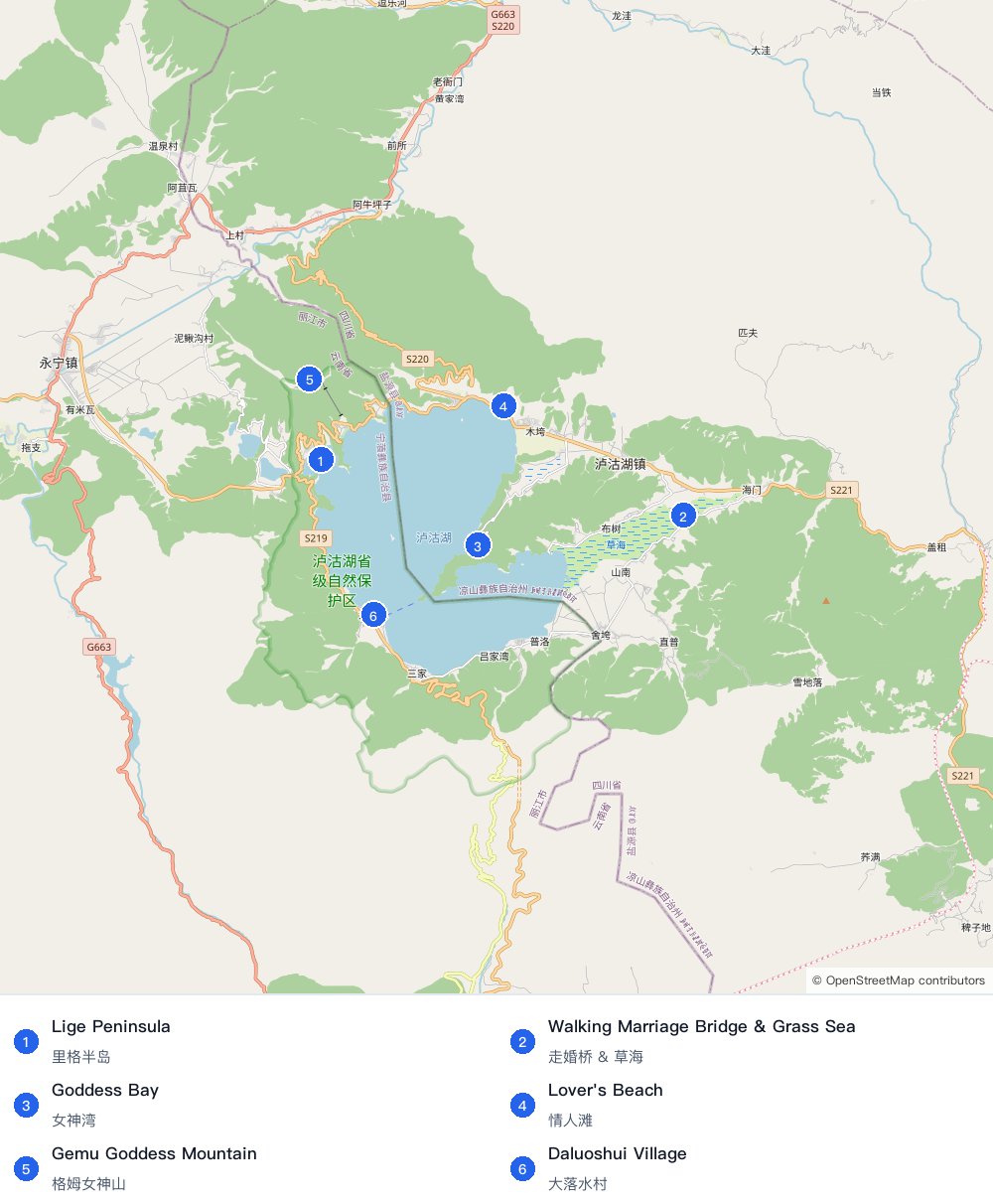
Interactive map of Lige Peninsula, Walking Marriage Bridge and Grass Sea, Goddess Bay, Lover's Beach, Gemu Goddess Mountain, and Daluoshui Village around Lugu Lake.
Around the lake
- Lige Peninsula (里格半岛)
Lugu Lake’s signature view: from the lookout above, the peninsula and its bay form a near-perfect heart shape. - Walking Marriage Bridge (走婚桥) & Grass Sea (草海)
A wooden bridge across a marshy bay, named for the Mosuo tradition of “walking marriages.” The grass turns a vivid green in the rainy season (roughly June-September). - Goddess Bay (女神湾)
The best sunset spot on the lake, sometimes nicknamed the “Hawaii of the East” for its golden evening light. - Lover’s Beach (情人滩)
Split into a Yunnan side (sandy, with willow trees, good for photos) and a Sichuan side (larger, quieter, with cleaner-looking water). - Gemu Goddess Mountain (格姆女神山)
An open-air cable car climbs to a panoramic viewpoint over the whole lake. Skip it if you’re afraid of heights, and go easy at the summit if you’re altitude-sensitive.
Water-lily season
From June to September, Lugu Lake’s water-celery flowers (水性杨花, botanically 海菜花) bloom across the shallows. They are a distinctive local sight unique to the lake. Flowers open widest from early morning to around midday and mostly close by afternoon. The best way to see them is a pig-trough boat (猪槽船) ride from Puluo, Wuzhiluo, or Aiqing piers, choosing a boatman who knows the “flower sea” route into the thick of the blooms. In winter (November-March), the draw shifts to migratory seagulls and morning mist instead.
Where to base yourself
- Daluoshui Village (大落水村): the most developed base, with the easiest access to food, transport, and evening entertainment. Scenery here holds up in both wet and dry season, unlike the east side of the lake, which turns yellow-brown outside the rainy season. A well-regarded homestay here is Sanse Yunhe (三色云河), consistently near the top of local review rankings.
- Lige Peninsula (里格半岛): the best scenery and the most sought-after lake-view rooms, at a higher price, in a smaller village with fewer choices.
- Goddess Bay / Langfang Village (女神湾/蒗放村): quiet, with wide-open sunset and lake views, but weaker on food and transport options.
- Nisai / Dazu (尼塞/达祖): small lakeside villages with good value for travelers with a rental car who want quiet over convenience.
Caution
Avoid cheap one-day tours from Lijiang. The round trip alone eats most of the day, leaving little real time at the lake. Do not rely on e-bikes to circle the lake: the altitude is high, the road has frequent steep climbs and sharp turns, and battery range often runs out in stretches with no houses or services nearby. Arrange a car or driver instead. Bonfire shows around the lake are commercialized (typically CNY30-50) and not great value. Politely decline invitations to a “Mosuo home visit.” These are usually a shop rather than a genuine cultural exchange.
Suggested Itineraries
2 Days in Lijiang
Day 1: Lijiang Old Town + Black Dragon Pool
Settle in, walk Sifang Street and the old town lanes, and see the Big Water Wheel and Mu Fu. Late afternoon or the next morning, walk over to Black Dragon Pool for the reflection shot.
Day 2: Jade Dragon Snow Mountain
A full day on the mountain: sunrise at Ganhaizi or Dongba Valley, then Ice Glacier Park, Spruce Meadow or Yak Meadow, and Blue Moon Valley around midday.
3 Days in Lijiang
Day 1: Lijiang Old Town + Black Dragon Pool
As above.
Day 2: Jade Dragon Snow Mountain
Full day on the mountain.
Day 3: Baisha, Shuhe & Yuhu Village
A slower day through the other two old towns and the quiet stone village closest to the mountain.
4 Days in Lijiang
Day 1: Lijiang Old Town
Arrive, settle in, evening walk and dinner.
Day 2: Jade Dragon Snow Mountain
Spend a full day on the mountain and book cable car tickets the night before.
Day 3: Baisha, Shuhe & Yuhu Village
Old town hopping and Dragon Maiden Lake.
Day 4: Lashihai or Black Dragon Pool
Choose Lashihai for a horseback ride and wetland walk, or a lighter day around Black Dragon Pool and Zhongyi Market.
6-7 Days: Lijiang with Tiger Leaping Gorge and Lugu Lake
Day 1: Lijiang Old Town
Arrival and easy walk.
Day 2: Jade Dragon Snow Mountain
Full day on the mountain.
Day 3: Baisha, Shuhe & Yuhu Village
Old town hopping and Dragon Maiden Lake.
Day 4-5: Tiger Leaping Gorge
Carpool out, hike the 2-day, 1-night high trail, then carpool back to Lijiang or onward to Shangri-La.
Day 6-7: Lugu Lake
Take a bus, rental car, or chartered car for a minimum 2-day loop of the lake, including a pig-trough boat ride if you’re visiting between June and September.
Where to Stay
Where you sleep changes the trip more in Lijiang than in most Chinese cities, because the old town, the quieter villages, and the two big side trips each have their own accommodation logic.
Inside Lijiang Old Town is the most convenient option because you are steps from the bonfire dance, restaurants, and onward buses. It is also the noisiest at night, and the stone lanes make arrival with luggage slower than it looks on a map. Naxi-style courtyard guesthouses are common here.
Just outside the old town, near Zhongyi Market, is a strong compromise: still an easy walk or short taxi to the old town, Baisha, and the snow mountain, but quieter at night. If you’re visiting in winter, confirm your room has heating before booking because not every property does.
Shuhe or Baisha work well if you’d rather wake up somewhere quieter than the old town, with Baisha giving you a snow mountain view over breakfast. Weigh Shuhe’s quiet evenings against the fact that some travelers, especially solo women, have found it too empty after dark.
Along the Tiger Leaping Gorge trail, lodging is simple and built around the hike itself: Tea Horse Guesthouse for a food stop, Halfway Guesthouse or nearby Banshanju for the overnight stop, and Tina’s Guesthouse if you continue down toward the road.
For a more luxurious destination stay, MoYe | Snow Mountain Cliff Hotel (墨野·雪山悬崖酒店) is a social-media favorite in Yongsheng Village above Tiger Leaping Gorge. Its cliffside rooms face Jade Dragon Snow Mountain and the Jinsha River canyon, with large windows and private soaking pools in many room categories. It is considerably more expensive than the trekking guesthouses and works best as a scenic hotel stay rather than a practical substitute for Halfway Guesthouse on the classic two-day hike. Confirm road transfers and the exact room view before booking.
At Lugu Lake, base yourself in Daluoshui Village for convenience and consistent scenery, Lige Peninsula if lake-view rooms matter more than price, or Goddess Bay/Langfang and Nisai/Dazu for a quieter, more self-sufficient stay.
Where to Eat
- Zhongyi Market: The best spot for cheap, honest Yunnan rice noodles and breakfast snacks, plus local fruit and handicrafts.
- Lijiang Old Town, around the Big Water Wheel: The widest variety, including Dai cuisine and fish hot pot.
- Shuhe: Home to a few more inventive Yunnan-fusion kitchens than the main old town.
- Near Black Dragon Pool: Good for a sit-down meal away from the busiest tourist streets.
Dishes to Try
- Cured pork rib hot pot (腊排骨火锅): Lijiang’s signature dish consists of smoky, salted pork ribs simmered into a rich broth, often with a choice of a straight cured-pork base or one built around black chicken (黑鸡锅) for extra depth. Worth ordering as a shared pot rather than a solo portion.
- Wild mushroom hot pot (野生菌火锅): A slow-cooked broth, often chicken-based, packed with a mix of foraged mushrooms. As with any wild mushroom dish in Yunnan, make sure everything is boiled thoroughly. Undercooked wild mushrooms are a genuine poisoning risk, not just a texture issue.
- Grilled rushan (烤乳扇) and grilled ěrkuài (烤饵块): Two classic street snacks, best bought and eaten hot from a stall rather than pre-made. Rushan is a chewy, milky dairy snack; ěrkuài is a grilled rice cake, usually folded around a savory or sweet filling like a wrap.
- Yunnan rice noodles (云南米线): The default breakfast. Zhongyi Market has cheap, reliably good bowls that are a better bet than the versions sold on the main tourist streets.
- Yunnan sour-soup beef hot pot (酸菜牛肉火锅): A tangy, pickled-greens broth served with yak sashimi, mujiangzi beef, and konjac. It is a good lighter alternative to the richer cured pork rib hot pot. Found at the restaurant beneath the Lijiang Eye viewpoint, among other spots.
- Snow mountain fish hot pot (雪山鱼): A milder fish-based hot pot, often served with wild mushroom fried rice and Dai-style chicken feet on the side. It is a good order if you want something lighter than pork or mushroom hot pot after a day on the mountain.
Help keep this guide accurate
Found something incorrect, outdated, or missing? Tell us what changed and include a source when possible.
Suggest an update