
On this page13 sections
✓ Prices and practical details last verified August 2, 2026
Jiuzhaigou is the most famous stretch of alpine scenery in China, a Y-shaped valley high in the mountains of northern Sichuan where dozens of lakes glow in shades of turquoise, blue, and green. Clear water reveals submerged logs and pale travertine beneath forests that turn gold and red in autumn. Formally, Jiuzhaigou is a UNESCO World Heritage site, a national nature reserve, and a national scenic area. Visitors explore the open sections by park shuttle and boardwalk, and often pair the valley with the nearby travertine pools of Huanglong.
Highlights
- Follow selected boardwalks past the lakes of Jiuzhaigou (九寨沟), using the park shuttle to move between the three arms of the Y.
- Photograph the submerged logs and shifting colors of Five Flower Lake (五花海), the valley’s most famous pool.
- Stand above the wide curtain of Nuorilang Waterfall (诺日朗瀑布) at the heart of the park.
- Ride to the top of the valley at Long Lake (长海) and the nearby Five-Color Pond (五彩池).
- Add the terraced travertine pools of Huanglong (黄龙), a short trip away over the mountains.
Transportation
Getting there
Jiuzhaigou is high and remote, and every public-transport route ends with a mountain-road transfer to the scenic entrance.
Railway Station
Most visitors take a train from Chengdu to Huanglong-Jiuzhai Railway Station (黄龙九寨站), a journey of about 2 hours, with the fastest published service taking 1 hour 39 minutes. The station is about 93 km and 2 hours by road from the park. Buses leave from outside the station exit. Direct scenic-area coaches run from Huanglong-Jiuzhai and Songpan stations to Jiuzhaigou; check current departures and fares through the Chinese-language 九旅悦行 WeChat mini-program or account. Songpan Station (松潘站) is a useful alternative.
Airport
Jiuzhai Huanglong Airport (九寨黄龙机场 / JZH) is about 88 km and 1.5 hours by road from the park, but it has very few scheduled flights. Check current routes on FlightConnections. Do not treat flying as the default way into Jiuzhaigou. Airport coaches serve the main scenic areas. Mountain weather can also disrupt operations, especially in winter.
Long-distance coaches, private transfers, organized tours, and rental cars are also possible. When booking any road transfer, choose Jiuzhaigou Scenic Area / Goukou (九寨沟景区 / 沟口) rather than Jiuzhaigou County (九寨沟县城), which is a different destination.

The practical public-transport route is the train from Chengdu followed by a scenic-area coach. Flights operate only on limited Beijing and Chengdu schedules; Lanzhou is a full-day onward drive.
Common onward routes
| Route | Best option | Travel Time | Notes |
|---|---|---|---|
| Jiuzhaigou (九寨沟) -> Chengdu (成都) | High-speed train | 2 hours plus a shuttle | To Huanglong-Jiuzhai station, then onward by scenic-area bus. |
| Jiuzhaigou (九寨沟) -> Beijing (北京) | Limited direct flight | about 2 hours 45 minutes | Check the operating days before building the itinerary around this route. |
| Jiuzhaigou (九寨沟) -> Lanzhou (兰州) | Private car, coach, or rental car | Full day | Continue north by road through the grasslands into Gansu; there is no direct flight. |
| Jiuzhaigou (九寨沟) -> Gannan (甘南) | Private car, rental car, or organized route | Multi-day route | Combine Jiuzhaigou with the grasslands, monasteries, and mountain villages of Gannan rather than treating it as a simple point-to-point transfer. |
| Jiuzhaigou (九寨沟) -> Huanglong (黄龙) | Private car, rental car, or tour | About 2.5 hours | Allow extra time for mountain weather and traffic. |
Jiuzhaigou works particularly well with Gannan (甘南) on a longer road itinerary through the Tibetan cultural regions of northern Sichuan and southern Gansu. Public transport between individual stops is thin, so a rental car, private car, or organized route is much easier than assembling the circuit from separate buses.
Getting around inside the park
Jiuzhaigou is explored on foot and by the park’s green shuttle buses. The shuttle ticket covers transport inside the scenic area, but buses stop only at designated stations and dispatch patterns can change with crowd levels. Ride to an upper stop, walk one or two worthwhile boardwalk sections downhill, then rejoin the shuttle. Private cars cannot enter the visitor circuit.
Key Attractions
Jiuzhaigou is a Y-shaped valley: the lower Shuzheng arm splits at Nuorilang into the Rize and Zechawa arms. The right map enlarges this visitor circuit, where shuttles link selected walking sections. Huanglong is a separate scenic area to the south. Zharu Valley branches near the entrance, but access beyond the regular visitor area is restricted. Numbered stops in Jiuzhaigou Valley guide are the highlights and should be your priority when time is limited. The numbers match the sections below; click a numbered dot to jump to it.

See also the official English park map published by the Jiuzhaigou Scenic Area administration.
1. Jiuzhaigou Scenic Area (九寨沟景区)
Getting there: The park entrance is at the mouth of the valley near Zhangzha town
Admission: Peak season (April 1 to November 15): CNY190 admission plus a CNY90 in-park shuttle. Low season (November 16 to March 31): CNY80 admission plus a CNY80 shuttle. Tickets are real-name and date-specific, and advance online booking is required. Check the official ticket page or book on Trip.com
Time needed: One full day; a second day requires another dated ticket
Jiuzhaigou, the “Valley of Nine Villages,” is named for the Tibetan settlements within it. From the entrance, the shuttle follows the Shuzheng arm to the Nuorilang junction, where the valley forks into the Rize arm and the Zechawa arm. Boardwalks cover selected lakes and waterfalls rather than every kilometre of the valley, so use the shuttle between the sections you most want to walk.
What to see
- The three arms of the valley
The lower Shuzheng stem and the upper Rize and Zechawa arms, each strung with lakes and linked by shuttle. - The Tibetan villages
Tibetan settlements such as Shuzheng and Zechawa sit within the scenic area, with traditional buildings, prayer flags, and visitor stalls. - Autumn color
Autumn brings the strongest contrast between blue water and red and gold forest, but it is also the busiest season.
Caution
Entry uses real-name online booking and a daily capacity limit, so reserve ahead for holidays and autumn. The valley is at altitude and weather changes quickly, so bring warm and waterproof layers even in summer. Overnight stays inside the scenic area, swimming, feeding wildlife, and unauthorized drone flights are prohibited. Check official notices before travel.
2. Shuzheng Lakes (树正群海)
Getting there: On the lower Shuzheng arm; use a shuttle stop, then walk the open boardwalk sections
Time needed: 1 to 2 hours
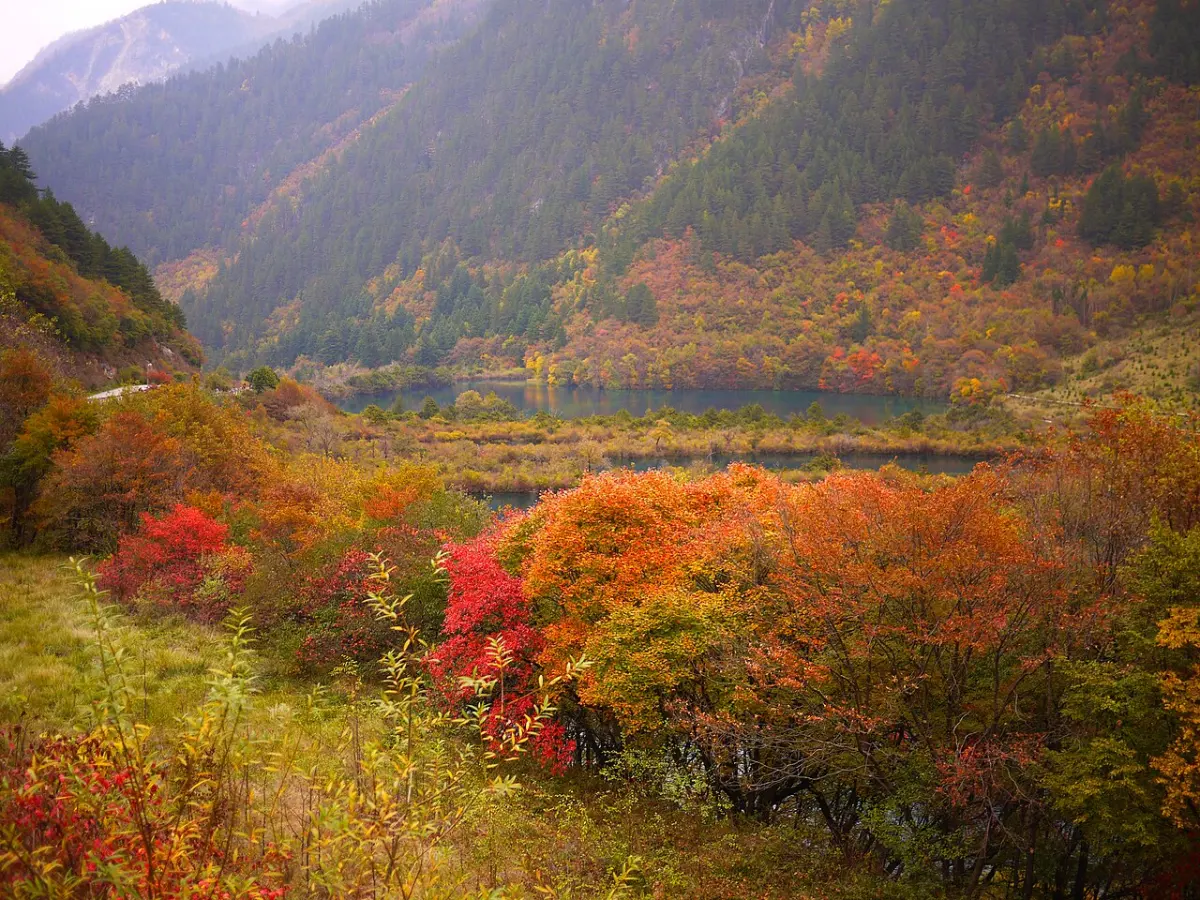
Shuzheng Lakes are a chain of 19 lakes and travertine cascades in the lower valley, with boardwalk sections near Shuzheng village. This is an accessible introduction to Jiuzhaigou’s characteristic clear water, pale mineral shelves, and low waterfalls.
What to see
- The stepped lakes and cascades
A chain of pools linked by travertine falls, easily walked on the lower boardwalks. - Shuzheng village (树正寨)
A Tibetan village beside the lakes, with prayer flags, a small temple, and stalls. - Reed Lake and Sparkling Lake nearby
Neighboring lakes in the lower valley, each with its own color and character.
Caution
This is one of the main lower-valley walking areas and can be busy around shuttle stops. Use only open boardwalks and do not assume that every lakeside path connects continuously to the next stop.
3. Nuorilang Waterfall (诺日朗瀑布)
Getting there: At the Nuorilang junction where the valley forks; a main shuttle hub
Time needed: 30 to 45 minutes
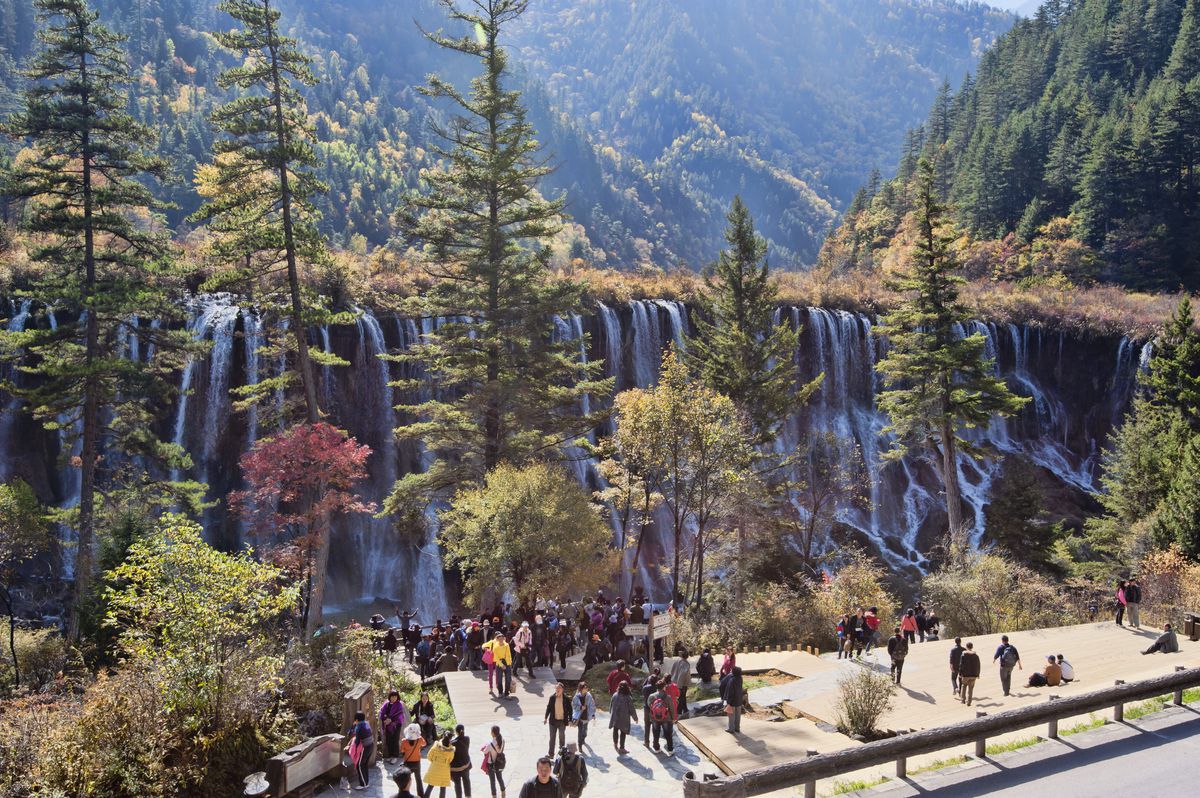
Nuorilang is a 320-metre-wide, 24.5-metre-high travertine waterfall at the junction of the valley’s upper arms. Water from the Nuorilang Lakes spills through the forest over a broad mineral ledge. The clearest full view is from the roadside hillside viewing platform opposite the falls.
What to see
- The main falls
The wide curtain of water, best seen from the viewing platform across the road. - The Nuorilang junction
The central shuttle interchange where the Rize and Zechawa arms meet, and a good orientation point. - The forest backdrop
Especially striking in autumn, when the trees behind the falls turn color.
Caution
As the main interchange, this spot gets crowded and the shuttle queues can be long at peak times; time your pass through it for earlier or later in the day.
4. Five Flower Lake (五花海)
Getting there: On the Rize arm, southwest of the Nuorilang junction
Time needed: 1 hour
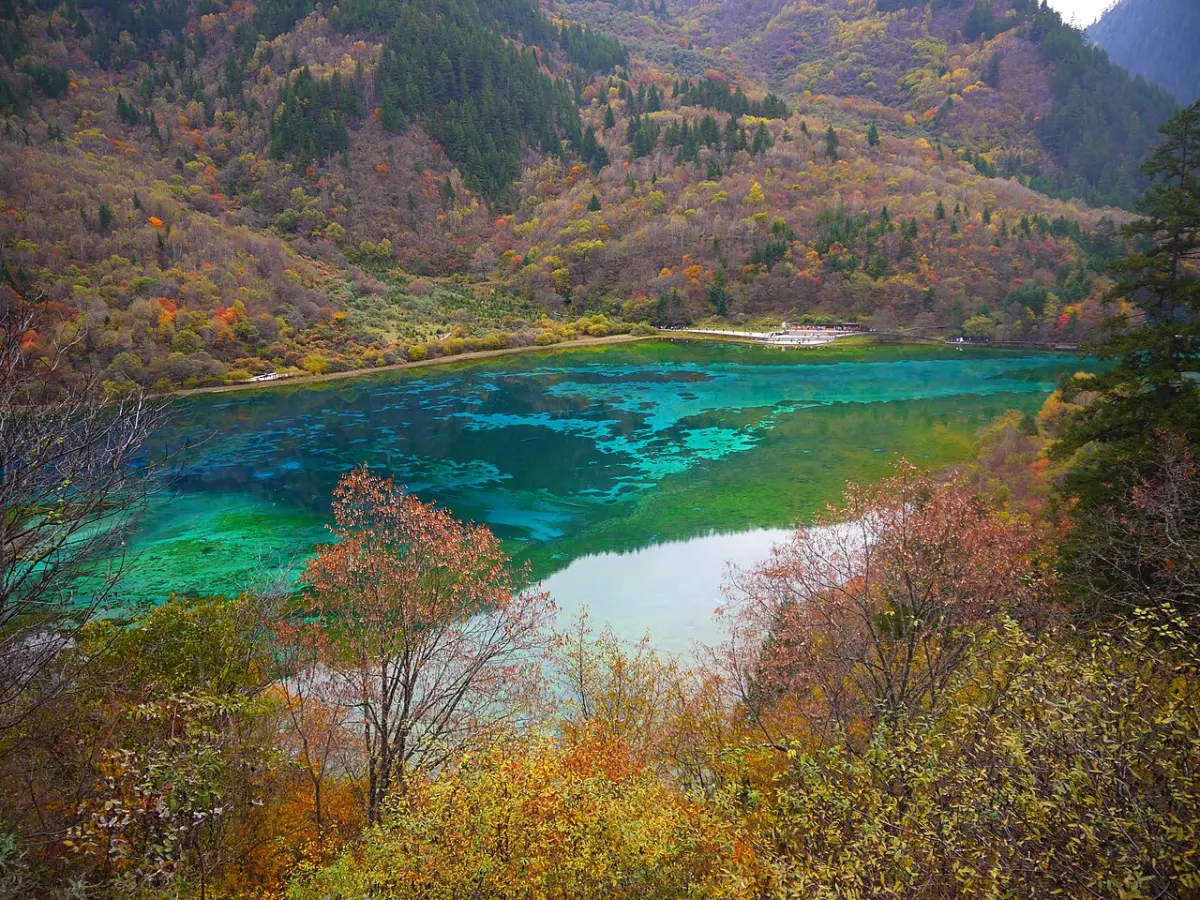
Five Flower Lake is one of Jiuzhaigou’s signature lakes. Its water shifts from turquoise to deep blue and green, with fallen tree trunks visible below the surface. Travertine, aquatic plants, algae, and reflections all contribute to the changing color. The open lakeside boardwalk and roadside viewpoints provide the practical views.
What to see
- The multicolored water
The lake’s shifting turquoise, blue, and green, with the submerged logs showing straight through. - The lake-level boardwalk
Close views reveal the submerged wood and changes in color across the lake. - Pearl Shoal and Mirror Lake nearby
A cascading travertine shoal and a still mirror lake close by on the same arm, both worth the short walk.
Caution
The boardwalk can become congested. The old Tiger Mouth overlook and connecting paths have faced closures, so follow current signs rather than planning around an upper viewpoint. Sunlight strengthens the color, but crowd control may determine where the shuttle lets you off.
5. Long Lake & Five-Color Pond (长海)
Getting there: At the top of the Zechawa arm, the highest point reached by shuttle
Time needed: 1 to 1.5 hours
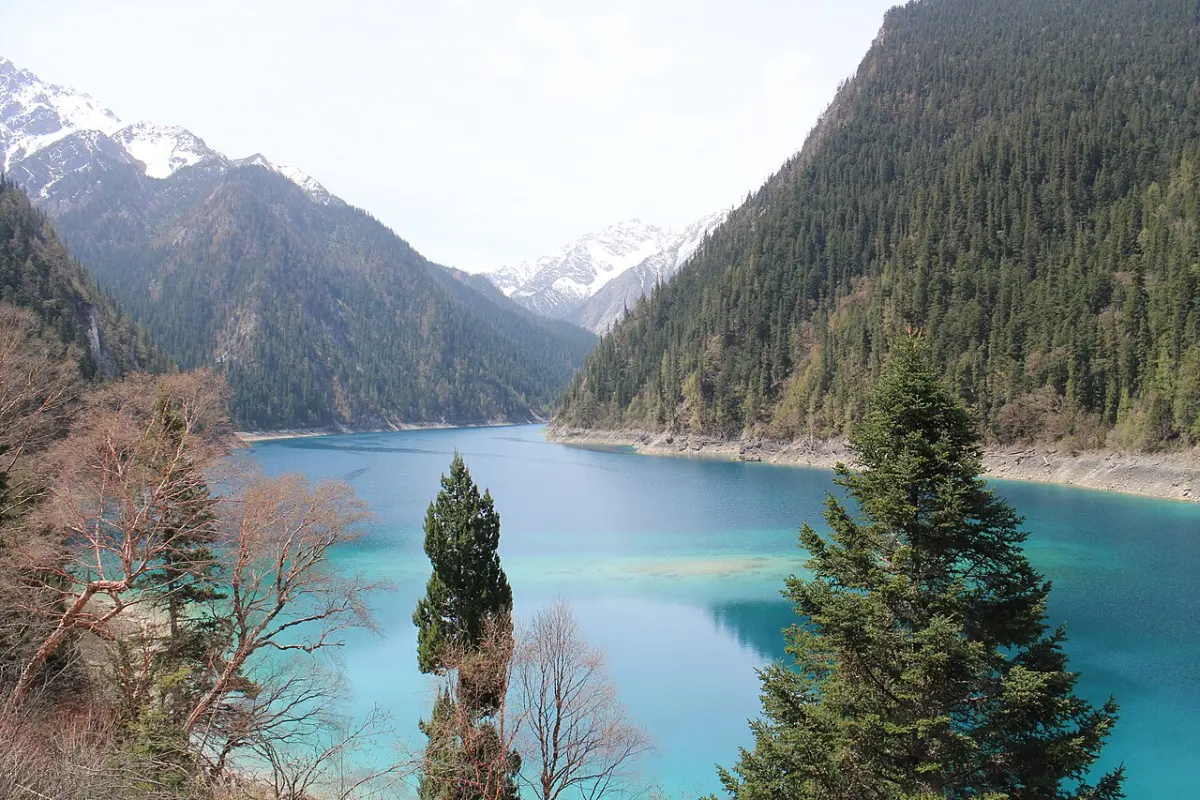
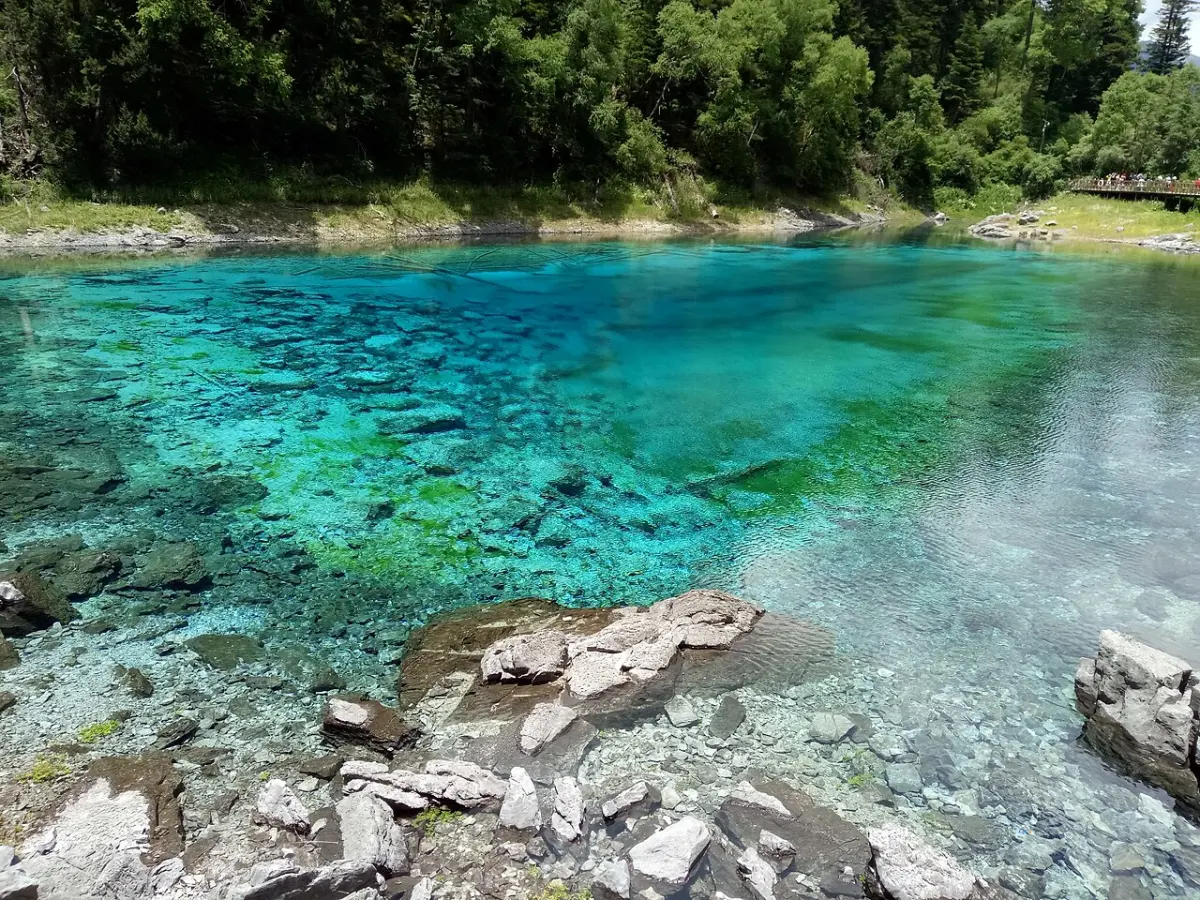
Long Lake is the largest and highest lake in the valley, a long, deep body of water ringed by forested peaks that are often snow-dusted, at the very top of the Zechawa arm. Unlike the shallow travertine pools lower down, it is deep and still, a different kind of beauty. A short walk away, the small Five-Color Pond is one of the most vividly colored pools in the whole park despite its size.
What to see
- Long Lake (长海)
The valley’s biggest lake, deep blue and ringed by peaks, at the highest shuttle stop. - Five-Color Pond (五彩池)
A small but intensely colored pool nearby, remarkable for the vividness of its water. - The mountain backdrop
Snow-capped peaks above the lake, at their most dramatic in the shoulder seasons.
Caution
This is the highest point in the valley, so the air is thinner and it can be cold and windy even when the lower valley is mild; bring an extra layer for the top.
6. Huanglong (黄龙)
Getting there: About 2.5 hours by road from Jiuzhaigou; a private car, rental car, or organized transfer is simplest
Admission: CNY170 from June 1 to December 15 and CNY60 from December 16 to May 31; the cableway and sightseeing shuttle are sold separately. Check the official Huanglong website
Time needed: A full day
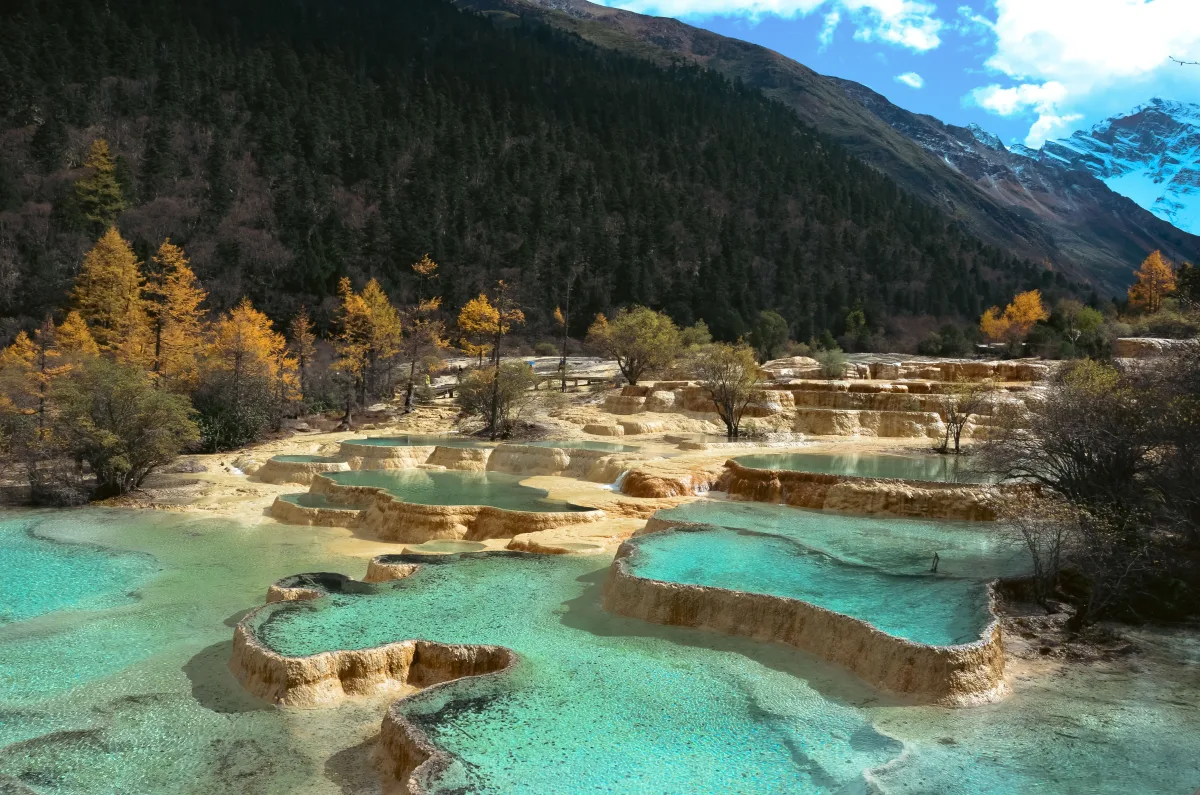
Huanglong, the “Yellow Dragon,” is a separate scenic area south of Jiuzhaigou, known for mineral-rimmed pools stepping down a forested valley. Five-Colored Pond, the main upper sight, sits at about 3,576 metres, so even the cableway-assisted route involves high-altitude walking.
The easiest circuit is to take the entrance shuttle to the lower cableway station and ride up. If the separately booked sightseeing shuttle is operating, it shortens the approach toward Five-Colored Pond. Walk the final section, then descend past Huanglong Temple, the travertine terraces, and Welcome Pond to the entrance.

What to see
- The Five-Colored Pool (五彩池)
The cluster of vivid terraced ponds at the top of the valley, Huanglong’s signature sight. - The travertine terraces and falls
Golden mineral shelves and flowing water along the whole climb up the valley. - The high alpine setting
Forest, meadows, and snow peaks around the trail, at real altitude.
Caution
Five-Colored Pond is above 3,500 metres, high enough for altitude symptoms. Move slowly and do not treat the cableway as removing the altitude risk. Pool conditions and transport operations vary with weather and season, so check the official notice before setting out.
7. Zharu Valley (扎如沟)
Getting there: A side valley branching off near the Jiuzhaigou entrance
Time needed: A brief cultural stop if the visitor route is open
Zharu is a side valley near the Jiuzhaigou entrance. Its principal visitor sight is Zharu Monastery, the only religious temple within the scenic area and a sacred site of the Bon tradition. The temple was founded in the late Ming dynasty (1368-1644), though the buildings have been renovated since.
What to see
- Zharu Monastery (扎如寺)
A Bon Tibetan monastery in the side valley, the cultural heart of this quieter area. - Bon religious culture
The monastery and sacred landscape offer cultural context distinct from the lake circuit. - The side-valley setting
A quieter landscape close to the entrance, subject to current access controls.
Caution
Do not enter trails or attempt a mountain circuit unless the scenic-area authority explicitly offers and authorizes that route. A May 2026 protection notice prohibits unauthorized hiking, traverses, climbing, and camping in unopened parts of the nature reserve. Check at the visitor center whether Zharu Monastery is included in the day’s visitor route.
Suggested Itineraries
1 Full Day
Enter early and follow the day’s shuttle dispatch. The official sample route normally covers the Rize arm first, including Five Flower Lake and Pearl Shoal, then changes at Nuorilang for Long Lake and Five-Color Pond before finishing with Nuorilang Waterfall and selected Shuzheng boardwalks. If staff send the first buses to a different arm, reverse the order rather than fighting the crowd plan.
2 Days
Split the valley across two separately ticketed days: the Rize arm and lower Shuzheng sights on the first, then the Zechawa arm and selected favorites on the second. Peak-season tickets and shuttle tickets are valid only for their booked day, so a second visit is a substantial extra cost rather than a free re-entry.
Adding Huanglong
Give Huanglong its own day, either on the way in or out. For most visitors, one full day in Jiuzhaigou plus one day at Huanglong is a more efficient plan than buying a second Jiuzhaigou ticket.
Where to Stay
The most convenient base is near the scenic entrance in Pengfeng or the surrounding Zhangzha area. Zhangzha stretches along the valley road, so check the actual distance to the gate rather than relying on the town name alone. Resort areas farther from the entrance trade an early start for quieter grounds and more facilities.
Luxury
- Rissai Valley, a Ritz-Carlton Reserve (日赛谷丽思卡尔顿隐世酒店)
One of only nine Ritz-Carlton Reserve properties worldwide, and the only one in China, this all-villa resort in Zhongcha Valley is designed as a destination in its own right rather than simply a place to sleep before entering Jiuzhaigou. It is not beside the scenic-area gate, so arrange transport and allow extra time for the morning transfer. - Resorts near the valley mouth
Larger international and domestic resorts offer broader facilities, but some require a drive to the gate.
Midscale
- Hotels in Zhangzha town
The broadest mix of chain hotels and independent properties, with restaurants and transport nearby.
Budget
- Guesthouses and Tibetan-run inns
Smaller properties around Pengfeng and Zhangzha can be convenient, but check recent reviews for heating, hot water, and soundproofing.
Where to Eat
- Zhangzha town: The strip near the entrance has most of the area’s restaurants, from Sichuan standards to hotpot and Tibetan food.
- Inside the park: Food options within the valley are limited and pricey, centered on the Nuorilang service area, so carry snacks and water.
- Tibetan and Sichuan flavors: The area mixes Sichuan cooking with Tibetan mountain food, including yak dishes and barley.
Dishes to Try
- Yak meat (牦牛肉): Braised, dried, and grilled yak dishes are common across the surrounding highland region.
- Highland barley and tsampa (青稞): Tibetan barley products, from roasted flour to barley wine, reflect the mountain culture.
- Sichuan hotpot (火锅): The warming, spicy communal pot is popular in the cool mountain evenings.
- Mushrooms and mountain vegetables (菌菇、山野菜): Seasonal mushroom and vegetable dishes appear frequently on local menus.
- Buttered and sweet teas: Tibetan butter tea and sweet milk tea are the traditional drinks at altitude.
Hero photo: Chensiyuan, CC BY-SA 4.0, via Wikimedia Commons.
Help keep this guide accurate
Found something incorrect, outdated, or missing? Tell us what changed and include a source when possible.
Suggest an update