
On this page13 sections
✓ Prices and practical details last verified August 1, 2026
Shangri-La, the town once called Zhongdian and renamed in 2001 after the fictional paradise of a 1933 novel, is the gateway to the Tibetan highlands of northwest Yunnan. At around 3,200 metres, it is a place of grassland, prayer flags, and yak herds, with a great golden-roofed monastery on the edge of town and a rebuilt Tibetan old city at its heart. Beyond it the land rises toward the sacred snow peak of Meili and drops into the Yangtze’s Tiger Leaping Gorge. It is the highest and most Tibetan stop on the well-worn Yunnan trail up from Lijiang and Dali, and the air, the light, and the culture all feel like a different country.
For foreign visitors, Shangri-La is also one of the easiest places in China to experience Tibetan culture without entering the Tibet Autonomous Region. Foreign passport holders traveling to Tibet generally need a Tibet Travel Permit (入藏函) and an organized itinerary, while Shangri-La is part of Yunnan and can be reached independently by train, air, or road. It is not a substitute for Tibet itself, but its Tibetan communities, monasteries, architecture, food, and highland landscapes make it a convenient and rewarding introduction.
Highlights
- Visit the golden-roofed Songzanlin Monastery (松赞林寺), the largest Tibetan monastery in Yunnan.
- Wander the rebuilt Dukezong Old Town (独克宗古城) and turn its giant hilltop prayer wheel.
- Drift past the grassland and cranes of Napa Lake (纳帕海) on the edge of town.
- Walk the boardwalks and alpine lakes of Pudacuo National Park (普达措).
- Look up at the sacred snow peak of Meili (梅里雪山), or stop at Tiger Leaping Gorge (虎跳峡) while traveling between Lijiang and Shangri-La.
- Spend several days hiking from Yubeng (雨崩) to glacial lakes, sacred waterfalls, and the inner valleys below Meili Snow Mountain.
Transportation
Getting there
Shangri-La is high and remote, and getting there is part of the journey.
By train
Shangri-La Railway Station (香格里拉站) is the easiest arrival point for most visitors. direct trains reach Lijiang in about 1 hour 20 minutes and Kunming in about 4.5 hours. The railway approaches from Kunming through Dali and Lijiang, making Shangri-La a straightforward northern extension of a Yunnan itinerary. Taxis, ride-hailing cars, buses, and hotel transfers connect the station with Dukezong Old Town and the newer city area.
By air
Diqing Shangri-La Airport (迪庆香格里拉机场 / DIG) is close to the city and handles domestic flights, with routes changing by season. Check current nonstop destinations on FlightConnections. A taxi, ride-hailing car, or hotel pickup is the simplest transfer into town.
Long-distance buses, private transfers, organized tours, and rental cars remain useful from Lijiang, Deqin, and other parts of northwest Yunnan. Shangri-La sits at about 3,200 metres, high enough that altitude affects many visitors; take the first day slowly, drink plenty of water, and go easy on alcohol.
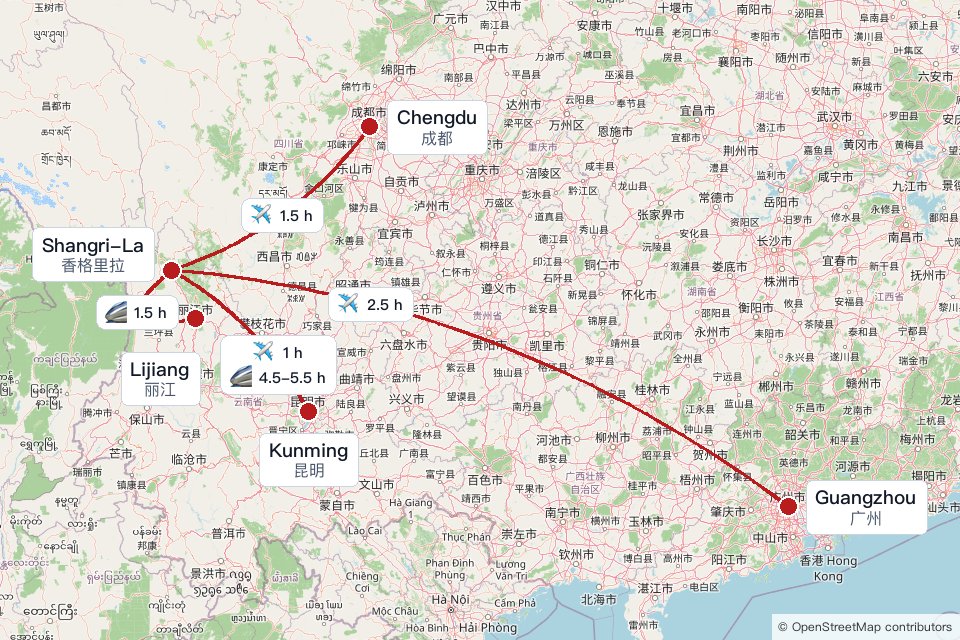
Reaching Shangri-La: direct trains from Lijiang and Kunming, plus flights from Kunming, Chengdu, and beyond into Shangri-La (Diqing) Airport.
Common onward routes
| Route | Best option | Travel Time | Notes |
|---|---|---|---|
| Shangri-La (香格里拉) -> Lijiang (丽江) | Train | 1.5 hours | The new railway south; Lijiang is the usual next stop. |
| Shangri-La (香格里拉) -> Kunming (昆明) | Train or flight | 4.5 to 5.5 hours by train; about 1 hour by air | Direct trains provide an overland option to Yunnan’s capital and its wider connections. |
| Shangri-La (香格里拉) -> Chengdu (成都) | Flight | ~1.5 hours | North to Sichuan. |
| Shangri-La (香格里拉) -> Guangzhou (广州) | Flight | ~2.5 hours | A direct link to the southern coast. |
| Shangri-La (香格里拉) -> Deqin / Meili (德钦) | Car or tour | 3-4 hours | North by road to the Meili Snow Mountain viewpoints. |
Getting around
The town itself is small and walkable, centered on Dukezong old town. The nearer sights, Songzanlin Monastery and Napa Lake, are a short taxi or bus ride away. Pudacuo National Park lies to the east, while Meili Snow Mountain requires a much longer journey north toward Deqin, so a hired car or an organized tour makes the outlying trips far easier. Tiger Leaping Gorge (虎跳峡) sits between Lijiang and Shangri-La and works better as a stop on that route than as a return day trip from town. Take altitude seriously on arrival and do the gentle sights first.
Key Attractions
Shangri-La’s sights fall into a close-in group and a set of highland excursions. Songzanlin Monastery, Dukezong old town, and Napa Lake are all within easy reach of the town and fill the map zoom. The bigger trips spread across the wider Diqing prefecture: Pudacuo National Park to the east, and the Balagezong canyon and sacred Meili Snow Mountain to the north. Yubeng hiking uses the same northern approach as Meili and is covered separately because it requires several days. Tiger Leaping Gorge lies south on the road toward Lijiang. Its orange route marker opens the full hiking guide on the Lijiang page, while the numbered points jump to Shangri-La sections below.
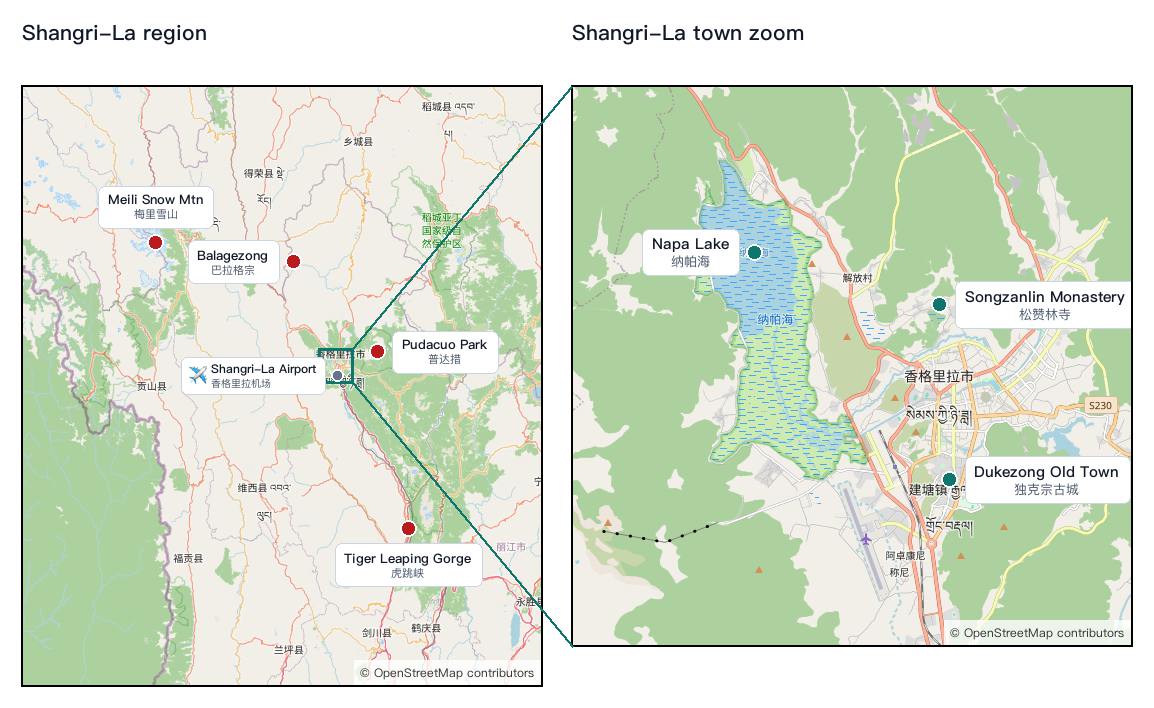
1. Songzanlin Monastery (松赞林寺)
Getting there: About 5 km north of the town center; bus or taxi
Admission: around CNY100 to 115, including the shuttle up to the monastery
Time needed: Half a day
Songzanlin, built in the 17th century under the Fifth Dalai Lama, is the largest Tibetan Buddhist monastery in Yunnan and often called the Little Potala Palace for its tiered, golden-roofed halls climbing a hillside above a lake. It is a living Gelugpa monastery, home to hundreds of monks, and the walk up through the whitewashed monks’ quarters to the grand assembly halls, with their murals, butter lamps, and gilded statues, is the essential Shangri-La experience. The reflection of the monastery in the lake below is the classic view.
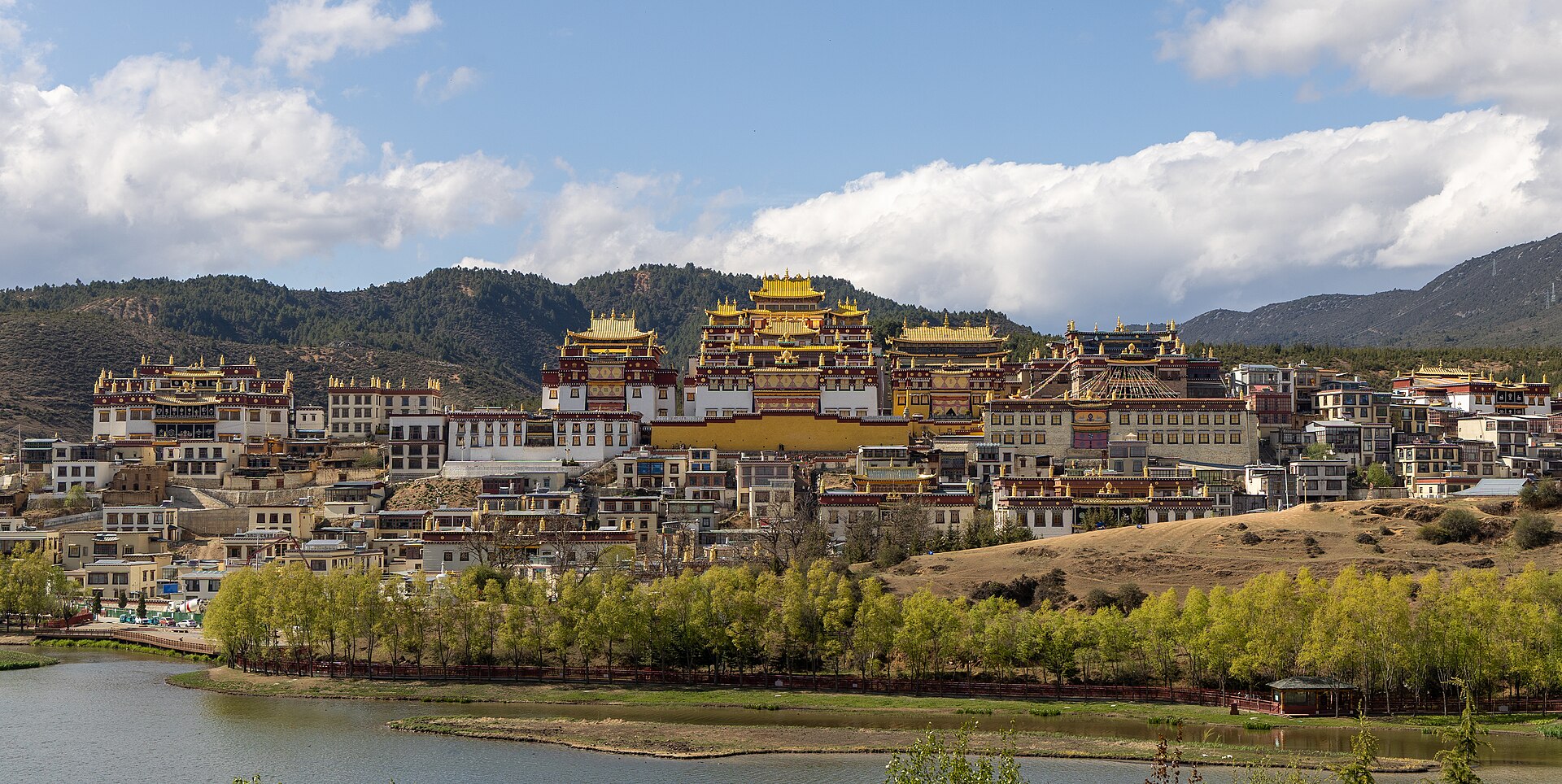
What to see
- The main assembly halls
The great tiered halls at the top, with gilded Buddhas, murals, and monks at prayer. - The hillside monks’ quarters
The whitewashed lanes of dormitories and shrines climbing up to the halls. - The lakeside reflection
The view of the whole monastery mirrored in Lamu Lake below, best in still morning light.
Caution
It is a working monastery at altitude, so climb slowly and dress and behave respectfully in the halls. Photography is restricted inside the shrines; follow the signs and the monks’ lead.
2. Dukezong Old Town (独克宗古城)
Getting there: The historic center of Shangri-La town
Admission: free to wander; the giant prayer wheel on Guishan hill in the old town is one of the largest in the world and turned by hand at dusk
Time needed: A half day, plus an evening
Dukezong is the old Tibetan trading town at the heart of Shangri-La, a cluster of timber houses and cobbled lanes that was a stop on the old Tea Horse Road. A serious fire in 2014 destroyed much of it, and what you see is largely rebuilt, but it keeps its shape and atmosphere, with guesthouses, shops, and cafes in Tibetan style. Above it on Guishan hill stands one of the largest prayer wheels in the world, gilded and enormous, which crowds gather to turn together at dusk.
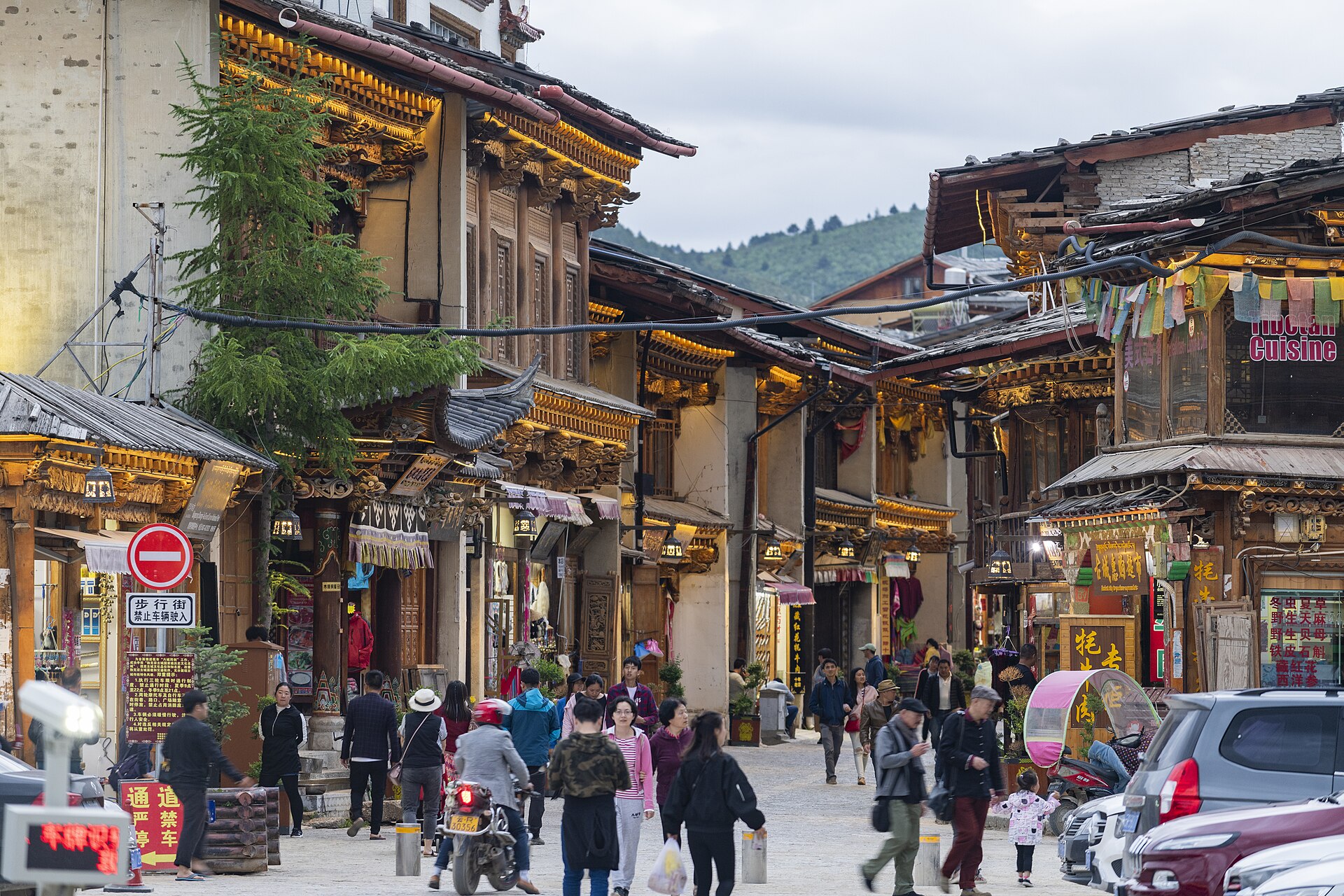
What to see
- The giant prayer wheel (转经筒)
The huge golden wheel on Guishan hill above the town, turned by hand by groups of visitors and locals in the evening. - The old lanes and squares
Cobbled streets of rebuilt Tibetan houses, with the main square where locals gather to dance in the evenings. - The Tea Horse Road heritage
The town’s history as a caravan stop, told in small museums and the old street layout.
Caution
Much of the old town is a post-2014 reconstruction, so treat it as an atmospheric base rather than an ancient survival. Evenings on the square, when locals dance and the prayer wheel turns, are the best time to be there.
3. Meili Snow Mountain (梅里雪山)
Getting there: Near Deqin, 3 to 4 hours north by road; organized tour, hired car, or rental car
Admission: the classic viewpoint is the Feilaisi platform near Deqin, about 3 to 4 hours north by road, with a small entry fee; clear sunrises over Kawagebo peak are the prize but far from guaranteed
Time needed: An overnight trip
Meili Snow Mountain is a sacred range on the Yunnan-Tibet border, crowned by Kawagebo, a 6,740-metre peak that remains unclimbed out of respect for local belief. The classic experience is to watch the sunrise light the snow peaks gold from the Feilaisi viewing platform above Deqin, a pilgrimage in itself. Mingyong Glacier offers a closer mountain outing, while the deeper valleys around Yubeng require a separate multi-day trek covered in the next section. It is the grandest and most remote of the Shangri-La excursions.
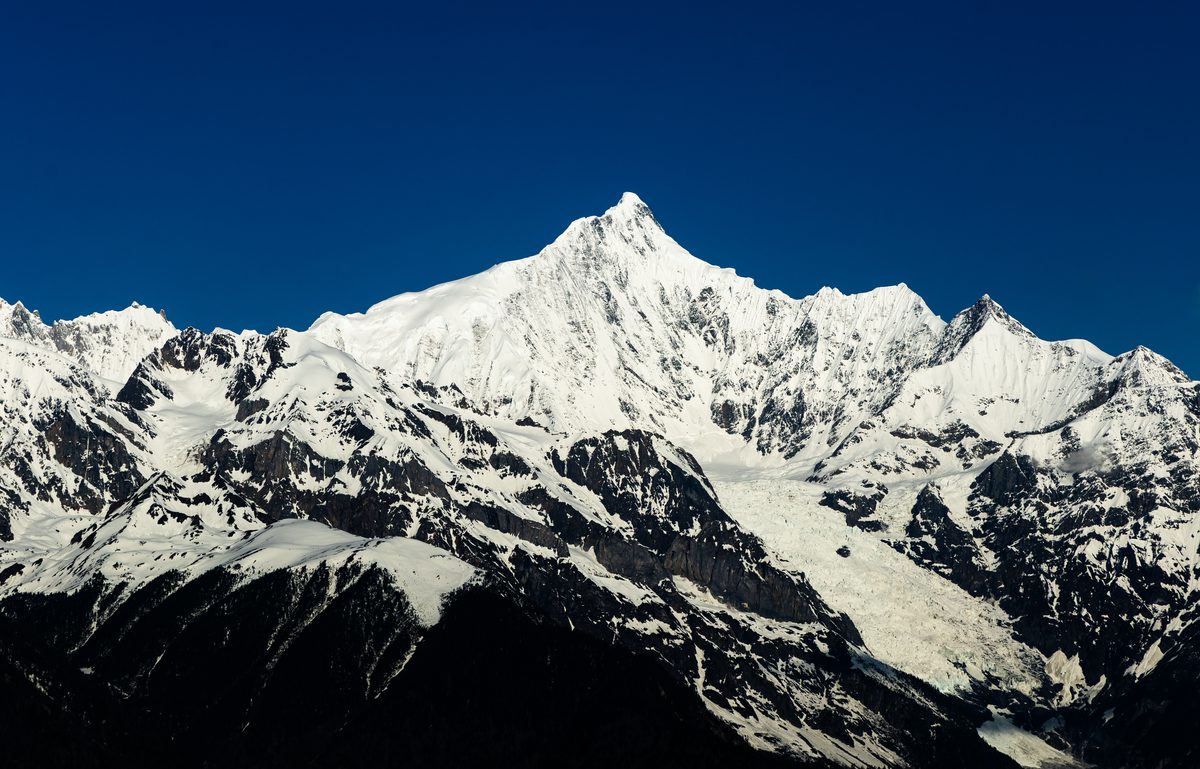
Photo: Ruili River, CC BY-SA 4.0, via Wikimedia Commons
What to see
- The Feilaisi viewpoint (飞来寺)
The classic platform above Deqin for sunrise over Kawagebo and the row of snow peaks. - Wunongding viewpoint (雾浓顶)
A second broad view of the Meili range near Deqin, useful when cloud or crowds make Feilaisi less rewarding. - Mingyong Glacier (明永冰川)
A low-altitude glacier tongue on the mountain’s flank, reachable on a day hike.
Caution
Clear sunrises over Kawagebo are famously elusive, often hidden by cloud, so build in a spare morning if you can. It is a long, high trip requiring at least an overnight near Deqin, and the treks beyond need real preparation.
4. Yubeng Hiking (雨崩徒步)
Getting there: Buses run from Feilaisi to Ninong. From Deqin or Shangri-La, use a taxi, shared car (拼车), or rental car to reach the current Yubeng access parking area; private vehicles cannot continue into the village. Confirm the departure point with your accommodation before traveling.
Admission: CNY55. Local vehicle transfers are charged separately.
Time needed: Allow 4 to 6 days from Shangri-La, including at least 3 nights around Yubeng
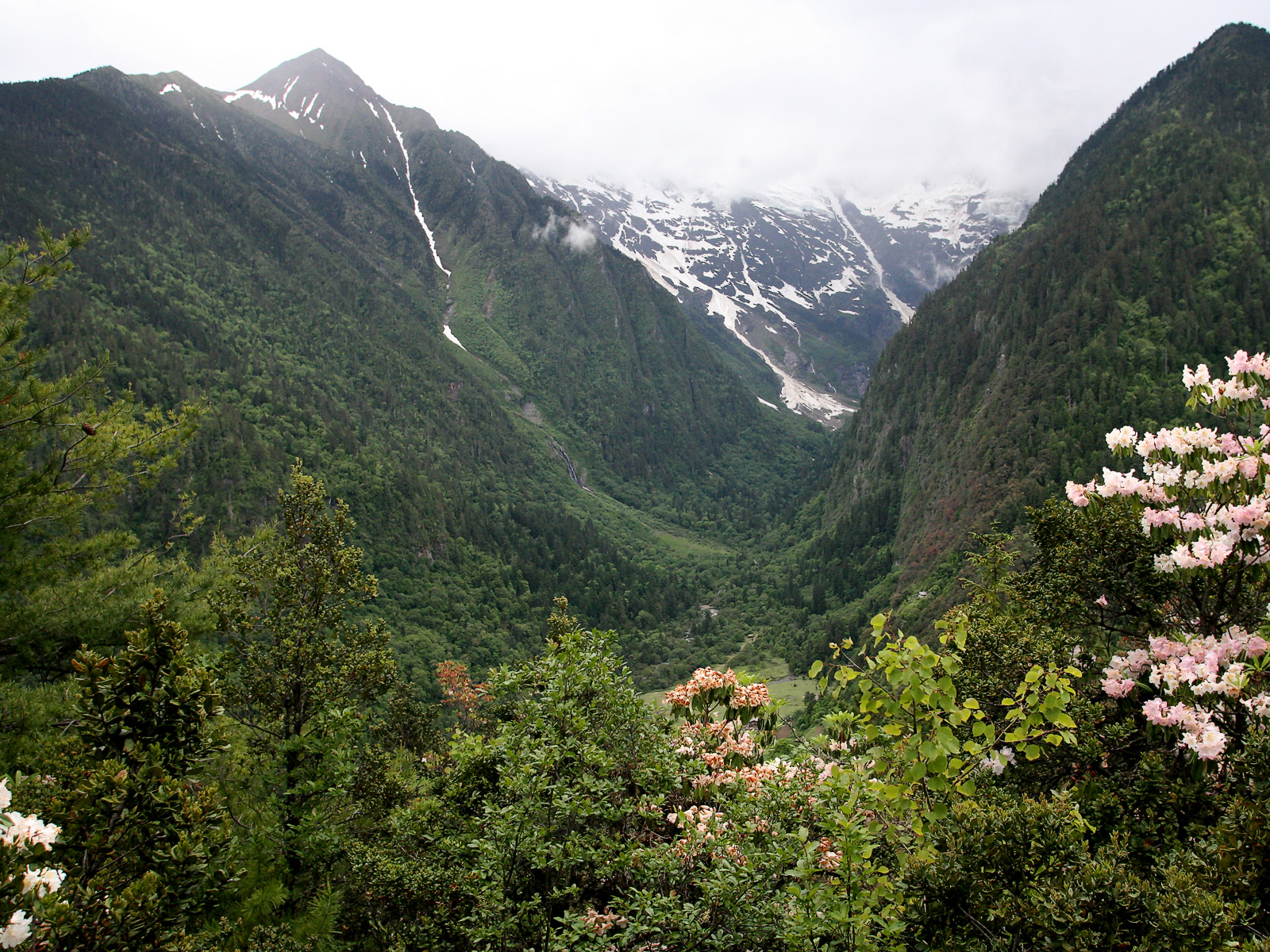
Yubeng is a pair of Tibetan villages hidden beneath the eastern face of Meili Snow Mountain. Upper Yubeng (上雨崩) is the more convenient base for the Ice Lake route, while Lower Yubeng (下雨崩) sits closer to the Sacred Waterfall trail and the exit through Ninong Canyon. Local vehicles have made reaching the villages easier than it once was, but this is still a high-altitude hiking destination rather than a scenic-area day trip. Stay long enough to give each major route its own day and keep some flexibility for mountain weather.
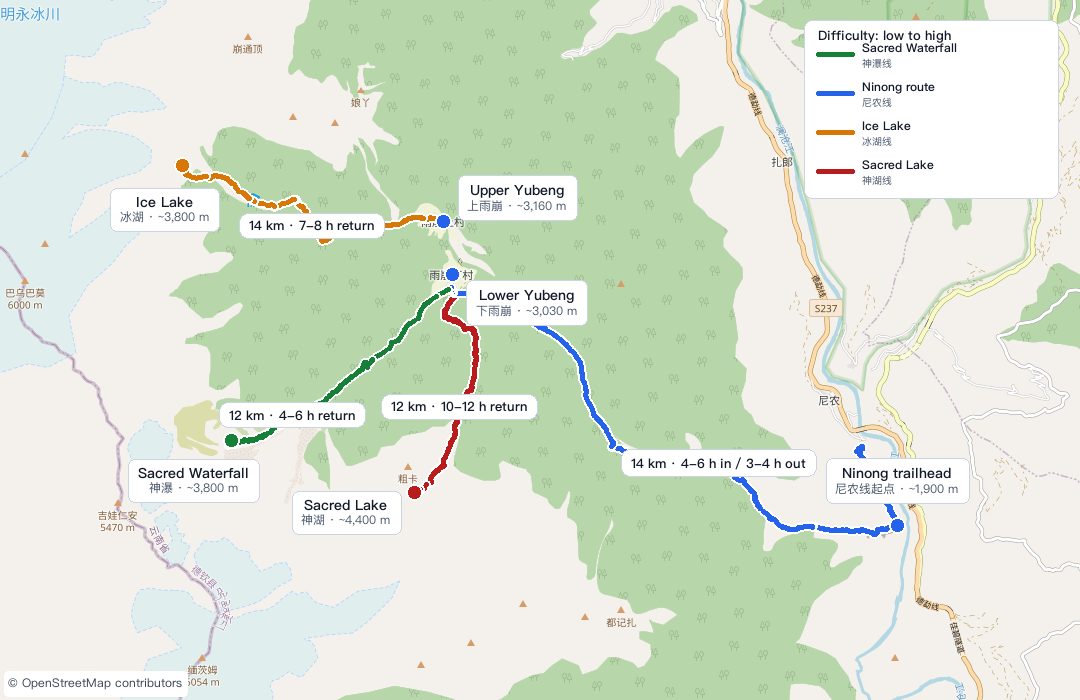
Four classic routes
From lowest to highest difficulty: Sacred Waterfall < Ninong < Ice Lake < Sacred Lake. The Sacred Waterfall and Ice Lake are the two most useful additions to a first visit. The Sacred Lake is substantially harder, less straightforward to navigate, and better reserved for experienced hikers with local guidance.
A balanced 4-day plan
- Day 1: Arrive in Upper Yubeng
Enter Yubeng and continue directly to Upper Yubeng. Stay close to the Ice Lake trailhead so the next morning can begin early. - Day 2: Ice Lake → Lower Yubeng
Complete the roughly 14 km Ice Lake return hike, normally 7 to 8 hours, then descend to Lower Yubeng for the night. - Day 3: Sacred Lake
Attempt the roughly 12 km Sacred Lake return route from Lower Yubeng. It can take 10 to 12 hours and is the hardest day of the itinerary. Stay a second night in Lower Yubeng. - Day 4: Sacred Waterfall and departure
Walk the roughly 12 km Sacred Waterfall return route, normally 4 to 6 hours, then leave Yubeng using a pre-arranged transfer or your chosen exit route. Confirm the final departure time in advance and start early.
Where to stay
For this itinerary, a practical split is 1 night in Upper Yubeng and 2 nights in Lower Yubeng. Upper Yubeng is better positioned for the Ice Lake route and has atmospheric hostels and hiking guesthouses, though standards tend to be simpler. Lower Yubeng generally has the more comfortable accommodation and works better as the base for the Sacred Lake and Sacred Waterfall days. Walking between the villages takes roughly an hour on a steep path, so move downhill after the Ice Lake hike and keep the same Lower Yubeng room for the final two nights.
What to see
- Ice Lake (冰湖)
The more demanding standard day hike, climbing from Upper Yubeng through forest and the former Xiaonong base-camp area toward a glacial lake below the snow peaks. The final approach is rougher and more exposed than the lower forest trail. - Sacred Waterfall (神瀑)
A pilgrimage trail from Lower Yubeng to a waterfall beneath the mountain. It is usually the gentler of the two classic day hikes and has strong religious significance, so give pilgrims space and behave respectfully at the falls. - Upper and Lower Yubeng villages (上雨崩 / 下雨崩)
The two settlements are separated by a steep valley path. Choose accommodation according to the next day’s hike instead of assuming that moving between them is a quick, level walk. - Ninong Canyon (尼农峡谷)
The traditional walking exit follows a dramatic canyon toward the Lancang River. It can be beautiful, but exposed sections become hazardous in heavy rain, ice, or landslide conditions. - Sacred Lake (神湖)
A much harder and less straightforward route than Ice Lake or the Sacred Waterfall. Trail finding can be difficult, so this is best attempted with reliable local guidance rather than treated as a standard signed day walk.
Caution
This is sustained hiking at altitude, with fast-changing weather and limited rescue access. Carry rain protection, warm layers, proper footwear, trekking poles, offline maps, and enough food and water for delays. Do not plan the Ice Lake or Sacred Lake routes immediately after arriving from lower elevation. Access roads, vehicle transfers, and trail closures can change after rain or snow, so confirm conditions locally before each outing. Travel insurance should explicitly cover hiking at the elevations reached here.
5. Napa Lake (纳帕海)
Getting there: About 8 km northwest of town; bus, taxi, or bike
Admission: the Napahai wetland and Yila grassland are free to view from the road, though the fenced scenic area and horse riding are ticketed; best in autumn when black-necked cranes arrive
Time needed: A half day
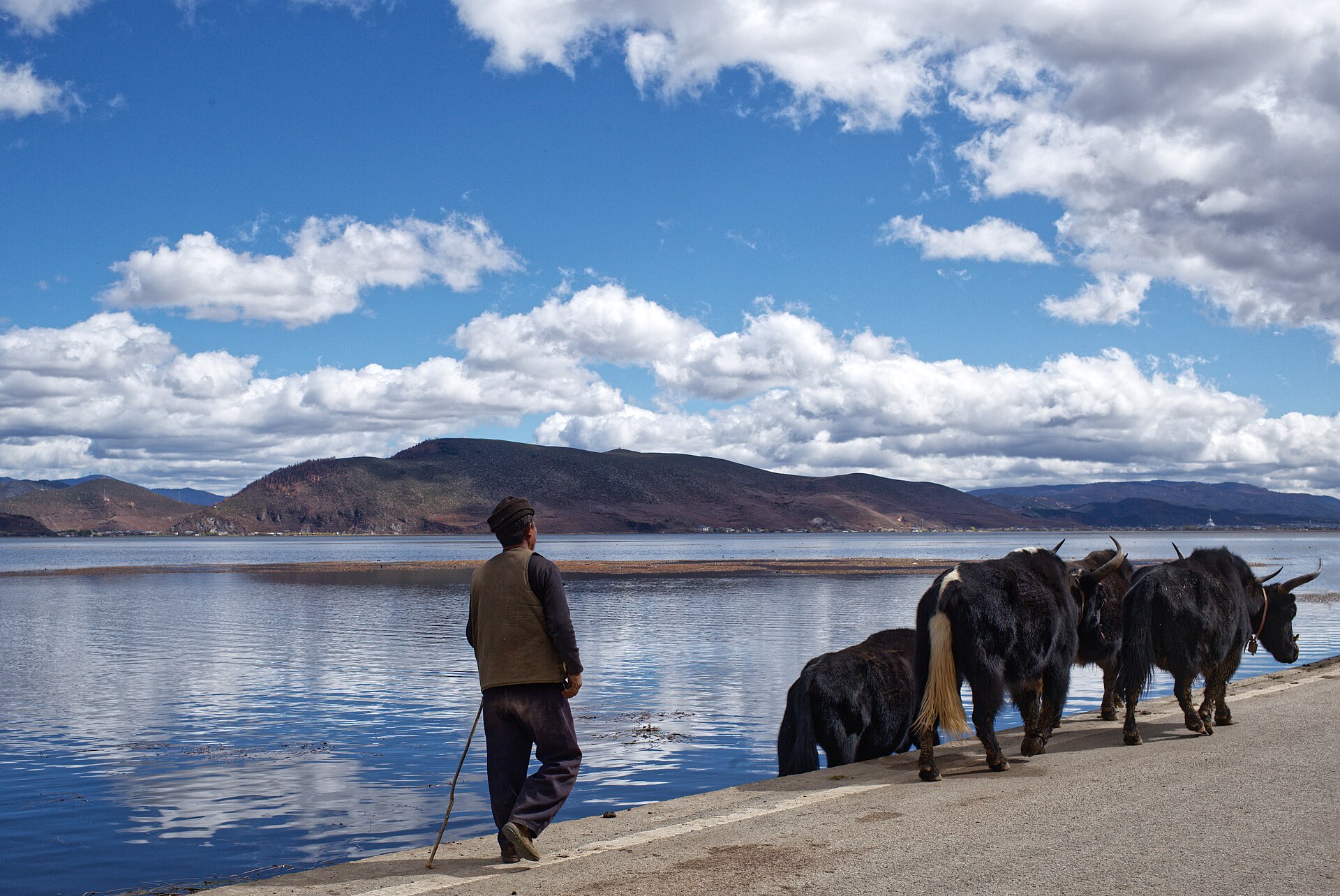
Napa Lake, known in Tibetan as Napahai, is a seasonal wetland ringed by grassland just outside town, part of the wider Yila grassland. In summer it is a green pasture grazed by yaks and horses; in autumn and winter the water rises and rare black-necked cranes and other birds arrive. It is a gentle, scenic stop, easy on the lungs while you acclimatize, and a good place for a slow walk, a bike ride, or a horse trek across the grassland.
What to see
- The Yila grassland (依拉草原)
Open pasture around the lake, grazed by yaks and horses, with big skies and distant peaks. - The migratory birds
Black-necked cranes and other waterbirds that gather in the wetland from autumn into winter. - A horse or bike outing
Grassland horse rides and cycling loops, a relaxed way to take in the scenery.
Caution
The lake is highly seasonal, a wetland in the cooler months and mostly meadow in summer, so what you see depends on timing. Horse touts can be pushy; agree a price and route before setting off.
6. Pudacuo National Park (普达措)
Getting there: About 22 km east of town; shuttle bus, organized tour, hired car, or rental car to the visitor center, followed by the scenic-area shuttle
Admission: a through ticket of about CNY258 (roughly CNY138 admission plus a CNY120 shuttle); the lake boat is an optional extra
Time needed: Most of a day
Pudacuo (also written Potatso) was among China’s first national parks, a high-altitude reserve of alpine lakes, meadows, and dense forest around Bita Lake and Shudu Lake. A shuttle bus links the sites, with boardwalk trails along the lakeshores where you can walk between stops through pristine highland scenery, often grazed by yaks and, in early summer, carpeted with wildflowers. It is one of the most accessible ways to experience the wild Tibetan-plateau landscape around Shangri-La.
What to see
- Bita Lake (碧塔海)
The larger of the park’s lakes, ringed by forest and meadow, with a lakeside boardwalk and an optional boat. - Shudu Lake (属都湖)
A second alpine lake with its own boardwalk trail through the forest. - The meadows and wildlife
Highland pastures grazed by yaks, with wildflowers in early summer and clear mountain air throughout.
Caution
The park is above 3,500 metres, so the boardwalk walks feel harder than they look; take them slowly. It is expensive for what it is once the shuttle is added, so decide whether the full loop or a shorter visit suits you.
7. Balagezong (巴拉格宗)
Getting there: About 2.5 to 3 hours northwest of town; organized tour, hired car, or rental car
Admission: A combined scenic-area ticket covering the shuttle and sights
Time needed: A full day
Balagezong is a dramatic canyon-and-mountain scenic area northwest of Shangri-La, built around a remote Tibetan valley beneath a sacred snow peak. It combines a deep gorge, a glass skywalk, an old Tibetan village, and grand alpine scenery, reached by a long shuttle ride up a spectacular mountain road. It is more developed and adventure-oriented than the other sights, and its remoteness means far fewer crowds than Pudacuo or Tiger Leaping Gorge.
What to see
- The Balagezong gorge and skywalk
A deep canyon with a glass viewing walkway and dramatic cliff scenery. - The old Tibetan village
A remote traditional settlement beneath the sacred Balagezong peak. - The mountain road and passes
The long, scenic drive up into the valley, an attraction in itself.
Caution
It is a long day out on winding mountain roads, so it does not combine well with other sights in one day. As with everything here, the altitude is high, so pace the walking.
Suggested Itineraries
2 Days in Shangri-La
Day 1: Acclimatize gently
Take it easy on arrival: Dukezong old town, the giant prayer wheel at dusk, and an evening on the square, saving strenuous sights for later as you adjust to the altitude.
Day 2: Monastery and grassland
Songzanlin Monastery in the morning and Napa Lake or a grassland ride in the afternoon, both close to town and not too taxing.
3 to 4 Days: The highland trips
Days 1 to 2 as above, then add Pudacuo National Park for a day. Continue south through Tiger Leaping Gorge (虎跳峡) on the way to Lijiang, or make a longer overnight run north to Meili Snow Mountain.
On the Yunnan trail
Shangri-La is the high end of the classic Yunnan route up from Kunming through Dali and Lijiang, and Tiger Leaping Gorge (虎跳峡) sits neatly between it and Lijiang. Many travelers arrive by train, but traveling by road allows you to use the gorge as an intermediate stop or begin its overnight high-trail hike. After Shangri-La, continue north to Deqin and Meili or loop back south.
Where to Stay
Choose your base according to the trip rather than the hotel category. Dukezong is best for atmosphere, the newer city is better for standardized chain hotels, and Feilaisi is the practical overnight stop for Meili Snow Mountain.
Dukezong Old Town (独克宗古城)
The old town has many good independently run guesthouses and boutique inns, often inside timber Tibetan-style buildings with courtyards and stoves. Staying here puts cafes, restaurants, the evening square, and the giant prayer wheel within walking distance. Check recent reviews for heating, hot water, soundproofing, and whether a car can reach the entrance, since some properties sit inside pedestrian lanes.
Shangri-La New Town
Outside the old town, the newer city has a wider selection of international and Chinese chain hotels. These are useful if you prefer standardized rooms, larger facilities, reliable vehicle access, or easier pickup for the railway station and day tours. The setting is less atmospheric, but the practical advantages can matter in cold weather or when carrying luggage.
Feilaisi for Meili Snow Mountain (飞来寺)
Stay in Feilaisi when visiting Meili Snow Mountain rather than trying to make the journey from Shangri-La in one day. Many hotels face the snow peaks and have rooftop terraces where guests can watch the first sunlight turn Kawagebo and the surrounding summits gold. Confirm that the property still provides an unobstructed mountain-facing rooftop or viewing area before booking, since the view varies by building and room.
Where to Eat
- Dukezong old town: Most of the town’s restaurants and cafes are here, mixing Tibetan, Yunnanese, and traveler-friendly food.
- Tibetan food: Yak dishes, butter tea, and barley staples reflect the highland culture, warming at altitude.
- Yunnan crossover: The town sits where Tibetan and Yunnanese cooking meet, so mushrooms, cured ham, and hotpot appear alongside yak.
Dishes to Try
- Yak meat and yak hotpot (牦牛肉): The local highland staple, braised, dried, or simmered in a warming hotpot.
- Butter tea and barley (酥油茶、青稞): Tibetan butter tea and roasted barley products, the everyday fuel of the plateau.
- Tibetan-style chicken and mushroom stew: Highland chicken slow-cooked with local wild mushrooms, a regional favorite.
- Highland barley wine (青稞酒): The local barley liquor, though go easy given the altitude.
- Yunnan wild mushrooms (野生菌): In summer, the prized fungi of Yunnan appear on menus here too.
- Tibetan yogurt and cheese: Fresh dairy from the grassland herds, served plain or with sugar and honey.
Hero photo: Songzanlin Monastery, CC BY-SA 3.0, via Wikimedia Commons.
Help keep this guide accurate
Found something incorrect, outdated, or missing? Tell us what changed and include a source when possible.
Suggest an update